Kubernetes as the substrate
Why Kubernetes is a natural substrate for a data mesh, and how the four principles map onto namespaces, operators, RBAC, and platform primitives.
The previous page ended on a claim worth taking seriously: a data mesh is a pattern, not a tool, and the tools are expressions of it. So why build the capstone on Kubernetes at all? Because the four principles map onto Kubernetes primitives unusually cleanly — cleanly enough that “implement a data mesh on Kubernetes” stops feeling like a translation exercise and starts feeling like the primitives were waiting for it. This page makes that mapping explicit, then shows the shape of the system you’ll build on top of it.
Why the alignment is so good
Kubernetes was designed around multi-tenancy, declarative resources, an extensible type system, and operators that turn operational knowledge into software. Those are exactly the capabilities a data mesh needs — a place for each domain to own its slice, a way to express a data product as a deployable artifact with a contract, a shared platform layer domains consume without building it themselves, and a boundary where standards get enforced automatically. You can build a data mesh without Kubernetes, and you can certainly run Kubernetes without building a mesh. But the alignment is strong enough that each principle has a natural home in Kubernetes primitives you already know.
The four principles, mapped to primitives
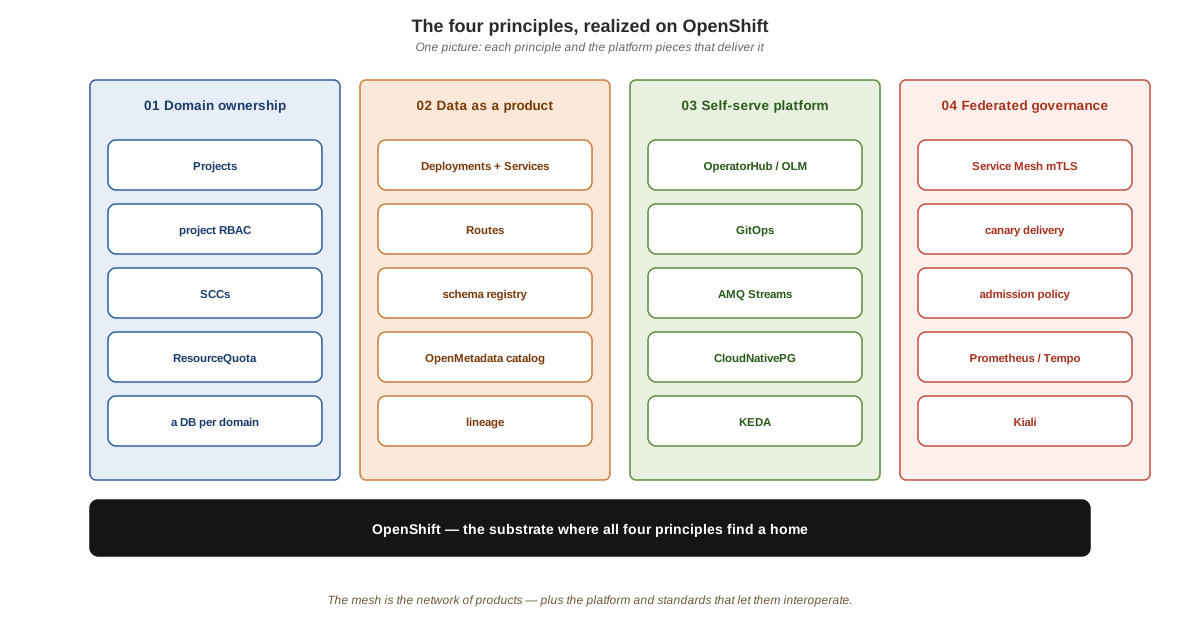
Domain ownership → namespaces, ServiceAccounts, RBAC, quotas. The unit of tenancy in Kubernetes is the namespace, and it carries its own identities (ServiceAccounts), its own permissions (Roles and RoleBindings), and its own resource budget (quotas). That’s precisely the boundary a domain needs: a place it owns, with access it controls and a budget it lives within, isolated from other domains by default. A domain team gets a namespace the way a microservice team gets a repository.
Data as a product → Deployments, Services, and CRDs. A data product is a deployable
artifact that exposes a contract — which is exactly what a Deployment plus a Service
is. The Deployment runs the product; the Service is its stable address. And because
Kubernetes lets you extend its own type system with Custom Resource Definitions, the
platform can offer domain-specific types — a Kafka Topic, a Postgres Cluster, a
schema registration — that a domain declares the same way it declares a Deployment.
The data product becomes a first-class, declarable thing rather than an informal
collection of scripts.
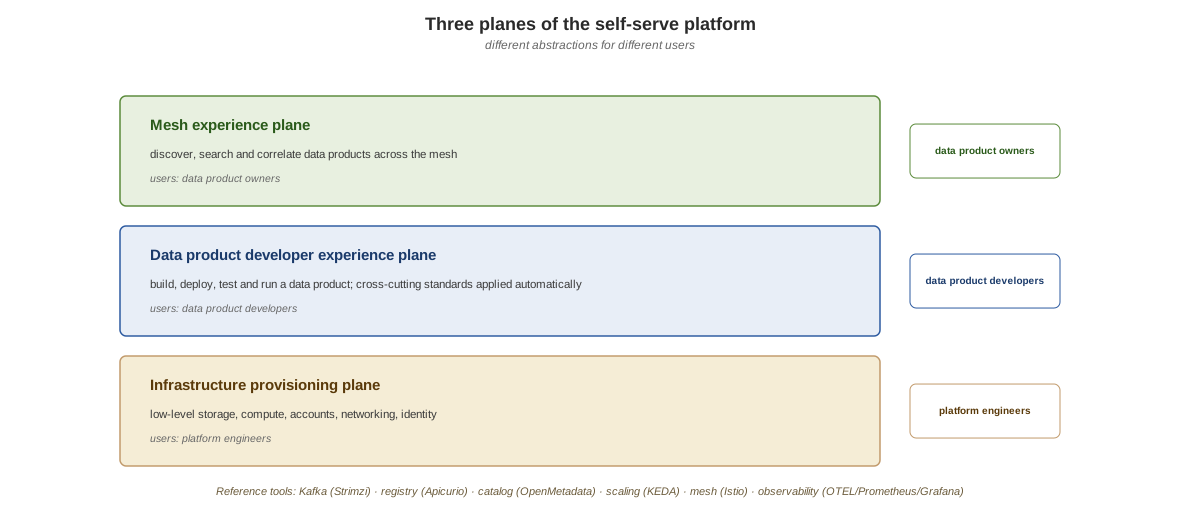
Self-serve data platform → operators and shared cluster infrastructure. This is where Kubernetes earns its place most clearly. An operator packages the knowledge of how to run a complex stateful system — Kafka, Postgres, autoscaling, a service mesh — into a controller that reconciles a simple declarative request into a running system. A domain team that needs Kafka doesn’t learn to operate Kafka; it asks the platform’s Kafka operator for a cluster and gets one. In this build the event backbone (via its operator), the database (via its operator), autoscaling, the service mesh, and the observability stack are all shared platform infrastructure the domains consume by declaration. That’s the self-serve principle made literal.
Federated computational governance → admission control, policy engines, mesh policy, CRD validation. Governance in a mesh is supposed to be enforced by the platform, automatically, at the boundary — not by review meetings after the fact. Kubernetes has several boundaries where that enforcement lives: admission controllers and policy engines that accept or reject resources as they’re created, service-mesh authorization and mutual-TLS policies that govern traffic between products, and the schema validation built into every CRD. The rules become code that runs at the edge of the system, which is exactly what “computational governance” means.
The shape of the system
With the mapping in hand, here’s the system this capstone builds. It has three horizontal tiers: external clients at the top, the service mesh running the domain services in the middle, and the self-serve platform providing shared infrastructure underneath.
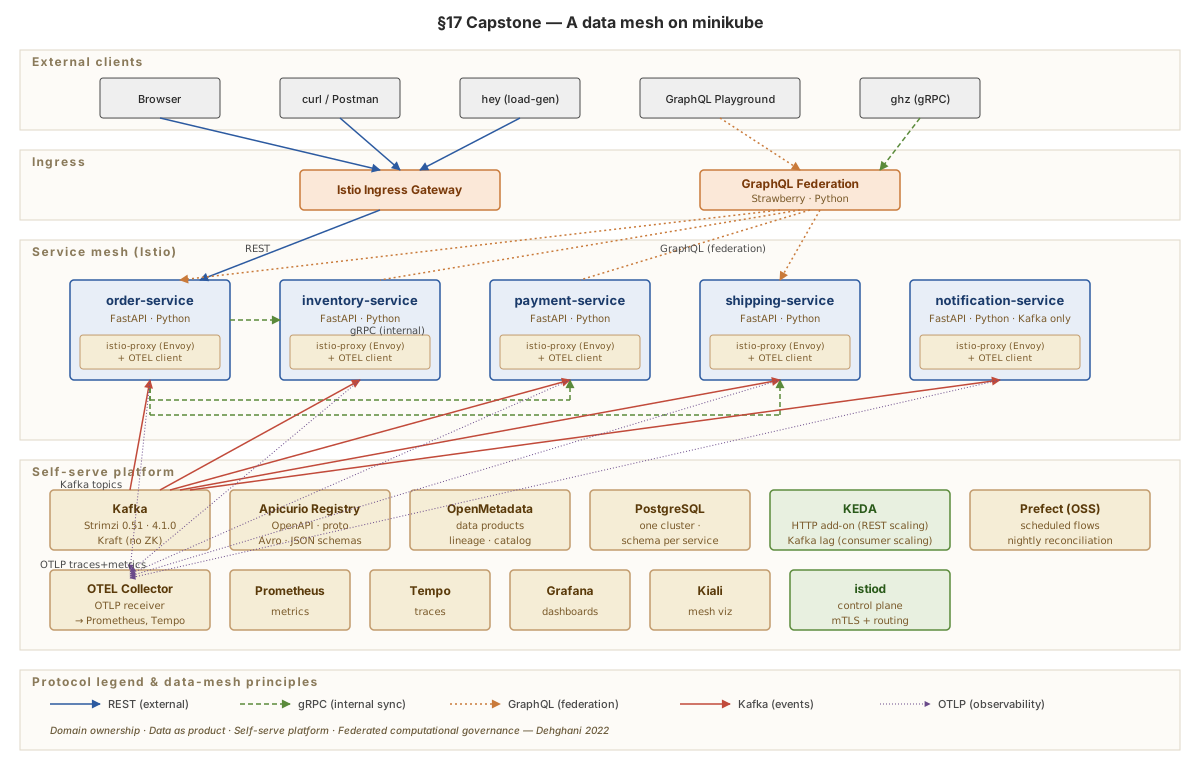
The diagram doubles as a map of the protocol decisions, which the data planes page develops in full: REST crosses the ingress between external clients and services, gRPC flows synchronously between services inside the mesh, GraphQL composes reads across services through a dedicated gateway, and the event backbone carries events asynchronously from producers to consumers. Telemetry flows out of every service to the observability stack, the subject of the observability page.
Read top to bottom, the diagram is the four principles again: external clients consume products through stable contracts (data as a product), the domain services each own their slice of the mesh (domain ownership), the platform tier underneath is shared and consumed by declaration (self-serve platform), and the mesh and policy layers enforce the rules on the traffic between everything (federated governance). It’s the picture to return to as the rest of the set works through the parts.
A note on minikube specifically
This capstone runs on minikube — a single-node Kubernetes cluster — which is the right
choice for learning the pattern and wrong for running it in production. A single node
means every tier shares one machine’s resources, which keeps the whole mesh runnable on
a laptop but also concentrates failure modes that a real multi-node cluster would
spread out. Where those single-node realities bite — resource ceilings, node-level
decay, the operational care a long-lived single-node cluster needs — they’re collected
as operational gotchas rather than mixed into the conceptual material here, because
they’re particular to this deployment choice rather than to data mesh as a pattern. The
profile is a Docker container (the docker driver) running containerd with the runc
runtime, sized by MINIKUBE_MEMORY, MINIKUBE_CPUS and MINIKUBE_DISK.
Host access follows the same single-node logic. The capstone’s UIs and service
endpoints are NodePorts published on 127.0.0.1 when the minikube profile is created
(--ports=127.0.0.1:<hostPort>:<nodePort>), never SSH tunnels or port-forwarding.
The ports are fixed at creation, so changing the set means recreating the profile with
./scripts/setup-capstone-profile.sh --replace. --replace deletes and recreates the cluster, so run ./scripts/bootstrap-capstone.sh again afterwards. Run the workshop in isolation: shut down
CRC, other minikube profiles, and other workloads first, so the host ports are free.
./scripts/show-endpoints.sh prints what is published and reachable.
Next, the services themselves: what a data product looks like in this build, the order-service template the others follow, and how each one is packaged and shipped.