Concepts & principles
What a data mesh is, operational vs. analytical data, and Dehghani's four principles — the conceptual grounding before any commands.
The previous page covered the landscape of data architectures — pipelines, warehouses, and lakes — and where the mesh sits in relation to all of them. This page goes deeper into what a data mesh actually is and the four principles it rests on.
Before any commands, it’s worth being precise about what a data mesh actually is — because the term gets attached to a lot of things it isn’t. This page is a working grounding in the idea and its four principles, enough to make the rest of the set make sense. It’s deliberately brief: if you want the full conceptual treatment — the history, the operating-model shifts, the worked argument for decentralization — that’s what the Data Mesh 101 material in the presentation is for. Here we cover just enough to build on.
What a data mesh is
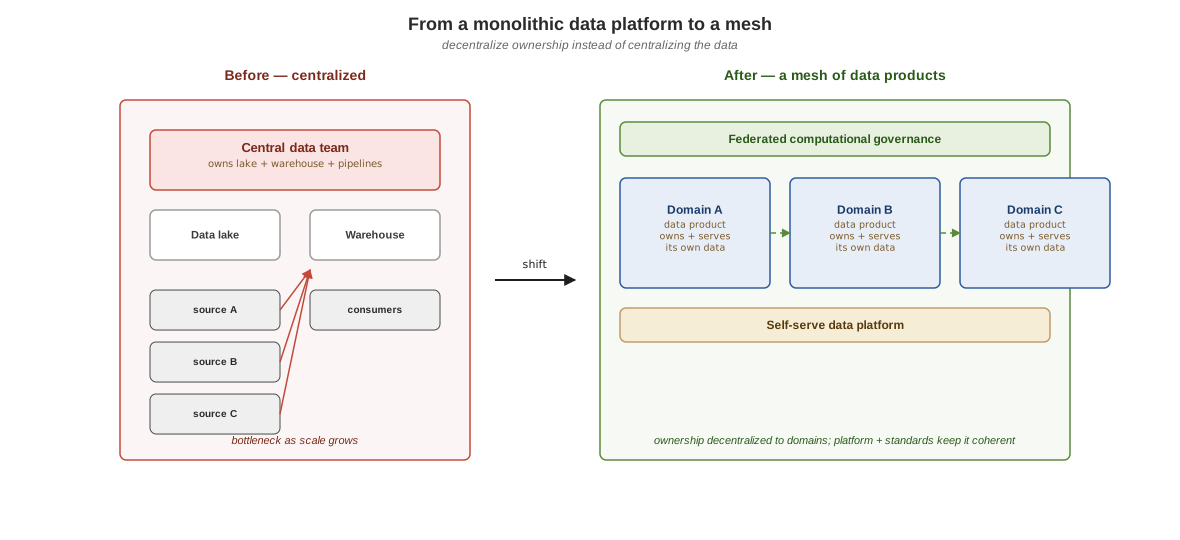
The term data mesh was coined by Zhamak Dehghani in 2019 and formalized in Data Mesh: Delivering Data-Driven Value at Scale (O’Reilly, 2022). It’s a response to a recurring failure: centralized data platforms — the monolithic data lake, the monolithic warehouse, the sprawl of ETL pipelines feeding them — stop scaling once an organization has enough data sources, enough consumers, and enough use cases. The bottleneck isn’t the technology; it’s that one central team ends up owning all the data but understanding none of the domains it came from.
The shift a data mesh proposes is from “centralize the data, then carve out access” to decentralize ownership: let each domain own its data as a product, with a shared platform providing the substrate those products use to publish, discover, and govern themselves. The analogy that lands hardest is microservices. Just as a monolithic application gets refactored into bounded contexts owned by domain teams, a monolithic data platform gets refactored into bounded data products owned by domain teams. The mesh is the network of those products plus the platform and standards that let them interoperate.
Operational vs. analytical data
One distinction underlies everything and is worth stating plainly, because blurring it is itself a common mistake. Operational data is the current-state data behind a domain’s running services — the rows a microservice reads and writes to do its job, transactional and live. Analytical data is the historical, aggregated view used to make decisions, train models, and understand the business over time. Traditionally these live in separate worlds joined by a tangle of pipelines: operational databases on one side, a lake or warehouse on the other, ETL shuttling between them on a delay.
A data mesh doesn’t erase the distinction, but it reorganizes it by domain rather than by technology layer. Instead of “all operational data here, all analytical data there, pipelines between,” each domain owns both its operational systems and the analytical products derived from them, and publishes those products for other domains to consume. The aim is to close the loop between the two planes within each domain, rather than leaving analytical data as a stale downstream copy.
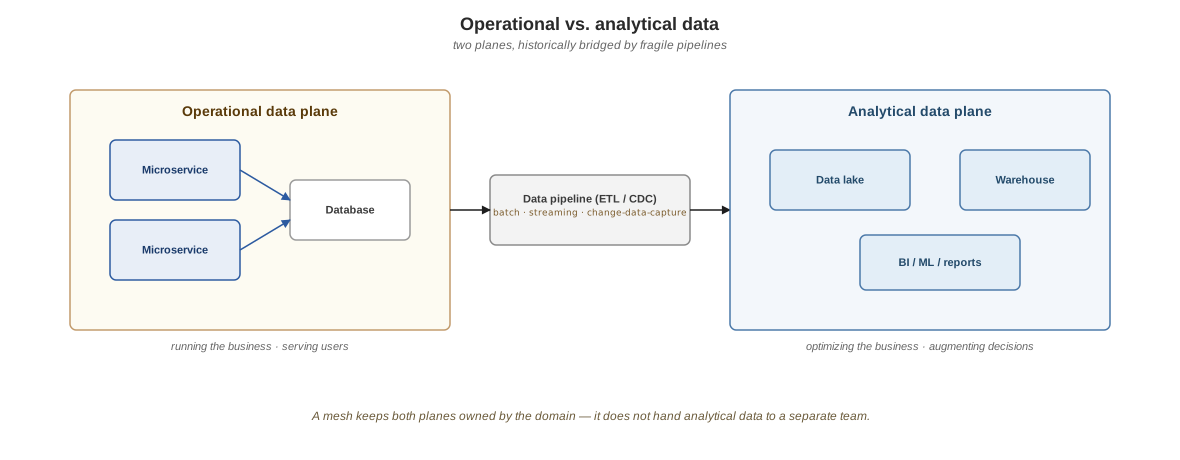
This capstone models the operational side concretely — services that own their data and emit events — and shows how analytical consumers attach to that operational flow through the event backbone, rather than through a nightly extract. That’s the loop the mesh is meant to keep closed.
The four principles
Dehghani’s data mesh rests on four interlocking principles. They depend on each other — implement one without the others and you get a distributed mess rather than a mesh — and each shows up explicitly in this capstone:
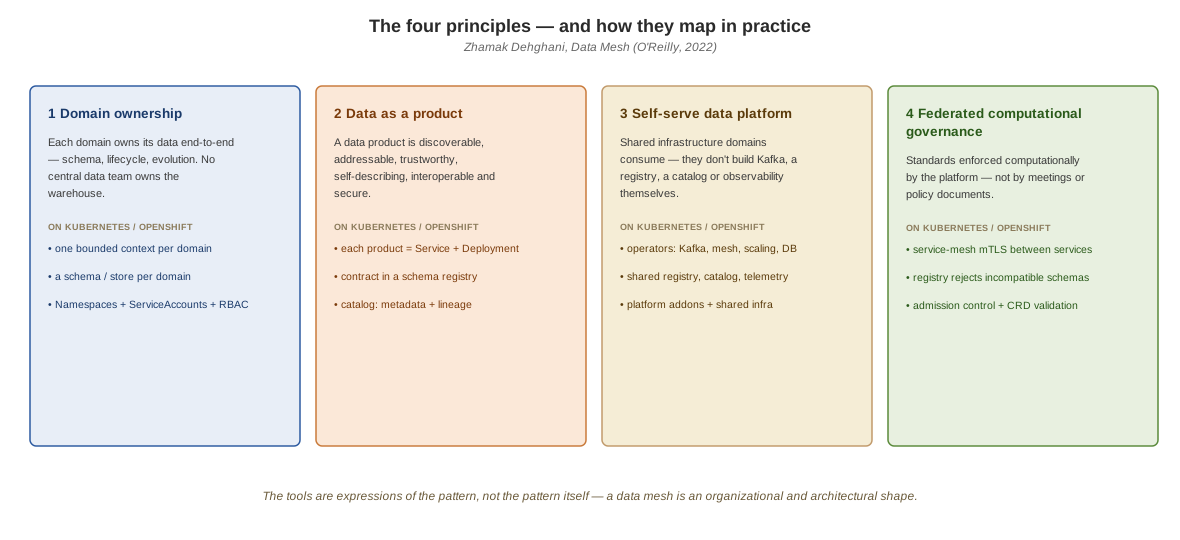
Domain ownership. Data is owned, end to end, by the domain team that produces it. There is no central team that “owns the warehouse.” Each domain owns its data’s schema, its lifecycle, and its evolution. In this build, each domain service owns its data outright — the order domain owns orders, inventory owns stock — and nothing reaches across that boundary to mutate another domain’s data directly.
Data as a product. A data product is held to the same standards as any other software product: it’s discoverable, addressable, trustworthy, self-describing, and carries explicit expectations about quality and availability. It is not a renamed table. In this build, each domain service publishes its API contracts to a registry and its metadata to a catalog, so consumers can find it, understand it, and depend on it — the subject of the contracts & catalog page.
Self-serve data platform. Domain teams should not each build their own event streaming, observability, registry, or catalog. The platform provides these as shared infrastructure that every domain consumes, so a domain team can stand up a data product without first becoming experts in running Kafka or Prometheus. In this build, the event backbone, the observability stack, the registry, the catalog, and autoscaling are all platform infrastructure shared by the services — Kubernetes as the substrate is about exactly how Kubernetes makes that self-serve layer real.
Federated computational governance. Standards are enforced computationally — by the platform, automatically — rather than by review meetings and policy documents. A small set of global rules keeps independent products interoperable; the platform enforces them. In this build, the service mesh enforces mutual TLS between services automatically, the registry rejects schema-incompatible contract changes at publish time, and lineage is recorded as part of deploying rather than as a separate audit. The anti-patterns page covers what happens when governance is instead bolted on from outside, or re-centralized into an approval bottleneck.
The pattern is not the tools
A data mesh isn’t a product, a tool, or a vendor offering — it’s an organizational and architectural pattern. The tools this capstone uses are expressions of the pattern, chosen because each one makes a principle concrete and runnable, not because any of them is the mesh. That distinction matters enough that it’s the first anti-pattern: the most common way these efforts fail is mistaking the tooling for the transformation.
With the vocabulary in place, the next page looks at why Kubernetes is a natural substrate for all of this — and how each of the four principles maps onto concrete Kubernetes primitives.