Summary — the four principles, realized
A closing summary — for each of the four data-mesh principles, the value it delivers, the implementation pieces that realize it, and what happens without it.
The reading set has worked through the data mesh implementation by concern — substrate, services, contracts, planes, mesh, scaling, observability, failure modes. This closing page reorganizes the same material by principle. For each of Dehghani’s four principles, you’ll see the value the principle delivers when it’s honored, the concrete implementation pieces in this reference that realize it, and the failure mode that shows up when the principle is missing.
The diagrams on this page are reproduced from the implementation deck at
presentation/data-mesh-openshift/. Because the deck pairs this reference
with OpenShift specifically, the diagrams use OpenShift vocabulary in a few
places — Project for namespace, SCCs for PodSecurity, OperatorHub /
OLM for the operator install path, AMQ Streams for Strimzi, CNPG for
CloudNativePG. The principles and the implementation pieces themselves are
runtime-agnostic; the OpenShift framing is one concrete instance of the
same shape. If your runtime is something else (vanilla Kubernetes, EKS,
GKE, AKS, minikube), the substitutions are direct: read Project as
namespace, SCCs as PodSecurity, OperatorHub as helm install of the
relevant operators, and so on.
The reference’s own runnable implementation lives in
examples/lgtm-datamesh/ and runs on a minikube profile — verified
configuration for laptop reproducibility — but every choice it makes is
recognizable on any compliant Kubernetes cluster.
Principle 01 — Domain ownership
Each domain ships its data product on its own, with a clear owner and an enforced boundary. No central data team sits in the path between the domain that produces the data and the domains that consume it. The platform’s job is to enforce the boundaries; the domain’s job is to fill them with a working product.
The value of getting this right is that ownership is unambiguous. There’s one team responsible for the customer data product, one team responsible for orders, one team responsible for inventory. Decisions about what those products look like, how they evolve, and what guarantees they provide are made by the people closest to the work.
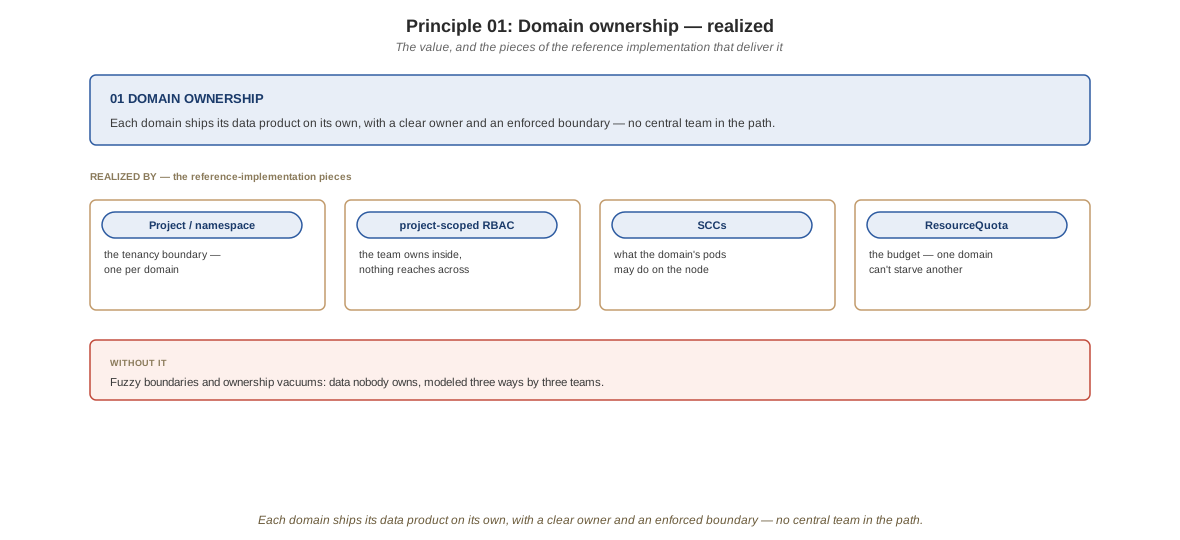
In Kubernetes terms, the boundary is the namespace. Each domain gets a namespace (an OpenShift Project, on that runtime), and the platform enforces ownership through namespace-scoped RBAC (the domain team owns inside, nothing reaches across), pod security policies (PodSecurity admission on vanilla K8s, Security Context Constraints on OpenShift) that constrain what the domain’s workloads may do on the node, and ResourceQuotas that prevent any single domain from starving the cluster of capacity another domain needs.
The reference’s order, inventory, payment, shipping, and notification
domains each live in their own namespace. The reference uses a single
shared capstone namespace for the demo’s clarity, but the production
shape is one namespace per domain — the reference’s helm chart structure
supports that directly.
Without this principle: fuzzy boundaries and ownership vacuums. Data that nobody owns is modeled three different ways by three different teams. The mesh becomes a misnomer; it’s a centralized data lake with extra steps.
Principle 02 — Data as a product
A data product is discoverable, addressable, trustworthy, and self-describing. Consumers find it through a catalog rather than through a relationship with the producing team. They depend on it through a versioned contract rather than a phone call. They trust it because the platform — not a tribal knowledge channel — enforces the guarantees.
The value of getting this right is that consumption decouples from production. A consumer doesn’t need to know which team owns a data product; they need to know what the product is, what it guarantees, and how to address it.
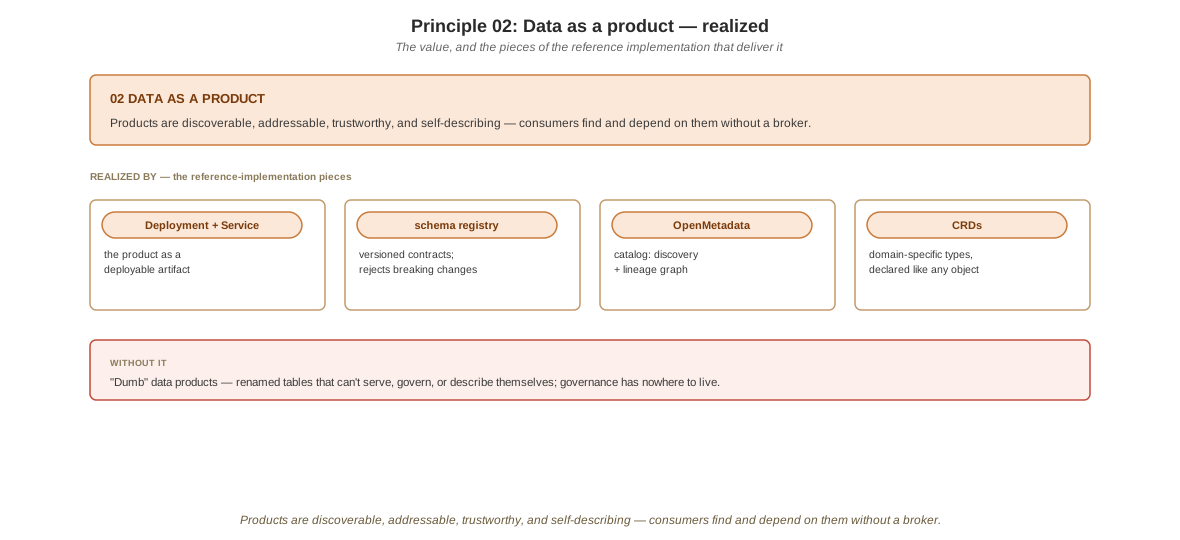
The implementation pieces that realize this in the reference: every
service’s Deployment + Service makes the product addressable — a
domain consumer reaches order-service.capstone.svc.cluster.local and
gets the order product. The Apicurio schema registry holds the
versioned contracts — OpenAPI for REST, Protobuf for gRPC, AsyncAPI
for the Kafka events — and rejects breaking changes at registration
time. OpenMetadata is the catalog of discoverability: every product
in the mesh is listed, with its owner, its schema, its lineage, and
its consumption pattern. CRDs (custom resource definitions) carry
domain-specific types declared like any other Kubernetes object, so
the platform’s admission policies can enforce mesh-wide standards
about what a data product must look like before it’s deployable.
The four pieces together make a product self-describing: you can discover it (catalog), depend on its shape (contract), reach it (addressable Service), and verify it conforms to mesh standards (CRD + admission).
Without this principle: “dumb” data products — renamed tables with no contract that can’t serve themselves, govern themselves, or describe themselves to consumers. Discovery becomes a Slack channel; trust becomes word-of-mouth; governance has nowhere to live.
Principle 03 — Self-serve data platform
Domains consume the platform’s capabilities (streaming, databases, scaling, the mesh itself) by declaration. They don’t operate the substrate. The platform team’s job is to make the right things easy and the wrong things hard; the domain team’s job is to declare what its product needs and let the platform deliver it.
The value of getting this right is that the platform stops being a bottleneck. Each domain can ship without waiting for the platform team to provision a queue, stand up a database, configure scaling, or wire in observability. The declarative pattern means the platform team scales by adding capabilities, not by processing tickets.
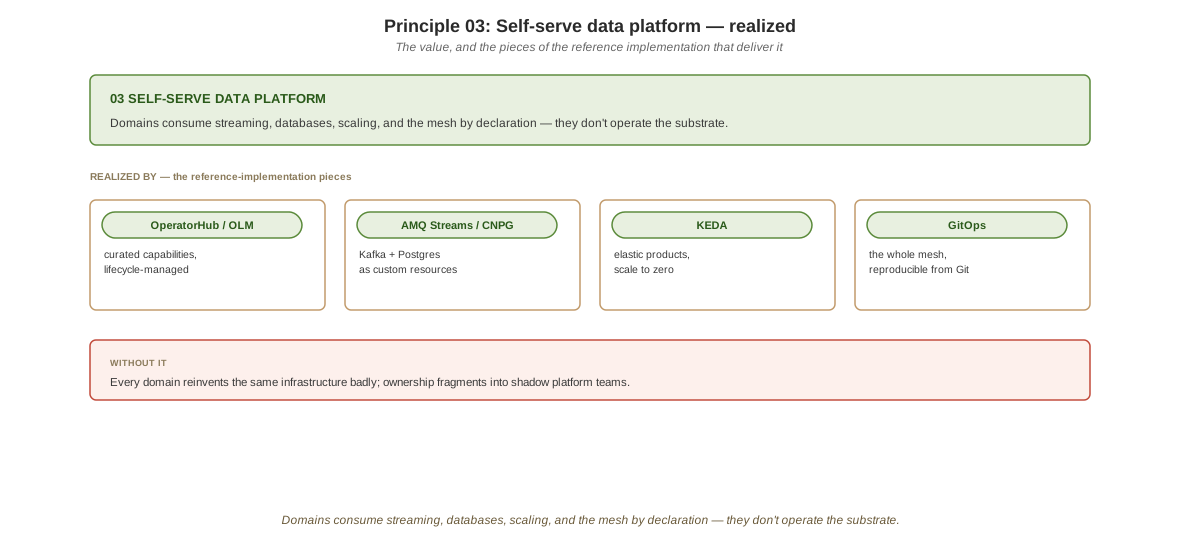
The implementation pieces: the operator pattern (OperatorHub / OLM on
OpenShift; helm install of upstream operators on other runtimes)
makes platform capabilities curated and lifecycle-managed — install
once, every domain consumes by declaration. Strimzi (AMQ Streams on
OpenShift) makes Kafka available as a custom resource: a domain
declares its consumer group; the operator handles the cluster.
CloudNativePG (CNPG) does the same for Postgres: a domain declares its
database; the operator handles the cluster, the backups, the failover.
KEDA makes elastic scaling — including scale-to-zero — available as a
ScaledObject, the same way: declare the demand signal, the operator
handles the scaling. GitOps closes the loop by making the whole mesh
reproducible from Git: every namespace, every operator, every
ScaledObject, every Istio policy lives in a repo and is the source of
truth.
Without this principle: every domain reinvents the same infrastructure badly. Ownership fragments into shadow platform teams — each domain builds its own Kafka cluster, its own database, its own scaling logic — and the cost of the duplication is hidden in domain budgets where nobody sees it as a platform-investment problem.
Principle 04 — Federated computational governance
Global rules (security policy, contract-versioning rules, observability standards, data-classification rules) are enforced by the platform, automatically, at the boundary. Standards hold across the mesh while ownership stays decentralized. Governance isn’t a review meeting after the fact; it’s code that runs at the points where data products enter the system.
The value of getting this right is that decentralization doesn’t require giving up consistency. Every domain can ship independently because the platform is enforcing the shared rules automatically.
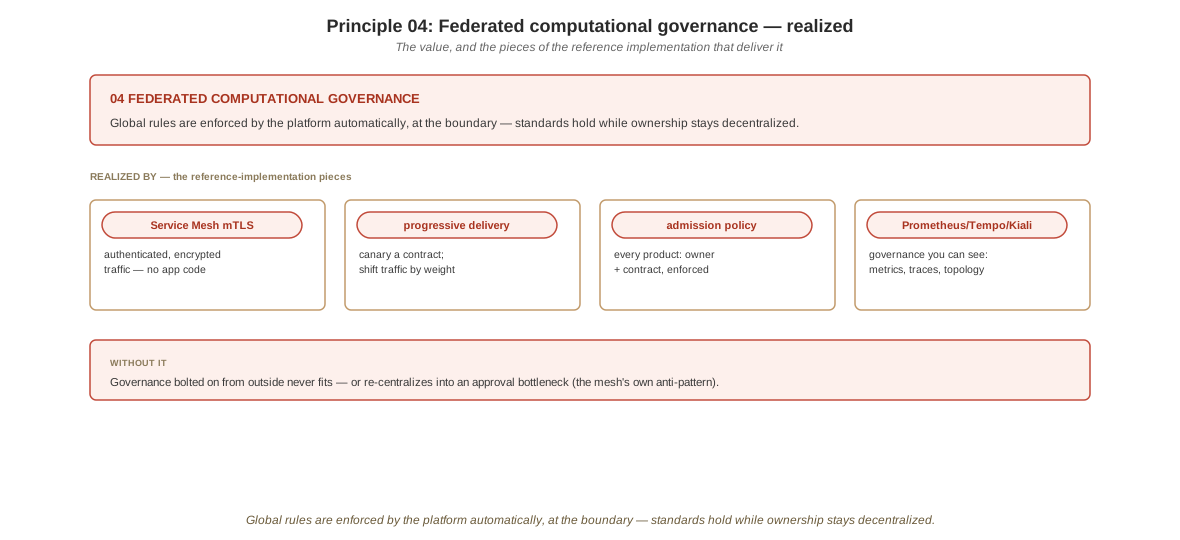
The implementation pieces: service-mesh mTLS makes every product-to-product call authenticated and encrypted, without any application code knowing about TLS. Istio’s traffic-management primitives (VirtualService, DestinationRule, the canary subset routing the reference uses for the v1→v2 contract demo) make progressive delivery a platform capability — a contract evolves under controlled traffic, weight-shifted live, with the application layer unchanged. Kubernetes admission policies (ValidatingAdmissionPolicy on modern K8s, OPA/Gatekeeper or Kyverno on older clusters) enforce mesh-wide invariants: every data product carries an owner annotation, every namespace carries a domain label, every Deployment has its resource requests set. Prometheus/Tempo/Grafana/Kiali make governance observable: the metrics show the mesh’s behavior, the traces show cross-product dependencies, the topology shows who’s calling whom in real time. That visibility is the feedback loop that makes governance actually work — without it, governance is theatre.
Without this principle: governance bolted on from outside the platform never fits, or worse, re-centralizes into an approval bottleneck — the mesh’s own anti-pattern of “federated governance” implemented as a review board. The anti-patterns page walks through this failure mode in more detail.
A trusted base for every data product
One more piece, beyond the four principles: the supply chain. Every data product in the mesh ships as a container image, and the platform’s job extends to giving every domain a trusted base to layer on.
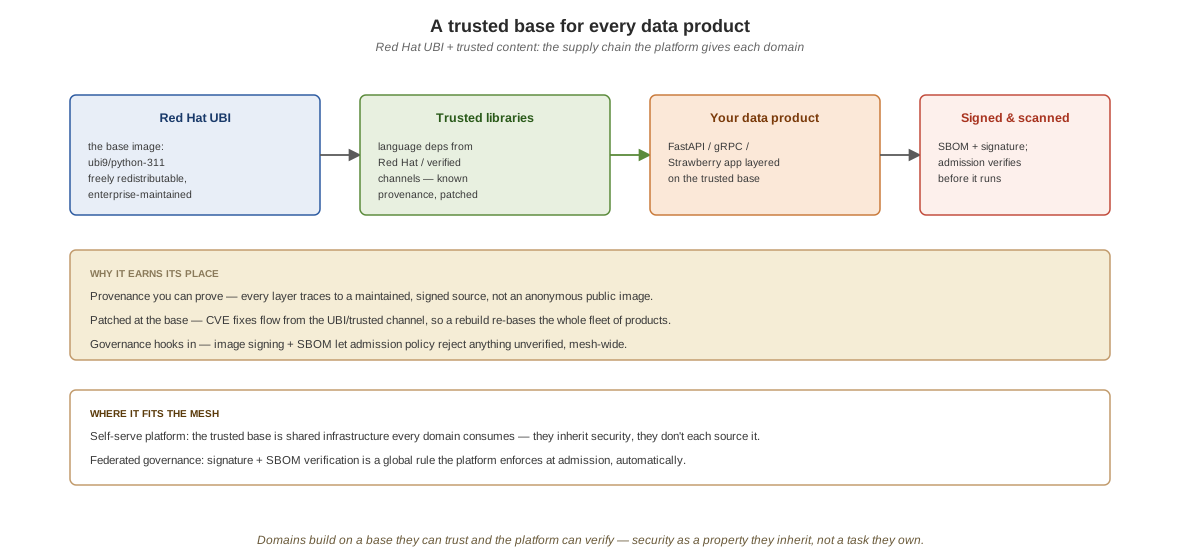
The deck pairs this reference with OpenShift’s specific supply chain:
Red Hat Universal Base Image (UBI) — ubi10/python-314-minimal is the base for
every Python service in the reference. UBI is freely redistributable
and enterprise-maintained, which means a domain team gets a base image
they can use without licensing constraints and that’s patched on a
regular cadence by Red Hat. Language dependencies come from Red Hat’s
verified channels or PyPI, with known provenance; the resulting images
are signed and have an SBOM, and admission policies verify both before
the image runs. The domain’s data product layers its FastAPI / gRPC /
Strawberry code on top of the trusted base — the domain owns its
application; the platform owns the base.
On other runtimes, the supply-chain shape is the same: a curated base image (Distroless, Chainguard, or a minimal distro base — choose by your trust model), language dependencies from controlled channels, signed images, an SBOM at build time, and admission policies that verify both. The reference’s bootstrap uses UBI because the implementation deck pairs with OpenShift; the substitution to another base is a single line in each service’s Dockerfile.
The reason the supply chain belongs in this summary is that it’s the piece of the mesh that’s most often missed in discussion. Domains can own their products, products can be discoverable and self-describing, the platform can be self-serve, and governance can be federated — and none of that matters if the base images are unpatched. The mesh’s weakest link is the layer underneath everyone’s application code.
Where to go from here
This reference is one worked example. The principles it implements are runtime-agnostic; the specific implementation pieces are one good choice among several reasonable choices for each. If you’re starting your own data mesh on Kubernetes, the pattern is:
- Read this set straight through once for the shape of the system, then once more for the trade-offs.
- Run the example tree to see the cross-product behaviors live — the trace tree across three products, the canary contract evolution under live traffic, the autoscaler reacting to a Kafka backlog.
- Use the decision log at
_plans/archive/capstone-decisions.mdto understand the reasoning for each implementation choice, not just the choice itself. The rejected alternatives are where the institutional memory of the build lives. - Adapt to your runtime by swapping the substitutions: namespace
for Project, PodSecurity for SCCs,
helm installfor OperatorHub. The reference’s chart structure is set up to make this tractable; the bootstrap script is one of the natural places to fork.
The reference’s most important property is that the principles and their implementation pieces are visible together. Conceptual material gives you the principles; vendor material gives you the pieces. This reference’s job is to be the bridge — concrete enough to be runnable, explicit enough about its choices to be portable.