The data planes
The async backbone of Kafka events and the read layer of GraphQL composing REST and gRPC — when to reach for each, and why the capstone uses all of them.
The services each expose a contract, and the catalog makes them discoverable. This page is about how data actually moves between them — the planes the mesh runs on. There are two: a synchronous read layer (REST, gRPC, and a GraphQL gateway composing across them) and an asynchronous event backbone (the streaming spine that lets domains react to each other). The capstone uses all of them on purpose, and the purpose is the point.
Protocols by fitness, not by hierarchy
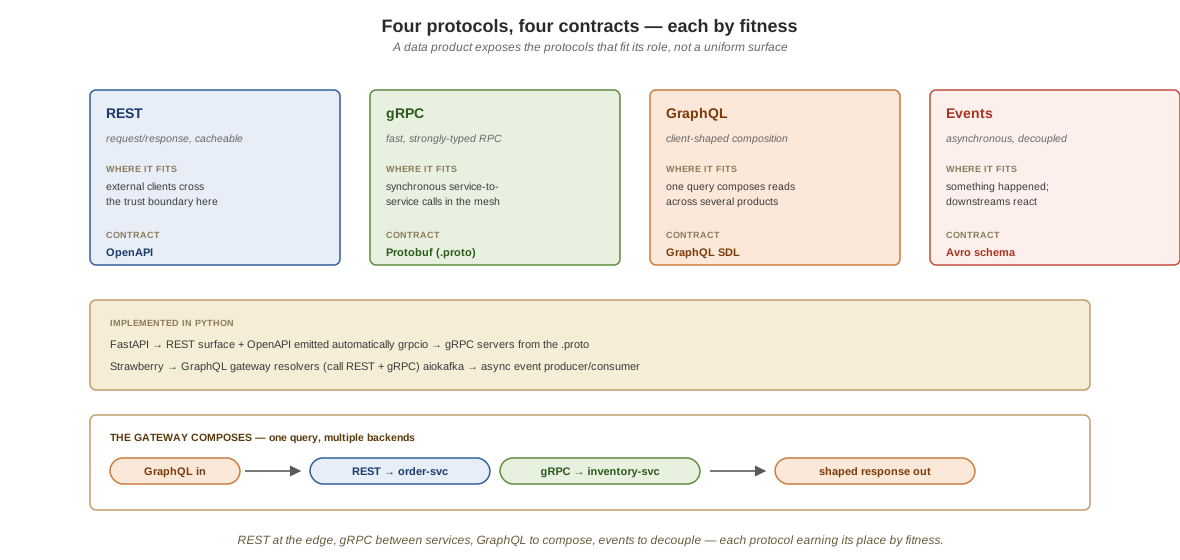
It would be simpler to pick one protocol and use it everywhere. The capstone deliberately doesn’t, because the honest lesson is that each protocol is best at a different job, and a data mesh exercises all those jobs. This isn’t a ranking where one protocol wins; it’s a matter of fitness for context:
- REST at the edge. External clients meet the system over REST, because it’s the universal, cacheable, tooling-rich lingua franca for crossing a trust boundary.
- gRPC between services internally. Synchronous service-to-service calls inside the mesh use gRPC, because it’s fast, strongly typed from its Protobuf contract, and built for exactly that low-latency internal RPC.
- GraphQL for composing reads. When a client needs data assembled from several domains in one shaped response, GraphQL composes it — one query, multiple backends, the response shaped by the caller rather than by each service.
- Events for everything asynchronous. When something happens and other domains need to react without the producer waiting on them, the event backbone carries it.
The capstone makes this concrete in one place: the gateway’s resolvers literally call REST and gRPC side by side, and GraphQL stitches the result — so you can see all three synchronous protocols cooperating rather than competing.
The read layer: a gateway that composes
A consumer that wants an order and its current stock level and its payment status shouldn’t have to call three services and join the results by hand. The read layer solves that with a GraphQL gateway: the client sends one query, and the gateway’s resolvers fetch each piece from the owning service over that service’s existing interface — the order from order-service over REST, the nested stock field from inventory-service over gRPC — and GraphQL assembles the shaped response.
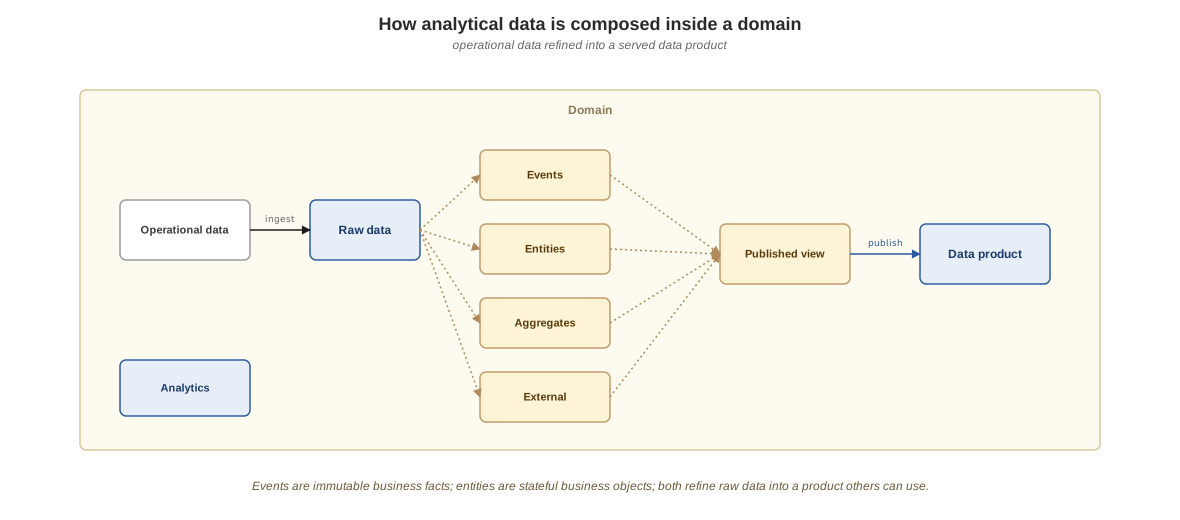
There’s an important precision here about how the gateway composes, because there are two ways to build a unified GraphQL graph and they’re often conflated. In true subgraph federation, each service exposes its own GraphQL subgraph and a gateway plans queries across them into a supergraph — each domain owns and evolves its slice of the graph independently. That’s the production-scale pattern. This capstone uses the simpler gateway orchestration approach instead: one stateless gateway exposes the unified graph, and its resolvers fetch from the services over their existing REST and gRPC interfaces, with no GraphQL added to the domain services at all.
The reason is honesty about what the capstone is — a learning implementation. Gateway orchestration demonstrates the value GraphQL adds (one client query, multiple backends, client-shaped response) with one new service and zero changes to the five domain services, and it makes the protocol comparison vivid because the resolvers call REST and gRPC right next to each other. The trade-off worth stating: true federation is what you’d reach for in production, because it preserves domain ownership of the graph — with orchestration, the gateway has some knowledge of how to reach each domain. For teaching the shape, orchestration is the right call; for a production mesh, federation keeps the ownership boundary cleaner. (This is also why the gateway is not itself a domain data product — it’s a read-layer convenience that composes products it doesn’t own.)
The async backbone: domains reacting to events
The read layer is request-and-response: a consumer asks, a service answers, the caller waits. The other plane is the opposite shape, and it’s what actually keeps a mesh’s operational/analytical loop closed. When an order is placed, several domains need to react — inventory adjusts stock, payment processes, notification informs the customer — but the order service shouldn’t block waiting on any of them, and it certainly shouldn’t call them in a synchronous chain that fails if one is down. Instead it emits an event, and the interested domains consume it on their own schedule.
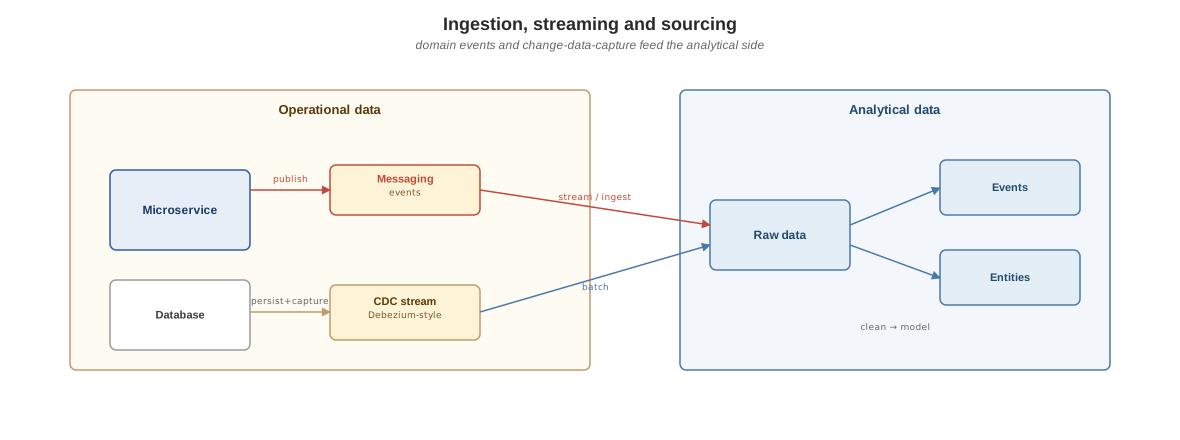
This capstone builds that spine on a Kafka cluster managed by an operator, and models
the canonical pattern with the smallest real flow: order-service emits an
order.placed event, keyed by order id, and notification-service consumes it. That one
flow is the whole “something happened, downstreams react” shape in miniature — the
producer doesn’t know or care who’s listening, and consumers can be added without
touching the producer. Widen it and you get the full choreography: inventory and
payment also react to order.placed, shipping reacts to payments.processed, and
notification listens across all of them.
This is the plane that distinguishes a data mesh from a pile of services behind a gateway. The synchronous read layer composes current state on demand; the event backbone propagates change as it happens, so analytical consumers attach to the live operational flow rather than to a stale nightly extract. That’s the closed loop the concepts page introduced — and its absence is the open-loop anti-pattern, where downstream products are disconnected from the operational systems that feed them.
Two planes, one mesh
The synchronous and asynchronous planes aren’t competitors; they’re complementary, and a mesh needs both. Reads compose current state when a consumer asks for it. Events propagate change when something happens. REST crosses the boundary, gRPC moves between services, GraphQL shapes the composite, and the event backbone carries the reactions. Each protocol earns its place by being best at its job — which is the whole argument for using all of them rather than forcing one to do everything.
With data moving across both planes, the next concern is how the mesh evolves safely while it’s running: shipping a new version of a product’s contract without breaking the consumers depending on it.