gRPC-Web and JSON transcoding
The browser problem, grpc-gateway and Envoy transcoding, and the REST to gRPC interop seam made concrete.
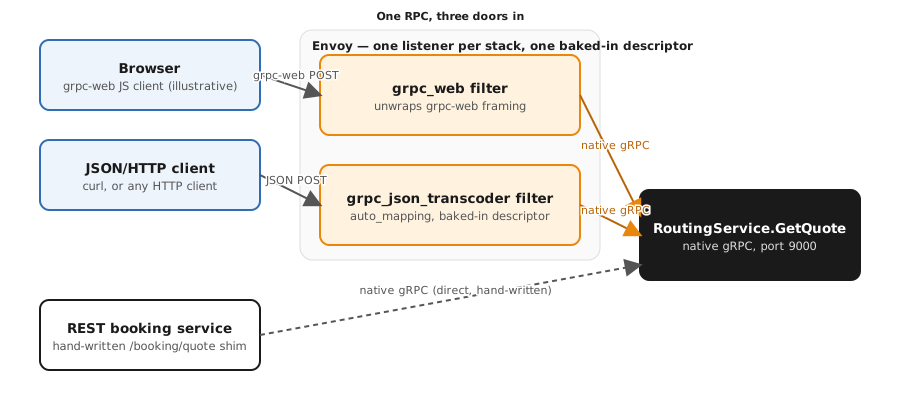
Chapter 22 put RoutingService.GetQuote behind three replicas and a mesh, and every fix in that chapter assumed the caller already speaks gRPC: a client holding one long-lived HTTP/2 channel, reused across calls, exactly as Chapter 7 built it. This chapter’s caller cannot make that assumption true. A browser’s fetch() and XMLHttpRequest cannot open a raw HTTP/2 stream, cannot send gRPC’s binary length-prefixed frames, and cannot read the HTTP/2 trailers gRPC uses to carry its final status — three separate gaps, not one. Nothing about RoutingService changes to close them: the fix lives entirely in a proxy sitting in front of the exact same server every prior chapter has called directly, and this chapter builds that proxy twice, once per stack, and drives it four different ways against the identical GetQuote RPC.
The code is in examples/23-grpc-web-transcoding/. The run script there (verify.sh) builds and brings up both app stacks and both Envoy proxies, then checks all four paths; its README.md covers what it does and how to drive it by hand.
The browser problem
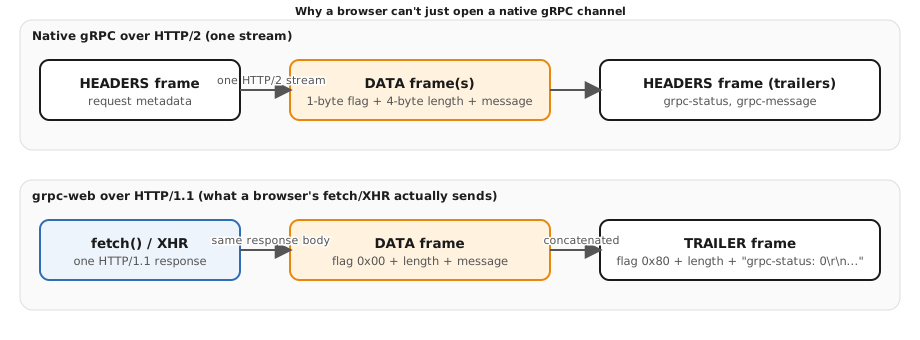
gRPC’s wire format is simple to describe and awkward for a browser to produce. A unary call is one HTTP/2 stream: a HEADERS frame carrying the method and any metadata, one or more DATA frames each holding a 1-byte compression flag, a 4-byte big-endian length, and a serialized protobuf message, and a second HEADERS frame — sent as HTTP/2 trailers, after the body — carrying the final grpc-status and grpc-message. Every piece of that depends on controlling the HTTP/2 stream directly: choosing frame types, writing raw bytes to the wire, and reading trailers that arrive after the response body has already been delivered to the caller.
A browser’s JavaScript networking APIs do not offer any of that. fetch() and XMLHttpRequest speak HTTP in terms of a request/response pair with a status code, a set of response headers available before the body, and a body you read as text, JSON, or bytes — there is no API surface for an HTTP/2 trailer, because the Fetch spec does not expose one, and there is no way to hand the browser a raw frame to put on the wire. This is not a bug anyone intends to fix: HTTP/2 trailers exist for exactly the kind of use gRPC makes of them — a status that can only be known after the body streams out — and browsers simply were not built to surface them to page script.
Two unrelated fixes close this gap for two unrelated audiences, and this chapter builds both in front of the same server:
- grpc-web keeps gRPC’s framing idea but repacks it into something a browser’s networking stack can actually send and receive: the same length-prefixed message frame, plus a second length-prefixed frame carrying the trailer’s
grpc-status/grpc-messageas plain text, both inside one ordinary HTTP/1.1 (or HTTP/2, but without needing trailers) response body. A browser only ever sees a normal response with a byte-string body; it never needs to touch an HTTP/2 trailer. - JSON/HTTP transcoding does not try to make gRPC framing reachable at all. It converts a conventional REST-shaped request — a URL, an HTTP verb, a plain JSON body — directly into a native gRPC call on the caller’s behalf, and converts the gRPC response back into JSON. The caller never speaks any gRPC-flavored protocol; from its point of view, it called a JSON API.
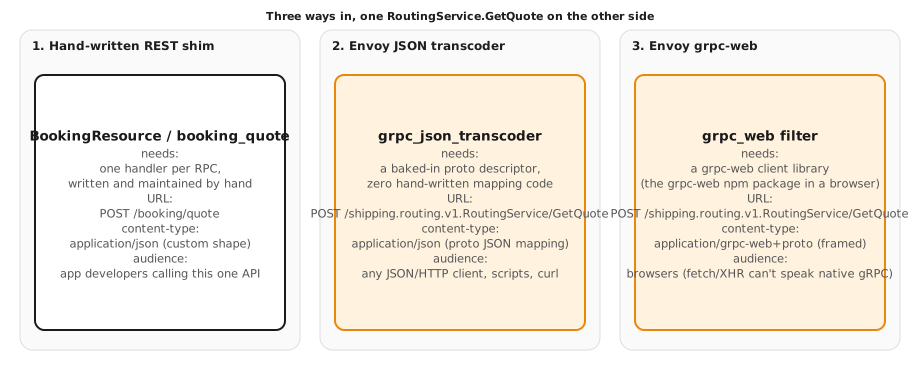
Chapter 21 already solved one version of this problem by hand: BookingResource/booking_quote is a REST endpoint purpose-built for one RPC, written by a person who knows GetQuoteRequest’s shape and translates a BookingQuoteRequest into it field by field. That approach works, and this chapter keeps it running unchanged specifically so it can sit next to the two new approaches for comparison. What it cannot do is generalize: every new RPC this book ever adds needs its own hand-written handler, in every language this book’s stacks are written in, forever. The two mechanisms this chapter adds exist to remove that per-RPC, per-language tax — at the cost of real trade-offs between the two, covered below.
Envoy as the one place both fixes live
Both mechanisms in this chapter are filters in Envoy’s HTTP connection manager, not application code, and both read the same input: a FileDescriptorSet, a binary snapshot of the proto schema, built once at image-build time and baked into the Envoy image. examples/23-grpc-web-transcoding/envoy/Containerfile builds it with buf build contracts/proto -o descriptor.binpb — a command run directly against this book’s frozen contracts at authoring time, with the output inspected to confirm it holds not only routing.proto, quote.proto, and types.proto, but their transitive imports too: google/protobuf/field_mask.proto (imported by routing.proto) and google/protobuf/timestamp.proto (imported by types.proto). Leaving those two files out would not break the build — buf build simply would not compile without them — but it illustrates the real requirement: grpc_json_transcoder has to resolve every field of every message it transcodes, and a Timestamp or FieldMask field appearing anywhere in the schema means the descriptor needs those well-known types present, not just the three shipping/* files a reader might assume are “the proto.”
One Envoy container runs per stack (envoy-quarkus, envoy-python), each with its own static config whose only difference is the upstream address — quarkus:9000 or python:9000. Both configs run the identical filter chain on one listener:
grpc_web            # application/grpc-web+proto -> application/grpc
grpc_json_transcoder # application/json -> application/grpc, via the baked-in descriptor
router              # forwards to the "app" cluster over real HTTP/2
Order matters here in a way that is easy to miss: both filters run on every request, but each only acts on the content-type it cares about. A JSON request’s content-type: application/json does not match what grpc_web is watching for, so it passes through unchanged and reaches grpc_json_transcoder, which decodes it against the descriptor and emits a native gRPC call. A grpc-web request’s content-type: application/grpc-web+proto matches grpc_web, which unwraps the framing and emits a native gRPC call with content-type: application/grpc — and because that content-type no longer looks like JSON, grpc_json_transcoder leaves it alone on its way through. Neither filter needs to know the other exists; the content-type header is the entire coordination mechanism between them, and the router filter at the end sees the same shape of request — native gRPC over HTTP/2 to the app cluster — no matter which door a request came in through.
Decision
Write a hand-written REST shim like BookingResource when an endpoint needs its own purpose-built request/response shape — a booking form, a dashboard widget — that does not map cleanly onto any one RPC's native fields, or when the team shipping it wants full control over validation, field naming, and versioning independent of the proto. Reach for Envoy's grpc_json_transcoder when the caller is any ordinary JSON/HTTP client — a script, another backend, an internal tool — and the proto's own shape is good enough to expose directly: it needs zero hand-written mapping code per RPC, at the cost of a less readable URL (/shipping.routing.v1.RoutingService/GetQuote instead of something like /v1/quotes) unless a google.api.http annotation is added to the proto itself (see "On the wire" below for why this book does not wire one). Reach for grpc_web specifically when the caller is a browser and nothing else will do — it is strictly more machinery than the transcoder for the same proxy to run, and buys nothing over JSON transcoding for a caller that is not constrained by what fetch()/XHR can actually send.
How the code works
The app itself is unchanged from Chapter 21. RoutingServiceImpl/RoutingServiceServicer still calls QuoteServiceImpl/QuoteServiceServicer over a loopback channel, and BookingResource/booking_quote is still the hand-written REST shim — see Chapter 21 for that walkthrough. What is new in this chapter lives in envoy/ and in one new Python module, python/app/grpcweb_client.py.
The descriptor-build stage, in envoy/Containerfile:
FROM docker.io/bufbuild/buf:1.73.0 AS descriptor
WORKDIR /work
COPY contracts/proto ./proto
RUN buf build ./proto -o /descriptor.binpb
This is the same repo-root build-context trick every app Containerfile in this book already uses — contracts/proto is copied in at build time, never committed into this module — pointed at buf instead of mvn or protoc. buf build is given a directory, not a buf.yaml-governed module, which is enough: buf treats the directory itself as the proto root and resolves every import statement inside it, plus the well-known Google types it ships internally, producing one self-contained binary file. The runtime stage then copies that one file, plus one of two static envoy.yaml configs, into the distroless Envoy image:
FROM docker.io/envoyproxy/envoy:distroless-v1.40.0
ARG ENVOY_CONFIG=envoy-quarkus.yaml
COPY --from=descriptor --chown=65532:65532 /descriptor.binpb /etc/envoy/descriptor.binpb
COPY --chown=65532:65532 examples/23-grpc-web-transcoding/envoy/${ENVOY_CONFIG} /etc/envoy/envoy.yaml
The base image’s own ENTRYPOINT/CMD already runs envoy -c /etc/envoy/envoy.yaml as its baked-in nonroot user — this Containerfile supplies nothing but the two files that command expects to find at that path. compose.yaml builds this one Containerfile twice, once per stack, passing a different ENVOY_CONFIG build argument each time, which is why two static YAML files exist instead of one templated one: the distroless runtime stage has no shell to run a template engine against at container start, so the choice between quarkus:9000 and python:9000 as the upstream address has to be made at build time, by selecting which already-correct file to copy.
The transcoder filter’s configuration is the part of envoy.yaml doing the real work:
- name: envoy.filters.http.grpc_json_transcoder
  typed_config:
    "@type": type.googleapis.com/envoy.extensions.filters.http.grpc_json_transcoder.v3.GrpcJsonTranscoder
    proto_descriptor: /etc/envoy/descriptor.binpb
    services:
      - shipping.routing.v1.RoutingService
    auto_mapping: true
    convert_grpc_status: true
proto_descriptor points at the file the first stage built; services names exactly the one service this chapter exposes — RoutingService, not QuoteService, since nothing outside this process ever calls QuoteService directly. auto_mapping: true is what makes zero-hand-written-mapping-code true in practice: without it, every RPC the transcoder exposes needs an explicit google.api.http rule telling Envoy which URL and HTTP verb map to which method, the same google.api.http annotation this book does not add to the shared proto, for the reason covered in “On the wire” below. With auto_mapping on, Envoy derives that mapping itself, for every method on the named service, using the same convention native gRPC already uses: POST /<package>.<Service>/<Method>, with the entire JSON body bound to the request message. convert_grpc_status: true is what turns GetQuote’s internal gRPC status codes into the HTTP status codes a JSON client actually understands — INVALID_ARGUMENT becomes 400, NOT_FOUND becomes 404, and so on — the malformed-JSON check in verify.sh exercises exactly this mapping.
grpcweb_client.py is the one piece of new application code this chapter adds. It builds the identical GetQuoteRequest every other path in this chapter builds, then frames it by hand:
def frame(message: bytes) -> bytes:
    return struct.pack(">BI", 0x00, len(message)) + message
The 5-byte header — one flag byte, always 0x00 for an uncompressed data frame, followed by the message length as a 4-byte unsigned big-endian integer — is grpc-web’s entire framing contract for a request. The response comes back the same way, except a real response carries two frames instead of one: a data frame holding the serialized GetQuoteResponse, and a second frame whose flag byte has its high bit set (0x80) marking it as the trailer, whose payload is plain key: value\r\n text carrying grpc-status and grpc-message — the HTTP/2-trailer information a browser cannot read, repacked into something an ordinary response body can carry:
def _unframe_all(body: bytes) -> list[tuple[int, bytes]]:
    frames = []
    offset = 0
    while offset < len(body):
        flag, length = struct.unpack(">BI", body[offset:offset + 5])
        offset += 5
        payload = body[offset:offset + length]
        offset += length
        frames.append((flag, payload))
    return frames
call_get_quote POSTs the framed request to Envoy with content-type: application/grpc-web+proto, splits the response into its frames, deserializes the data frame’s payload as a GetQuoteResponse, and checks the trailer frame’s grpc-status before trusting the result — because a grpc-web proxy answers 200 OK at the HTTP layer even when the underlying RPC failed; the real outcome rides in that trailer, exactly as it would in a native HTTP/2 trailer. Nothing about this file is a mock or a simulation of grpc-web: it performs the exact bytes a real browser’s grpc-web JavaScript library would send and parses the exact bytes it would receive, using only the Python standard library’s urllib and this module’s own generated protobuf stubs — which is what makes it something a CI job can run deterministically, with no browser, no headless-Chrome layer, and no flakiness from a UI automation stack that has nothing to do with this chapter’s actual subject.
Build, run, observe
cd examples/23-grpc-web-transcoding && ./verify.sh
The script brings up both app stacks and both Envoy containers, then drives all four paths against each stack and checks that every one returns USD 2500.00 for a 1000kg shipment from USNYC to NLRTM, routed as rte_USNYC-NLRTM via MAERSK — the same formula every prior anchor chapter has used. Watch for the grpc-web step in particular: it runs grpcweb_client.py as a one-shot docker compose run against the Envoy service’s in-network name (envoy-quarkus:10000), not the host-published port, because the client executes inside the compose network rather than from the host the way the curl checks do.
Cross-check
Point grpcurl at either app’s native gRPC port with server reflection — grpcurl -plaintext localhost:9230 list — to confirm shipping.routing.v1.RoutingService is exactly the schema the Envoy descriptor was built from, independent of Envoy entirely. If the two ever disagreed — a proto field renamed in the app without rebuilding Envoy’s descriptor — the transcoder and grpc-web paths would fail or silently drop a field while the native path kept working, which is exactly the failure mode a baked-in, build-time descriptor is meant to catch early rather than at request time.
What you learned
- A browser cannot speak native gRPC because
fetch()/XHRcannot send raw HTTP/2 frames or read HTTP/2 trailers — grpc-web repacks both into one ordinary HTTP response body instead. grpc_json_transcoder’sauto_mappingderives a JSON/HTTP mapping for every method on a named service directly from a proto descriptor, with zero hand-written per-RPC code, using the nativePOST /<package>.<Service>/<Method>URL convention.- One
FileDescriptorSet, built once at image-build time withbuf buildand including every transitive import, feeds both the JSON transcoder and gives Envoy everything it needs to resolve every field — without ever touching the app’s own reflection service. grpc_webandgrpc_json_transcodercoexist on one filter chain by content-type alone: each acts only on the content-type it owns and passes everything else through untouched.
Chapter 24 asks a related but different question: once a request reaches the server over HTTP/2, is HTTP/3 worth reaching for next — and what, precisely, “gRPC over HTTP/3” does and does not mean today.
On the wire
The JSON/HTTP transcoding call:
curl -s -X POST localhost:10230/shipping.routing.v1.RoutingService/GetQuote \
  -H 'content-type: application/json' \
  -d '{"origin":{"unLocode":"USNYC"},"destination":{"unLocode":"NLRTM"},"cargo":[{"weightKg":1000}]}'
{"quote":{"currency":"USD","amount":"2500.00"},"route":{"id":"rte_USNYC-NLRTM","legs":[{"carrier":"MAERSK","origin":{"unLocode":"USNYC"},"destination":{"unLocode":"NLRTM"}}]}}
Notice the URL: /shipping.routing.v1.RoutingService/GetQuote, not something cleaner like /v1/quotes. That shape is auto_mapping’s doing — it reuses gRPC’s own /<package>.<Service>/<Method> addressing rather than inventing REST-style resource paths, because it has no other information to go on. A google.api.http annotation on the proto itself — option (google.api.http) = { post: "/v1/quotes" body: "*" }; on the GetQuote RPC — would give Envoy an explicit, readable URL to map instead, and is the standard mechanism Google’s own APIs use for exactly this. This book does not wire one in: doing so means importing google/api/annotations.proto into routing.proto, which pulls a googleapis dependency into contracts/’s buf.yaml and, from there, into every single example’s protoc/buf build across every chapter in this book — Chapter 1 through Chapter 22’s examples included — for a URL-prettiness improvement that benefits only this one chapter. The teaching point survives either way: auto_mapping is what a schema can give with no additional code; a google.api.http annotation is what a human has to add on top, chapter by chapter, RPC by RPC, in exchange for a cleaner URL.
The grpc-web call, decoded:
docker compose run --rm --entrypoint python python -m app.grpcweb_client envoy-quarkus:10000
{"quote": {"currency": "USD", "amount": "2500.00"}, "route": {"id": "rte_USNYC-NLRTM", "legs": [{"carrier": "MAERSK", "origin": {"unLocode": "USNYC"}, "destination": {"unLocode": "NLRTM"}}]}}
Same URL, same RPC, same answer — the only difference from the JSON call above is the request’s content-type (application/grpc-web+proto instead of application/json) and the 5-byte frame wrapped around the serialized protobuf bytes instead of a JSON object. verify.sh asserts these exact fields — quote.currency, quote.amount, route.id, route.legs[0].carrier — from all four paths, on both stacks, before printing PASS.
Verification status: verified.
./verify.sh was run end to end against a real Docker Engine: both app
stacks and both Envoy containers built and started, and native gRPC, the
REST shim, the JSON/HTTP transcoder, and the grpc-web filter all returned the
expected quote on both the Quarkus and the Python stack, including the
non-fatal malformed-JSON -> HTTP 400 check.