Cross-protocol choices and HTTP/3
gRPC versus REST-over-HTTP/2 versus WebSockets, and gRPC over HTTP/3, tier-gated and measured.
Every prior chapter in this part answered a narrower question than the one this one closes with: given that a call is already gRPC, how does a browser, a REST client, or a JSON caller reach it? This chapter steps back a level, to the choice that happens before any of that — when a team is deciding how a new streaming interaction should travel across the wire at all, gRPC is one option among at least three realistic ones, and the right answer depends on who is calling, how many directions data flows, and what tooling the team already trusts. It also closes with the question every engineer asks the moment they hear “HTTP/3 fixes TCP’s problems”: does gRPC get to use it yet? As of this writing, no — grpc-java and grpcio both still speak gRPC exclusively over HTTP/2, and this chapter states that directly instead of hedging around it. RoutingService.GetQuote, unchanged from every earlier chapter, is still the call this chapter measures; nothing in the proto contract moves.
The code is in examples/24-cross-protocol-http3/. The run script there (verify.sh) builds and starts both stacks, proves GetQuote correct over native gRPC, runs a real ghz load-test baseline against it, and then runs a separate, clearly-labeled HTTP/3 transport probe that is non-fatal if it can’t complete; its README.md covers what it does and how to drive it by hand.
Three ways to carry a streaming call
A team choosing how a new streaming interaction should travel across the wire is really choosing among three mature, production-proven options, and each one optimizes for a different caller.
gRPC gives up nothing on the server-to-server path: a protobuf contract generated into real client and server code, four RPC shapes (this book’s Part 3) covering unary, server-streaming, client-streaming, and bidirectional exchange, and HTTP/2 flow control that applies backpressure end to end — a slow consumer’s stalled stream throttles how fast the producer on the other end of that same stream is allowed to send. The cost is reach: a browser cannot speak native gRPC at all (Chapter 23 covered grpc-web and JSON transcoding as the two ways around that), and anyone debugging a call without a .proto file in hand is working blind, because the wire format is binary and self-describing only with a schema or server reflection.
REST over HTTP/2, specifically server-sent events or chunked transfer encoding layered over a conventional REST API, trades gRPC’s typed contract for universal reach: any browser’s fetch or EventSource API consumes it with zero extra tooling, any engineer with curl can watch it happen live, and an OpenAPI document (even if hand-maintained and prone to drifting from the implementation) describes the shape well enough for most integrations. What it does not give you is a second direction: SSE and chunked responses are server-to-client only, so a bidirectional interaction — a client that needs to both send a continuous stream and receive one — has no clean expression in plain REST, and backpressure has to be built by hand at the application layer, because HTTP/1.1-style chunked transfer has no flow-control primitive of its own.
WebSockets split the difference in the other direction: full-duplex, free-form messages, natively supported in every browser with no proxy or shim required, and nothing resembling a schema anywhere in the protocol itself. That absence of a schema is not a defect introduced by sloppy engineering — it is WebSockets’ entire design point, a raw bidirectional pipe the application is free to put anything on — but it means a WebSocket endpoint’s message shapes live entirely in whatever documentation or out-of-band convention the team maintains, with no buf breaking equivalent to catch an incompatible change before it reaches a deployed client. Backpressure, like REST’s, is the application’s problem to solve, not the protocol’s.
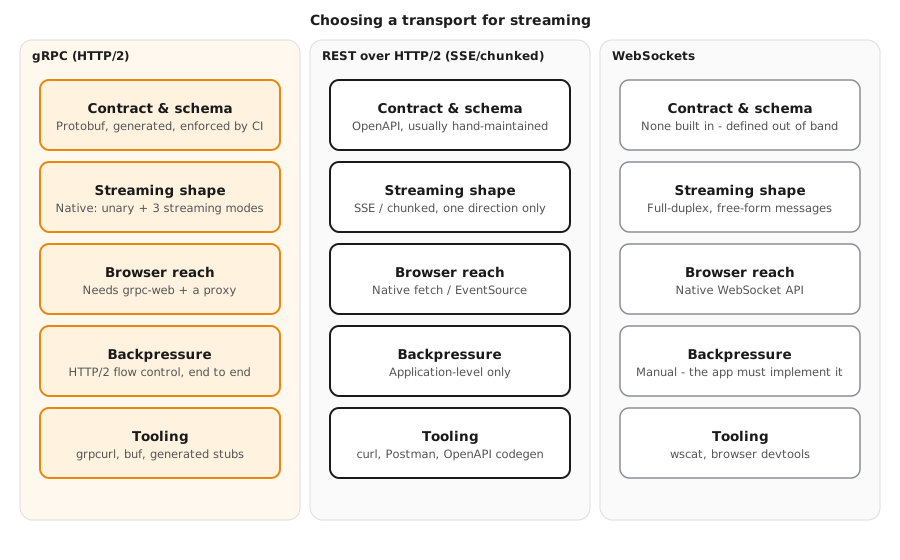
None of these three is categorically “faster” or “better” — they are optimized for different callers, and the deciding question is almost always who is on the other end of the call, not a raw throughput number. A payments service calling another internal service wants gRPC’s typed contract and native bidirectional streaming, and controls both ends of the wire so grpc-web’s extra hop never enters the picture. A public API serving a web dashboard wants REST-over-HTTP/2’s zero-tooling reach for a one-directional feed — a live price ticker, a progress stream — where the client is a browser fetch call and nothing more exotic. A collaborative editor or a multiplayer game wants WebSockets’ full duplex and accepts the schema-discipline cost, because the message shapes change often enough during development that generated-stub regeneration would be more friction than help. This book’s shipping domain leans toward the first case for exactly the reason Chapter 2’s decision framework gave at the very start: two backend services, high call volume, a shared team maintaining both ends of the contract — the profile gRPC was built for.
HTTP/3: what QUIC actually fixes, and why that’s not the same as “gRPC gets faster”
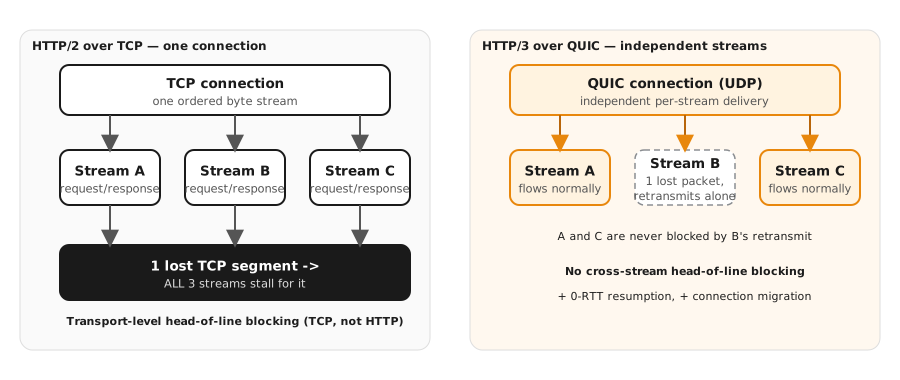
Figure 24.1 above is the whole story HTTP/3 tells for a transport under packet loss: TCP, the protocol every HTTP/1.1 and HTTP/2 connection rides on, delivers bytes to the application in strict order, which means a single lost TCP segment stalls every one of HTTP/2’s multiplexed streams sharing that connection, even the ones whose data already arrived intact — a transport-level head-of-line block that has nothing to do with HTTP and everything to do with TCP’s ordering guarantee. QUIC, the transport HTTP/3 is built on, runs over UDP instead and tracks each stream’s delivery independently, so a lost packet belonging to stream B stalls stream B’s retransmission and nothing else — streams A and C keep flowing while B catches up. QUIC adds two more properties worth naming because they show up in almost every HTTP/3 pitch: 0-RTT connection resumption, which lets a client that has talked to a server before skip a full round trip on a repeat connection, and connection migration, where a client’s address can change — a phone moving from Wi-Fi to cellular — without tearing down and rebuilding the connection, because QUIC identifies a connection by a connection ID rather than the client’s IP and port tuple.
Watch out
Every one of those three properties is a fix for a TCP-level problem, and none of them says anything about which application protocol rides on top of QUIC. HTTP/3 is HTTP semantics (the same request/response model, the same status codes, the same headers) carried over QUIC instead of over TCP — and gRPC's own wire format, the binary framing Chapter 6 covered in depth, is defined in terms of HTTP/2 specifically: HTTP/2 trailers for the final status, HTTP/2 flow control for per-stream backpressure, and an HTTP/2 stream per RPC. "gRPC over HTTP/3" is not a free upgrade of an existing HTTP/2 implementation — it is a distinct transport binding that has to be specified and implemented separately, the same way gRPC-over-HTTP/2 itself had to be specified and implemented once.
That distinct transport binding does not exist natively in either stack this book builds on, as of this writing. grpc-java and grpcio — the two reference implementations behind every Quarkus and Python example in this book — both still speak gRPC exclusively over HTTP/2; neither project ships a QUIC-based transport a GrpcService or a grpc.aio.server() can bind to instead. That is not a gap specific to these two implementations: it reflects where the broader gRPC ecosystem stands today, and it is why this chapter treats HTTP/3 as a transport worth understanding and demonstrating in isolation, never as something this book’s RoutingService can be switched onto. Every gRPC call in this book, including the one two sections below, travels over HTTP/2, and that remains true for the foreseeable future on these two stacks.
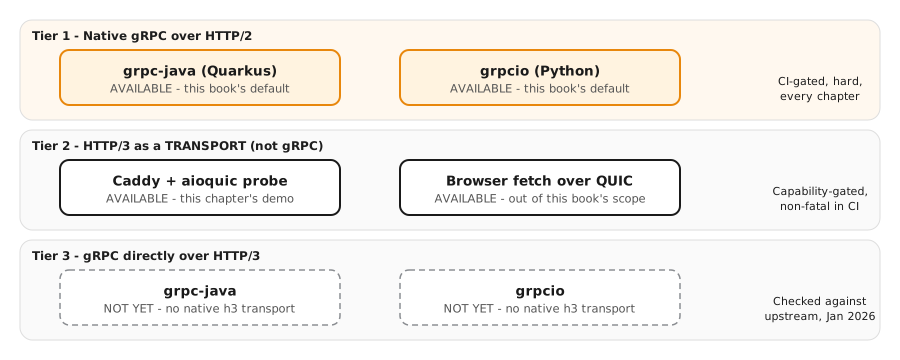
This is also why this chapter’s example keeps the two transports in entirely separate services rather than trying to bolt one onto the other. quarkus and python each run a lean RoutingService server that answers GetQuote over native gRPC — HTTP/2, the only transport either stack has. A third service, caddy, serves one static JSON file over HTTPS and has nothing to do with either RoutingService; it exists only because Caddy turns HTTP/3 on automatically for any site it serves over TLS, which makes it a convenient, real endpoint for a QUIC client to talk to. Reusing one for the other — pointing an HTTP/3 client at a gRPC server that can’t speak HTTP/3, or claiming a JSON fetch over QUIC says anything about gRPC’s performance — would misrepresent what either half of this example proves.
How the code works
The server: the leanest RoutingService in the book. quarkus/src/main/java/.../RoutingServiceImpl.java and python/app/routing_service.py implement exactly one RPC, GetQuote, with the identical formula every chapter since Chapter 7 has used — quote.amount = round_half_up(sum(cargo[].weight_kg) * 2.50, 2), a single MAERSK leg, a route id built from the two UN/LOCODEs. FindOptimalRoute, ListRoutes, NegotiateRoute, and RecomputeRoutes all return UNIMPLEMENTED, the same discipline every prior chapter’s example has followed for methods out of scope. There is no ListRoutes catalog here the way Chapter 18 built one, and no REST front door the way Chapter 21’s QuoteService loopback added one: this chapter’s subject is the transport a call travels over, not a new capability, so the server stays as small as the proto contract allows while still answering something real.
ghz, fed the proto directly, same pattern as Chapter 18’s. ghz has no server-reflection client, so compose.yaml mounts contracts/proto/ read-only into a dedicated, profiled-off ghz service and verify.sh invokes it with docker compose run --rm ghz, naming the method and feeding it the compiled .proto plus its import path:
docker compose run --rm ghz --insecure \
  --proto /contracts/shipping/routing/v1/routing.proto --import-paths /contracts \
  --call shipping.routing.v1.RoutingService.GetQuote \
  -d '{...}' -c 10 -n 300 -O json quarkus:9000
verify.sh parses the JSON result and asserts three loose, relative bounds, the identical discipline Chapter 18 established: zero errors, a 99th-percentile latency under a generous 1.5-second ceiling, and a throughput over a 20-requests-per-second floor. A real run on this book’s dev box landed Quarkus at rps=1888.1 p99=12.6ms and Python at rps=5117.6 p99=4.6ms — both comfortably inside those bounds, and both entirely over native gRPC/HTTP2, the only transport either call ever travels on in this chapter.
caddy and h3_probe.py: a transport probe, deliberately kept separate. caddy/Caddyfile declares one site, caddy:8443, localhost:8443, with tls internal — Caddy’s own non-ACME issuer, which mints a fresh self-signed CA and a leaf certificate for exactly the hostnames the site block names, inside the container, on every start. Naming both hostnames matters: the probe connects to the service by its compose network name (caddy), and the certificate has to carry that name as a SAN for the TLS handshake to have something to validate against, same as any TLS certificate needs the name a client actually dials to appear somewhere in it. Caddy enables HTTP/3 automatically the moment a site is served over TLS — no separate directive, no experimental flag, true since Caddy 2.6 — so this one plain file_server block, with nothing resembling application logic behind it, is enough to give a QUIC client something real to negotiate with.
python/app/h3_probe.py is that QUIC client, built on aioquic — the Python ecosystem’s QUIC and HTTP/3 implementation, used here entirely independently of grpcio. It opens a QuicConfiguration advertising the h3 ALPN token (the TLS extension that tells a server which application protocol the client wants — h2 for HTTP/2, h3 for HTTP/3 — negotiated during the same TLS handshake QUIC carries), drives one GET request over an H3Connection, and records two things: whether HandshakeCompleted fired, and whether the response status came back 200. Certificate verification is explicitly disabled (verify_mode=ssl.CERT_NONE) — Caddy’s internal CA is regenerated on every container start, and distributing that one-off CA to the probe would add real machinery to teach nothing new, since Chapter 19 and Chapter 20 already cover TLS trust chains and mutual authentication at the depth this book commits to. This script proves a protocol can run, not that a certificate chain is trustworthy.
h3_probe: QUIC handshake_completed=True alpn=h3 status=200 body='{"service": "ch24-cross-protocol-http3-caddy", "transport": "HTTP/3 over QUIC", ...}'
h3_probe: HTTP/3 transport confirmed over QUIC — this is the transport, not gRPC-over-HTTP/3 (no gRPC call was made)
verify.sh’s run_h3_probe treats this step differently from everything before it: it retries the probe a few times to absorb Caddy’s own cold start (minting a certificate, binding a UDP socket takes a moment), but any failure after that — a sandboxed network that blocks inter-container UDP, which some CI runners and corporate networks do, since QUIC rides on UDP and UDP is blocked far more often than TCP — logs a clear SKIP with a documented fallback command and lets the script continue. Nothing about this step ever fails the build; it is capability-gated by design, exactly because “can this sandbox route UDP between two containers” is a property of the environment, not of the code being verified.
Build, run, observe
cd examples/24-cross-protocol-http3 && ./verify.sh
verify.sh brings all three services up with docker compose, verifies GetQuote on both stacks via grpcurl, runs ghz against GetQuote on each stack and asserts its loose bounds, then runs the HTTP/3 transport probe and logs its result either way without failing on it. A real run on this book’s dev box:
lib.sh: ok — quarkus quote.amount: '3001.25'
lib.sh: ok — quarkus route.id: 'rte_USNYC-NLRTM'
lib.sh: info — quarkus ghz (h2): errors=0 rps=1888.0997659832508 p99=0.012580479s
lib.sh: ok — python quote.amount: '3001.25'
lib.sh: info — python ghz (h2): errors=0 rps=5117.610187947304 p99=0.004636686s
lib.sh: ok — h3 transport confirmed: a real QUIC handshake completed and Caddy answered HTTP/3 with 200.
PASS — Ch24 cross-protocol-http3: ...
Cross-check
Point curl at the same GetQuote correctness grpcurl already confirmed, from a completely independent tool, to rule out a grpcurl-specific quirk: grpcurl -plaintext -d '{...}' localhost:9240 shipping.routing.v1.RoutingService/GetQuote and the Python stack’s identical call against localhost:9241 should return byte-identical quote and route fields, since both stacks compute the same formula from the same request. For the HTTP/3 half, a curl build with HTTP/3 support compiled in (curl --http3-only -k https://localhost:8443/transport.json, checking curl --version for HTTP3 in its feature list first — not every distribution’s curl ships it) is a second, independent way to confirm the same QUIC handshake h3_probe.py completes, from a tool that has nothing to do with aioquic.
Decision
Choose gRPC when both ends of a call are services your team controls, the interaction needs a typed, CI-enforced contract, and any of the four RPC shapes — especially bidirectional streaming — fits the problem; the up-front cost is browser reach, which Chapter 23's grpc-web and transcoding patterns close when a browser client later shows up. Choose REST over HTTP/2 (SSE or chunked) when the consumer is a browser or a loosely-coupled external caller, the data only needs to flow one direction, and the integration cost of a generated stub outweighs the benefit of one. Choose WebSockets when you need full-duplex exchange with a browser and the message shapes are too fluid, or too close to the UI's own event model, to justify a generated contract. Do not choose a transport based on an HTTP/3 timeline: HTTP/2 is the gRPC transport everywhere today, on every stack this book builds on, and that stays true until grpc-java and grpcio (or whichever implementation a reader depends on) ship a native QUIC transport binding — a decision worth revisiting when that lands, not before.
What you learned
- gRPC, REST-over-HTTP/2, and WebSockets each optimize for a different caller — typed server-to-server contracts, universal one-directional browser reach, and schema-free full-duplex exchange, respectively — and the right choice follows from who calls and which direction data flows, not from a throughput benchmark.
- QUIC’s independent per-stream delivery fixes HTTP/2’s transport-level head-of-line blocking (one lost TCP segment stalling every multiplexed stream), and adds 0-RTT resumption and connection migration — real fixes, but fixes to TCP’s problems, not automatic upgrades to whatever application protocol happens to ride on top.
- gRPC-over-HTTP/3 is a distinct transport binding, specified and implemented separately from gRPC-over-HTTP/2, and neither grpc-java nor grpcio implements it natively as of this writing — every gRPC call in this book, including this chapter’s own
GetQuote, travels over HTTP/2, and a correctness-plus-measured-baseline check against that call is the only thing this chapter’s CI gate enforces; the HTTP/3 transport probe against an unrelated static file is demonstrated, logged, and never allowed to fail the build.
Chapter 25 turns from choosing and measuring a transport to proving a gRPC service conforms to its contract at all: a testing strategy spanning unit tests against generated stubs, integration tests against a real server, and the CLI tools — grpcurl, buf, ghz among them — this book has used throughout.
On the wire
Native gRPC, HTTP/2, both stacks — the only transport RoutingService.GetQuote travels on anywhere in this book:
grpcurl -plaintext -d '{
  "origin": {"unLocode": "USNYC", "name": "New York"},
  "destination": {"unLocode": "NLRTM", "name": "Rotterdam"},
  "cargo": [{"weightKg": 1200.5, "description": "Palletized electronics", "cargoType": "GENERAL"}]
}' localhost:9240 shipping.routing.v1.RoutingService/GetQuote
{
  "quote": { "currency": "USD", "amount": "3001.25" },
  "route": { "id": "rte_USNYC-NLRTM", "legs": [{ "carrier": "MAERSK", ... }], "price": {...} }
}
A real ghz run against that same call (-c 10 -n 300):
Quarkus:  rps=1888.10  p99=12.58ms  errors=0
Python:   rps=5117.61  p99=4.64ms   errors=0
And, entirely separately — the HTTP/3 transport probe against Caddy, not a gRPC call:
curl -k --http3-only https://localhost:8443/transport.json
# (or, the deterministic CI equivalent:)
docker compose run --rm --entrypoint python python -m app.h3_probe caddy 8443 --path /transport.json
h3_probe: QUIC handshake_completed=True alpn=h3 status=200
h3_probe: HTTP/3 transport confirmed over QUIC — this is the transport, not gRPC-over-HTTP/3
Verification status: unverified.
verify.sh ran green against both stacks on the authoring machine across
repeated runs, including the GetQuote correctness checks, the ghz
measured baseline (both stacks comfortably inside the loose bounds quoted
above), and the HTTP/3 transport probe, which completed a real QUIC
handshake and received a 200 from Caddy every time it was run. The
highest-risk things a reader’s own run should confirm: that the ghz
bounds (p99 < 1.5s, rps > 20) hold on meaningfully slower or more
contended hardware than the authoring machine; that the HTTP/3 transport
probe’s non-fatal SKIP path, exercised only by simulating a UDP-blocked
network during authoring, behaves as described on a CI runner that blocks
UDP outright; and that the claim at this chapter’s center — that grpc-java and
grpcio have no native gRPC-over-HTTP/3 transport — still holds against
whatever release of either project a reader is running, since this is
exactly the kind of gap an upstream project can close in a later release.