Load balancing & service mesh
The L4 single-connection problem behind a plain Kubernetes Service, the client-side (headless + round_robin) and mesh (Istio/Envoy) fixes, and STRICT mTLS + retries/timeouts — run by hand on minikube.
Chapter 7 established the rule every example since has followed without comment: build one grpc.aio channel, reuse it for the life of the process, never dial a fresh one per call. That discipline is correct, and every chapter in this book has rewarded it — a channel is one long-lived HTTP/2 connection, and reusing it is what lets gRPC multiplex hundreds of concurrent calls over a single socket instead of paying a TLS handshake and a TCP three-way handshake per request. This chapter puts that same correctly-built, correctly-reused channel behind a Kubernetes Deployment running three replicas of RoutingService.GetQuote, and shows the failure mode a single-container Compose stack can never expose: the channel’s one connection terminates at exactly one of those three pods, and it never moves. Every chapter before this one ran against one server process, so “the client’s one connection goes to the one server” was never a choice — it was the only option. The moment a service has more than one replica, which is the moment it is actually ready to carry production traffic, reusing one connection turns into a routing decision nobody actually made.
This chapter’s example is different from every other one in the book in one respect: it needs a running Kubernetes cluster, so it runs on minikube by hand rather than inside CI. examples/22-mesh-loadbalancing/’s README.md covers the full procedure; scripts/bootstrap.sh starts minikube and installs Istio, and scripts/run-demo.sh builds the server image, deploys it, and runs the three phases this chapter walks through. There is no verify.sh in that directory, and scripts/validate.py’s cluster-dir-no-verify check fails the build if one ever appears there, because the clusterless examples CI matrix auto-discovers every verify.sh it finds and would try to run this one without a cluster to run it against. The contract is untouched: GetQuoteRequest/GetQuoteResponse are byte-for-byte what Chapter 5 defined, and the pod-identity signal this chapter’s whole demo depends on — x-served-by: <HOSTNAME> — is a response trailer, gRPC metadata riding outside the message entirely, plus a server log line. git diff main -- contracts/ stays empty.
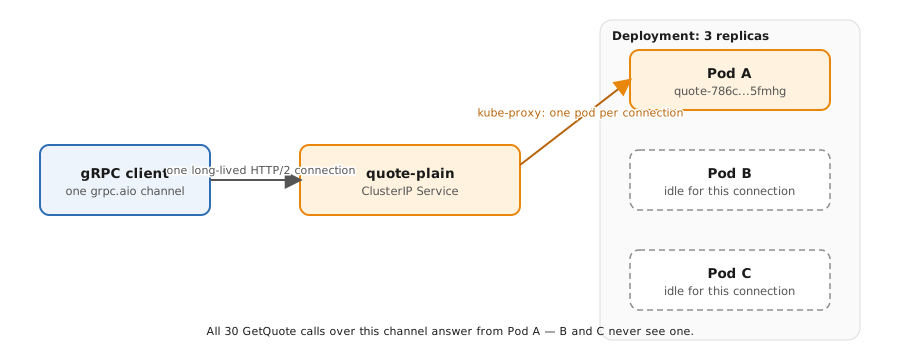
The L4 problem: one connection, one pod, for life
A Kubernetes ClusterIP Service is a virtual IP with no process behind it. kube-proxy programs iptables (or IPVS) rules that intercept a packet addressed to that virtual IP and rewrite its destination to one of the Service’s backing pods — and it makes that choice once per TCP connection, not once per request. For an HTTP/1.1-style client that opens a new connection per request, this is invisible: every request gets its own fresh roll of the dice, and traffic spreads across the backing pods on its own. For a gRPC client, it is a trap, because the entire design point of HTTP/2 — and the entire reason Chapter 7 told you to build one channel and keep it — is that one connection carries every call for as long as the process runs. kube-proxy rewrites that connection’s destination exactly once, and from that moment on, every RPC the channel ever carries, no matter how many, goes to the same pod.
examples/22-mesh-loadbalancing/k8s/service-plain.yaml is an entirely ordinary ClusterIP Service — nothing is misconfigured, nothing is a toy example of bad YAML. It is also the first thing scripts/run-demo.sh’s plain phase points loadclient.py at, and the result demonstrates exactly this mechanism on a real cluster: loadclient.py opens one channel to quote-plain.mesh-lb-demo.svc.cluster.local:9000, makes 30 GetQuote calls over it, and reads the x-served-by trailer after each one.
=== phase1-plain-pin ===
target=quote-plain.mesh-lb-demo.svc.cluster.local:9000 lb_policy=(default: pick_first) calls=30
distinct pods answering: 1
  quote-786c5744c4-5fmhg: 30/30
Thirty calls, one pod, while kubectl get pods confirmed the other two replicas (quote-786c5744c4-tx68v, quote-786c5744c4-w5f49) were Running and ready the entire time. Nothing about this is a bug in Kubernetes or in grpc-core’s default LB policy, pick_first — pick_first does exactly what its name says, and a ClusterIP Service resolves to exactly one address, so there is only ever one thing to pick first. The failure is architectural: a stateless, horizontally-scaled service, fronted by the one Kubernetes primitive most engineers reach for first, silently collapses to a single replica for every long-lived client — and nothing in that client’s logs, metrics, or return values says so. A naive load test that opens a fresh connection per request (the next section names the specific tool that does this) would show perfectly even traffic and hide the problem completely, right up until a real client — a backend service holding one reused channel open for its process lifetime, exactly as Chapter 7 recommends — sends every request to one pod indefinitely.
Watch out
Running grpcurl in a bash loop as a load generator looks like an equivalent test and is not one. Every grpcurl invocation is a fresh process that dials a brand-new channel for that one call and exits, so a loop of 30 invocations opens 30 independent TCP connections — against the plain ClusterIP Service above, that means kube-proxy rolls a fresh backend pod for each of the 30 connections, and the loop reports a perfectly even fan-out across all three pods. That result is real, and it is also not what any actual long-lived client experiences. loadclient.py exists specifically to avoid this trap: it builds exactly one channel and reuses it for all 30 calls, the way Chapter 7's reuse client — and every correctly-written gRPC client — already does.
Fix #1: a headless Service, and client-side round_robin
The first fix changes nothing about the client’s code path and everything about what DNS tells it. examples/22-mesh-loadbalancing/k8s/service-headless.yaml sets clusterIP: None — a headless Service has no virtual IP at all, and kube-proxy is not involved in routing to it in any way. What it does instead is purely a DNS trick: resolving quote-headless.mesh-lb-demo.svc.cluster.local returns one A record per ready pod, not one virtual IP standing in for all of them. A client that asks for all of those records, and uses more than the first one, gets real load distribution with no server-side change at all.
grpc-core already knows how to do this. loadclient.py builds its channel with a dns:/// scheme target and an explicit LB policy:
options = [("grpc.lb_policy_name", LB_POLICY)] if LB_POLICY else []
async with grpc.aio.insecure_channel(TARGET, options=options) as channel:
    stub = routing_pb2_grpc.RoutingServiceStub(channel)
With TARGET=dns:///quote-headless.mesh-lb-demo.svc.cluster.local:9000 and LB_POLICY=round_robin, the channel’s DNS resolver returns three addresses instead of one, and round_robin opens a persistent subchannel — its own HTTP/2 connection — to each of them, cycling through all three for successive RPCs. This is still exactly one channel object and still exactly the “build once, reuse for the process lifetime” discipline Chapter 7 teaches; what changed is that the channel now holds three connections instead of one, because there are three addresses behind the name instead of one virtual IP standing in for all of them.
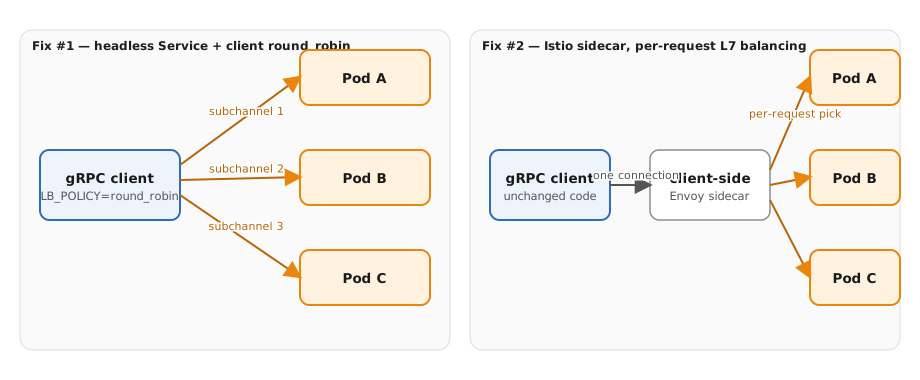
scripts/run-demo.sh’s headless phase runs the identical 30-call loop against this target, and the real tally is a clean three-way split:
=== phase2-headless-round-robin ===
target=dns:///quote-headless.mesh-lb-demo.svc.cluster.local:9000 lb_policy=round_robin calls=30
distinct pods answering: 3
  quote-786c5744c4-5fmhg: 10/30
  quote-786c5744c4-tx68v: 10/30
  quote-786c5744c4-w5f49: 10/30
Same three pods that answered Phase 1’s pinned calls, same client shape (one channel, 30 calls, read the trailer after each), only the Service type and one channel option changed. This is a real fix, and it is also entirely the client’s responsibility: every service this pattern protects needs its callers to know to ask for a headless name and set round_robin explicitly, which means every language’s client stack, every internal caller, and every future caller all have to get this right independently, forever. That is the opening for the second fix.
Fix #2: the mesh — Envoy balances at Layer 7, not Layer 4
Istio does not ask the client to do anything differently. scripts/run-demo.sh’s istio phase flips the Deployment’s pods into the mesh — kubectl patch sets sidecar.istio.io/inject: "true" on the pod template (overriding the "false" k8s/deployment.yaml ships by default, so the base kustomize manifest stays mesh-agnostic), then kubectl rollout restart recreates every pod with an istio-proxy sidecar alongside the application container:
NAME                     READY   STATUS    RESTARTS   AGE
quote-7f47bcc96-4vt7v    2/2     Running   0          18s
quote-7f47bcc96-b8vqc    2/2     Running   0          23s
quote-7f47bcc96-fgr2l    2/2     Running   0          28s
It then applies examples/22-mesh-loadbalancing/istio/destination-rule.yaml, which tells every meshed client’s sidecar how to spread calls to quote-plain across its endpoints:
spec:
  host: quote-plain.mesh-lb-demo.svc.cluster.local
  trafficPolicy:
    loadBalancer:
      simple: ROUND_ROBIN
    outlierDetection:
      consecutive5xxErrors: 3
      interval: 10s
      baseEjectionTime: 30s
      maxEjectionPercent: 50
The mechanism behind this fix differs from Fix #1 in kind, not just in degree. Once a pod is meshed, Istio’s iptables rules redirect its outbound traffic through its own local Envoy sidecar before the packet ever reaches kube-proxy’s Service-VIP rewrite. The client’s gRPC channel still opens exactly one connection — to its own sidecar, over loopback — but the sidecar, which already knows every pod behind quote-plain from Istio’s control plane (Pilot/istiod), opens its own upstream connections to all three pods and picks one per individual HTTP/2 stream, not once for the whole connection. A stream is one RPC. The client’s channel is still one TCP connection, end to end, from its point of view; the fan-out happens one layer below that, inside the sidecar, which is exactly why this fix needs no client code change at all.
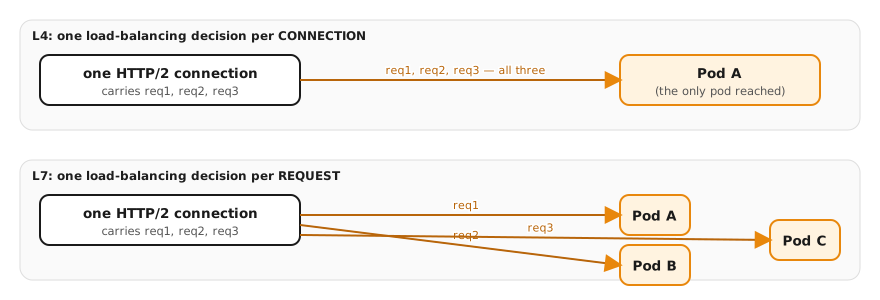
Running the identical loadclient.py — same 30 calls, same request, LB_POLICY unset, same pick_first default — against the exact same quote-plain Service Phase 1 pinned to one pod now produces this:
=== phase3-istio-l7 ===
target=quote-plain.mesh-lb-demo.svc.cluster.local:9000 lb_policy=(default: pick_first) calls=30
distinct pods answering: 3
  quote-7f47bcc96-4vt7v: 10/30
  quote-7f47bcc96-b8vqc: 10/30
  quote-7f47bcc96-fgr2l: 10/30
A perfect 10/10/10 split, over the plain ClusterIP Service, with no headless Service and no client-side LB policy anywhere in sight. Figure 22.1’s Pod B and Pod C, idle for the life of a pinned connection, are now receiving a third of the traffic each — and the client that produced this tally is byte-for-byte the same client that produced Figure 22.1’s pinned tally minutes earlier, pointed at the same Service name, with LB_POLICY unset both times.
STRICT mTLS: the other half of putting a service in the mesh
examples/22-mesh-loadbalancing/istio/peer-authentication.yaml sets mesh-wide mTLS to STRICT for the demo namespace — every meshed pod now refuses a plaintext connection from anything that isn’t also meshed, with no change to RoutingServiceServicer or loadclient.py, because the TLS origination and termination both happen in the sidecars, transparently, around application code that still just calls grpc.aio.insecure_channel. This is Chapter 19’s mTLS, applied at the infrastructure layer instead of hand-rolled per service: the same mutual-authentication guarantee, without certgen, without a Java keystore, without either stack’s application.properties or main.py knowing TLS exists.
The cost of that guarantee is real, and scripts/run-demo.sh makes it observable by accident: a load-client Job explicitly annotated sidecar.istio.io/inject: "false" — the same annotation that keeps Phases 1 and 2 out of the mesh — now fails every call against the meshed quote-plain Service, once STRICT mode is active:
grpc.aio._call.AioRpcError: <AioRpcError of RPC that terminated with:
	status = StatusCode.UNAVAILABLE
	details = "failed to connect to all addresses; last error: UNAVAILABLE: ipv4:10.102.229.60:9000: recvmsg:Connection reset by peer (104)"
>
A connection reset, not a gRPC status code the application chose — the same transport-versus-application distinction Chapter 19 draws for a plaintext call against a TLS-only server. The rejection happens in the sidecar, before a single byte of a GetQuoteRequest is deserialized; RoutingServiceServicer.GetQuote never runs, never gets the chance to return UNAUTHENTICATED, because the call never reaches gRPC’s own status-code machinery at all.
Retries, timeouts, and why a retry is a new load-balancing decision
examples/22-mesh-loadbalancing/istio/virtual-service.yaml layers retry and timeout policy on top of the DestinationRule’s load-balancing policy:
http:
  - route:
      - destination:
          host: quote-plain.mesh-lb-demo.svc.cluster.local
    retries:
      attempts: 2
      perTryTimeout: 1s
      retryOn: unavailable,resource-exhausted
    timeout: 3s
A retry here is not a replay against the same backend — it is a new pick from the same ROUND_ROBIN pool the DestinationRule configures, made by the same sidecar that made the original pick. If Pod B is answering GetQuote correctly but happens to be momentarily overloaded and returns RESOURCE_EXHAUSTED, Envoy’s retry lands on whichever pod its load-balancing policy selects next — which, under round robin, is very likely a different pod — with zero code in RoutingServiceServicer or loadclient.py aware that a retry even happened. The outlierDetection block on the DestinationRule closes the loop: three consecutive 5xx-equivalent failures from one pod get it temporarily ejected from the pool for 30 seconds, so an unhealthy pod stops receiving new picks at all rather than merely getting retried around.
Native sidecars and why the load-client Job still completes
Older Istio releases had a well-known rough edge with exactly this book’s load-client pattern: a sidecar container that runs for the life of the pod, with no concept of “the main work is done,” kept a Job’s pod alive forever, because the pod could not be considered complete while the sidecar was still running — the Job would sit at 1/2 indefinitely until something killed it by hand. Istio 1.29 and later ship native sidecars, built on the Kubernetes “sidecar containers” feature: istio-proxy runs as an initContainer with restartPolicy: Always, a lifecycle Kubernetes itself understands as “stays up alongside the main containers, and shuts down automatically once they’re all done.” scripts/run-demo.sh’s Istio phase meshes the load-client Job too — it needs its own sidecar for the same mTLS reasons the server pods do — and the real run shows exactly this working as designed:
NAME                              READY   STATUS      RESTARTS   AGE
loadclient-phase3-istio-l7-k992w  0/2     Completed   0          15s
Both of its containers — istio-init and istio-proxy — report terminated / exitCode 0 / reason Completed, confirming the sidecar shut itself down the moment the loadclient container finished its 30 calls, rather than hanging.
Build, run, observe
cd examples/22-mesh-loadbalancing
./scripts/bootstrap.sh    # minikube start + pinned istioctl install + namespace
./scripts/run-demo.sh     # all three phases: plain, headless, istio
run-demo.sh builds ch22-routing-python:dev from python/Containerfile, loads it straight into minikube with minikube image load (no registry involved), applies the kustomize base in k8s/, and then runs each phase’s loadclient-<phase> Job, deleting and recreating it so the whole script is safe to re-run from the top after a transient failure — README.md and expected-output.md carry the complete recorded transcript from the run quoted throughout this chapter, including the kubectl/istioctl version record from bootstrap.sh: minikube v1.39.0, Kubernetes v1.34.0, Istio 1.31.1.
What CI validates, and what it does not
This chapter’s example sits outside the Compose-based examples CI matrix entirely, because that matrix auto-discovers every verify.sh it finds under examples/*/ and this directory has none — scripts/validate.py’s cluster-dir-no-verify check fails the build the moment one appears here, which is the mechanism that keeps a future contributor from accidentally wiring this cluster-only example into a CI runner with no cluster. The one piece of this example CI does check is purely structural: the k8s-manifests job runs kubectl kustomize examples/22-mesh-loadbalancing/k8s | kubeconform -strict -summary against the four resources in k8s/ — the namespace, the Deployment, and both Services — confirming they parse as schema-valid core Kubernetes objects on every push. That check cannot and does not prove the pin happens, that round_robin fans out, or that mTLS rejects an unmeshed caller; those are cluster-behavior claims, and this chapter’s “Verification status” footer says so directly. The three Istio custom resources live in istio/, a separate directory the k8s-manifests job never touches, because kubeconform -strict has no schema for a PeerAuthentication or a DestinationRule and would fail outright the moment one showed up in the same pipe.
Cross-check
loadclient.py’s tally comes entirely from the client side — the x-served-by trailer each pod sets on its own responses. An independent confirmation that those pods really are the ones doing the work is a plain kubectl logs against each one, which shows the exact same identity, logged server-side, for every call:
kubectl --context grpc-ch22 -n mesh-lb-demo logs deploy/quote --all-containers=false --prefix | grep "GetQuote served-by"
[pod/quote-7f47bcc96-4vt7v/quote] GetQuote served-by=quote-7f47bcc96-4vt7v: USNYC -> NLRTM, 1 cargo item(s), quote=USD 3001.25
[pod/quote-7f47bcc96-b8vqc/quote] GetQuote served-by=quote-7f47bcc96-b8vqc: USNYC -> NLRTM, 1 cargo item(s), quote=USD 3001.25
[pod/quote-7f47bcc96-fgr2l/quote] GetQuote served-by=quote-7f47bcc96-fgr2l: USNYC -> NLRTM, 1 cargo item(s), quote=USD 3001.25
Two completely independent signals — a client-read response trailer and a server-emitted log line, produced by two different code paths in routing_service.py that never share state — agree on which pod answered which call. That agreement is what makes the fan-out claim trustworthy rather than an artifact of one observation method.
Decision
Reach for the headless Service plus client-side round_robin fix when every caller of a service is code you control and can audit — an internal library, a shared client wrapper — because it costs nothing to run (no sidecar, no extra hop, no mesh to operate) and is easy to reason about from the client alone. Reach for a service mesh when callers are heterogeneous, numerous, or simply not all under one team's control: the fix becomes infrastructure configuration instead of a convention every caller has to independently remember, and it comes bundled with mTLS and retry/timeout policy that would otherwise need reimplementing per language, per client. Turn on STRICT mTLS for any internal namespace where every legitimate caller can reasonably be meshed — it is the same mutual-authentication guarantee Chapter 19 builds by hand, with certificate issuance and rotation handled by the mesh's own identity system instead of a demo certgen script. Keep retry budgets and outlier detection paired, never one without the other: a retry policy with no outlier detection keeps hammering a broken pod with every caller's retries; outlier detection with no retry policy still leaves the first unlucky request on a failing pod to simply fail.
What you learned
- A Kubernetes
ClusterIPService makes its backend-pod choice once per TCP connection, not once per request — invisible to a client that opens a connection per call, and a silent trap for a gRPC client correctly following Chapter 7’s “build one channel, reuse it” rule. - A headless Service (
clusterIP: None) removeskube-proxyfrom the path entirely and exposes every ready pod as its own DNS record; a channel built with adns:///target andgrpc.lb_policy_name=round_robinopens one subchannel per pod and spreads calls across all of them, with real measured output of exactly 10/10/10 across three pods for 30 calls. - Istio moves the same load-balancing decision into the client’s own sidecar, which balances individual HTTP/2 streams — one gRPC call each — across upstream connections it manages itself, so the identical client code, the identical
ClusterIPService, and zero application changes produce the identical 10/10/10 fan-out once the Deployment is meshed and aDestinationRuleis applied. - STRICT
PeerAuthenticationsecures every meshed-to-meshed call automatically and rejects an unmeshed caller with a transport-layer connection reset, never a gRPC status code — confirmed on this chapter’s own cluster by running an unmeshed load-client Job against the now-STRICT namespace and watching it fail exactly that way. - A
grpcurl-in-a-loop load generator opens a fresh connection per call and would mask the pin this chapter demonstrates;loadclient.pybuilds one channel and reuses it specifically so the demo measures what a real long-lived client experiences. - Native sidecars (Istio 1.29+, built on Kubernetes’ own “sidecar containers” feature) let a meshed
Jobcomplete normally once its main container exits, instead of hanging at1/2the way older Istio releases did.
Chapter 23 moves outside the cluster entirely: it exposes RoutingService.GetQuote to a browser that cannot speak native gRPC at all, and compares a grpc-web proxy against a REST transcoding gateway for doing it.
On the wire
Start the cluster and run all three phases:
cd examples/22-mesh-loadbalancing
./scripts/bootstrap.sh
./scripts/run-demo.sh
Check which Istio actually landed, and confirm the data-plane proxies are on the same pinned version as the control plane:
istioctl version --context grpc-ch22
# client version: 1.31.1
# control plane version: 1.31.1
# data plane version: 1.31.1 (5 proxies)   # 3 meshed GetQuote pods + ingress + egress gateways
Confirm the Istio custom resources are actually applied before trusting a fan-out result:
kubectl --context grpc-ch22 -n mesh-lb-demo get peerauthentication,destinationrule,virtualservice
NAME                                           MODE     AGE
peerauthentication.security.istio.io/default   STRICT   20s

NAME                                              HOST                                          AGE
destinationrule.networking.istio.io/quote-plain   quote-plain.mesh-lb-demo.svc.cluster.local    20s

NAME                                             GATEWAYS   HOSTS                                             AGE
virtualservice.networking.istio.io/quote-plain              ["quote-plain.mesh-lb-demo.svc.cluster.local"]   20s
Re-run just the load-client tally for one phase, without rebuilding or redeploying anything:
./scripts/run-demo.sh plain       # expect: 1 pod, 30/30
./scripts/run-demo.sh headless    # expect: 3 pods, 10/10/10
./scripts/run-demo.sh istio       # expect: 3 pods, 10/10/10 — plain Service, zero client changes
And the static check CI actually runs on this example, reproducible without a cluster at all:
kubectl kustomize examples/22-mesh-loadbalancing/k8s | kubeconform -strict -summary
# Summary: 4 resources found parsing stdin - Valid: 4, Invalid: 0, Errors: 0, Skipped: 0
Verification status: unverified.
This example runs on minikube by hand, never in CI — scripts/validate.py’s
cluster-dir-no-verify check confirms no verify.sh exists under
examples/22-mesh-loadbalancing/ to be auto-discovered by the clusterless
examples matrix, and the k8s-manifests CI job validates only that
k8s/’s four resources are schema-correct, never that the demo’s claims
hold on a live cluster. All three phases, the STRICT mTLS rejection, and
the native-sidecar Job-completion behavior described in this chapter were
run on an actual minikube cluster, v1.39.0 (docker driver, containerd), with
Kubernetes v1.34.0 and a self-downloaded, pinned Istio 1.31.1 — see
examples/22-mesh-loadbalancing/expected-output.md for the complete
recorded transcript this chapter’s numbers are drawn from. The highest-risk
things a reader’s own run should confirm: that Kubernetes v1.34.0 stays
inside whatever Kubernetes range the Istio release they install officially
supports (re-check both projects’ release notes before bumping either),
that registry.access.redhat.com/ubi10/python-314-minimal:10.2-1791464217
continues to resolve (re-check with skopeo list-tags first, same
discipline as Chapter 7’s and Chapter 19’s identical pin), and that a
minikube profile on a machine with less than the roughly 4 CPU / 6 GiB this
chapter’s bootstrap.sh requests still schedules Istio’s control plane and
three application replicas without eviction.