AuthN/AuthZ
JWT/OAuth2 bearer tokens in call metadata, a signature-and-expiry-checking server interceptor, and per-method authorization — the auth hook Chapter 12 built, grown into a real credential check.
Chapter 12’s AuthLoggingInterceptor checked one thing about every call: whether an authorization entry existed in the request’s metadata at all. It never looked at what that entry said — Bearer demo-token passed the check exactly as well as a forged string typed by hand, because presence was the whole test. That gap was a scope choice, not an oversight: Chapter 12 was about where a cross-cutting concern belongs, not about cryptography, and a real credential check would have buried the interceptor pattern under machinery the chapter didn’t need yet. This chapter builds that machinery: a JSON Web Token with a signature the server verifies, an expiry it checks, and a scope it uses to decide not just whether a caller is who they claim, but what that caller is allowed to call. RoutingService.GetQuote is still the RPC under test — no proto field changes, because authentication and authorization live entirely in metadata and in the interceptor sitting in front of the handler, exactly where Chapter 12 left them.
The code is in examples/20-authn-authz/. The run script there (verify.sh) builds and starts both stacks, mints four distinct tokens at runtime, and asserts every claim this chapter makes against both of them; its README.md covers what it does and how to drive it by hand.
What a JWT is, and why metadata is where it rides
A JSON Web Token is three base64url-encoded segments joined by dots: a header naming the signing algorithm, a payload of claims (facts about the caller and the token itself), and a signature over the first two segments. eyJhbGciOiJIUzI1NiJ9.eyJzdWIiOiJkZW1vLWNsaWVudCIsInNjb3BlIjoicXVvdGU6cmVhZCIsImV4cCI6MTc5MDAwMDAwMH0.c2lnbmF0dXJl decodes to a header of {"alg":"HS256"}, a payload naming a subject, a scope, and an expiry, and a signature nobody can forge without the signing key. That shape matters for where it travels on a gRPC call: a JWT is a string, so it fits naturally into Metadata/invocation_metadata — the same header map Chapter 12’s presence check already read — as the value of a standard authorization key, conventionally prefixed Bearer to name the authentication scheme. Nothing about gRPC treats a JWT specially; it is exactly as opaque to the transport as demo-token was in Chapter 12. What changes in this chapter is entirely on the receiving end: the interceptor now decodes that string, recomputes a signature over it, and makes two separate decisions instead of one.
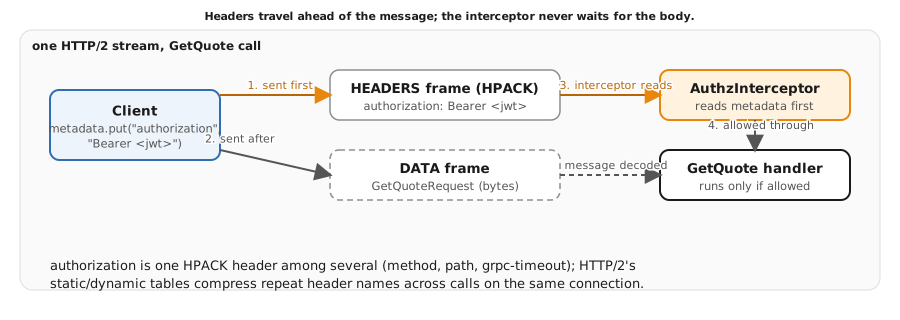
Two properties of this placement are worth being explicit about, because both get this chapter’s test cases right. First, metadata is sent in gRPC’s HEADERS frame, which HTTP/2 transmits before the DATA frame carrying the request message — the token arrives, and can be rejected, before the server has spent any work deserializing the body. Figure 20.1 draws that ordering directly. Second, metadata is per-call, not per-connection: a client can reuse the same HTTP/2 connection (as Chapter 18 insists it should) for a call carrying a fresh token and a later call carrying an expired one, and the server has no way to know from the connection alone which is which — every call has to prove its own credential, every time.
Authentication vs. authorization: two questions, two outcomes
It is tempting to treat “checking the token” as one step, but AuthzInterceptor makes it two, kept separate and evaluated in a fixed order:
- Authentication answers “is this caller who they claim to be?” A signature that doesn’t match, a token that’s expired, or no token at all are all authentication failures, and all three map to the same gRPC status:
UNAUTHENTICATED. The interceptor never looks at what the token claims to permit until it has confirmed the token itself is valid and unexpired. - Authorization answers “is this caller allowed to do this?” — asked only of a token that already passed authentication. A
demo-clienttoken carryingscope: quote:readauthenticates perfectly well; it isn’t entitled to a method that requiresroutes:admin. That failure isPERMISSION_DENIED, a different code, because it is a categorically different fact: the caller is who they say, and that identity still doesn’t have the privilege the call requires.
Collapsing these into one check is a common and costly mistake — a service that returns UNAUTHENTICATED for both an unverifiable identity and an insufficient privilege forces every client-side retry policy and every log-triage workflow to guess which one happened, when the two call for entirely different responses: re-authenticate (get a new token) versus request a different grant (get a better token, or accept the call isn’t yours to make). Figure 20.2 draws the full decision tree AuthzInterceptor implements, with the two outcome families kept visually distinct.
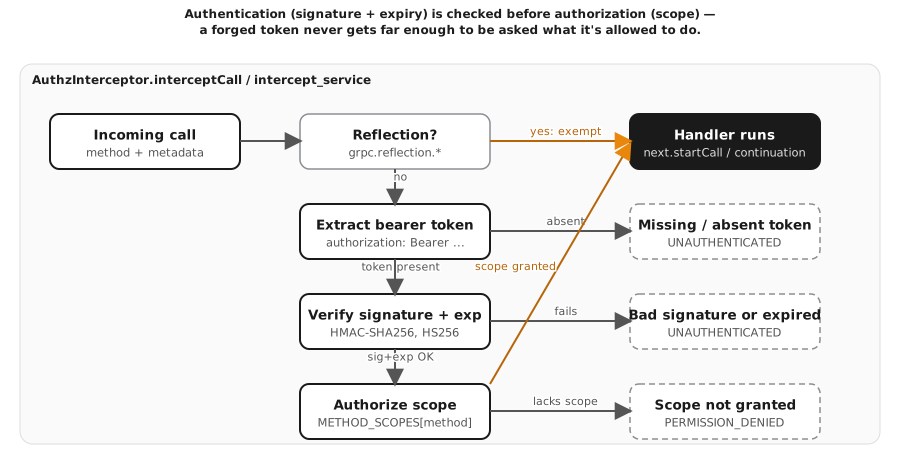
Both stacks implement that tree with the same shape Chapter 12 established for AuthLoggingInterceptor: reflection is checked and exempted first, then the interceptor either substitutes a handler that immediately aborts with the right status, or lets the real handler run. What’s new here is that the auth decision now needs the token’s contents, not just its presence, which means a real signature check and a real clock comparison have to happen on the hot path of every call — the implementation this chapter adds.
Per-method authorization: the same token, three outcomes
Chapter 12’s auth hook was uniform: every method behind it got the identical check, because presence-of-a-header doesn’t vary by method. Real authorization almost never works that way — a routing service’s read path (GetQuote) and its administrative path (a hypothetical bulk route rewrite) have no business requiring the same privilege, and a token minted for a customer-facing integration should never be able to exercise an operator-only method just because it happens to carry some valid signature. AuthzInterceptor encodes that as a plain map from method name to the scope it requires:
shipping.routing.v1.RoutingService/GetQuote    -> quote:read
shipping.routing.v1.RoutingService/ListRoutes  -> routes:admin
GetQuote requires quote:read, which this chapter’s valid demo token carries, so it succeeds. ListRoutes requires routes:admin — a privilege nothing in this chapter’s token set grants — so calling it with any of the demo tokens returns PERMISSION_DENIED, regardless of how well-formed, correctly signed, or unexpired that token is. A method with no entry in the map (FindOptimalRoute, NegotiateRoute, RecomputeRoutes) needs only a valid, authenticated token; this interceptor doesn’t gate those on any particular scope, which is itself a choice worth naming — an un-gated method is authenticated-only, not unauthenticated, and a service that means to restrict it eventually has to add it to the map explicitly, the same way ListRoutes was added here.
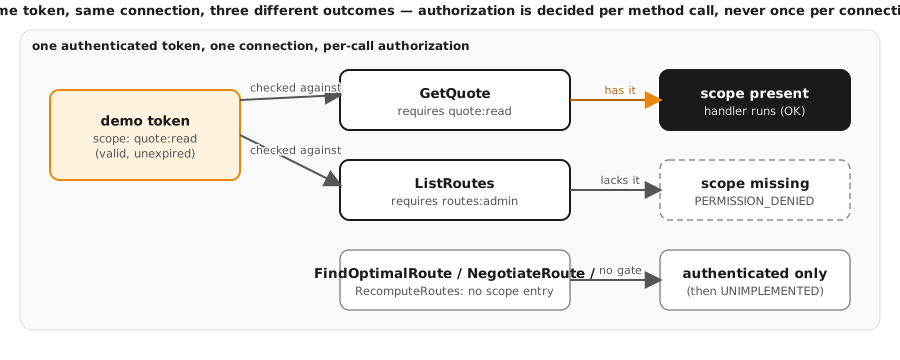
Authorization is per-call, not per-connection, and not even per-token in any blanket sense: a single HTTP/2 connection, carrying a single bearer token on every call, produces OK for one method and PERMISSION_DENIED for another on the very next call — nothing about the connection or the prior successful call makes the second one more likely to succeed. That is also exactly why this chapter’s ListRoutes test needs care in how it’s read: the interceptor’s PERMISSION_DENIED fires before RoutingServiceImpl.listRoutes/RoutingServiceServicer.ListRoutes is ever invoked, and this example’s handler for that method is left unoverridden — it would answer UNIMPLEMENTED if the interceptor ever let a call reach it. A token that legitimately carried routes:admin would still hit UNIMPLEMENTED here, because implementing ListRoutes’s actual logic isn’t this chapter’s job. The PERMISSION_DENIED verify.sh asserts is the authorization decision, proven independently of what — if anything — sits behind it.
The shared secret is a demo prop, not a design
Both stacks verify against the identical hardcoded string, ch20-demo-shared-hmac-secret-DO-NOT-USE-IN-PRODUCTION, baked directly into source on both sides. That is the right call for a self-contained example with no IdP and no network dependency, and the wrong call for anything that ships: a secret checked into a repository is a secret every contributor, every CI log, and every forked clone has already seen. See this chapter's "Decision" callout for what replaces it in production.
How the code works
Both stacks share one claim shape — sub, scope, iat, exp — and one method-to-scope map, but verify signatures with entirely different mechanisms, which is a useful demonstration that the contract (what a valid token looks like) and the implementation (how a given stack checks one) are independent concerns.
The shared secret and scope map (Python, app/auth.py). SECRET and WRONG_SECRET are plain module-level strings — SECRET is what both stacks verify against; WRONG_SECRET exists only so mint_token.py’s bad-sig case can produce a token signed with a key neither server recognizes. METHOD_SCOPES is a dict[str, str] from a normalized method name (leading / stripped, since gRPC’s wire-format method string carries one but MethodDescriptor.getFullMethodName() on the Java side doesn’t) to the scope that method requires. A dict is the right structure here specifically because the lookup is exact-match on a small, fixed set of method names known at authoring time — there’s no prefix matching or wildcarding to justify anything more elaborate. verify_token wraps PyJWT’s jwt.decode(token, SECRET, algorithms=["HS256"]) in a try/except that collapses PyJWT’s whole InvalidTokenError hierarchy — ExpiredSignatureError, InvalidSignatureError, DecodeError, and others — into one TokenError. Every one of those failures produces the identical UNAUTHENTICATED outcome one level up, so there is no reason for the interceptor to branch on which PyJWT exception fired.
The token minter (app/mint_token.py). Four cases share one claims dict — sub, scope: "quote:read", iat: now, exp: now + 300 — built fresh on every invocation so exp is always five minutes from the actual moment the script runs, never a timestamp baked into the container image at build time. expired is the baseline with exp set to now - 300 instead; wrong-scope swaps scope to "shipments:write" (a value that satisfies neither quote:read nor routes:admin); bad-sig keeps the baseline claims but signs with WRONG_SECRET. The script’s entire output contract is one line on stdout — the encoded token, nothing else — so verify.sh can capture it directly with command substitution: TOKEN="$(docker compose run ...)". This is the Chapter 18 bundled-client pattern applied to a signer instead of a load-testing client: the minter ships inside the same image as the server it’s testing, so there’s no second image to build and no drift between the claim shape the minter produces and the one the interceptor expects.
The interceptor (Python, app/interceptors.py). AuthzInterceptor.intercept_service follows the exact resolve-then-decide structure Chapter 12 established: continuation(handler_call_details) resolves the real handler without invoking it, so every branch below still has the option of substituting a different handler before anything the client sent gets processed. Reflection is checked first and exempted unconditionally. _bearer_token extracts the token from the authorization entry, requiring the Bearer prefix and returning None for anything else — a header present but malformed is treated identically to a header that’s absent, because neither identifies a usable credential. verify_token either returns the decoded claims or raises TokenError, caught and converted to UNAUTHENTICATED with a message naming the specific problem. Only once that succeeds does required_scope(method) get consulted: None means no gate (pass straight to logging), and a scope name means the token’s own scope claim — split on whitespace into a set, the standard OAuth2 convention for a space-delimited scope string — has to contain it, or the call is rejected with PERMISSION_DENIED. The handler-substitution machinery below that (_abort_handler, _with_logging) is unchanged from Chapter 12’s cardinality-matching helpers: both match the real handler’s unary/streaming shape on each side, so the same interceptor protects NegotiateRoute’s bidirectional stream exactly as it protects GetQuote’s unary call, without the interceptor itself branching on which.
The verifier (Quarkus, JwtVerifier.java). This is the chapter’s one real cryptographic implementation, written by hand because the whole point is to show what a signature check does rather than hide it behind a framework. verify(String token) splits on ., requiring exactly three segments. It recomputes the HMAC over header.payload using javax.crypto.Mac.getInstance("HmacSHA256") seeded with SECRET as a SecretKeySpec — the JDK’s own HMAC implementation, no third-party crypto library needed — and compares the result against the token’s own signature segment with MessageDigest.isEqual, not Arrays.equals or ==. That distinction matters: MessageDigest.isEqual runs in time independent of where the first mismatched byte occurs, where a short-circuiting comparison leaks exactly that information through timing, letting an attacker recover a valid signature one byte at a time by observing how long rejection takes for each guess — a Mac verification routine that gets this wrong defeats the entire point of using a MAC. Only after the signature checks out does the method base64url-decode the payload segment and hand the bytes to a CDI-injected Jackson ObjectMapper (quarkus-jackson) to produce a Map<String, Object> of claims, then checks exp against System.currentTimeMillis() / 1000. A malformed token, a bad signature, or an expired exp all throw the same JwtVerifier.TokenError — mirroring Python’s single-exception collapse — so AuthzInterceptor has one catch clause to reason about, not three.
The interceptor (Quarkus, AuthzInterceptor.java). Structurally identical to Chapter 12’s AuthLoggingInterceptor: an @ApplicationScoped bean implementing io.grpc.ServerInterceptor, registered everywhere via @GlobalInterceptor. Reflection is exempted by isReflection(method) before anything else runs. A missing or non-Bearer-prefixed authorization header, or a JwtVerifier.TokenError caught from jwtVerifier.verify(...), both call reject(...), which logs the outcome and calls call.close(status, new Metadata()) directly — next.startCall(...) is never invoked, so RoutingServiceImpl never runs. Only a token that both authenticates checks METHOD_SCOPES.get(method): a null means no gate; a non-null scope is checked against the claims map’s scope value, split on whitespace into a Set<String> the same way the Python side does, and a miss produces PERMISSION_DENIED through the identical reject(...) path. A successful call wraps the ServerCall in a ForwardingServerCall.SimpleForwardingServerCall that logs whatever status the handler eventually closes with — the same timing mechanism Chapter 12 used, now running only after both authentication and authorization have already passed.
The fragile part. JwtVerifier and app/auth.py hardcode a literal secret string in source. That is correct for this example’s goal — demonstrating the shape of signature verification and scope authorization without an IdP container — and it is precisely the thing a real deployment must never do. A production service fetches its identity provider’s public signing keys from a JWKS endpoint (Keycloak publishes one; so does any OIDC-compliant IdP), caches them, and verifies an asymmetric signature (commonly RS256 or ES256) where the verifying party never possesses — and therefore can never leak — the key that produced the signature. Quarkus’s path there is quarkus-oidc, not a hand-rolled Mac; this chapter’s JwtVerifier is sized for a demo with a fixed secret, not a template to extend toward production.
Build, run, observe
cd examples/20-authn-authz
./verify.sh
This brings both services up with docker compose, waits for each gRPC server to answer reflection’s list, mints all four token cases at runtime via docker compose run --entrypoint python python -m app.mint_token <case>, and drives six assertions against localhost:9200 (Quarkus) and localhost:9201 (Python): reflection answers with no token; a valid token reaches GetQuote and returns the correct quote; a missing token, a bad-sig token, and an expired token are each rejected with UNAUTHENTICATED; and a wrong-scope token calling ListRoutes is rejected with PERMISSION_DENIED. It prints PASS only once every assertion holds for both stacks, then tears the stack down.
Cross-check
A hand-rolled HMAC verifier is exactly the kind of code worth checking against an independent implementation, not just against its own test suite — a bug that happens to make the Java verifier agree with itself proves nothing. Mint a token and recompute its signature with openssl, which has no awareness of this chapter’s code at all:
TOKEN="$(docker compose -p ch20-auth run --rm --entrypoint python python -m app.mint_token valid)"
HEADER_PAYLOAD="$(cut -d. -f1-2 <<<"$TOKEN")"
echo -n "$HEADER_PAYLOAD" | openssl dgst -sha256 -hmac "ch20-demo-shared-hmac-secret-DO-NOT-USE-IN-PRODUCTION" -binary \
  | base64 | tr '+/' '-_' | tr -d '='
The base64url string openssl prints matches the token’s own third segment (cut -d. -f3 <<<"$TOKEN") byte for byte. Agreement between openssl’s general-purpose HMAC implementation and JwtVerifier’s hand-rolled Mac/MessageDigest.isEqual pair is the strongest evidence that the Java side computes the correct signature rather than one that merely satisfies its own round trip.
What you learned
- Authentication (is this caller who they claim?) and authorization (is this caller allowed to do this?) are separate decisions with separate gRPC status codes —
UNAUTHENTICATEDandPERMISSION_DENIED— and collapsing them into one check destroys information a client’s retry logic and a log’s triage workflow both depend on. - A server interceptor is where both decisions belong, for the same reason Chapter 12 put the presence check there: the check is identical across every method it protects, so it never has to be remembered by whoever adds the next RPC.
- Authorization attaches to the method being called, not the connection or even the token as a whole — the same valid, authenticated token produces
OKfor one method andPERMISSION_DENIEDfor another, on the same connection, back to back. MessageDigest.isEqual(or an equivalent constant-time comparison) is not an optional nicety in a signature check; a short-circuiting comparison turns a MAC verification into a timing oracle.
Chapter 21 picks up where this chapter’s logging left off: the same interceptor seam, now wired to OpenTelemetry’s own span machinery, so a rejected call and an authorized one both show up on a trace, not just in a log line.
On the wire
No token at all — the interceptor never reaches RoutingServiceImpl/RoutingServiceServicer:
grpcurl -plaintext -d '{"origin":{"unLocode":"USNYC"},"destination":{"unLocode":"NLRTM"},"cargo":[{"weightKg":1000}]}' \
  localhost:9200 shipping.routing.v1.RoutingService/GetQuote
ERROR:
  Code: Unauthenticated
  Message: missing 'authorization: Bearer <jwt>' metadata
A valid token reaches the handler and gets the identical Chapter 5 quote:
TOKEN="$(docker compose -p ch20-auth run --rm --entrypoint python python -m app.mint_token valid)"
grpcurl -plaintext -H "authorization: Bearer $TOKEN" \
  -d '{"origin":{"unLocode":"USNYC"},"destination":{"unLocode":"NLRTM"},"cargo":[{"weightKg":1000}]}' \
  localhost:9200 shipping.routing.v1.RoutingService/GetQuote
{
  "quote": { "currency": "USD", "amount": "2500.00" },
  "route": { "id": "rte_USNYC-NLRTM", "legs": [ { "carrier": "MAERSK" } ] }
}
The same token, valid and unexpired, called against a method it isn’t entitled to:
grpcurl -plaintext -H "authorization: Bearer $TOKEN" -d '{}' \
  localhost:9200 shipping.routing.v1.RoutingService/ListRoutes
ERROR:
  Code: PermissionDenied
  Message: token lacks required scope 'routes:admin'
And reflection, which needs none of this:
grpcurl -plaintext localhost:9200 list
grpc.reflection.v1.ServerReflection
grpc.reflection.v1alpha.ServerReflection
shipping.routing.v1.RoutingService
Three different calls, three different outcomes, from a server that never ran RoutingServiceImpl.getQuote/RoutingServiceServicer.GetQuote for the first request and never ran listRoutes/ListRoutes for the third — both rejections happened entirely inside AuthzInterceptor, before either handler had a chance to run. Swap port 9200 for 9201 and the Python stack answers all four calls identically, because examples/20-authn-authz/verify.sh asserts precisely that for both stacks before it prints PASS.
Decision
Validate a token's signature and expiry in an interceptor, not inside each handler — the check is identical for every method a service exposes, which is the same symmetry test Chapter 12's "Decision" callout named: code that's correct unmodified in front of every method belongs in the chain, and a credential check is the textbook example. Keep per-method authorization in the interceptor too, as a lookup against a method name, rather than scattering an if (!hasScope(...)) at the top of each handler — the lookup table is the whole policy, visible in one place, instead of implicit in however many handlers remembered to add the check. Reach for a JWT, verified against an IdP's published JWKS, when identity needs to travel with the call itself — through a gateway, across a service a client never has a direct TLS session with, in a token a client can inspect and reason about client-side. Reach for mTLS (Chapter 19) when identity is a property of the connection — the two endpoints establishing it — not of the request riding over it — a service mesh's sidecar-to-sidecar identity being the common case. The two are not alternatives to pick once; a system commonly uses both; mTLS secures the hop between two services, while a JWT travels end-to-end inside the payload that hop carries, surviving a hop a TLS session itself does not. And wherever this chapter's hardcoded HS256 secret appears in a reader's own service, replace it: verify against an identity provider's JWKS endpoint over an asymmetric algorithm, never a shared secret both sides have to know and keep equally secret.
Verification status: verified. examples/20-authn-authz/verify.sh was run end to end against both stacks: reflection answered with no token, a valid token returned the correct GetQuote quote, a missing/bad-signature/expired token was rejected with UNAUTHENTICATED in every case, and a wrong-scope token calling ListRoutes was rejected with PERMISSION_DENIED — on both Quarkus (port 9200) and Python (port 9201). The cross-check’s HMAC computation was independently confirmed against a freshly-minted valid token using Python’s stdlib hmac/hashlib (matching signature byte for byte); the openssl CLI form shown above was not re-run in the authoring sandbox, which has no openssl binary installed — confirm it with a local openssl before relying on that exact command.