TLS & mTLS
Channel and transport credentials, certificate management, a Compose-local cert bootstrap, and the progression from one-way TLS to mutual TLS on RoutingService.GetQuote.
Chapter 18 closed by turning from making an existing plaintext connection fast to making it private and mutually authenticated. Every example before this one dialed RoutingService.GetQuote with grpc.aio.insecure_channel or quarkus.grpc.server.plain-text=true — correct for a book whose subject was request shape, streaming, and throughput, but not a configuration any of those services could run with outside a laptop. This chapter closes that gap without touching the contract at all: TLS and mTLS live entirely in how a channel is built and how a server is configured, never in a .proto file, so GetQuote — the same unary anchor Chapter 7 served and Chapter 18 tuned — is the RPC under test again, unchanged down to its formula. What changes is everything underneath it: the bytes on the wire are now encrypted, the client verifies the server’s identity before trusting a single response, and — once this chapter turns on mutual TLS — the server verifies the client’s identity right back.
The code is in examples/19-tls-mtls/. The run script there (verify.sh) builds and starts both stacks, brings up a one-shot certificate-bootstrap service ahead of either server, and asserts every claim this chapter makes against both of them, in two phases; its README.md covers what it does and how to drive it by hand.
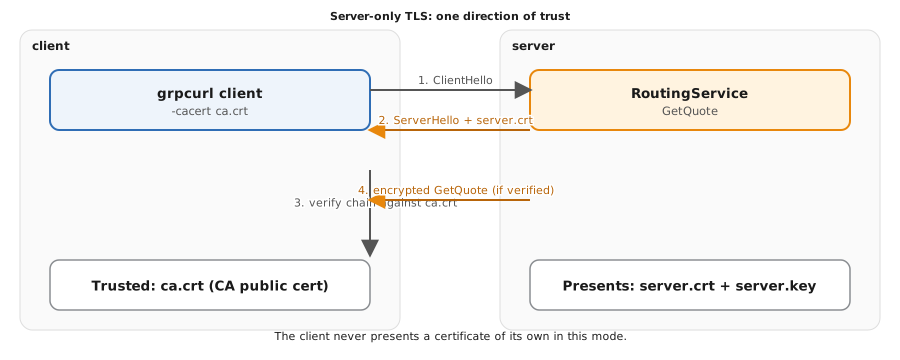
What a channel’s transport credentials actually are
Every prior chapter’s client built what grpc-core and grpc-java both call plaintext, or insecure, channel credentials: a value that tells the channel “do not negotiate TLS at all, send HTTP/2 frames in the clear.” TLS channel credentials replace that value with one carrying a trust store — the set of certificate authorities the client is willing to accept a server certificate from — and, for mutual TLS, a client identity of its own. Server-side, the equivalent concept is transport credentials: a certificate and private key the server presents during the handshake, optionally paired with its own trust store for verifying whatever certificate a client presents back. Both stacks in this book expose the same four moving parts under different names. Quarkus, running the gRPC Java server (quarkus.grpc.server.use-separate-server stays at its default true, unchanged from every prior chapter), configures all four directly in application.properties:
quarkus.grpc.server.plain-text=false
quarkus.grpc.server.ssl.certificate=/certs/server.crt
quarkus.grpc.server.ssl.key=/certs/server.key
quarkus.grpc.server.ssl.trust-store=/certs/ca-truststore.jks
quarkus.grpc.server.ssl.trust-store-password=changeit
quarkus.grpc.server.ssl.client-auth=REQUIRED
Python’s grpc.aio server builds the same four values as one call, with the certificate and key passed as a list of (key, cert) pairs — the shape grpc-core uses so a server can present more than one identity, even though this example presents exactly one:
server_credentials = grpc.ssl_server_credentials(
    [(server_key_bytes, server_cert_bytes)],
    root_certificates=ca_cert_bytes,
    require_client_auth=True,
)
server.add_secure_port(bind_addr, server_credentials)
add_secure_port replaces add_insecure_port — the one-line swap every prior chapter’s Python main.py would need to stop serving plaintext. Nothing about RoutingServiceServicer.GetQuote changes; the credentials object is built once at startup and handed to the server before it starts, the same way a channel is built once and reused across calls in Chapter 18. The two stacks disagree on vocabulary — Quarkus calls the client-verification knob client-auth with three string values; grpc-core calls it require_client_auth with one boolean — but they agree completely on what a handshake does: the server always presents server.crt/server.key; the client always validates that certificate against a CA it trusts; and whether the server also validates the client’s own certificate is a single, independently togglable setting on each side.
TLS alone: encrypting the channel, authenticating one direction
Plain TLS — what Figure 19.1 shows — authenticates exactly one party: the server proves its identity to the client, and the client proves nothing back. A grpcurl call presenting only a CA certificate, with no client certificate, completes a full handshake and gets a normal response, because quarkus.grpc.server.ssl.client-auth defaults to NONE and require_client_auth=False on the Python side means the server never asks for one:
grpcurl -cacert ca.crt -servername quarkus \
  -d '{"origin":{"unLocode":"USNYC"},"destination":{"unLocode":"NLRTM"}}' \
  localhost:9190 shipping.routing.v1.RoutingService/GetQuote
-servername sets TLS’s Server Name Indication value — the name grpcurl checks the server’s certificate’s Subject Alternative Names against, independent of the socket address it actually dialed. This example’s server certificate carries four SAN entries — DNS:quarkus, DNS:python, DNS:localhost, IP:127.0.0.1 — covering both in-container service names plus the loopback address a host-side grpcurl call actually uses, which is why the same certificate works unmodified whether a caller is quarkus talking to python inside the compose network or a human on the host hitting localhost:9190.
What a plaintext call gets, against this same server, is not a clean application error — it never gets far enough to produce one:
grpcurl -plaintext -d '{...}' localhost:9190 shipping.routing.v1.RoutingService/GetQuote
# Failed to dial target host "localhost:9190": context deadline exceeded
A TLS-only listener does not recognize an incoming plaintext HTTP/2 preface as anything meaningful; depending on exactly where the mismatch is caught, grpcurl reports a stalled dial (context deadline exceeded), a dropped connection (EOF), or an explicit TLS alert (remote error: tls: certificate required, seen later in this chapter’s mTLS phase) — three different error shapes for the same underlying fact: the call never reached gRPC’s status-code machinery at all. That absence of a Code: line is itself the signal. A real application error — NOT_FOUND, INVALID_ARGUMENT, the rich-error payloads Chapter 11 built — only exists once a handshake has already succeeded; a transport failure happens earlier, and grpcurl’s own “Failed to dial” prefix marks exactly that distinction.
Watch out
Quarkus's gRPC Java server accepts a plain PEM file directly for certificate/key, but its trust-store property always loads through Vert.x's KeyStoreHelper, which expects an actual Java keystore. Handing it a PEM CA throws Invalid keystore format at startup, which fails fast and points straight at the cause. A PKCS12 trust-store built with openssl pkcs12 -export -nokeys -in ca.crt -out ca.p12 is the harder failure mode: it loads without error, but Java's PKIX validator reports zero usable trust anchors (InvalidAlgorithmParameterException: the trustAnchors parameter must be non-empty) the moment a client actually presents a certificate to verify — a one-way TLS handshake never exercises that code path, so the mistake only surfaces once mTLS is turned on. keytool -importcert builds a trust-store Java recognizes correctly; see "Cert bootstrap" below.
mTLS: the server asks back
Mutual TLS adds the direction plain TLS leaves out: the server requests a certificate from the client during the handshake and verifies it against its own trust store before completing the connection. Quarkus’s client-auth property takes three values — NONE (never asked), REQUEST (asked for, accepted either way), REQUIRED (handshake fails without one) — mirroring the Vert.x ClientAuth enum underneath it; grpc-core’s require_client_auth collapses the same idea to a boolean, since Python’s API has no middle “ask but don’t enforce” option. This example only ever uses the two ends of that range. GRPC_CLIENT_AUTH, an environment variable both application.properties and main.py read, switches a running stack between them without a rebuild:
quarkus.grpc.server.ssl.client-auth=${GRPC_CLIENT_AUTH:REQUIRED}
CLIENT_AUTH = os.environ.get("GRPC_CLIENT_AUTH", "REQUIRED")
require_client_auth=(CLIENT_AUTH == "REQUIRED")
REQUIRED is this example’s steady state — a plain docker compose up serves mTLS from the first request. verify.sh demonstrates the progression by recreating both servers with GRPC_CLIENT_AUTH=NONE first, running the one-way-TLS assertions against that, then recreating them again with GRPC_CLIENT_AUTH=REQUIRED for the mTLS assertions — the same certificate material throughout, only the server’s willingness to ask changes.
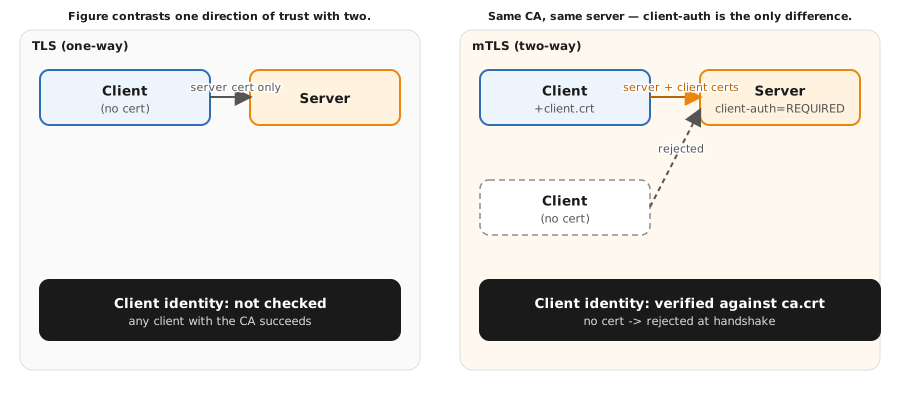
With client-auth=REQUIRED, the exact grpcurl invocation that succeeded in the TLS-only phase — CA certificate only, no client identity — now fails the same way a plaintext call always has:
grpcurl -cacert ca.crt -servername quarkus -d '{...}' \
  localhost:9190 shipping.routing.v1.RoutingService/GetQuote
# Failed to dial target host "localhost:9190": remote error: tls: certificate required
Presenting a client certificate the server’s trust store recognizes restores the call to a normal response:
grpcurl -cacert ca.crt -cert client.crt -key client.key -servername quarkus \
  -d '{...}' localhost:9190 shipping.routing.v1.RoutingService/GetQuote
That contrast — identical flags, identical server, opposite outcomes, purely because one configuration value changed between the two calls — is this chapter’s central point. TLS proves the server’s identity to the client. Mutual TLS proves both directions, and it does so at the transport layer, before a single byte of the GetQuoteRequest message is deserialized — a rejection here never reaches RoutingServiceImpl.getQuote or RoutingServiceServicer.GetQuote at all, the same way Chapter 12’s interceptors run ahead of a handler but one layer further down the stack, in the handshake itself rather than in gRPC’s own request pipeline.
Cert bootstrap: certgen, the shared volume, and the SAN list
Every certificate this example uses is minted fresh, every run, by a one-shot certgen compose service — never a server, never left running, and never baked into an image layer. compose.yaml wires it as an init dependency: both quarkus and python declare depends_on: certgen: condition: service_completed_successfully, so a plain docker compose up runs certificate generation to completion automatically before either server container starts, the same one-shot pattern Chapter 18’s ghz load generator uses for a different purpose. certgen’s image is a pinned registry.access.redhat.com/ubi10/ubi-minimal base with openssl and a headless JDK (java-21-openjdk-headless, for keytool alone) installed at build time — a cached layer — while the actual key material is generated by gen-certs.sh at container-run time, so every verify.sh invocation produces a brand-new certificate authority rather than reusing one committed to the repository.
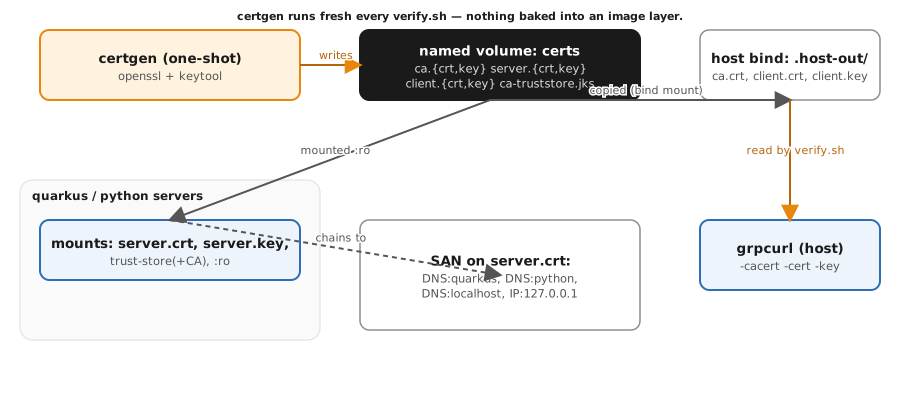
gen-certs.sh builds three identities from one locally-generated CA, each with a ten-year validity window and a notBefore backdated about a day to absorb clock skew between the certgen container, the two servers, and whatever host eventually runs verify.sh:
openssl req -x509 -new -key ca.key -sha256 \
  -subj "/O=PatternCatalyst/CN=ch19-tls-mtls example CA" \
  -not_before "$NOT_BEFORE" -not_after "$NOT_AFTER" -out ca.crt

openssl req -new -key server.key -subj "/O=PatternCatalyst/CN=ch19-tls-mtls server" -out server.csr
openssl x509 -req -in server.csr -CA ca.crt -CAkey ca.key -CAcreateserial \
  -not_before "$NOT_BEFORE" -not_after "$NOT_AFTER" \
  -extfile server-ext.cnf -out server.crt   # server-ext.cnf sets subjectAltName
One server certificate, carrying all four SAN entries, is shared by both the Quarkus and Python services — simpler than minting a certificate per stack, and it exercises the exact property SAN checking exists for: a single certificate can legitimately answer to more than one name. The client identity follows the same CA-signing pattern with extendedKeyUsage = clientAuth in place of serverAuth, producing client.crt/client.key for grpcurl to present during the mTLS phase.
Everything certgen writes lands in a named Docker volume called certs, mounted read-only into both servers — the single source both stacks’ TLS configuration points at. Because verify.sh’s grpcurl calls run as a plain host process (the same self-contained binary every prior chapter’s verify.sh downloads, not a container on the compose network), certgen also copies the public material — ca.crt, client.crt, client.key, deliberately never server.key or ca.key — into a second, bind-mounted host directory a host-side grpcurl can read directly. The private server key and the CA’s own signing key never leave the named volume; only identities a client is meant to present cross that boundary.
The one piece of material that is not a plain certificate is ca-truststore.jks: a Java keystore keytool -importcert builds from ca.crt, which exists purely because of the gotcha the callout above describes. The gRPC Java server’s trust-store loader wants a real keystore, not PEM and not a certificate-only PKCS12 — keytool, not openssl pkcs12, is what produces one Java’s own PKIX validator actually recognizes as carrying a trust anchor. grpc-core has no equivalent requirement; root_certificates=ca_cert_bytes on the Python side reads ca.crt directly, the same file the host-side grpcurl process uses with -cacert.
Build, run, observe
cd examples/19-tls-mtls && ./verify.sh
verify.sh brings the stack up with GRPC_CLIENT_AUTH=NONE, waits for certgen’s output to land, then runs the TLS-only assertions against both stacks’ host ports (localhost:9190 Quarkus, localhost:9191 Python): a CA-only grpcurl call returns the correct quote.currency/quote.amount/route.id/route.legs[0].carrier, and the identical request over -plaintext fails at the transport layer. It then recreates both servers with GRPC_CLIENT_AUTH=REQUIRED and repeats the correctness check with a client certificate added, followed by the same CA-only call — now rejected — to prove the server’s new requirement is actually enforced. Expect PASS once all eight assertions (four per stack) hold; the full set of real error strings from an authoring-machine run is in examples/19-tls-mtls/README.md.
Progression toward a real cluster
Everything in this chapter’s example is Compose-local by design: a one-shot container writes certificates into a volume two sibling containers mount. A production Kubernetes deployment replaces every piece of that mechanism without touching RoutingServiceImpl/RoutingServiceServicer at all, because the application code only ever reads file paths — /certs/server.crt, /certs/server.key, /certs/ca-truststore.jks — and never cares how those files got there. On minikube or any other cluster, the natural replacement for certgen is cert-manager, which issues and automatically rotates certificates into Kubernetes Secret objects mounted as volumes at the same paths this chapter’s application.properties and main.py already reference; a Certificate resource requesting the same SAN list (now a cluster-internal DNS name like routing-quarkus.default.svc.cluster.local rather than a bare compose service name) replaces gen-certs.sh’s openssl invocation, and cert-manager’s renewal controller replaces the ten-year validity window this example uses to avoid rotation entirely. The trust-store conversion gotcha this chapter spent real effort working around is unaffected by that move — a Kubernetes-issued PEM certificate still needs the same keytool -importcert step before Quarkus’s gRPC Java server will accept it as a trust-store, unless that deployment switches to the Vert.x-based server and the centralized quarkus.tls.* registry instead, which accepts PEM trust material directly. This book does not stand up that migration — Appendix A’s OpenShift Local path and the later load-balancing chapter cover running services on a real cluster — but every certificate and configuration key in this chapter is the same one a cluster deployment would use; only who writes the files and how often they rotate changes.
Cross-check
Independent of grpcurl, OpenSSL’s own client confirms the same chain and SAN list a different way:
openssl s_client -connect localhost:9190 -servername quarkus \
  -CAfile examples/19-tls-mtls/.host-out/ca.crt </dev/null 2>&1 | grep -E "Verify return code|subjectAltName"
# Verify return code: 0 (ok)
A Verify return code: 0 (ok) from a completely different TLS client, using the same CA file grpcurl was handed, is a reasonable sanity check that the certificate chain itself is sound — independent of any gRPC-specific behavior grpcurl might add on top.
Decision
Terminate TLS at the service itself, not in front of it, whenever a call might cross a network boundary a different team or a different trust domain controls — a sidecar or ingress can add defense in depth, but the service's own certificate is what makes "this call came over an encrypted, verified connection" a property the application code can rely on rather than assume. Require mutual TLS (client-auth=REQUIRED / require_client_auth=True) for any internal service that should only ever be called by other known services in the same system — it is the cheapest form of service identity available, cheaper than a bearer token because there is no credential to steal from a log line, only a private key that never leaves the calling service's own filesystem. Reserve one-way TLS (client-auth=NONE) for a public-facing endpoint whose callers cannot reasonably hold a client certificate at all. Rotate certificates on a schedule measured in weeks or months, never this chapter's ten-year demo window — in production, let a tool built for the job (cert-manager on Kubernetes, a service mesh's own identity system) own issuance and renewal rather than a hand-rolled script, so an expiring certificate is a non-event instead of an outage.
What you learned
- TLS channel and transport credentials replace plaintext/insecure credentials with a trust store (the client) and a certificate-and-key pair (the server); mutual TLS adds a trust store on the server side too, so both parties verify who they are talking to before a single RPC runs.
- A transport-layer rejection — a failed dial, a dropped connection, an explicit TLS alert — never produces a gRPC status code, because the handshake never got far enough for one to exist; that absence is what distinguishes it from a clean application-level error.
- The same
grpcurlflags that succeed against a one-way-TLS server fail against the identical server onceclient-auth=REQUIREDis turned on — the contrast this chapter’sverify.shproves explicitly, on both stacks, is mutual TLS’s entire value proposition in one pair of commands. - A Java keystore and a PEM certificate are not interchangeable even when they encode the identical trust material: the gRPC Java server’s trust-store loader silently produces zero usable trust anchors from an openssl-built PKCS12 file, a failure mode that only surfaces once mTLS, not plain TLS, is exercised.
Chapter 20 keeps this chapter’s encrypted, mutually-trusted channel and adds a third question on top of it: now that the server knows which service is calling, what is that caller allowed to do?
On the wire
TLS only, client-auth=NONE — a CA-only call succeeds:
grpcurl -cacert ca.crt -servername quarkus \
  -d '{"origin":{"unLocode":"USNYC","name":"New York"},"destination":{"unLocode":"NLRTM","name":"Rotterdam"},"cargo":[{"weightKg":1200.5,"description":"Palletized electronics","cargoType":"GENERAL"}]}' \
  localhost:9190 shipping.routing.v1.RoutingService/GetQuote
{
  "quote": { "currency": "USD", "amount": "3001.25" },
  "route": { "id": "rte_USNYC-NLRTM", "legs": [{"carrier": "MAERSK", "...": "..."}], "price": {"currency": "USD", "amount": "3001.25"} }
}
The same request over -plaintext, against that same TLS-only server, refused at the transport layer:
grpcurl -plaintext -d '{...}' localhost:9190 shipping.routing.v1.RoutingService/GetQuote
# Failed to dial target host "localhost:9190": context deadline exceeded
mTLS, client-auth=REQUIRED — the identical CA-only call that succeeded above now fails:
grpcurl -cacert ca.crt -servername quarkus -d '{...}' \
  localhost:9190 shipping.routing.v1.RoutingService/GetQuote
# Failed to dial target host "localhost:9190": remote error: tls: certificate required
Presenting a client certificate restores the call:
grpcurl -cacert ca.crt -cert client.crt -key client.key -servername quarkus \
  -d '{...}' localhost:9190 shipping.routing.v1.RoutingService/GetQuote
# { "quote": { "currency": "USD", "amount": "3001.25" }, ... }
The Python stack (localhost:9191, -servername python) produces byte-for-byte the same four outcomes against the identical four invocations — grpc-core’s dial failure for the no-client-cert mTLS case renders as Failed to dial target host "localhost:9191": EOF rather than Quarkus’s explicit tls: certificate required alert, a difference in exactly where each server’s TLS stack chooses to report the same refusal, not a difference in behavior.
Verification status: unverified.
verify.sh ran green against both stacks on the authoring machine across
repeated runs, including both the TLS-only phase (CA-only success, plaintext
refused) and the mTLS phase (client-cert success, CA-only rejected) on each
of Quarkus and Python. The highest-risk things a reader’s own run should
confirm: that registry.access.redhat.com/ubi10/ubi-minimal continues to
ship a java-21-openjdk-headless package reachable via microdnf (re-check
with skopeo list-tags before bumping the pin, same discipline as this
book’s other base-image pins), that the exact quarkus.grpc.server.ssl.*
keys and the PKCS12-trust-store gotcha this chapter documents continue to
hold on a future quarkus-grpc point release, and that a Docker Engine
other than the Linux-native one this book was authored against still
produces host-readable files under the certs named volume’s bind-mounted
export directory.