AuthN and AuthZ
Who is asking and what they may see: Keycloak-issued JWTs validated on both stacks, identity in the context and nothing else, operation rules with annotations and permission classes, ownership enforced at one choke point so every path obeys it, a field rule that fails with a code, and 401 for tokens that do not validate.
Chapter 2 pointed at one query that touches cargo owned by one customer and reference data owned by nobody, and said authorization has to work per field, not per route. Chapter 7 left a place in the context for the caller’s identity. This chapter fills both in. The tracking view stops answering everyone the same way: it learns who is asking, and the same document returns different data to different people.
The code is in examples/18-authn-authz/. It starts from the Chapter 13 example and serves the same schema, so the SDL does not change. What changes is around it. Keycloak issues the tokens, each stack validates them, and three rules apply to what a valid caller may see: one per operation, one per object and one per field. verify.sh asserts each rule on both stacks, as three users and as an anonymous caller.
Who is asking, and what may they see
Authentication answers who the caller is. Authorization answers what that caller may do. The two fail differently, and the API keeps the difference: a caller nobody can identify is told to authenticate, and a caller who is known but not allowed is told no.
The example has three people. ana ships for ACME and owns VWX901, DEF456 and ABC123. bo ships for GLOBEX and owns XYZ789, STU678 and GHI345. ops is port staff with the operator role and sees everything. The owner of each booking is private data of the booking service, like bookedAt in Chapter 12. It is not a field of any type, so no query can ask for it, and no viewer field or Cargo.shipper appears in the schema. Chapter 5 said rules of this kind live outside the SDL, and this chapter is where they land.
One query shows why a per-route rule is not enough:
{ location(unLocode: "NLRTM") { name }
  cargo(trackingId: "ABC123") { trackingId handlingHistory(first: 2) { edges { node { id registrationTime } } } } }
The location is public reference data and anyone may read it. The cargo belongs to ACME. Within the cargo, the events belong to ACME too, but the time they were registered is for staff. A rule attached to the URL cannot express any of that, so the rules attach to operations, objects and fields.
Tokens from an identity provider
The server does not keep passwords. A separate identity provider authenticates people and hands them a token, and the server only validates it. The example uses Keycloak 26.8.1, an open source provider, started with start-dev --import-realm from a committed realm file, keycloak/shipping-realm.json. The realm shipping has the three users, two realm roles (shipper and operator) and the clients that matter here.
tracking-cli is a public client. Its audience mapper adds tracking-api to the token’s aud claim, and a second mapper copies the user’s shipper attribute into a shipper claim. other-cli is the same client without the audience mapper, so its tokens are valid but meant for something else. A third client, short-cli, issues four-second tokens, so that the example can watch one expire.
Figure 18.1 follows ana’s token. The access token is a JWT (RFC 7519): three base64url parts, a header, a payload of claims and a signature. The claims the server relies on are iss (who issued it), aud (who it is for), exp (when it ends), sub (the user), realm_access.roles and the shipper claim. Keycloak signs the token with a private key and publishes the matching public keys as a JWKS, a JSON document of keys, at a well-known URL.
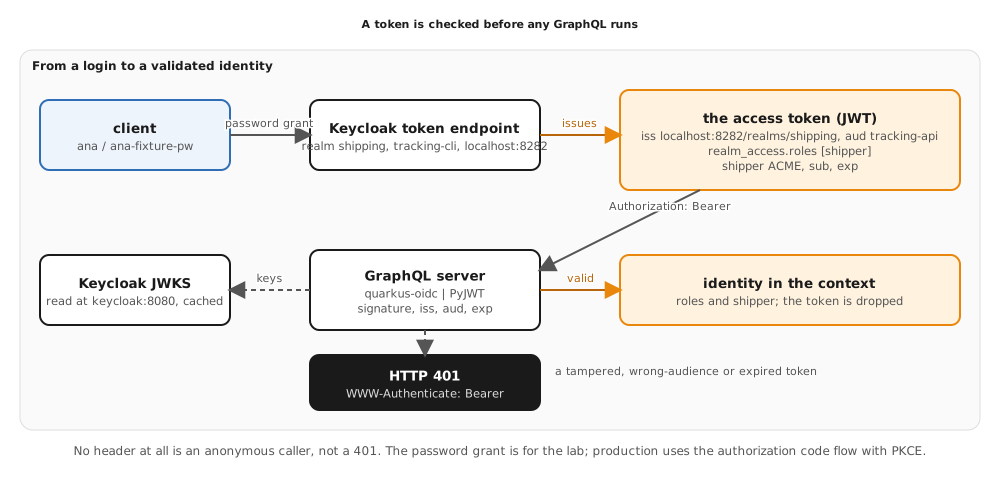
The lab gets its tokens with the password grant: one POST with the username and password. That is a shortcut for scripts, and the README and the realm say so. RFC 9700, the OAuth 2.0 Security Best Current Practice, says the grant MUST NOT be used. A production client sends the user to the provider with the authorization code flow and PKCE, and the application never sees a password. The realm also sets sslRequired to none, which is acceptable on localhost and nowhere else; Chapter 17 covers transport security. Every password in the repository ends in -fixture-pw for that reason.
One address matters. A token’s iss is the address the client used to reach Keycloak, which is http://localhost:8282/realms/shipping in the lab. The apps run inside the compose network and read keys from keycloak:8080, a different address, so each stack pins the issuer explicitly and fetches keys by the back channel, with discovery switched off. A token fetched at any other address is rejected.
Validating a token
Validation checks four things, and a server that skips one is open (RFC 8725, “JSON Web Token Best Current Practices”). The signature must verify against a key from the issuer’s JWKS. The iss must be the issuer the server expects. The aud must contain the audience this API answers to. And exp must be in the future. Without the audience check, a token issued for any other service in the realm opens this one. Without the signature check, anyone can write a token.
Neither stack parses a token by hand. On Quarkus the quarkus-oidc extension does all four from configuration:
quarkus.oidc.application-type=service
quarkus.oidc.auth-server-url=http://keycloak:8080/realms/shipping
quarkus.oidc.discovery-enabled=false
quarkus.oidc.jwks-path=protocol/openid-connect/certs
quarkus.oidc.token.issuer=http://localhost:8282/realms/shipping
quarkus.oidc.token.audience=tracking-api
quarkus.oidc.roles.role-claim-path=realm_access/roles
Python does it with PyJWT. PyJWKClient fetches and caches the key set and picks the key a token names, and jwt.decode verifies the rest. The require option makes a token without exp, iss, aud or sub invalid, instead of valid by omission:
try:
    # PyJWKClient does blocking I/O on a cache miss: keep it off the event loop.
    key = await run_in_threadpool(self._jwks.get_signing_key_from_jwt, token)
    claims = jwt.decode(
        token,
        key,
        algorithms=["RS256"],
        audience=self._audience,
        issuer=self._issuer,
        options={"require": ["exp", "iss", "aud", "sub"]},
    )
What a failure looks like is a decision of its own. A token that does not validate is not a GraphQL error: the request is refused at the HTTP layer with 401 and a WWW-Authenticate: Bearer header, as RFC 6750 describes, and no GraphQL runs. That holds even for a public field, because a client that presents a bad token has a problem it needs to know about. A request with no Authorization header at all is different: it is anonymous, not a failure, and public data still works. verify.sh sends a tampered signature, a payload rewritten to claim the operator role with the old signature, a token for the wrong audience, a malformed token and an expired one. All five are 401 on both stacks.
The tamper tests change a character in the middle of the signature, so the signature bytes change, and the payload test rewrites the role and keeps the original signature.
Identity in the context, nothing else
Chapter 7 named the context as the place for the caller’s identity. The rule for what goes in is short: the identity, not the token. A resolver needs to know who is asking and what roles they hold. It has no use for the signed string, and a token in the context ends up in a log or a trace sooner or later.
On Quarkus the identity is the SecurityIdentity, which quarkus-oidc fills from the validated token. A small bean turns it into the Viewer the booking source needs:
public Viewer current() {
    if (identity.isAnonymous()) {
        return Viewer.ANONYMOUS;
    }
    String shipper = identity.getPrincipal() instanceof JsonWebToken token ? token.getClaim("shipper") : null;
    return new Viewer(identity.hasRole("operator"), shipper);
}
Every resolver calls viewers.current() on entry, like the request id of Chapter 6, and passes the result on. That matters on a stack where continuations resume on another thread after a source’s delay. The batch resolvers for CargoEdge.node and HandlingEvent.cargo run that way, and verify.sh sends six ana requests and six bo requests together and checks that each caller gets only its own cargos.
On Python the identity is built once, in the dependency that builds the context, and TrackingContext.identity is the only authentication state. It is an Identity with the subject, a frozen set of roles and the shipper, or None for an anonymous caller. A bad token raises there, so the 401 happens before the GraphQL router sees the request.
Operation-level rules
The coarsest rule is whether an operation may be called at all. In the tracking view cargo and cargos need a signed-in caller, and registerHandlingEvent needs the operator role. location, voyage, node and nodes stay open: they return public reference data, or null for what the caller may not see.
@Query
@Authenticated
@Description("Look up one cargo by its tracking id. Null when no such cargo exists.")
public Uni<Cargo> cargo(
        @Name("trackingId") @NonNull @Description("The tracking id issued at booking.") TrackingId trackingId,
        Context context) {
    return booking.getCargo(context.getExecutionId(), trackingId.value(), viewers.current());
}
class IsAuthenticated(BasePermission):
    def has_permission(self, source: Any, info: Info[TrackingContext], **kwargs: Any) -> bool:
        return info.context.identity is not None

    def on_unauthorized(self) -> None:
        raise Unauthenticated("authentication required")
The Quarkus annotation is a standard security annotation. Quarkus runs the check in an interceptor before the method body, so a refused call reaches no source, and SmallRye reports the failure as an execution error at the operation’s path. @RolesAllowed("operator") on the mutation works the same way. On Strawberry a field lists permission classes, and permission_classes=[IsAuthenticated, IsOperator] evaluates them in order.
Both stacks answer an anonymous cargo(...) the same way: data.cargo is null and one error at ["cargo"] carries the code UNAUTHENTICATED and the message authentication required. cargos is non-null, so the null climbs to data, which is the Chapter 4 rule at work. A signed-in shipper who writes gets FORBIDDEN with operator role required, and because the mutation’s payload is non-null, data is null too (Chapter 8). The source-call log is empty in every refused case, which verify.sh asserts: the check runs before any work.
Figure 18.2 puts the three layers side by side and shows what a refusal looks like at each.
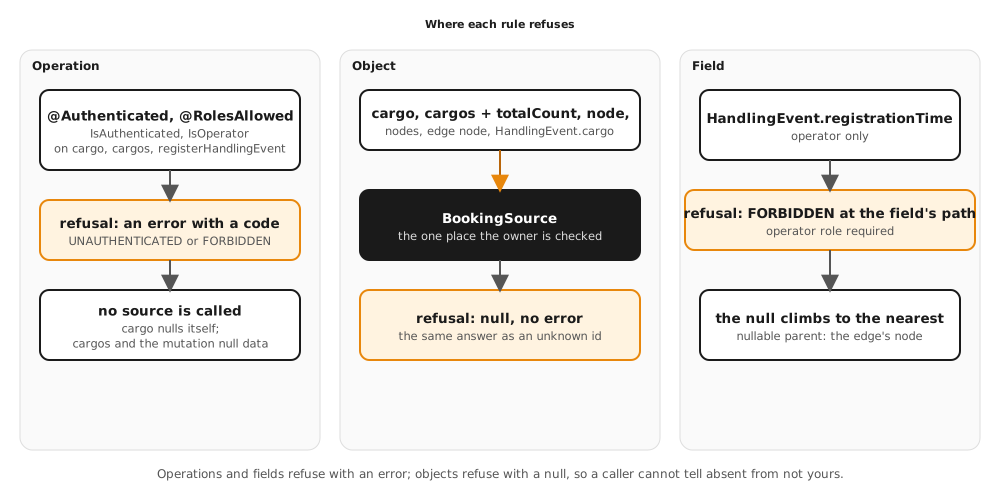
On Quarkus, UnauthorizedException and ForbiddenException are what the security interceptor throws. SecurityErrorTranslator, a small interceptor that runs outside Quarkus’s own, swaps them for AuthenticationRequiredException and OperatorRoleRequiredException. They are @ErrorCode exceptions in the same allowlist as the outage of Chapter 9, so they pass the mask with their messages. SecurityErrorTranslator gives both refusals the contract’s messages; the check itself is still the framework’s. On Python the permission classes raise ExposedError subclasses for the same reason: Strawberry’s default permission error would be masked as Internal server error., because Chapter 9’s predicate trusts only exposed errors.
Object-level rules: a shipper sees its own cargos
Operation rules are not enough. cargos is open to every signed-in caller, so something must keep ana from reading bo’s cargos, and the something must hold on every path to a cargo. There are many: cargo, cargos, node, nodes, the node of each edge, and HandlingEvent.cargo. A check written in each resolver is a check somebody forgets in the next one.
The example has one place for the rule, the booking source. Every path to a cargo reads it, so every path obeys it. On Quarkus the source takes the Viewer:
private Cargo load(String trackingId, Viewer viewer) {
    // The rule runs before the load: a cargo the viewer may not see is not
    // loaded, so its outage (GHI345) cannot reveal that it exists.
    if (!viewer.canSee(data.owner(trackingId))) {
        return null;
    }
and on Python the source is bound to the caller’s identity when the context is built:
def _load(self, tracking_id: str) -> Cargo | None:
    # The rule runs before the load: a cargo the caller may not see is not
    # loaded, so its outage (GHI345) cannot leak its existence.
    if not visible(self.identity, data.OWNERS.get(tracking_id)):
        return None
The listing needs the same rule, applied earlier. listCargos filters the booking index by owner before it pages, so the page, the cursors, hasNextPage and totalCount all describe the caller’s view. ana’s totalCount is 3, not 6. Filters compose with the rule: cargos(routingStatus: NOT_ROUTED) is empty for her, because both unrouted cargos are GLOBEX’s. A rule applied after paging would leak through the count, and one applied only to the nodes would show a page of nulls.
A cargo the caller may not see is null with no error, the same answer the server gives for an id that does not exist. cargo(XYZ789) and cargo(ZZZ999) return identical bodies for ana. An error such as “not yours” would tell her that XYZ789 exists and belongs to someone else, and she could enumerate every tracking id that way. Response times match as well for an unowned, an unknown and an owned cargo, so timing reveals nothing; this was observed, not asserted. Figure 18.3 sets this beside the field rule.
node and nodes reach the same source. nodes(ids: ["cargo_ABC123", "cargo_XYZ789", "evt_1", "evt_3"]) as bo returns [null, Cargo XYZ789, null, null]: ABC123 and its events are ACME’s, so the positions are null and the order is kept. An event is as visible as its cargo, so node(id: "evt_1") asks the booking source about the event’s cargo and returns null for bo and the event for ana. Anonymous callers get null for every cargo and event, and the public locations and voyages still resolve.
Failures keep their own rules. bo owns GHI345, whose booking load fails, so bo’s page of three reports SERVICE_UNAVAILABLE, with the Chapter 13 difference: Strawberry nulls one edge, and SmallRye fails the whole batch and nulls all three. For ana the source never loads GHI345 at all, so her answer carries no trace of the outage.
Field-level rules: errors or nulls
The last rule is about one field. HandlingEvent.registrationTime is when the event entered the system, and only operators read it. A shipper may read the event, its type and its completion time, and not that one field. The rule is stated where the field is declared. On Quarkus the field is a method with an annotation, and the record component is ignored:
@RolesAllowed("operator")
@NonNull
@Description("When the event was registered in the system.")
public Instant registrationTime(@Source HandlingEvent event) {
    return event.registrationTime();
}
@strawberry.field(
    description="When the event was registered in the system.",
    permission_classes=[IsAuthenticated, IsOperator],
)
def registration_time(self) -> datetime:
    return self.registered_at
A refused field is an error with a code at the field’s own path, and the null lands where Chapter 4’s rules put it. registrationTime is DateTime!, so it cannot be null, and the null climbs one step to the nearest nullable parent, the edge’s node. When ana asks for the history of ABC123 with registrationTime, both stacks return two errors, at ["cargo","handlingHistory","edges",0,"node","registrationTime"] and the same path with 1. Both nodes are null and both cursors survive, so the page is intact and a client can still paginate it. Asked through node(id: "evt_1"), the nearest nullable parent is node itself, and data.node is null. Asked without the field, ana gets her events with no error: the rule is per field.
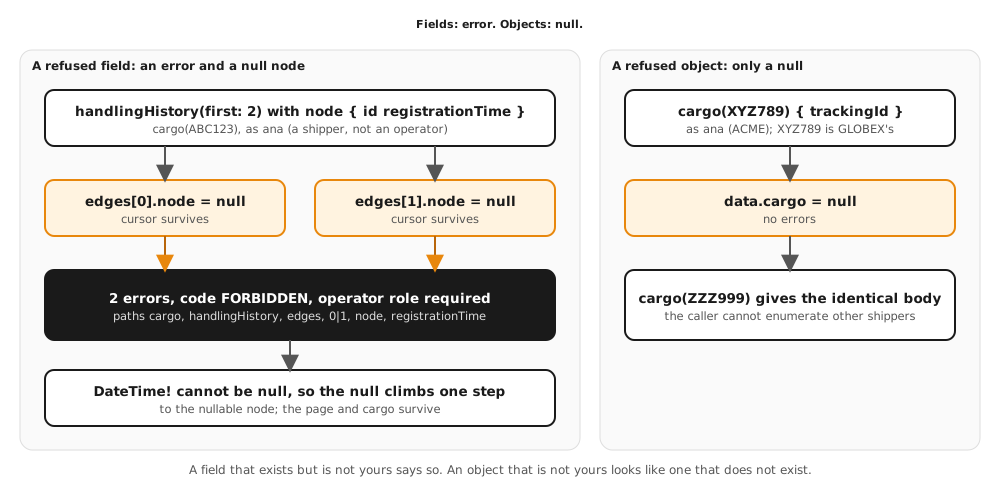
The two answers differ by design. An object that is not yours is better as a plain null, because an error would confirm it exists. A field is the opposite. The field is in the schema, and any client can see it there, so there is nothing to hide, and a null would be ambiguous. A client that gets null for registrationTime cannot tell “not allowed” from “no value”, and a UI built on it would show nothing where it should show a prompt to sign in as someone else. An error with FORBIDDEN at the path gives the client something to act on.
A field that is nullable could return null instead, and Strawberry even has a permission mode for that. The example does not use it. A null on a refused field turns an access decision into data that looks like a fact about the cargo.
Writes need a role
registerHandlingEvent is the operator’s. A shipper does not record that a container was loaded: the port does. The rule is the operation annotation or permission class of the earlier section, and the result is the same as for reads. ana gets FORBIDDEN at ["registerHandlingEvent"], an anonymous caller gets UNAUTHENTICATED, and neither writes anything: the source-call log has no handling.appendEvent. ops registers the unload of ABC123 as evt_10, and the payload’s registrationTime is readable because ops is an operator.
The check runs before the resolver and before the idempotency check of Chapter 8. A refused caller cannot even learn through the mutation whether a key was used.
Codes the client can act on
Chapter 9 set the vocabulary: SERVICE_UNAVAILABLE, BAD_USER_INPUT. This chapter adds two, with fixed messages that are identical on both stacks.
| Code | Raised for | Message |
|---|---|---|
UNAUTHENTICATED |
an anonymous caller reaching an operation that needs a signed-in one | authentication required |
FORBIDDEN |
a signed-in caller without the operator role | operator role required |
The two codes tell a client what to do next. UNAUTHENTICATED means send the user to log in, or refresh the token. FORBIDDEN means a login will not help. Both pass through the allowlist of exposed errors, and everything else is still masked. verify.sh also checks that no io.quarkus class name and no exception name reaches a client.
The HTTP 401 for a bad token is outside this vocabulary. It is not an error in a GraphQL response, because no GraphQL ran, and a client library should treat it as an authentication problem for the whole request, usually by fetching a fresh token and retrying once. The GraphQL-over-HTTP specification expects this: a request the client may not make gets 401 or 403 (its “Status Codes” section), and decisions about the data are made during execution.
Caching and identity
Chapter 16 is where responses start to be reused. A response that depends on the caller must not be reused for another one. The rule Chapter 16 applies is to bypass shared caches when an Authorization header is present, and to put the caller in the key of anything cached inside the server whose value depends on the caller. The ownership rule in this chapter sits above those caches: the booking source applies it before anything below it is read, so a cached event list is reached only through a cargo the caller was allowed to see. Reference data that no one owns, locations and voyages, is the only data where a shared cache is safe.
On the wire
Start the stack. Quarkus is on 8280, Python on 8281 and Keycloak on 8282. Tokens come from localhost:8282, the address the apps pin as the issuer.
docker compose -f examples/18-authn-authz/compose.yaml up -d --build
tok() {
  curl -s localhost:8282/realms/shipping/protocol/openid-connect/token \
    -d grant_type=password -d client_id=tracking-cli -d username=$1 -d password=$1-fixture-pw \
    | python3 -I -c 'import json,sys; print(json.load(sys.stdin)["access_token"])'
}
Q() {  # Q <port> <token or ""> <query>
  curl -s localhost:$1/graphql -H 'Content-Type: application/json' ${2:+-H "Authorization: Bearer $2"} \
    -d "$(python3 -I -c 'import json,sys; print(json.dumps({"query": sys.argv[1]}))' "$3")"; echo
}
ANA=$(tok ana); BO=$(tok bo); OPS=$(tok ops)
An anonymous caller reaches the public location, and is refused the cargo. Python:
Q 8281 "" '{ location(unLocode: "NLRTM") { name } }'
Q 8281 "" '{ cargo(trackingId: "ABC123") { trackingId } }'
{"data":{"location":{"name":"Rotterdam"}}}
{"data":{"cargo":null},"errors":[{"message":"authentication required","locations":[{"line":1,"column":3}],"path":["cargo"],"extensions":{"code":"UNAUTHENTICATED"}}]}
ana sees three cargos, and a count of three. bo asks for two and gets hers. Quarkus:
Q 8280 $ANA '{ cargos(first: 10) { totalCount edges { node { trackingId } } } }'
Q 8280 $BO '{ cargos(first: 2) { totalCount edges { node { trackingId } } } }'
{"data":{"cargos":{"totalCount":3,"edges":[{"node":{"trackingId":"VWX901"}},{"node":{"trackingId":"DEF456"}},{"node":{"trackingId":"ABC123"}}]}}}
{"data":{"cargos":{"totalCount":3,"edges":[{"node":{"trackingId":"XYZ789"}},{"node":{"trackingId":"STU678"}}]}}}
The field rule. ana asks for registrationTime and gets errors with paths and null nodes. Python:
Q 8281 $ANA '{ node(id: "evt_1") { id ... on HandlingEvent { registrationTime } } }'
{"data":{"node":null},"errors":[{"message":"operator role required","locations":[{"line":1,"column":46}],"path":["node","registrationTime"],"extensions":{"code":"FORBIDDEN"}}]}
A token that does not validate:
BAD="${ANA%.*}.AAAA"
curl -si localhost:8280/graphql -H "Authorization: Bearer $BAD" -H 'Content-Type: application/json' -d '{"query":"{ __typename }"}' | head -3
HTTP/1.1 401 Unauthorized
www-authenticate: Bearer
Python’s header is Bearer error="invalid_token" with the body {"detail":"invalid token"}. Column numbers and header details can differ by stack. The codes, paths, messages and counts do not, except where the table says so.
| Check | Quarkus | Python |
|---|---|---|
anonymous location(NLRTM) |
Rotterdam, no errors |
the same |
anonymous cargo(ABC123) |
null; error at ["cargo"], UNAUTHENTICATED, authentication required; 0 source calls |
the same |
anonymous cargos(first: 2) |
data null, UNAUTHENTICATED |
the same |
anonymous nodes(["loc_NLRTM","cargo_ABC123"]) |
[Location, null], no errors |
the same |
ana, cargos(first: 10) |
VWX901, DEF456, ABC123; totalCount 3 |
the same |
ana, cargos(routingStatus: NOT_ROUTED) |
totalCount 0 |
the same |
ana, cargo(XYZ789) and cargo(ZZZ999) |
null, no errors, identical bodies | the same |
ana, node(cargo_XYZ789) and node(evt_1) |
null; the event resolves | the same |
ana, node(evt_1) { ... on HandlingEvent { cargo { trackingId } } } |
ABC123, no errors |
the same |
bo, cargos(first: 2) |
XYZ789, STU678; totalCount 3 |
the same |
bo, cargos(first: 10) |
3 errors, all three nodes null | 1 error at edge 2; nodes XYZ789, STU678, null |
bo, cargo(ABC123), node(cargo_ABC123), node(evt_1) |
null, no errors | the same |
bo, nodes(cargo_ABC123, cargo_XYZ789, evt_1, evt_3) |
[null, XYZ789, null, null] |
the same |
ops, cargos(first: 10) { totalCount } |
6 | the same |
ana, registrationTime on ABC123’s history |
2 FORBIDDEN errors at the field paths; both nodes null; both cursors present |
the same |
ana, node(evt_1) with registrationTime |
data.node null; error at ["node","registrationTime"] |
the same |
ops, registrationTime |
2026-10-01T08:35:00Z, 2026-09-30T16:05:00Z |
the same |
| ana and anonymous writes | data null; FORBIDDEN / UNAUTHENTICATED; 0 calls |
the same |
| ops write | evt_10, IN_PORT, one appendEvent |
the same |
| tampered signature, tampered payload, wrong audience, malformed, expired | 401, WWW-Authenticate: Bearer, no GraphQL body |
401, Bearer error="invalid_token", {"detail":"invalid token"} |
| twelve concurrent requests, two callers | each caller gets only its own cargos | the same |
| schema | anonymous introspection conforms; finalArrivalDate deprecated; only Subscription unserved |
the same |
Stop the stack when done:
docker compose -f examples/18-authn-authz/compose.yaml down -v
bash examples/18-authn-authz/verify.sh runs the whole sequence on both stacks and prints PASS only when both hold.
Decision
Authorization is where the operational and security cost axis of Chapter 2 turns into code, and the aggregation across sources axis shapes where the rules sit: one query reads reference data nobody owns and cargo somebody does, so the rules attach to operations, objects and fields, not routes. The client diversity and shape variance axis decides how a refusal reads. An object that is not yours is a null, so a client cannot enumerate other shippers by asking, and a field that is not yours is an error with a code, so a client can tell it from an absent value. The contract and evolution style axis is untouched, because none of this changes the SDL. The tracking view therefore validates a signed token from an open source identity provider before any GraphQL runs, keeps the identity and not the token in the context, states each rule in one place, and returns UNAUTHENTICATED and FORBIDDEN as stable codes with HTTP 401 for tokens that do not validate.
Where this goes next
This chapter put a caller in front of every rule: tokens from Keycloak validated for signature, issuer, audience and expiry, an identity and no token in the context, annotations and permission classes for operations and fields, ownership at the booking source for every path to a cargo, and two codes a client can act on.
Chapter 19 makes the server observable per operation, and the identity is a candidate for what to record: a trace attribute for the subject is fine, and a token or an owner list is not. For the specifications, read RFC 6750 on bearer tokens, RFC 7519 on JWTs, RFC 8725 on JWT best practices, RFC 9700 on OAuth 2.0 security, and OpenID Connect Core for the difference between an ID token and an access token. Full Stack GraphQL Applications takes the other placement in its chapter “Adding authorization and authentication”, where the rules are written in the schema with an @auth directive; this chapter keeps them outside the SDL (Chapter 5). The provider side is in the Keycloak Server Administration and Server guides (importing realms, hostname, health). The Quarkus OIDC bearer token authentication guide and the security section of the SmallRye GraphQL guide cover the Java side, and Strawberry’s permissions guide and the PyJWT documentation for PyJWKClient cover Python. The OWASP GraphQL Cheat Sheet has an “Access Control” section.