Transport security and introspection control
Serving GraphQL over TLS from framework configuration with generated certificates, each stack's protocol floor, HSTS, public against internal instances, turning off introspection, field suggestions, the IDE and GET, closing the form and text/plain CSRF paths, CORS for one origin, size and token limits, and checking the contract without a public schema.
Chapter 13 ended with a server that answers a four-cargo page in six or eight source calls. Every request so far has crossed the wire in clear text, and any caller could ask the server for its whole schema. This chapter closes both. The tracking view moves behind TLS, and the instance the public reaches stops describing itself.
The code is in examples/17-transport-security/. It starts from the Chapter 13 example, so the schema, the seed and the masked errors are unchanged. Each stack’s image is deployed twice: a public instance with introspection, field suggestions, the IDE and GET queries off, and an internal instance that leaves introspection on. verify.sh generates a certificate authority, runs all four instances over HTTPS and asserts what each refuses and allows.
What the transport must guarantee
A GraphQL request carries the same secrets a REST request does, to one URL. Chapter 18 puts a bearer token in the Authorization header; a token sent over plain HTTP is a token any router on the path can copy. The transport has to give three things: the client knows it reached the server it meant to reach, nobody on the path can read the exchange, and nobody can change it. TLS 1.3 (RFC 8446) is the protocol that provides all three, and every other control here assumes it.
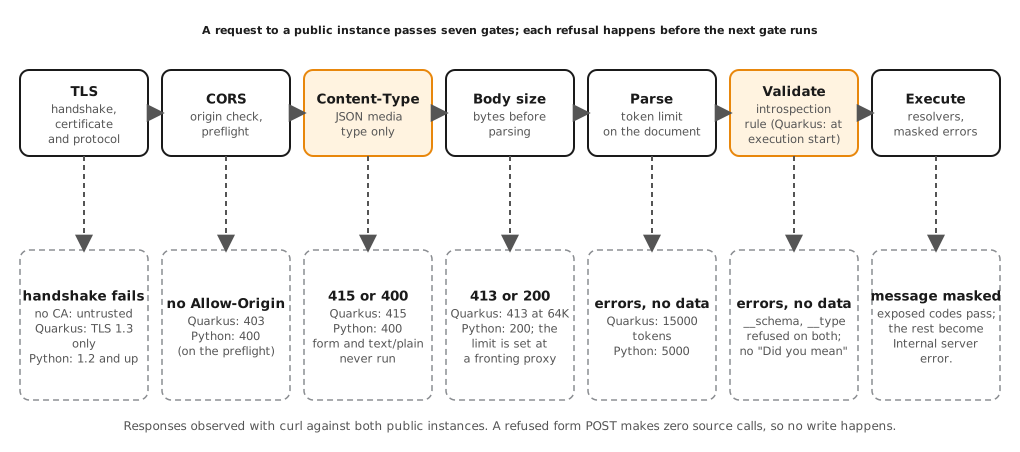
Two further problems are specific to GraphQL. The schema is queryable by default, so an attacker with no credentials can ask what exists. And a browser can be made to send a request to your endpoint from a page on another origin, so the server must not trust a request just because the browser attached its cookies. The sections below follow the order a request meets them. Figure 17.1 shows the gates.
TLS in the framework
Both stacks terminate TLS in the process. A reverse proxy or a service mesh can do it instead, and Chapters 25 to 27 return to that, but in-process configuration shows what each framework decides for you.
Quarkus reads a certificate and key through its TLS registry. The settings are in application.properties:
quarkus.tls.key-store.pem.tls.cert=/certs/tls.crt
quarkus.tls.key-store.pem.tls.key=/certs/tls.key
quarkus.http.ssl-port=8443
quarkus.http.insecure-requests=disabled
quarkus.http.header."Strict-Transport-Security".value=max-age=31536000
Uvicorn takes the same two files as command-line options in the Containerfile:
ENTRYPOINT ["opentelemetry-instrument", "uvicorn", "app.main:app", "--host", "0.0.0.0", "--port", "8443", \
    "--ssl-certfile", "/certs/tls.crt", "--ssl-keyfile", "/certs/tls.key"]
insecure-requests=disabled closes the plain-HTTP port, so a client that forgets the s gets a dropped connection instead of a readable response. Uvicorn speaks TLS on its one port, so a plain-HTTP request there is not understood either. verify.sh asserts that curl fails against http://localhost:8270 and http://localhost:8271 with exit 52.
The stacks differ in the oldest protocol they accept. The Quarkus TLS registry defaults to TLS 1.3 only (quarkus.tls.protocols), so a client limited to TLS 1.2 fails the handshake with a protocol version alert (curl exit 35). Uvicorn hands the files to Python’s ssl module, whose default minimum is TLS 1.2, so the same client succeeds. Both accept TLS 1.3. verify.sh runs curl --tlsv1.2 --tls-max 1.2 against both and asserts the difference. Each floor is the stack’s default. On Uvicorn the minimum version is set by building the SSLContext with uvicorn’s programmatic ssl_context_factory, or by terminating TLS at a proxy. A Quarkus deployment that must serve old clients can list TLS 1.2 in quarkus.tls.protocols. State the floor you intend, and test it.
HSTS (RFC 6797) tells a browser to use HTTPS for the host for the stated number of seconds, even if a link or a typed address says http://. Quarkus sets the header with quarkus.http.header. Python sets it in a small @app.middleware("http") function. Both answer strict-transport-security: max-age=31536000, and verify.sh reads it back.
Certificates for a lab
A TLS example needs a certificate, and a certificate needs a private key. A key committed to a repository is public, so nothing here is committed. gen-certs.sh runs openssl and writes a two-day certificate authority, and a server certificate signed by it, into a directory it is given. The server certificate carries the names localhost, quarkus, python, quarkus-internal, python-internal and 127.0.0.1. The directory certs/ is git-ignored, and verify.sh generates its own set into a scratch directory, exports CERT_DIR for compose to mount read-only at /certs, and deletes it on exit.
The client trusts only ca.crt. curl takes it with --cacert, and the harness takes it from LGTM_CACERT, which it also passes to graphql-inspector as NODE_EXTRA_CA_CERTS. Three cases in verify.sh show that verification is real. Without the CA, curl fails with exit 60. A request to wrong.example resolved to 127.0.0.1 also fails with exit 60, because no subject name matches. A request to the name quarkus or python, resolved the same way, succeeds, because that name is in the certificate. Production replaces the lab authority with a certificate from a public or an internal CA; the application configuration does not change.
Introspection is a map
Introspection (the GraphQL specification’s “Introspection” section) lets any client ask a schema for its types, fields and arguments. That is how GraphiQL completes your query and how a code generator reads the contract, and it is why the schema in this book is published. It is also a map for a person with no business knowing the territory: the Cargo type names handlingHistory, the mutation names registerHandlingEvent, and an anonymous caller can read all of it in one request. Chapter 6 introduced the meta fields and said this chapter decides when to turn them off.
The decision is by instance. Anonymous callers get no introspection; your own tools, in CI and on developer machines, need it. Figure 17.2 shows one image per stack deployed twice, and the settings that differ.
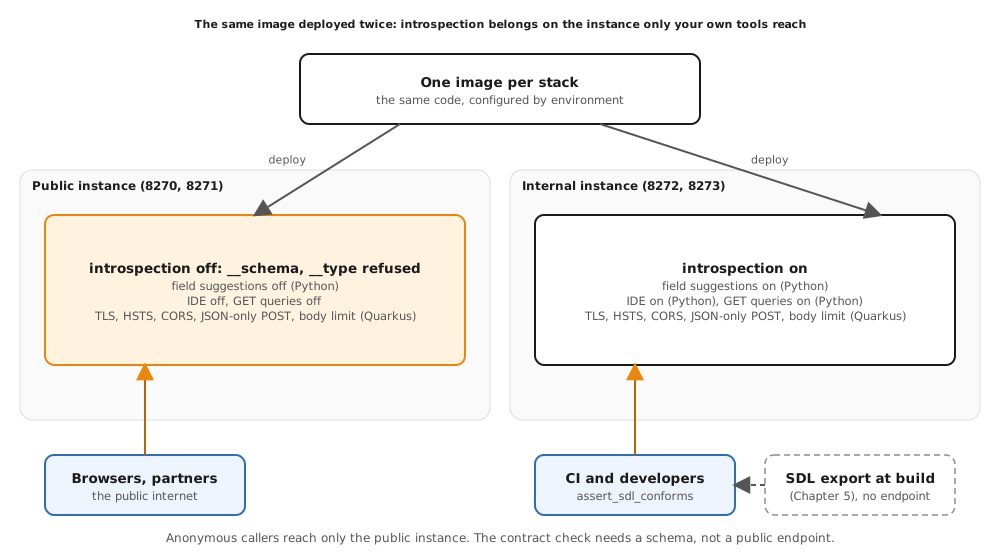
On Quarkus, introspection is turned off with graphql-java’s Introspection.enabledJvmWide(false), called at startup when tracking.introspection.enabled is false. Each instance runs in its own JVM, so the flag applies per instance: the public one sets TRACKING_INTROSPECTION_ENABLED=false and the internal one keeps the default. Both root fields, __schema and __type, are refused, with an errors array and no data. On Python the schema is built by a function that takes a flag.
Validation answers differently for known and unknown type names (... on NoSuchType answers Unknown type). Turning introspection off hides the schema map, and a document allowlist (Chapter 15) governs which names a client can send.
@ApplicationScoped
public class IntrospectionSwitch {

    @ConfigProperty(name = "tracking.introspection.enabled", defaultValue = "true")
    boolean enabled;

    void onStart(@Observes StartupEvent event) {
        if (!enabled) {
            Introspection.enabledJvmWide(false);
        }
    }
}
def schema_for(public: bool) -> strawberry.Schema:
    extensions: list = [
        partial(MaskErrors, should_mask_error=should_mask, error_message="Internal server error."),
        partial(MaxTokensLimiter, max_token_count=MAX_TOKENS),
    ]
    if public:
        extensions.append(DisableIntrospection)
    return strawberry.Schema(
        query=Query,
        mutation=Mutation,
        config=StrawberryConfig(scalar_map=SCALAR_MAP, disable_field_suggestions=public),
        extensions=extensions,
    )
The refusals read differently. Strawberry’s DisableIntrospection is a validation rule that reports each field it finds: GraphQL introspection has been disabled, but the requested query contained the field '__schema'. graphql-java answers Introspection has been disabled for this request with the classification IntrospectionDisabled. In both cases the response has errors and no data, __type(name: "Cargo") and __type(name: "NoSuchType") get identical responses, and { __typename } still answers Query, because __typename is a property of every selection set and not part of the schema map. verify.sh asserts the refusal of __schema and of both __type lookups, the identical answers, the working __typename, and the working introspection on both internal instances.
Introspection has a second door. SmallRye can serve the schema as a document at /graphql/schema.graphql. That property, quarkus.smallrye-graphql.schema-available, is fixed at build time, so one image cannot have it on for one instance and off for the other. The example sets it false for both, and the internal instance is read by introspection. A browser IDE is a third door, covered below.
Suggestions reveal names
Turning introspection off is not enough if an error message still teaches the schema. graphql-core adds a hint when a field does not exist: querying trackingI on Cargo answers Cannot query field 'trackingI' on type 'Cargo'. Did you mean 'trackingId'? An attacker can probe names with a dictionary and let the server finish each guess, which is how tools recover a schema from a server that disabled introspection.
The public Python instance sets disable_field_suggestions=True in StrawberryConfig, and the same request answers Cannot query field 'trackingI' on type 'Cargo'. with no hint. verify.sh asserts that the public response contains neither Did you mean nor the real name, and that the internal one contains Did you mean 'trackingId'?, so a regression in either direction fails. graphql-java never suggests anything: its message is Validation error (FieldUndefined@[cargo/trackingI]) : Field 'trackingI' in type 'Cargo' is undefined, and that holds on both Quarkus instances. There is nothing to switch off on that stack, and the check on it is that the text stays free of a hint.
The IDE follows the same rule. Strawberry serves GraphiQL for a browser GET on the GraphQL path, so the router is built with graphql_ide=None if settings.public else "graphiql" (shown below). On the public instance a GET with Accept: text/html answers 404 and no page. SmallRye refuses Accept: text/html with 406 before it looks at the method. The internal Python instance answers 200 with the GraphiQL page.
CSRF for an API that takes JSON
A browser lets a page on https://evil.example send a POST to your API without a preflight when it uses a CORS-safelisted method and only CORS-safelisted request headers (the Fetch standard’s “CORS protocol” section), where Content-Type is text/plain, application/x-www-form-urlencoded or multipart/form-data. The browser attaches the visitor’s cookies. A server that reads such a body as JSON would let the page run a mutation as the visitor. An API that takes application/json is safe from this only if it refuses everything else, because JSON is the content type that forces a preflight.
A GraphQL endpoint should accept only JSON request bodies. The GraphQL-over-HTTP draft recommends 415 for an unsupported Content-Type, and the OWASP CSRF cheat sheet recommends disallowing simple content types, because a browser sends text/plain, form-encoded and multipart POSTs cross-origin without a preflight. The Quarkus example enforces this with a Vert.x filter, ContentTypeGuard, that answers 415. On Python, Strawberry’s content-type check answers 400 Unsupported content type.
ContentTypeGuard uses Quarkus’s filter API, the Filters event of quarkus-vertx-http (what @RouteFilter is built on), which runs before every route. On Python the router’s content-type check does the same work, so the second tab shows the router.
@ApplicationScoped
public class ContentTypeGuard {

    private static final Set<String> JSON = Set.of("application/json", "application/graphql-response+json");

    void register(@Observes Filters filters) {
        filters.register(rc -> {
            if (rc.request().method() == HttpMethod.POST && rc.normalizedPath().startsWith("/graphql")
                    && !isJson(rc.request().getHeader(HttpHeaders.CONTENT_TYPE))) {
                rc.response().setStatusCode(415).putHeader(HttpHeaders.CONTENT_TYPE, "text/plain")
                        .end("Unsupported Media Type: send application/json");
                return;
            }
            rc.next();
        }, 100);
    }
}
app.include_router(
    GraphQLRouter(
        schema_for(settings.public),
        context_getter=get_context,
        graphql_ide=None if settings.public else "graphiql",
        allow_queries_via_get=not settings.public,
    ),
    prefix="/graphql",
)
A POST to /graphql with any other media type, or none, gets 415. A charset parameter is ignored, so application/json; charset=utf-8 passes. The guard uses the GraphQL-over-HTTP draft’s request and response media types (https://http-spec.graphql.org/draft/), where the response type application/graphql-response+json is also accepted; a client that sends it is not wrong. The draft’s “Status Codes” section recommends 415 for an unsupported Content-Type. The Quarkus guard sends 415; Strawberry sends 400, which still refuses before parsing.
verify.sh sends the same mutation body as text/plain, as a form, as multipart and with the header removed. Quarkus answers 415 and Python 400 each time, and the source-call log stays empty: nothing resolved and nothing was written. The first mutation that is accepted, as application/json at the end, is evt_10, which proves the refused requests wrote nothing.
GET gets the same treatment. A mutation must never travel in a URL, which can be linked, prefetched and logged, and the GraphQL-over-HTTP draft requires a server to refuse one over GET (Chapter 8). Both public instances turn GET queries off: Quarkus because http.get.enabled defaults to false and answers 405, Python through allow_queries_via_get=not settings.public, which answers 400. The internal Python instance allows GET queries and still refuses a mutation. Chapter 15 turns GET on for persisted queries, a read path with a different threat model.
CORS for the one origin that needs it
CORS is permission for a browser to let a page on one origin read a response from another. It is not authentication, and curl reaches a server that lacks it. It controls which web pages may call the API with a visitor’s browser credentials and read the answer. The default is nobody, and the configuration lists the one origin the product needs.
Quarkus takes it as configuration:
quarkus.http.cors.enabled=true
quarkus.http.cors.origins=https://tracking.example.com
quarkus.http.cors.methods=POST
quarkus.http.cors.headers=content-type,authorization
Python gets the equivalent from FastAPI’s CORSMiddleware with the same origin, POST and the same two headers. A preflight OPTIONS from https://tracking.example.com asking for POST is answered with access-control-allow-origin: https://tracking.example.com and access-control-allow-methods: POST on both stacks. A preflight from https://evil.example gets no access-control-allow-origin header: Quarkus answers 403 and Python 400, and the browser blocks the real request. A POST that arrives anyway from an unlisted origin is refused with 403 by Quarkus before any source call; on Python CORSMiddleware sets only the CORS response headers and passes the request to the app, which answers 200. The allowed authorization header is what lets Chapter 18’s bearer token travel from the one trusted page.
CORS and the content-type check do different jobs. CORS stops a hostile page from reading a response and from sending a non-simple request. A simple request is sent without a preflight, and whether the server refuses it depends on its own checks: Quarkus’s CORS filter refuses a listed-origins mismatch with 403, while a server without an origin check runs it. The content-type check refuses the simple content types whatever the origin. You need both.
Size limits
An attacker needs no schema to hurt a server. A large body costs memory and time before any GraphQL rule runs, and a document of a hundred thousand tokens costs the parser. The stacks bound these differently.
Quarkus bounds the body with quarkus.http.limits.max-body-size=64K, and a larger POST gets 413 before parsing. The test body is a valid query with a 100 KB comment. curl negotiates HTTP/2 over TLS by default, and verify.sh sends that case with --http1.1 so the 413 arrives as a plain response.
Uvicorn leaves the body size to a fronting proxy. The same 100 KB comment passes on Python and returns Query, because a comment is not a token. The production setting is client_max_body_size in nginx or the ingress equivalent.
The parser limit is the second bound. Python sets MaxTokensLimiter with 5000 tokens: a 16000-token body fits in 32 KB and answers Syntax Error: Document contains more than 5000 tokens. Parsing aborted. On Quarkus the parser applies graphql-java’s default operation limit of 15000 tokens, and the 16000-token body answers Unparseable input document. Chapter 14 sets that limit to 5000 through graphql-java’s ParserOptions and adds depth, alias and cost limits on top of these.
Every request-level refusal of a GraphQL document here, the introspection error, the token limit, the unparseable document, answers 200 with an errors array and no data on both stacks. The GraphQL-over-HTTP draft recommends a 4xx there; both stacks answer 200 with the errors array, and clients read the body (Chapters 6 and 9). The content-type, size and CORS gates are HTTP-level refusals and send their own status.
Checking the contract without public introspection
Chapter 5 made the canonical SDL the contract, and assert_sdl_conforms compares the live schema with it by introspection. A public instance now refuses that query, so the check runs elsewhere, in one of two places.
The internal instance is the first. It runs the same image with introspection on and is not reachable from the internet. CI starts it, reads it over TLS with the generated CA, and diffs it against contracts/schema/. verify.sh does exactly that on ports 8272 and 8273: assert_sdl_conforms passes, finalArrivalDate is deprecated with its reason, the custom scalars carry their specifiedByURL, and the only difference from the canonical SDL is the unserved Subscription type.
The second is an export at build time. A code-first build can print its schema (Chapter 5) and the gate can diff the file, so no endpoint needs introspection. This costs one build step and is the cleaner answer when the schema is known before the service starts. The example uses the internal instance because it shows one image answering two ways.
Neither approach proves that the public instance serves the same schema as the internal one. They share an image and differ by environment variables, which is a small difference, and the public refusals in verify.sh show the switch is on.
On the wire
Run the whole sequence:
bash examples/17-transport-security/verify.sh
To explore by hand, generate the certificates once and trust the CA:
examples/17-transport-security/gen-certs.sh examples/17-transport-security/certs
docker compose -f examples/17-transport-security/compose.yaml up -d --build
curl -s --cacert examples/17-transport-security/certs/ca.crt https://localhost:8270/graphql \
  -H 'Content-Type: application/json' -d '{"query":"{ __schema { queryType { name } } }"}'
curl -s --cacert examples/17-transport-security/certs/ca.crt https://localhost:8272/graphql \
  -H 'Content-Type: application/json' -d '{"query":"{ __schema { queryType { name } } }"}'
docker compose -f examples/17-transport-security/compose.yaml down -v
The first call is refused on the public instance and the second answers Query on the internal one. Python is on 8271 and 8273.
| Check | Quarkus | Python |
|---|---|---|
{ __typename } over https, all four instances |
Query |
Query |
without the CA; for wrong.example; over plain http |
curl exit 60; 60; 52 | the same |
| TLS 1.3 client; TLS 1.2 client | 200; handshake fails (curl exit 35) | 200; 200 |
| HSTS | max-age=31536000 |
the same |
public __schema; __type of Cargo and of NoSuchType |
errors, no data, Introspection has been disabled for this request; the two __type answers match |
errors, data null, introspection has been disabled; the same match |
public { __typename }; internal __schema |
Query; answers |
the same |
misspelt trackingI |
Field 'trackingI' in type 'Cargo' is undefined, no Did you mean on any instance |
public Cannot query field 'trackingI' on type 'Cargo'.; internal adds Did you mean 'trackingId'? |
GET /graphql/schema.graphql; public GET /graphql as text/html |
404; 406, no HTML (internal: 406) | 404; 404, no HTML (internal: 200, GraphiQL) |
mutation as text/plain, form, multipart or no Content-Type |
415, 0 source calls | 400, Unsupported content type, 0 source calls |
| mutation or query by GET on public; mutation by GET on internal | 405 | 400 |
application/json; charset=utf-8 |
200 | 200 |
preflight from the allowed origin; from https://evil.example |
allow-origin header; 403, no header | allow-origin header; 400, no header |
actual POST with Origin: https://evil.example |
403, no source call | 200, the app answers |
... on Cargo and ... on NoSuchType fragments |
Cargo named in a spread error; Unknown type |
the same two messages |
| 100 KB body | 413 | 200, Query |
| 16000-token body | 200, Unparseable input document |
200, Document contains more than 5000 tokens |
cargo(trackingId: "GHI345") on public |
SERVICE_UNAVAILABLE, booking service unavailable |
the same |
first write, as application/json on public |
evt_10 |
evt_10 |
| internal schema | conforms; only Subscription unserved |
the same |
Decision
Transport security is where the operational and security cost axis of Chapter 2 becomes configuration. Every control has a price on every deployment: certificates to issue and rotate, an internal instance to run, an IDE and introspection that public users lose, and a CORS origin list to keep current. The contract and evolution style axis shapes the compromise: a contract-first schema (Chapter 5) can be exported at build time, so removing public introspection costs the tooling nothing. The aggregation across sources axis is untouched, because none of this changes how a field is resolved. The tracking view therefore serves HTTPS only with the floor each framework gives, sends HSTS, runs a public and an internal instance from one image, refuses introspection and suggestions on the public one, refuses every POST that is not JSON, allows one CORS origin, bounds the body and the token count, and checks the contract on the internal instance.
Where this goes next
This chapter moved the tracking view behind TLS, split each stack into a public and an internal instance, and closed introspection, field suggestions, the IDE, GET and the form and text/plain POST path on the public one, with one CORS origin and bounds on body and tokens.
Chapter 18 puts identity on the encrypted channel: Keycloak issues the tokens, each stack validates them, and authorization works per operation, per object and per field.
For the protocols and the stack settings, read RFC 8446 for TLS 1.3, RFC 6797 for HSTS, and the GraphQL specification’s “Introspection” section. The GraphQL over HTTP draft defines the request and response media types and the status codes. The Fetch standard’s “CORS protocol” section defines simple requests and preflight. The OWASP GraphQL Cheat Sheet covers introspection, GraphiQL and field suggestions (“Introspection + GraphiQL”, “Don’t Return Excessive Errors”), and the OWASP Cross-Site Request Forgery Prevention Cheat Sheet covers this chapter’s check under “Disallowing simple content types”. Artur Czemiel’s GraphQL Best Practices covers attacks on GraphQL servers and schema design for security; the book is listed on the Bibliography page. Quarkus documents the TLS registry reference and the HTTP reference for CORS, limits and headers, and the SmallRye GraphQL guide for schema-available. On the Python side read the Strawberry pages for DisableIntrospection and the schema configuration, the uvicorn settings for the SSL options, and the FastAPI guide to CORS.