Caching
Four places to keep an answer: the client's normalized cache, an HTTP cache that persisted GET URLs make possible, field-level caches under the server's loaders, and the sources. Cache-Control decided per response, an nginx edge that bypasses on Authorization, TTLs, invalidation on registerHandlingEvent, and why the identity of the caller belongs in every key.
Chapter 15 turned a document into a hash, and a hash fits in a URL. That is the precondition for everything in this chapter. A POST to /graphql carries its question in a body that no intermediary reads, so nothing between the client and the server can reuse an answer. A GET with a hash and variables in the URL can be reused by anything that keys on the URL, and the rest of the stack can reuse answers too.
The code is in examples/16-caching/. It starts from the Chapter 15 example in APQ mode only, so the schema, the seed, the error contract and the persisted-query code are unchanged. What is new is an nginx cache in front of each stack, a Cache-Control decision for every response, and three field-level caches inside each server. The chapter does not repeat Chapter 14’s limits, and a production service would carry both.
Four places to keep an answer
A GraphQL service has four places where an answer can be kept, and each one has its own key and its own way of losing an entry. Figure 16.1 lists them in the order a request meets them.
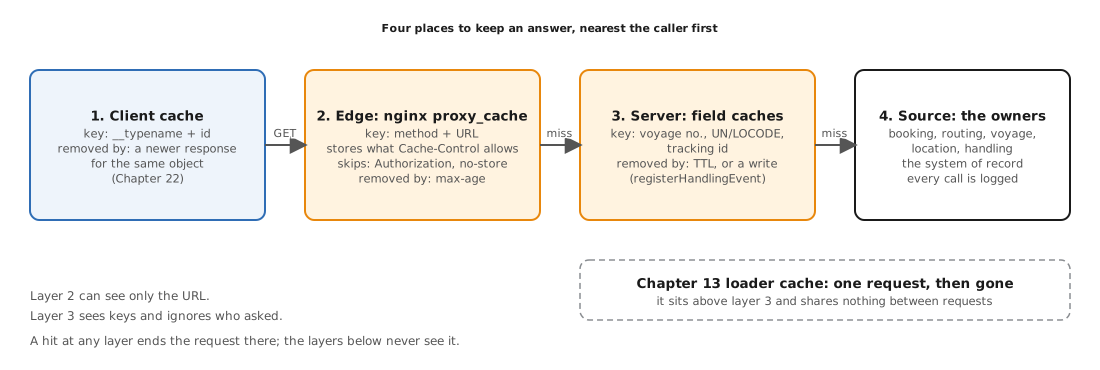
- The client’s normalized cache stores objects by
__typenameandid, the identity Chapter 10 gave everyNode. A response for one query updates the objects that a different query shows, which is how a mutation payload refreshes a screen. Chapter 22 builds it. - The edge keeps whole responses by method and URL. It is the layer that persisted
GETs make possible, and the one this chapter runs as nginx. - The server’s field caches keep what a source returned, by the source’s own key. They sit under the loaders: Chapter 13’s cache inside a loader lives for one request, and these outlive it.
- The sources are the owners. They are the system of record, and every other layer is a copy of what they said.
That last point frames the sections that follow. Martin Kleppmann and Chris Riccomini separate systems of record from derived data in Designing Data-Intensive Applications, 2nd edition. A cache is derived data: it can be thrown away and rebuilt from the source, and the only question is how stale a copy may be before someone is harmed. Each layer below answers that question with a time limit, an event, or both.
The client’s normalized cache
The client cache needs nothing from the server beyond what the schema already has. Chapter 10 made id stable and unique across the graph, and a client that selects id and __typename on every object can store each object once. When a later response contains the same Cargo, the client replaces the stored fields and every view that reads them updates. The nodes query refreshes a known set of objects in one request, and a mutation payload that returns the changed object updates the cache without a refetch.
The server’s part is to keep id stable and to return the changed object from a mutation, which registerHandlingEvent does with cargo { id delivery { transportStatus } }. Chapter 22 shows the client side. The remaining sections cover the three layers the server runs.
Caching at the edge needs GET
An HTTP cache keys on the request method and the URL. RFC 9111, in its section “Storing Responses in Caches”, lets a cache store a response only when the request method is one the cache understands, and nginx stores GET and HEAD and nothing else unless told to. Even where a cache is willing to store a POST response, the request body is not part of the key, so two different documents posted to one URL would collide. That is the reason Chapter 1 gave for GraphQL’s missing HTTP caching.
Chapter 15’s persisted GET removes the obstacle. The URL carries the hash, the variables and the operation name, so it identifies the question the way a REST path identifies a resource. Figure 16.2 follows one such request through the edge twice.
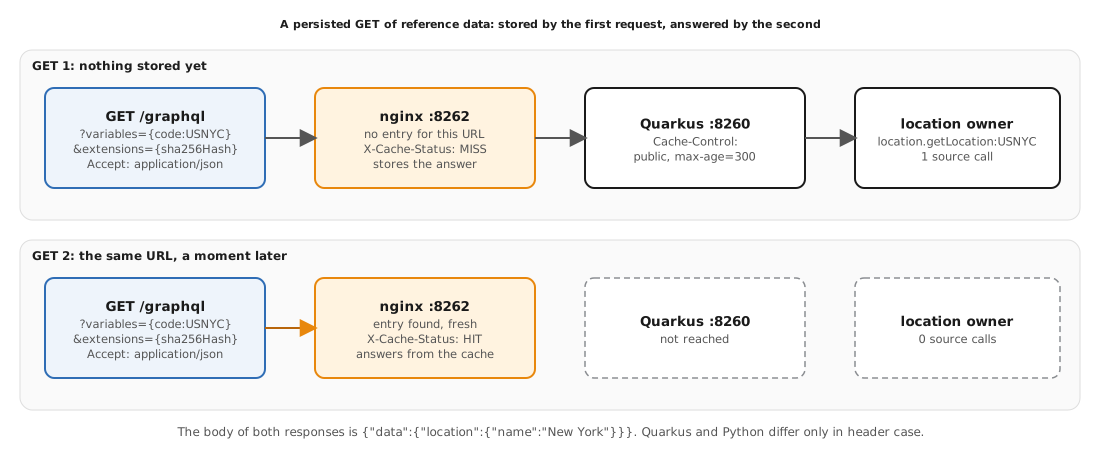
Three details of the setup matter.
The request must say it wants JSON. Chapter 15 showed that Strawberry answers a hash-only GET with its IDE page when Accept includes text/html or */*. nginx forwards Accept as sent, so the client must send Accept: application/json, and the example’s verify.sh does. The IDE page carries no Cache-Control, so the edge never stores it. Every public response carries Vary: Accept, as part of the policy, and nginx stores one entry per Accept value: a */* request that Quarkus answers as application/graphql-response+json does not fill the entry that a later Accept: application/json request is served from.
The key needs the origin. The two listeners share one cache zone and $host carries no port, so a key of scheme, method, host and URI would answer the Python listener with the Quarkus entry. The key includes the upstream. Any cache that fronts several origins needs the origin in its key.
Nothing is stored on nginx’s say-so. The example sets no proxy_cache_valid, so a response with no Cache-Control or Expires is never stored. The server must opt in, which leads to the next section.
Deciding Cache-Control per response
Cache-Control is the server’s statement about who may keep a response and for how long. RFC 9111’s section “Cache-Control” defines the directives, and the two the example uses are public, max-age=300, meaning any cache may keep the response for 300 seconds, and no-store, meaning no cache may keep it at all.
GraphQL has no per-URL answer to “how long”, because one URL path carries every document. The decision has to look at the operation and the result. The example makes it in one place per stack, from four tests in order, drawn in Figure 16.3.
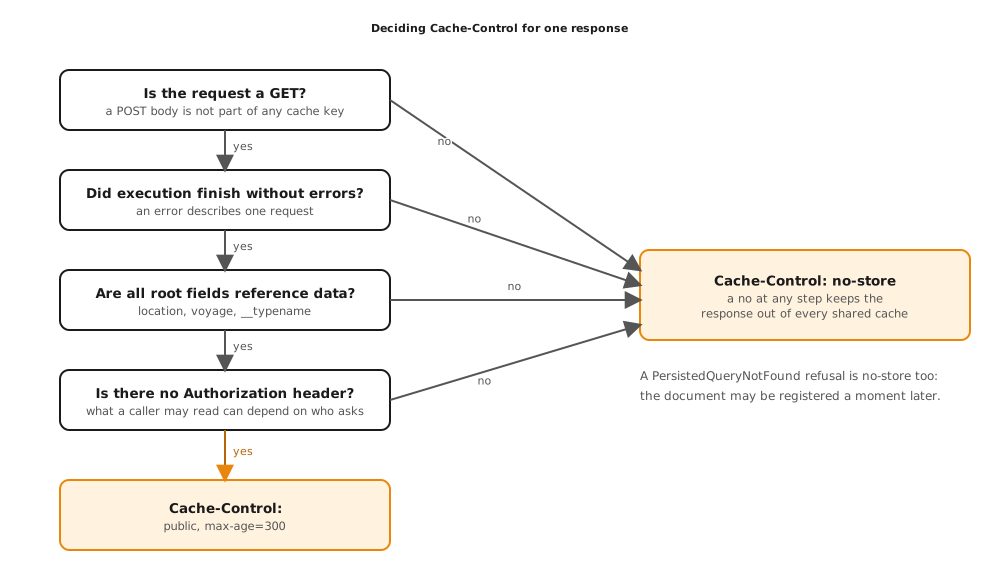
The rule is narrow. Only location and voyage are reference data: facts about the world that change on a timescale of days. A cargo’s delivery status changes with every handling event, and cargo is therefore never public. The policy is allowed to be wrong in the safe direction, and a response it calls no-store costs one more request to the server.
Each framework has a place to run this after execution. On Quarkus, the CDI event @AfterExecute fires once the result is known and before the response is written, and the observer puts the header on the Vert.x response. Strawberry’s SchemaExtension.on_operation wraps the whole operation, and the extension writes the header on the response FastAPI sends.
    void decide(@Observes @AfterExecute Context context) {
        RoutingContext routing = currentRequest.getCurrent();
        if (routing == null || routing.response().headWritten()) {
            return;
        }
        String policy = policyFor(routing, context);
        routing.response().putHeader("Cache-Control", policy);
        if (PUBLIC.equals(policy)) {
            // The body depends on the Accept header, so a cache keeps one entry per Accept value.
            routing.response().putHeader("Vary", "Accept");
        }
    }

    private static String policyFor(RoutingContext routing, Context context) {
        boolean get = HttpMethod.GET.equals(routing.request().method());
        boolean anonymous = routing.request().getHeader("Authorization") == null;
        ExecutionResult result = context.unwrap(ExecutionResult.class);
        boolean clean = result != null && result.getErrors().isEmpty();
        boolean reference = onlyReferenceData(context.unwrap(Document.class), context.getOperationName().orElse(null));
        return get && anonymous && clean && reference ? PUBLIC : NO_STORE;
    }
    def on_operation(self) -> Iterator[None]:
        context = self.execution_context
        response = context.context.response
        # The default comes first, so a request refused before execution (a hash the server does not
        # know) still carries a policy: the code after this yield runs for operations that complete.
        response.headers["Cache-Control"] = NO_STORE
        yield
        request = context.context.request
        result = context.result
        if (
            request.method == "GET"
            and "authorization" not in request.headers
            and result is not None
            and not result.errors
            and self._only_reference_data()
        ):
            response.headers["Cache-Control"] = PUBLIC
            # The body depends on the Accept header, so a cache keeps one entry per Accept value.
            response.headers["Vary"] = "Accept"
A refusal carries its own policy. The Chapter 15 extension refuses an unknown hash before execution, and the policy code that runs after the yield belongs to operations that complete. The Python extension therefore sets no-store first and replaces it after the yield when the result qualifies. On Quarkus the persisted-document route answers the refusal itself, before the @AfterExecute observer runs, and sets no-store on its own response. An unknown hash then comes back no-store on both stacks, and a client that registers the document a moment later does not meet a cache that remembers the refusal.
The chapter does not adopt field-level hints such as Apollo’s @cacheControl directive, which attaches a maximum age to a type or a field and lets the server compute the minimum over what a response touched. The canonical schema has no such directive, and Chapter 5 settled that caching policy lives outside the SDL. A per-root-field list in code is the same idea at a smaller scale.
The edge itself
The edge is registry.access.redhat.com/ubi10/nginx-126:10.1-1779165744 with one mounted file. It runs as uid 1001, so the pid file, the five temporary paths and the cache all live under /tmp, and the file is mounted :ro,z so that an SELinux host relabels it. The directives that matter:
proxy_cache         graphql;
proxy_cache_methods GET HEAD;
proxy_cache_key     "$scheme$request_method$proxy_host$request_uri";
proxy_no_cache      $http_authorization;
proxy_cache_bypass  $http_authorization;
add_header         X-Cache-Status $upstream_cache_status always;
proxy_cache_bypass makes a request that carries Authorization skip the lookup, and proxy_no_cache keeps its response out of the store. The status header says what happened: MISS, HIT, or BYPASS. nginx adds no Age header, so the example asserts X-Cache-Status. A Varnish cache would report Age, and either one honours max-age and no-store from the origin.
The reason for the bypass is in the key. The URL says nothing about who asked. If a response that depended on the caller were stored under a URL, the next caller would receive it. The tracking view’s reference data does not depend on the caller, and Chapter 18 adds callers that do, with operations that return only the cargos a shipper owns. The rule is to bypass shared caches whenever an Authorization header is present, and to give every response that came from a caller’s own data a no-store, which the policy above does through its fourth test. RFC 9111’s section “Storing Responses to Authenticated Requests” lets a shared cache store an authenticated response when it carries public, which is why the policy never sends public to a request with Authorization. The alternative is to add the caller to the key, and an edge that keys on identity stores one copy per caller and gains little.
Caching inside the server
The third layer keeps what a source returned, across requests. Chapter 13 batched a request’s reads into one call per kind of key and left the cache inside the loader to repeat nothing within a request. A field-level cache sits one level lower, at the bulk source, and answers keys it already holds so that only the misses reach the owner.
The example has three caches:
voyagesandlocationshold reference data for 300 seconds.handling-eventsholds a cargo’s event list under its tracking id. The TTL is 60 seconds by default and 20 seconds in the lab, so that the expiry case does not wait a minute.
The loaders are unchanged. They still batch every load of a tick into one call, and the call now goes to a source that checks a cache first. The log of calls to the owners records only what reached them, so a call that a cache answered leaves no entry. A bulk read answered in part by the cache logs only the missing keys. Chapter 13’s batch key rule carries over: sorted distinct keys joined with +, now the misses only.
Each stack uses the cache its framework provides. On Quarkus, quarkus-cache is Caffeine behind annotations. @CacheResult on the single-key read caches the item, and @CacheKey leaves the request id out of the key. The bulk read takes the keys itself, because an annotation caches one call per distinct argument and a bulk call takes many. It asks the cache for each key with getIfPresent, calls the owner once for the misses, and puts what it gets. On Python, cachetools.TTLCache is a mapping with an expiry, and the same split is a few lines around it.
    @CacheResult(cacheName = "voyages")
    public Uni<Voyage> getVoyage(String request, @CacheKey String number) {
        return calls.call(request, "voyage", "getVoyage", number, () -> data.voyage(number));
    }

    public Uni<List<Outcome<Voyage>>> getVoyages(String request, List<String> numbers) {
        return BulkCache.through(
                cache,
                Voyage.class,
                numbers,
                misses -> calls.callBatch(request, "voyage", "getVoyages", misses, data::voyage));
    }
    async def get_voyages(self, numbers: Sequence[str]) -> list[Outcome[Voyage]]:
        """Many voyages in one call: one outcome per voyage number, in the
        order asked; ``None`` when unknown. Only the cache misses reach the owner."""
        return await _through(
            self.cache,
            numbers,
            lambda misses: self.calls.call_batch(
                self.request, "voyage", "getVoyages", misses, data.VOYAGES.get
            ),
        )

    async def get_voyage(self, number: str) -> Voyage | None:
        if (cached := self.cache.get(number)) is not None:
            return cached
        found = await self.calls.call(
            self.request, "voyage", "getVoyage", number, lambda: data.VOYAGES.get(number)
        )
        if found is not None:
            self.cache[number] = found
        return found
The effect on Chapter 13’s fan-out is visible in the counts. The first run of the four-cargo query makes the same 6 calls on Python and 8 on Quarkus, with fewer keys in them. A second run inside the TTL makes 3 on Python and 4 on Quarkus: the booking page, the cargos and the itineraries, which no cache holds. The voyage, location and handling calls are gone. The two cached kinds do not behave the same way. Voyages and locations are static for the lifetime of the process, while handling events change when a write lands.
Where the stacks differ. On Quarkus, @CacheResult stores the result for an unknown key as well, so a second read of an unknown voyage makes no call: the single-key path remembers “unknown” for the TTL, which is negative caching. The bulk path, and Python, store only found values. A production service chooses whether a missing voyage may be remembered.
Invalidating on write
A TTL alone answers “how stale” with a number, and that number is wrong for a user who has just registered an event and reads it back. registerHandlingEvent returns a payload with the cargo’s new delivery.transportStatus. If the handling cache still held the old event list, the payload would say ONBOARD_CARRIER for the event it had just recorded.
The fix is to evict the cargo’s entry after the append succeeds and before the payload reads the cargo. Figure 16.4 shows the sequence the example’s case asserts.
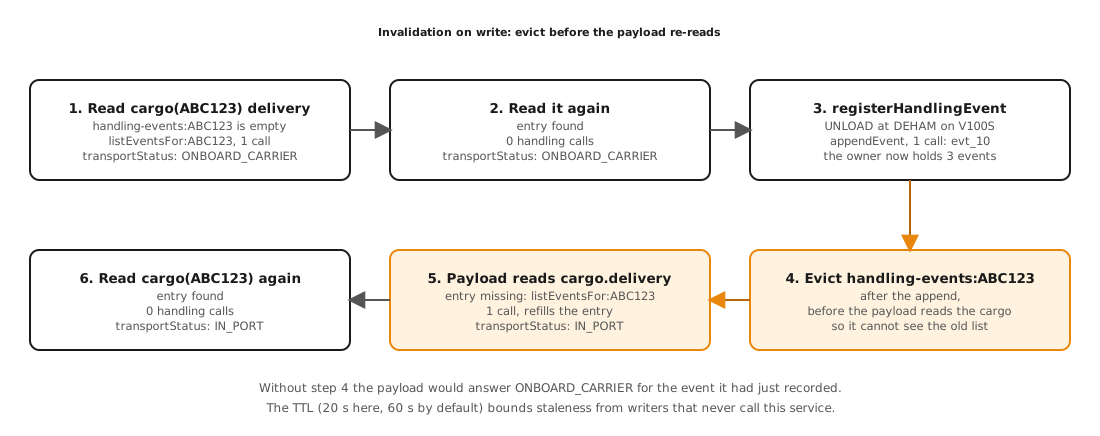
The eviction is one call in each stack. On Quarkus it is @CacheInvalidate(cacheName = "handling-events") on a method of HandlingSource, which HandlingRegistration chains between the append and the cargo read. On Python it is self.cache.pop(tracking_id, None), called in registration.py at the same point. The cargo’s next delivery read misses, makes one listEventsFor call for ABC123, and refills the entry, so the read after that makes no call.
The ordering is the whole design. Evicting before the append would let a concurrent reader refill the entry with the old list. Evicting after the payload read would hand the payload the old list. Even in the right order, a reader that started before the write and finishes after the eviction can store the old list again. That race is rare and bounded, and it is the first reason for the next section.
Expiry as the backstop
Eviction on write covers the writers this service knows about. It does not cover a batch import into the handling service, or a second API that writes to the same store. Both change the system of record and neither calls evict. The TTL is what bounds how long a copy can disagree with it, and it also bounds the race above.
A TTL is a choice about harm. Reference data changes rarely and does little damage when it is a few minutes behind, so 300 seconds is cheap. A cargo’s events matter to the person looking at the cargo, so the example’s production default is 60 seconds, and the lab’s 20 seconds exists so the chapter can show the entry expiring: the expiry case reads a cargo, sleeps 21 seconds, reads it again, and sees one handling.listEventsFor call for the key. A deployment sets these numbers from the business, and the same data can have a short TTL in one service and a long one in another.
What changes with replicas
Everything above lives in the process that owns it. With one replica per stack that is enough. With several, each replica holds its own copy: a write that lands on replica A evicts A’s entry, and replica B keeps serving the old list until its TTL passes. The edge has the same property, one cache per nginx.
There are two ways out. A shared cache, such as Valkey, the BSD-licensed fork of Redis that the Linux Foundation hosts, holds one copy for every replica and moves the eviction to a place all of them see. Or each replica keeps its own cache, and a write publishes an eviction on a channel that every replica subscribes to. Both add a moving part and a network hop to every read. The example runs neither, because a single replica has nothing to share. Chapters 25 to 27 run replicas, and the choice is made there.
Why not cache whole responses in the server
The server could also keep complete responses, keyed by document, variables and caller. The chapter does not build it, for three reasons.
- The key is large. It needs the document or its hash, the variables, the operation name and the identity of the caller, and a GraphQL server has no URL to lean on.
- Invalidation cannot see inside. A stored response is a blob. When a handling event is registered, the server cannot tell which stored responses contain that cargo without parsing every one.
- The edge already does it for public reads. Responses that every caller may share are exactly the ones the edge stores, keyed by a URL that already exists. Responses that depend on the caller are the ones a server cache would have to key by identity, and that is a cache with one entry per caller.
Chapter 1 mentioned response-level caching inside the server as an option. This chapter’s answer is that the response level belongs at the edge for public data, and that the server caches fields, where the keys are small and an event can name what to remove.
Identity belongs in the key
Every cache above holds data that is the same for every caller. Reference data is. A cargo’s event list is reached only after the booking source has returned the cargo, so a caller who may not see the cargo never reaches its entry. That is why none of the example’s keys contain an identity. The rule for anything else is simple: a stored value that varies by caller needs the caller in its key, or must not be stored. Chapter 18 introduces the identity and the ownership rule that sits under these caches, and it relies on the rule this chapter’s edge applies: bypass shared caches for any request that carries Authorization.
On the wire
Every value below is asserted by verify.sh on both stacks. Direct ports are 8260 (Quarkus) and 8261 (Python); the edge is 8262 and 8263. The H below is the hash of the PortName document in the example’s manifest.
docker compose -f examples/16-caching/compose.yaml up -d --build
H=$(printf '%s' 'query PortName($code: UnLocode!) { location(unLocode: $code) { name } }' | sha256sum | cut -d' ' -f1)
# register the document by POST: this response is no-store
curl -s -D - localhost:8260/graphql -H 'Content-Type: application/json' \
  -d "{\"query\":\"query PortName(\$code: UnLocode!) { location(unLocode: \$code) { name } }\",\"variables\":{\"code\":\"USNYC\"},\"extensions\":{\"persistedQuery\":{\"version\":1,\"sha256Hash\":\"$H\"}}}"
# the same document by GET, twice, through the edge
for i in 1 2; do
  curl -s -D - -o /dev/null -G localhost:8262/graphql -H 'Accept: application/json' \
    --data-urlencode 'variables={"code":"USNYC"}' \
    --data-urlencode "extensions={\"persistedQuery\":{\"version\":1,\"sha256Hash\":\"$H\"}}" | grep -iE '^(cache-control|x-cache-status)'
done
# with a bearer token the edge steps aside
curl -s -D - -o /dev/null -G localhost:8262/graphql -H 'Accept: application/json' -H 'Authorization: Bearer x' \
  --data-urlencode 'variables={"code":"USNYC"}' \
  --data-urlencode "extensions={\"persistedQuery\":{\"version\":1,\"sha256Hash\":\"$H\"}}" | grep -iE '^(cache-control|x-cache-status)'
docker compose -f examples/16-caching/compose.yaml down -v
The two GETs print Cache-Control: public, max-age=300 with X-Cache-Status: MISS, then HIT. The bearer request prints Cache-Control: no-store and X-Cache-Status: BYPASS. The cases run in a fixed order, because the earlier ones warm the keys the later counts expect.
| Check | Quarkus | Python |
|---|---|---|
| edge, first GET | public, max-age=300, MISS, New York; one call, location.getLocation:USNYC |
the same |
| edge, second GET | HIT, public, max-age=300, the same body, 0 source calls |
the same |
edge, Vary: Accept |
a */* GET, then Accept: application/json for the same URL: MISS with Content-Type: application/json, then HIT |
the same, with Accept: application/graphql-response+json first, because */* gets the IDE page |
| single-key voyage twice | first voyage.getVoyage:V200E; second 0 voyage calls |
the same |
| four-cargo query, run 1 | 8 calls; voyage.getVoyages V100S+V300A |
6 calls; voyage.getVoyages V100S+V300A |
| four-cargo query, run 2 | 4 calls, none to voyage, location, handling |
3 calls, the same exclusions |
Cache-Control, direct |
GET PortName: public, max-age=300; the same by POST, a TrackCargo GET, an error GET, a GET with Authorization, an unknown hash: no-store |
the same |
| edge, never stored | TrackCargo twice, an error twice, an unknown hash twice: never HIT; 2 booking.getCargo calls |
the same |
| edge, bypass | BYPASS, no-store, the same data |
the same |
| expiry | read, sleep 21, read: one handling.listEventsFor:XYZ789 call |
the same |
| invalidation | second read 0 handling calls; mutation evt_10, IN_PORT, one listEventsFor:ABC123; next read IN_PORT, 0 calls |
the same |
bash examples/16-caching/verify.sh runs the whole sequence on both stacks and prints PASS only when both hold.
Decision
Caching is where the caching needs axis of Chapter 2 gets its answer, and each layer answers it differently. Public reference data goes to the edge through persisted GETs with an explicit Cache-Control. Source reads go to field caches with a TTL and an eviction on write. Anything that depends on the caller stays out of shared caches. The operational and security cost axis is the price: every cache is derived data whose staleness is a decision, and the identity of the caller must be in every key or out of every store. The aggregation across sources axis sets the payoff, because the loaders' batched calls become even fewer when the cache answers part of the batch. The tracking view therefore caches reference data for 300 seconds at both the edge and the server, caches handling events briefly and evicts them on every registration, never stores a response for a request that carries Authorization, and runs no shared cache until there are replicas to share one.
Where this goes next
This chapter put answers where they are cheapest to reuse. It named four layers, made persisted GETs cacheable with a Cache-Control decided per response, ran an nginx edge that bypasses on Authorization, cached source reads with a TTL under Chapter 13’s loaders, and evicted on registerHandlingEvent so the payload stays fresh. It left a shared cache for the replica chapters.
Chapter 17 moves to the transport. It serves the same service over TLS with certificates generated at run time, separates a public endpoint from an internal one, and turns introspection and field suggestions off where a public client could read them. Chapter 18 adds the caller: tokens from Keycloak, ownership checks in the booking source, and the first responses that must never reach a shared cache.
For HTTP caching, read RFC 9111, “HTTP Caching”, especially the sections “Storing Responses in Caches” and “Cache-Control”, and the section “Safe Methods” of RFC 9110, “HTTP Semantics”, for why GET is the method a cache may reuse. For the data-systems frame, read Designing Data-Intensive Applications, 2nd edition, on systems of record and derived data, and the chapter “Optimizing data fetching” in Samer Buna’s GraphQL in Action. The implementations are in the nginx ngx_http_proxy_module reference (the proxy_cache directives), the Quarkus Application data caching guide, and the cachetools documentation. For contrast, Apollo’s documentation on caching describes the @cacheControl directive this chapter does not adopt, and the Valkey project is the shared cache named above.