Connections and pagination
How a growing list becomes a Relay connection: offset against keyset pagination, edges, nodes and PageInfo, opaque versioned cursors, forward and backward paging, stability under inserts, filters and totalCount, bad arguments as BAD_USER_INPUT, one failing node nulling one edge, and the source calls a page costs.
Every list in the tracking view so far has been short. A cargo has two legs and a handful of events, so a client reads all of them and nothing breaks. A cargo that has been handled for months has hundreds of events, and the list of cargos itself has no natural end. This chapter turns those two lists into pages a client walks one at a time, and it shows what the walk costs the sources behind it.
The code is in examples/12-pagination/. It starts from the Chapter 9 example, so the exposed and masked error machinery is still there, and it carries Query.nodes from Chapter 10 and the finalArrivalTime deprecation from Chapter 11. The Chapter 9 fault seeds are gone. The seed now holds six cargos, DEF456 has a full seven-event history, and one fault remains: the booking service lists GHI345 but cannot load it. The example adds Query.cargos and Cargo.handlingHistory, with the types CargoConnection, CargoEdge, HandlingEventConnection, HandlingEventEdge and PageInfo. Only Subscription, which Chapter 21 builds, is left unserved.
Lists that grow need pages
An unbounded list field makes the cost of a query depend on data the client does not control. The same handlingHistory selection returns two events today and two thousand next year, and the response size, the time spent in the handling service and the memory held while the engine assembles the result all grow with it. A page size puts a ceiling on that cost, and a cursor lets the client continue from where it stopped. Chapter 14 returns to cost as a property of the whole query. Here the concern is the shape of one list.
The ceiling has to hold when the client says nothing. A server that returns everything when first is absent has no ceiling at all, so a request without first or last gets a default page of 10, and no request may ask for more than 50. Those two numbers are part of the contract in the sense that matters: a client written against the default will break if the default grows to 100, so a change to either is a decision, not a tuning knob.
The shape also has to be settled early. Turning a plain list into a connection changes the field’s type, which is a breaking change for every client that selects it, so a list that may grow starts as a connection.
Offset versus keyset
Two designs answer “give me the next page”. Offset pagination counts: skip the first N rows and take the next M. Keyset pagination seeks: take the rows whose sort key comes after the last key the client saw. The first is simple to write, and its failure is silent. The second needs an ordering that is stable and unique, and it never miscounts.
Offset breaks when the data changes between two requests, and the tracking view shows it. DEF456’s history has seven events. Read three at a time, the first page is evt_9, evt_8, evt_7. Then a customs event that completed at 2026-10-11T20:00:00Z is registered late and becomes evt_10. By completion time it belongs between evt_8 and evt_7, in the part of the list the client has already read. A client that asks for “skip 3, take 3” now gets evt_7, evt_6, evt_5: evt_7 twice, because everything below the insert moved down one place. A client that sends the cursor of evt_7 gets evt_6, evt_5, evt_4, with no repeat and no gap, because the cursor names a position in the ordering and not a row count.
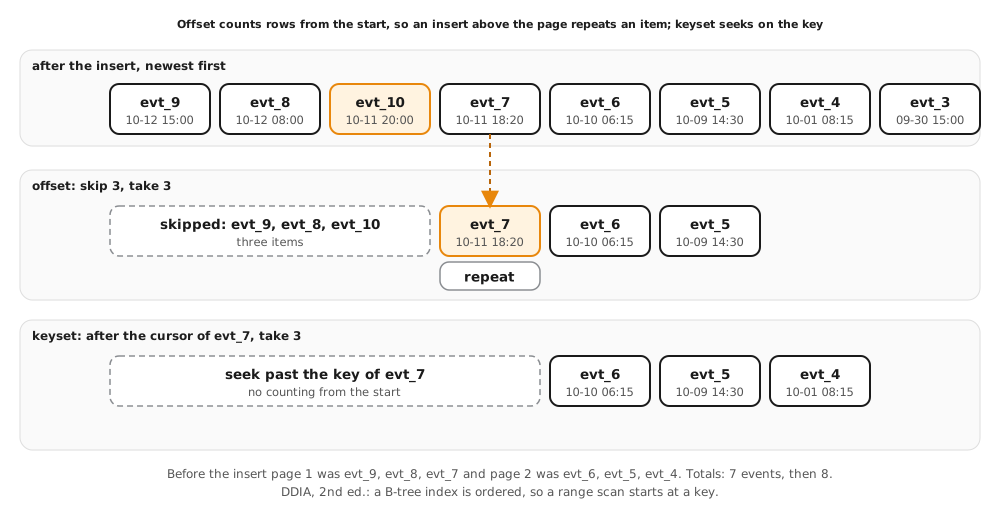
Martin Kleppmann and Chris Riccomini explain why the seek is cheap in Designing Data-Intensive Applications, 2nd edition, where they cover indexes. An ordered index keeps keys sorted, so a range scan starts at a key and reads forward, where an offset has to walk past every skipped row. The sort key must be total, which is why both connections here break ties: cargos by booking time and then tracking id, events by completion time and then the number in evt_<n>.
The connection shape
A connection is the Relay answer to “a page of a list”. The “Connection Types” and “Edge Types” sections of the Cursor Connections specification define it: a connection has edges and pageInfo, and an edge has a node and a cursor. The canonical SDL adds a nullable totalCount.
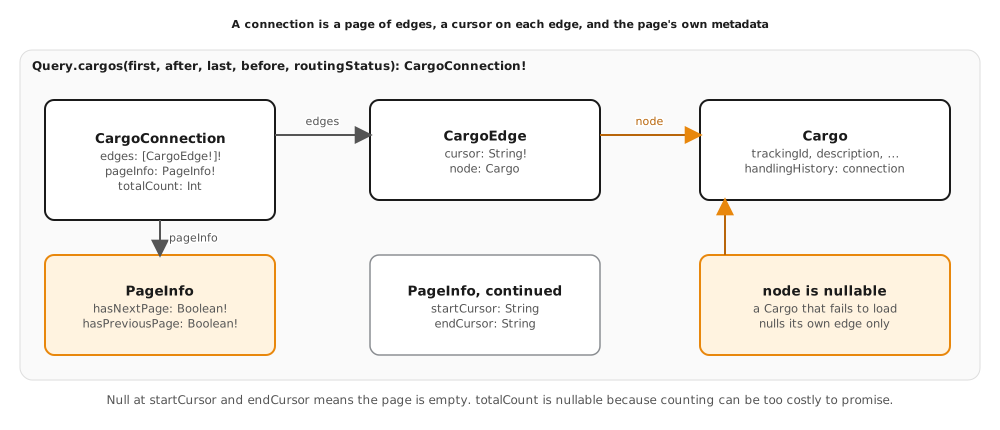
The cursor sits on the edge, not on the node, because it names a position in this connection and the same cargo could appear in another connection with a different cursor. pageInfo answers the two questions a client has after reading a page: is there more in each direction, and where do I continue from. startCursor and endCursor are null on an empty page, since there is no edge to take them from.
The node is nullable by design. The SDL describes it as “Null when the cargo failed to resolve, so one bad item nulls its edge instead of the whole page.” That is the fourth nullability fuse that Chapter 4 promised, and a later section reads it on a live page.
Cursors are opaque
A client holds a cursor and hands it back. It must not read it, build one or compare two. The server is then free to change what a cursor contains, and the specification asks for exactly that: the “Edge Types” section says a client should treat a cursor as opaque, and “Arguments” says it comes back as after or before.
This example encodes the sort key. The cargo cursor is the URL-safe base64 of the UTF-8 text cargo|v1|<bookedAt>|<trackingId>, without padding, and the event cursor is evt|v1|<completionTime>|<n>. The cursor of the first cargo is the encoding of cargo|v1|2026-09-29T09:00:00Z|VWX901, and both stacks return it byte for byte. Three parts do the work. The prefix names the connection, so a cargo cursor handed to handlingHistory is rejected. The version lets a later release change the key without misreading cursors clients still hold. The key fields are what the server seeks on.
The decoder accepts only text it could have issued. A wrong prefix, an unknown version, a different number of fields, a time with a fraction, a padded or non-canonical encoding and plain garbage all fail the same way, and so does a cursor from the other connection. Each is BAD_USER_INPUT with the message after is not a valid cursor for this connection, or before where that argument carried it. Opaque is a rule for clients, and the server is what enforces it: a client that parses a cursor today will break the day the key gains a field, and the version in the prefix is the server’s promise that it will notice the change first. Opaque does not mean encrypted: anyone can decode the base64, and the cursor carries nothing a client could not already read. If a cursor had to hide data, it would need a signature or a server-side lookup, and this example needs neither.
Paging forward
first and after read forward. The specification’s “Pagination algorithm” takes the edges after the after cursor, then the first first of them. hasNextPage is true when edges remain beyond the page, and endCursor is the value to send as the next after.
@Query
@NonNull
@Description("List cargos, newest first, as a Relay connection.")
public Uni<CargoConnection> cargos(
        @Name("first") @Description("Return the first N cargos.") Integer first,
        @Name("after") @Description("Return cargos after this cursor.") String after,
        @Name("last") @Description("Return the last N cargos.") Integer last,
        @Name("before") @Description("Return cargos before this cursor.") String before,
        @Name("routingStatus") @Description("Only cargos with this routing status.") RoutingStatus routingStatus,
        Context context) {
    Pagination.Page<Pagination.CargoKey> page = Pagination.page(first, after, last, before, Pagination::decodeCargo);
    return booking.listCargos(context.getExecutionId(), routingStatus, page).map(slice -> {
        List<CargoEdge> edges = slice.items().stream()
                .map(row -> new CargoEdge(Pagination.encodeCargo(row.key()), row.trackingId()))
                .toList();
        return new CargoConnection(
                edges,
                PageInfo.of(
                        slice.hasNext(),
                        slice.hasPrevious(),
                        edges.stream().map(CargoEdge::cursor).toList()),
                slice.totalCount());
    });
}
@strawberry.field(description="List cargos, newest first, as a Relay connection.")
async def cargos(
    self,
    info: Info[TrackingContext],
    first: Annotated[
        strawberry.Maybe[int | None], strawberry.argument(description="Return the first N cargos.")
    ] = None,
    after: Annotated[
        strawberry.Maybe[str | None], strawberry.argument(description="Return cargos after this cursor.")
    ] = None,
    last: Annotated[
        strawberry.Maybe[int | None], strawberry.argument(description="Return the last N cargos.")
    ] = None,
    before: Annotated[
        strawberry.Maybe[str | None], strawberry.argument(description="Return cargos before this cursor.")
    ] = None,
    routing_status: Annotated[
        strawberry.Maybe[RoutingStatus | None],
        strawberry.argument(
            name="routingStatus", description="Only cargos with this routing status."
        ),
    ] = None,
) -> CargoConnection:
    page = pagination.parse_page(
        pagination.argument(first),
        pagination.argument(after),
        pagination.argument(last),
        pagination.argument(before),
        pagination.decode_cargo,
    )
    cargos = await info.context.booking.list_cargos(pagination.argument(routing_status), page)
    edges = [
        CargoEdge(cursor=pagination.encode_cargo(row.key), tracking_id=row.tracking_id)
        for row in cargos.items
    ]
    return CargoConnection(
        edges=edges,
        page_info=PageInfo.of(cargos.has_next, cargos.has_previous, [e.cursor for e in edges]),
        total_count=cargos.total_count,
    )
The resolver does little: it validates, asks the booking source for one page of its index, and wraps the result. The paging itself lives in a small Pagination helper on each stack, which owns the argument rules, the cursor codec and the slice, so Query.cargos and Cargo.handlingHistory cannot drift apart. The Python arguments are strawberry.Maybe values with a Python default of None. That spelling makes an omitted argument arrive as None and a sent one as Some(value), and it keeps the printed SDL free of = null, which would be a dangerous change that only a live check notices.
Walked two at a time, the six cargos give VWX901, XYZ789, then STU678, DEF456, then ABC123 and GHI345. The first page has hasNextPage true and hasPreviousPage false, the second has both true, and the third has hasNextPage false. totalCount is 6 on every page.
Paging backward
last and before read the other way: the edges before the before cursor, then the last last of them. The page is still in connection order, newest first, so last: 2 before the cursor of ABC123 returns STU678 and then DEF456, the same middle page the second forward step returned. A request with last: 2 and no cursor returns the end of the list, ABC123 and GHI345.
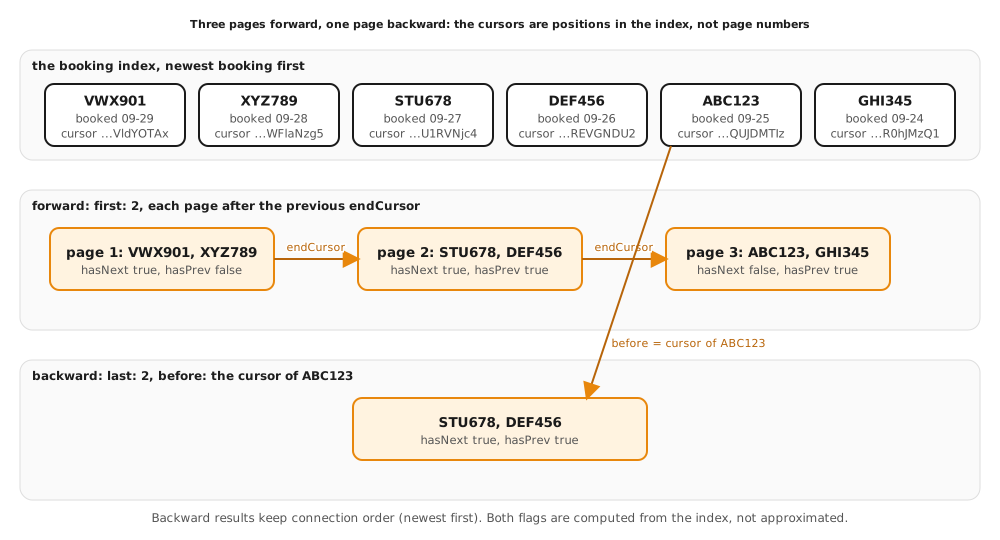
The specification lets a server approximate in the direction a client is not paging: with first it may report hasPreviousPage as false without checking. This example computes both flags exactly. They fall out of the slice, which knows the position of the page in the whole ordered list, so the page after the first one reports hasPreviousPage true and the page before the last reports hasNextPage true.
public static <T, K extends Comparable<K>> Slice<T> slice(
        List<T> newestFirst, Function<T, K> key, Page<K> page) {
    int total = newestFirst.size();
    int start = page.after() == null ? 0 : countAtLeast(newestFirst, key, page.after());
    int end = page.before() == null ? total : countGreaterThan(newestFirst, key, page.before());
    end = Math.max(start, end);
    if (page.first() != null) {
        end = Math.min(end, start + page.first());
    }
    if (page.last() != null) {
        start = Math.max(start, end - page.last());
    }
    return new Slice<>(List.copyOf(newestFirst.subList(start, end)), end < total, start > 0, total);
}
def slice_[T, K](newest_first: Sequence[T], key: Callable[[T], K], page: Page[K]) -> Slice[T]:
    total = len(newest_first)
    # Items at or before the cursor in connection order are those with a key >= the cursor's.
    start = 0 if page.after is None else sum(1 for item in newest_first if key(item) >= page.after)
    end = total if page.before is None else sum(1 for item in newest_first if key(item) > page.before)
    end = max(start, end)
    if page.first is not None:
        end = min(end, start + page.first)
    if page.last is not None:
        start = max(start, end - page.last)
    return Slice(list(newest_first[start:end]), end < total, start > 0, total)
The two windows are positions in the list, found by comparing keys and not by remembering rows. The comparison needs only a key, never the row the key came from. first: 0 returns no edges, null cursors, hasNextPage true and hasPreviousPage false: an empty page is a valid answer to a valid question.
Stable under inserts
The slice compares keys, so a registration that lands in the part of the history a client has already read cannot disturb the next page. The verify.sh case is the one in Figure 12.1. It reads DEF456’s history three at a time, registers the customs event as evt_10, and continues with the cursor of evt_7: the next page is evt_6, evt_5, evt_4, and the one after is evt_3 alone with hasNextPage false. A fresh request for the first three events now returns evt_9, evt_8, evt_10, and totalCount has moved from 7 to 8. The store keeps completion times in whole seconds, because the cursor encodes the sort key at that precision: an event registered with 2026-10-02T09:00:00.5Z is stored and returned as 2026-10-02T09:00:00Z, and the page after its cursor skips nothing.
Keyset has one limit the offset design does not. The client cannot jump to page 40, because a cursor exists only for a position the server has already shown. A screen that needs numbered pages needs offset, or a count taken from totalCount and a seek strategy of its own. A feed or a timeline, which is how the tracking view uses its lists, does not need to jump.
Filters and totalCount
routingStatus narrows cargos to one routing status. The filter is applied where the data is: the booking source reads the status stored in its index and pages only the matching rows, so one booking.listCargos call is logged with the status as its key. A filter applied after the page was cut would return short pages and a wrong hasNextPage: a page of two that loses one cargo to the filter is a page of one, and the client cannot tell whether the list ended. The index therefore filters first and pages what is left, so a filtered page is full whenever matches remain, and its cursors are positions in the same global ordering as the unfiltered list. The stored status must also agree with the derived one, since Cargo.delivery computes routingStatus from the itinerary. The example asserts it: the MISROUTED page is STU678 with a derived status of MISROUTED, and the NOT_ROUTED and ROUTED pages agree the same way.
totalCount is the number of matches regardless of the page, so it is 6 for no filter, 3 for ROUTED, 2 for NOT_ROUTED and 1 for MISROUTED. It is nullable in the contract because counting is not free. A database often has to scan the matches to count them, and a count over a filtered, joined or sharded list can cost more than the page it accompanies. A client that does not select totalCount should not pay for it, and a server that cannot count cheaply may return null. This example counts an in-memory index, so it always has a value.
Bad arguments are errors
Some arguments pass coercion and are still wrong. The specification’s “Arguments” section asks that first and last not be negative, and the server adds its own ceiling: both must be between 0 and 50, inclusive, and a request without either gets 10. Combining first and last is rejected; the specification strongly discourages it because the meaning of the result is unclear.
These failures are exposed execution errors (older editions of the specification call them field errors) with the code BAD_USER_INPUT, the same machinery Chapter 9 built for SERVICE_UNAVAILABLE. On Quarkus, BadUserInputException carries @ErrorCode("BAD_USER_INPUT") and is added to the show-runtime-exception-message allowlist. On Python, BadUserInput subclasses ExposedError. The messages are exact: first must be between 0 and 50, last must be between 0 and 50, first and last cannot be combined, and the cursor messages above.
The null lands where the non-null chain ends. Query.cargos is CargoConnection!, so the failure leaves nothing to hold it and data is null. Cargo.handlingHistory is HandlingEventConnection! and Query.cargo is nullable, so the failure nulls cargo and stops there, with the error path ["cargo","handlingHistory"]. Chapter 9 covers where a null lands and the status codes an HTTP response carries; neither is restated here.
One bad node, one null edge
The booking service lists GHI345 and cannot load it. On the last page of cargos(first: 2), edge 1 points at it. CargoEdge.node loads the cargo from the booking source when a query selects it, so the failure happens there. Because node is nullable, the null stops at the edge: the response has one error with the path ["cargos","edges",1,"node"], the edge keeps its cursor, edge 0 resolves as ABC123, and pageInfo and totalCount are intact. The spec rules behind this are in “List” and “Non-Null” in the type system and in “Handling Execution Errors”. Were node non-null, the null would climb to the edge, which is itself non-null in a non-null list, then to the connection, then to data.
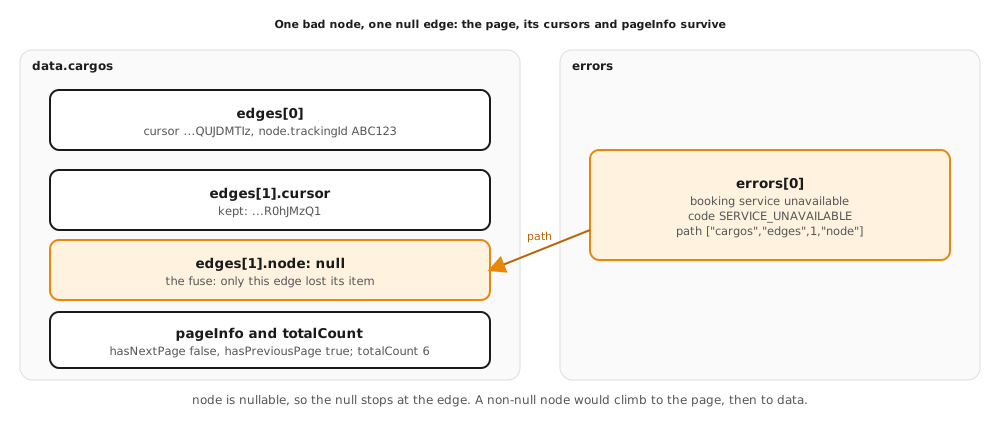
The same holds when the failing cargo is reached through a filter. The NOT_ROUTED page is XYZ789 and a null node for GHI345, with the same path, because the index lists a cargo that its owner cannot load.
Code-first connections on two stacks
Both stacks use plain types: five records on Quarkus, five @strawberry.type classes on Python, with the canonical descriptions. The edge holds the cursor and a private key for its node, and a node resolver loads the cargo. Strawberry ships strawberry.relay, which models connections differently from the contract. Its ListConnection pages by offset with cursors of the form arrayconnection:<n>, so a late insert repeats an item, as in Figure 12.1. Its node field is non-null, where the contract’s is nullable. It has no totalCount, and its Node and GlobalID use their own id encoding in place of the canonical Node.id. The example uses plain types so that the keyset cursors, the nullable node and totalCount match the contract. The README records the output.
The cost of hydrating a page
A page of cargo edges is a list of keys. Selecting anything about each cargo means one lookup per edge, and that is where the N+1 appears. The query in verify.sh pages four cargos and selects each one’s itinerary legs, with the voyage and both locations of each leg, and its delivery status. The source-call log counts 29 calls: one booking.listCargos, four booking.getCargo, eight routing.getItinerary, four handling.listEvents, four voyage.getVoyage and eight location.getLocation.
The numbers follow from the seed. Each cargo’s itinerary and its delivery both read the routing source, so four cargos make eight calls. The four cargos have one, none, one and two legs, which makes four legs, each with a voyage and two locations. The voyage log shows V300A twice, the same key fetched twice in one request. nodes(ids:) has the same shape: five ids cost five calls. Chapter 13 batches these calls and removes the repetition. The number to beat is 29.
On the wire
Start the stack. Quarkus is on 8220 and Python on 8221.
docker compose -f examples/12-pagination/compose.yaml up -d --build
Q() {
  local vars="${2:-}"; [ -n "$vars" ] || vars='{}'
  curl -s localhost:${3:-8220}/graphql -H 'Content-Type: application/json' \
    -d "$(python3 -I -c 'import json,sys; print(json.dumps({"query": sys.argv[1], "variables": json.loads(sys.argv[2])}))' "$1" "$vars")"; echo
}
The first page of two cargos:
Q 'query($f: Int, $a: String) { cargos(first: $f, after: $a) { edges { cursor node { trackingId } } pageInfo { hasNextPage hasPreviousPage startCursor endCursor } totalCount } }' '{"f":2}'
{"data":{"cargos":{"edges":[{"cursor":"Y2FyZ298djF8MjAyNi0wOS0yOVQwOTowMDowMFp8VldYOTAx","node":{"trackingId":"VWX901"}},{"cursor":"Y2FyZ298djF8MjAyNi0wOS0yOFQwOTowMDowMFp8WFlaNzg5","node":{"trackingId":"XYZ789"}}],"pageInfo":{"hasNextPage":true,"hasPreviousPage":false,"startCursor":"Y2FyZ298djF8MjAyNi0wOS0yOVQwOTowMDowMFp8VldYOTAx","endCursor":"Y2FyZ298djF8MjAyNi0wOS0yOFQwOTowMDowMFp8WFlaNzg5"},"totalCount":6}}}
Send the endCursor as $a for page two, and the second page’s endCursor for page three, where the failing edge shows:
Q 'query($f: Int, $a: String) { cargos(first: $f, after: $a) { edges { cursor node { trackingId } } pageInfo { hasNextPage hasPreviousPage } totalCount } }' '{"f":2,"a":"Y2FyZ298djF8MjAyNi0wOS0yNlQwOTowMDowMFp8REVGNDU2"}'
{"errors":[{"message":"booking service unavailable","locations":[{"line":1,"column":76}],"path":["cargos","edges",1,"node"],"extensions":{"code":"SERVICE_UNAVAILABLE"}}],"data":{"cargos":{"edges":[{"cursor":"Y2FyZ298djF8MjAyNi0wOS0yNVQwOTowMDowMFp8QUJDMTIz","node":{"trackingId":"ABC123"}},{"cursor":"Y2FyZ298djF8MjAyNi0wOS0yNFQwOTowMDowMFp8R0hJMzQ1","node":null}],"pageInfo":{"hasNextPage":false,"hasPreviousPage":true},"totalCount":6}}}
Python sends data before errors; the values do not differ. A bad argument and the history after the late insert:
Q '{ cargos(first: 51) { totalCount } }'
Q 'mutation($i: RegisterHandlingEventInput!) { registerHandlingEvent(input: $i) { handlingEvent { id } } }' '{"i":{"trackingId":"DEF456","type":"CUSTOMS","location":"NLRTM","completionTime":"2026-10-11T20:00:00Z"}}'
Q 'query($t: TrackingId!, $f: Int) { cargo(trackingId: $t) { handlingHistory(first: $f) { edges { node { id } } totalCount } } }' '{"t":"DEF456","f":3}'
docker compose -f examples/12-pagination/compose.yaml down -v
{"errors":[{"message":"first must be between 0 and 50","locations":[{"line":1,"column":3}],"path":["cargos"],"extensions":{"code":"BAD_USER_INPUT"}}],"data":null}
{"data":{"registerHandlingEvent":{"handlingEvent":{"id":"evt_10"}}}}
{"data":{"cargo":{"handlingHistory":{"edges":[{"node":{"id":"evt_9"}},{"node":{"id":"evt_8"}},{"node":{"id":"evt_10"}}],"totalCount":8}}}}
Timestamps and column numbers can differ by stack. The cursors, ids, paths, flags and counts do not.
| Check | Expected |
|---|---|
handlingHistory(first: 2) of ABC123 |
ids evt_2, evt_1; hasNextPage false |
cargos(first: 2), then after each endCursor |
VWX901, XYZ789 (next true, prev false), STU678, DEF456 (true, true), ABC123 and a null node (false, true); totalCount 6 |
| first cursor | base64url, no padding, of cargo|v1|2026-09-29T09:00:00Z|VWX901; identical on both stacks; no VWX901, 2026 or = in any cursor |
| the failing edge | 1 error, path ["cargos","edges",1,"node"], message booking service unavailable, code SERVICE_UNAVAILABLE; node null; cursor kept; ABC123 resolved |
last: 2, before: the cursor of ABC123 |
STU678, DEF456; next true, prev true |
last: 2 |
ABC123 and a null node; next false, prev true |
routingStatus MISROUTED, NOT_ROUTED, ROUTED |
[STU678] total 1; [XYZ789, null] total 2; [VWX901, DEF456, ABC123] total 3; stored status equals derived; one booking.listCargos call keyed by the filter |
first: 0 |
no edges; next true, prev false; null cursors; totalCount 6 |
first: -1, first: 51, last: 51 |
1 error each, path ["cargos"], code BAD_USER_INPUT, the message first must be between 0 and 50 or last must be between 0 and 50; data null |
first: 1, last: 1 |
first and last cannot be combined |
after with nope, a padded cursor, version v2, a time with a fraction, an extra field, or an event cursor; before with nope |
after is not a valid cursor for this connection (before is not ... for before) |
a cargo cursor on cargo(DEF456) { handlingHistory(after:) } |
the same message; path ["cargo","handlingHistory"]; cargo null |
first: 50 |
no error |
DEF456 history first: 3 |
evt_9, evt_8, evt_7, total 7, endCursor the encoding of evt|v1|2026-10-11T18:20:00Z|7 |
register CUSTOMS at NLRTM completing 2026-10-11T20:00:00Z |
evt_10 |
next page after evt_7, then the one after |
evt_6, evt_5, evt_4 (true, true); evt_3 (false, true) |
a fresh first: 3 |
evt_9, evt_8, evt_10, total 8 |
a fresh first: 6 |
items 4 to 6 are evt_7, evt_6, evt_5: an offset page of 3 repeats evt_7 |
register CUSTOMS for ABC123 completing 2026-10-02T09:00:00.5Z |
evt_11; first: 1 returns it with completionTime 2026-10-02T09:00:00Z and endCursor the encoding of evt|v1|2026-10-02T09:00:00Z|11; after that cursor returns evt_2 |
last: 2 |
evt_4, evt_3; next false, prev true |
three more events, then handlingHistory without arguments |
10 edges, next true, total 11; delivery still CLAIMED |
args { defaultValue } of Query.cargos and Cargo.handlingHistory |
every default null |
| four-cargo query with itineraries and delivery | 29 calls: listCargos 1, getCargo 4, getItinerary 8, listEvents 4, getVoyage 4 (V300A, V300A, V100S, V200E), getLocation 8 |
nodes with five ids |
5 calls; the ids cargo, evt, cargo_ give [null,null,null] and no call |
Itinerary.finalArrivalDate and finalArrivalTime |
deprecated with reason Use `finalArrivalTime`. and not deprecated; both 2026-10-11T18:00:00Z for DEF456 |
| the live schema | conforms to contracts/schema/; only Subscription is unserved |
bash examples/12-pagination/verify.sh runs the whole sequence on both stacks and prints PASS only when both hold.
Decision
Pagination is where the aggregation across sources axis of Chapter 2 meets volume: a page of edges is one index read, and each selected field adds a call to another owner, so the page size is also a multiplier on every source behind it. The contract and evolution style axis decides the shape and the cursor. A list that may grow starts as a connection, a cursor is opaque and versioned so its contents can change, and the sort key is total so a keyset never repeats an item. The operational and security cost axis decides the limits: a page ceiling of 50, a rejected cursor the server did not issue, a nullable totalCount that is not selected unless the client asks, and a nullable node so one failing source costs one edge. The tracking view therefore uses keyset connections with exposed BAD_USER_INPUT errors, and measures the 29 calls that Chapter 13 reduces.
Where this goes next
This chapter turned two growing lists into connections: keyset paging against offset, the connection shape, opaque versioned cursors, forward and backward paging with exact flags, stability under inserts, a filter pushed to the index, argument errors as BAD_USER_INPUT, the fuse on CargoEdge.node, and a measured baseline of 29 source calls for a four-cargo page.
Chapter 13 starts from this example and batches those calls: SmallRye batch resolvers on one side and Strawberry data loaders on the other, with the call counts compared. Chapter 14 treats the page size and the selection depth as inputs to query cost.
For the formal definitions, read the “Connection Types”, “Edge Types”, “Arguments”, “Pagination algorithm” and “PageInfo” sections of the Relay GraphQL Cursor Connections specification, and “List” and “Non-Null” in the GraphQL specification. Martin Kleppmann and Chris Riccomini’s Designing Data-Intensive Applications, 2nd edition, covers ordered indexes and range scans. William Lyon’s Full Stack GraphQL Applications closes with a chapter, “Advanced GraphQL considerations”, that treats pagination among its topics. Both books are on the Bibliography page. The framework behaviour is in the Quarkus SmallRye GraphQL guide and the Strawberry documentation.