The N+1 problem and DataLoaders
Counting the source calls a four-cargo page costs, batching them one call per owner, the DataLoader contract and its tick, SmallRye @Source List batch resolvers against Strawberry DataLoaders, per-field against per-key loaders, bulk source operations, and what one failing key does to its batch.
Chapter 12 ended on a number. A page of four cargos, each with its itinerary legs, their voyages and locations, and its delivery status, cost 29 source calls. Nothing in that query was unusual. This chapter takes the number apart, shows where each call comes from, and brings it to 8 on Quarkus and 6 on Python without changing a field of the schema.
The code is in examples/13-dataloaders/. It starts from the Chapter 12 example, so the seed, the keyset cursors, the exposed and masked errors and the deprecation of Chapter 11 are all there. Every source gains a bulk operation next to its single-key one, SmallRye batches with @Source List<...> resolvers, and Strawberry batches with DataLoaders built once per request. The schema is the one Chapter 12 served, and verify.sh diffs it against the canonical SDL to prove it.
Counting the N+1
The name comes from databases: one query for a list, then one more for each of its N rows. A GraphQL server does the same thing by construction. A resolver is called once per field occurrence, so a field under a list is called once per list item, and each call that reads a source is a round trip.
The query in verify.sh is the one Chapter 12 measured:
{ cargos(first: 4) { edges { node { trackingId
    itinerary { legs { voyage { number } loadLocation { unLocode } unloadLocation { unLocode } } }
    delivery { transportStatus } } } } }
Figure 13.1 counts the calls field by field. The page is one listCargos call. Each edge’s node loads its cargo, four calls. The itinerary and the delivery both read the routing source, so four cargos make eight getItinerary calls, and each delivery also reads its events, four more. The four cargos have one, none, one and two legs, which makes four legs with a voyage and two locations each: four getVoyage calls and eight getLocation calls. The total is 1 + 4 + 8 + 4 + 4 + 8 = 29.
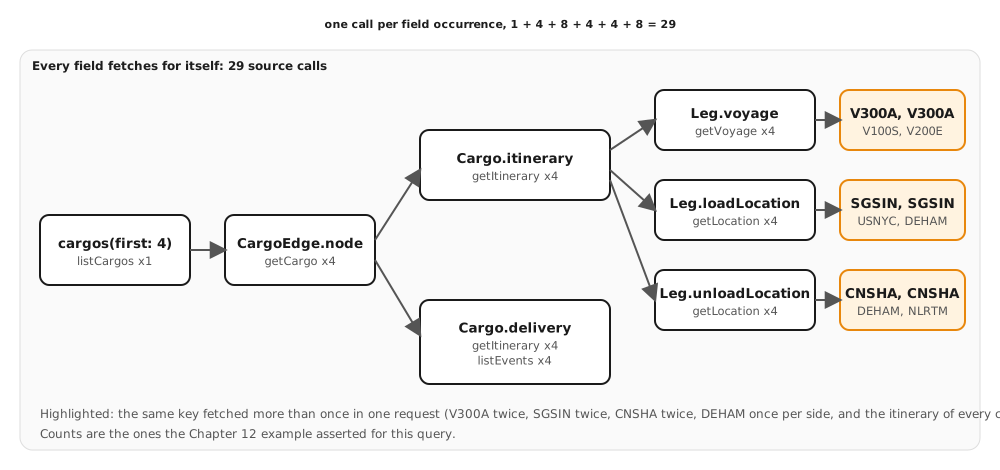
Several of those calls ask for the same thing. V300A is fetched twice because two cargos share a route, and every cargo’s itinerary is fetched twice because two fields need it. Chapter 7 showed the smallest version of this, two aliases on one leg costing four voyage calls, and Chapter 1 predicted the large one: a cargo with six legs and twelve events resolves twenty-four locations one at a time. The cost grows with the data, and the client controls the data.
Batching by owner
The fix starts from what the engine already does. A field’s resolver runs only after its parent has resolved, and siblings run together (Chapter 6), so the fields that want the same owner are asked for at about the same moment. Instead of one call per field, make one call per owner for all the keys asked at that moment.
Figure 13.2 shows the result for the same query. The page is still one call. The four cargos load in one getCargos call. Their itineraries and events load in one getItineraries call and one listEventsFor call. The voyages of the legs are one getVoyages call, and the locations are one getLocations call. A call waits for the call its keys come from, because those keys are in its results, and calls whose keys come from the same place run together.
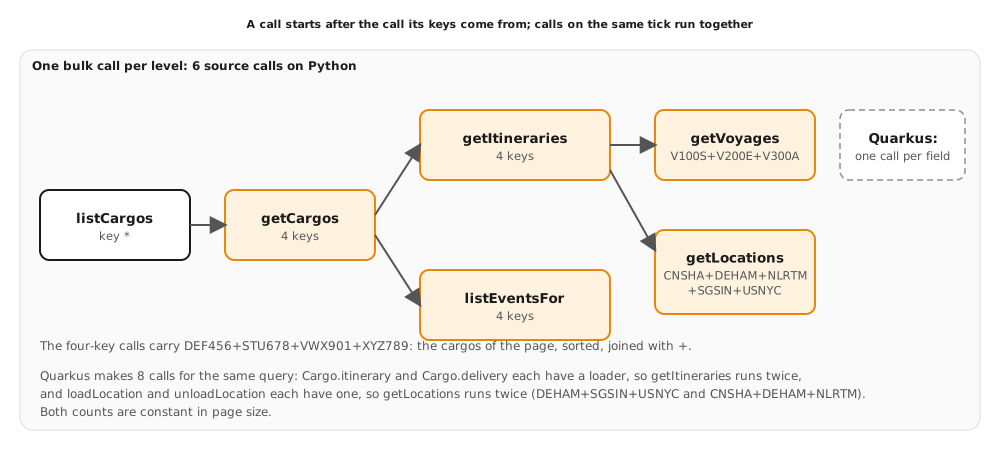
The number of calls now follows the number of fields in the selection, not the number of cargos. verify.sh pages two cargos and five cargos with the same selection and gets the same totals as four on both stacks. Chapter 6’s execution model, siblings together and children after their parent, is what makes this possible. Martin Kleppmann and Chris Riccomini show in Designing Data-Intensive Applications, 2nd edition, in its discussion of response time, how a request that makes several backend calls is as slow as the slowest of them (tail latency amplification); batching cuts the number of calls each request waits on.
The DataLoader contract
The tool that implements this is the DataLoader, an idea Facebook developed in 2010 for batching reads from its key-value back ends, before GraphQL, and published in 2015 as the JavaScript dataloader library. Its contract is small:
- Keys in, values out, same order. A loader’s function receives a list of keys and returns a list of values of the same length, in the same order. The caller of
load(key)gets the value at its key’s position. - Not found is a value. An unknown key gets
nullat its position.nodes(ids: ["voy_V999X", "voy_V100S"])returns[null, {Voyage V100S}]with no error, and the onegetVoyagescall carries both keys. - Failure can be per key. A key’s slot may hold a failure instead of a value. Whether that spares the other keys depends on the implementation, which is the last section’s subject.
- Keys are deduplicated and cached within a request. Asking for the same key twice in one request costs one lookup. The cache lives as long as the loader and no longer.
The last point carries the safety rule of the whole chapter. A cache that outlives a request serves stale data to the next one, and the handling store in this example changes between requests. A loader belongs to one request. It is created when the request starts and dropped when it ends, which the example proves with a write: after a handling event is registered, both the mutation’s payload and a fresh query report the new status.
The tick
A loader has to decide when to stop collecting keys and make the call. Each stack answers with a tick: a point in the execution when every field that is going to ask at this level has already asked.
On Strawberry the tick is the event loop’s next turn. DataLoader.load returns a future and, for the first key of a new batch, schedules the dispatch with loop.call_soon. Every resolver that runs before the loop’s next turn adds its key to the same batch. When the dispatch runs, the loader calls its function once with the distinct keys. A resolver that awaited a loader resumes after its batch returns, and its children start the next level.
On Quarkus the tick belongs to graphql-java. SmallRye turns a resolver with a @Source List<...> parameter into a batch data fetcher, which uses a loader from the java-dataloader library, one per such method per request. The engine dispatches a level’s loaders once the fields of that level have been fetched. The mechanism differs, and the observable result is the same: one call per loader per batch. graphql-java holds a level’s dispatch until the whole level above has completed, so on Quarkus the voyages also wait for the delivery batch. Strawberry has no such barrier.
Figure 13.3 is drawn from one real run of the four-cargo query on the Python stack, from the source-call log at /debug/source-calls. The thin ticks are the load calls queued before each dispatch. The bars are the bulk calls, and each starts as the call its keys come from ends. The lower lane is not measured. It places Chapter 12’s four getCargo calls at the cargo level’s interval: they ran together too, so the wall time was the same, but each was a call to the booking service.
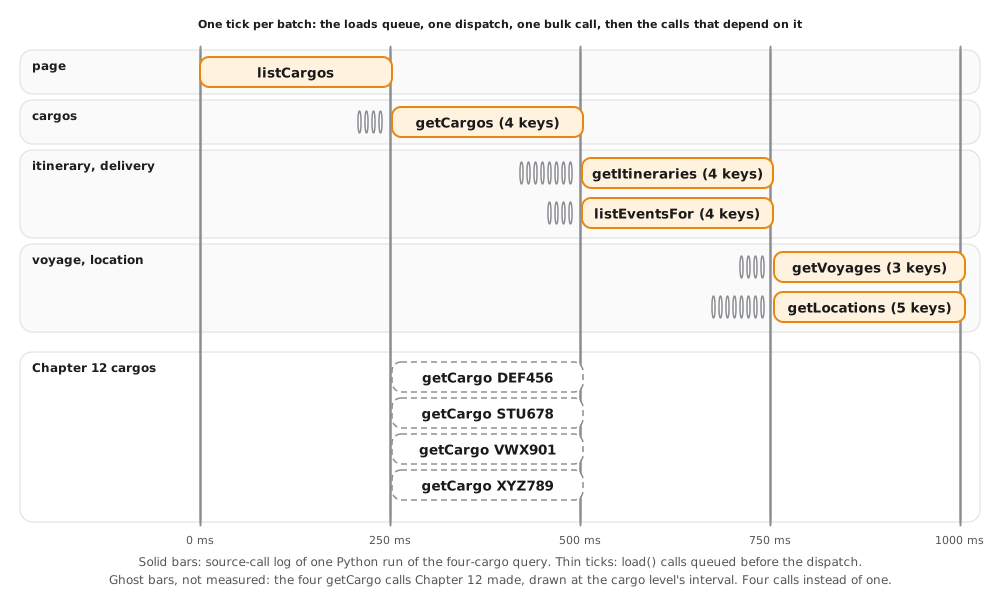
verify.sh asserts the order and the overlap from the log and never a duration. On both stacks listCargos ends before getCargos starts, getCargos ends before listEventsFor starts, and getVoyages overlaps the location call or calls. On Quarkus listEventsFor also ends before getVoyages starts, the level barrier. On Python getItineraries ends before getVoyages starts, and getItineraries overlaps listEventsFor. All of it sits under one request id.
Batching on SmallRye
A SmallRye field resolver that takes @Source Leg is called once per leg. Change the parameter to @Source List<Leg> and SmallRye calls it once per level with all the legs the level collected, and the method returns one value per leg in the same order. The batch resolver for Leg.voyage, next to the Python resolver that uses a loader:
@Description("The voyage that carries this leg. Null when the voyage service is unavailable.")
public Uni<List<Voyage>> voyage(@Source List<Leg> legs, Context context) {
    return voyages.getVoyages(context.getExecutionId(), legs.stream().map(Leg::voyageNumber).toList())
            .map(Outcome::values);
}
@strawberry.field(
    description="The voyage that carries this leg. Null when the voyage service is unavailable."
)
async def voyage(self, info: Info[TrackingContext]) -> Voyage | None:
    return await info.context.loaders.voyage.load(self.voyage_number)
The Quarkus method is the whole implementation. There is no loader to declare or register; the batching is the List in the signature. Three details were checked on the pinned versions. A batch method may return Uni<List<T>>, and the field keeps type T. It accepts the SmallRye Context, and getExecutionId() read at entry is the request’s id, the same one every other resolver sees. And @NonNull on a batch method makes the field non-null, not the list: loadLocation is still Location!. The conformance check confirms that no batch method changed the schema.
The two aliases of Chapter 7, a: voyage and b: voyage on the same leg, ask the same loader for the same leg. The loader’s cache key is the source object, Leg is a record with value equality, and the two loads become one. The log shows one getVoyages call, V100S+V200E, where Chapter 7 counted four.
Query.nodes is the exception. A root field has no parents for the engine to collect, so there is nothing to batch with @Source. It groups its own ids by prefix and calls one bulk operation per type: five ids make three calls, booking.getCargos for ABC123+XYZ789, location.getLocations for DEHAM+NLRTM and voyage.getVoyages for V100S, down from five. The order of the answer is the order of the ids, and an unknown id is null at its position. Chapter 10’s list with cargo_ABC123 twice costs three calls instead of four: the duplicate travels once. Events have no bulk read, so each evt_ id is still its own getEvent call.
DataLoaders on Strawberry
Strawberry’s DataLoader is built from a function, so the example builds five of them, one per kind of key, in app/loaders.py. The Quarkus tab is the bulk source operation the batch method calls; the Python tab is the load function over the same operation, inside Loaders.for_request, and the loader that wraps it:
public Uni<List<Outcome<Voyage>>> getVoyages(String request, List<String> numbers) {
    return calls.callBatch(request, "voyage", "getVoyages", numbers, data::voyage);
}
class Loaders:
    ...

    @classmethod
    def for_request(
        cls,
        booking: BookingSource,
        routing: RoutingSource,
        voyage: VoyageSource,
        location: LocationSource,
        handling: HandlingSource,
    ) -> Loaders:
        ...

        async def load_voyages(keys: list[str]) -> list[Voyage | None | Exception]:
            return _in_key_order(await voyage.get_voyages(keys))

        ...

        return cls(
            ...
            voyage=DataLoader(load_fn=load_voyages),
            ...
        )
The loaders are created per request in the context getter, which FastAPI calls once for each request:
return TrackingContext(
    request_id,
    booking,
    routing,
    voyage,
    location,
    handling,
    _DERIVATION,
    Loaders.for_request(booking, routing, voyage, location, handling),
)
Because the loaders hang off the request’s context, they cannot be shared between requests by accident. A loader at module level would be shared by every request, its cache would outlive them, and a handling event registered in one request would stay invisible to the next. The request-scope case in verify.sh runs the same query twice and finds two request ids, each with its own full set of calls: 6 and 6 on Python, 8 and 8 on Quarkus, nothing carried over.
The bulk operations on both stacks answer one outcome per key. The Python source returns an Outcome with a value or an error, and the loader function turns each into the value or the exception instance at that key’s position. Strawberry then fails only the load of a key whose slot holds an exception. It raises WrongNumberOfResultsReturned if the function returns a list of the wrong length, which is the contract’s first rule enforced.
Per field versus per key
The two stacks disagree on one count, and the disagreement is structural. Quarkus makes 8 calls for the four-cargo query and Python makes 6.
SmallRye has one loader per batch method, keyed by the parent object. Leg.loadLocation and Leg.unloadLocation are two methods, so they have two loaders, and each makes its own getLocations call: DEHAM+SGSIN+USNYC for the load side and CNSHA+DEHAM+NLRTM for the unload side. DEHAM travels in both. For the same reason Cargo.itinerary and Cargo.delivery each have a loader and each call getItineraries with the same four cargos. That is the two extra calls.
Strawberry’s loaders are keyed by the value that identifies the thing, a UN/LOCODE or a tracking id, and any field that wants a location uses the one location loader. loadLocation and unloadLocation share it, so DEHAM is one key loaded once, and the single call carries all five codes. Cargo.itinerary and Cargo.delivery share the itinerary loader. The same applies to Chapter 7’s pair, an itinerary and a delivery on one cargo: one routing call on Python and two on Quarkus.
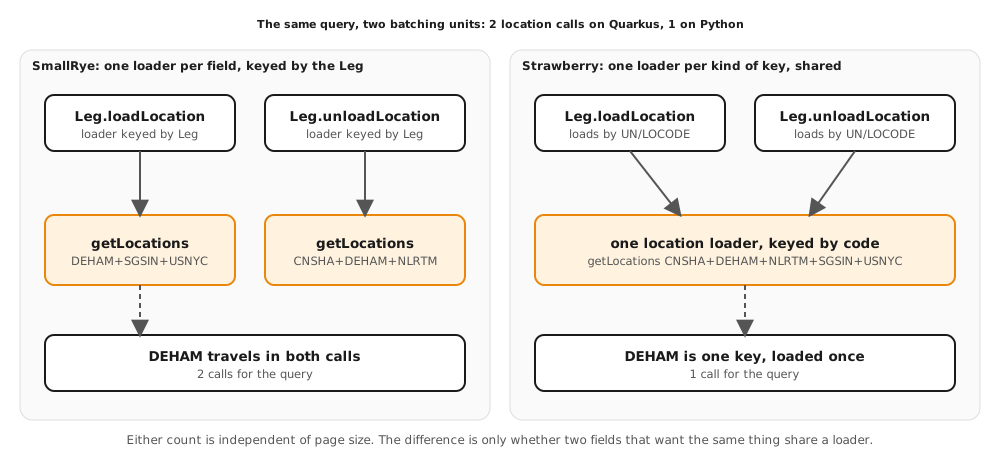
Both counts are fixed by the shape of the query and do not grow with the page. The Quarkus difference is the price of using the framework’s own batching, one loader per batch method. It is a constant, not a multiplier, and the N+1 is gone. Sharing one loader across fields would mean a hand-built request-scoped cache, which the example leaves out. Chapter 16 covers caching at the request and response level. The example accepts the two extra calls and shows them.
Where batching sits
Batching only helps if the owner can answer in bulk. Each source in the example gained a bulk operation next to its single-key one: getCargos, getItineraries, getVoyages, getLocations and listEventsFor. A bulk operation takes a list of keys and returns one outcome per key, in order: the value, null for an unknown key, or the failure that key alone hit. The log records the call once, under the sorted distinct keys joined with +, so V100S+V200E+V300A is one call for three voyages.
The single-key operations stay for the places that have only one key: Query.cargo, Query.voyage, Query.location, Query.node and the mutation. No resolver below a list calls them, and the case that counts Q_FAN asserts it: zero getCargo, getItinerary, listEvents, getVoyage and getLocation calls.
An owner may cap how many keys one call accepts. Strawberry’s DataLoader takes a max_batch_size that splits a large batch into several calls, and a bulk operation behind a service with such a cap should set it. The example’s sources have no cap and the example does not set one.
The history fan-out of Chapter 1 shows the same rule on a different shape. Seven events of DEF456, each with a location and, for four of them, a voyage, cost 7 + 4 calls in Chapter 12. Now they cost one getLocations call for DEHAM+NLRTM+USNYC and one getVoyages call for V100S+V200E, on both stacks. The three events without a voyage never reach the voyage service, so the resolver asks only for the keys it has. The same holds for Chapter 1’s twenty-four locations, a cargo with six legs and twelve events resolved one at a time. The count follows the fields of the selection, not the number of legs and events: asking DEF456 for its legs’ load and unload locations and its history’s event locations, eleven lookups before batching, makes three getLocations calls on Quarkus, one per location field, and one on Python. Each event’s cargo batches the same way: seven events of DEF456 make one getCargos call.
A failing key in a batch
GHI345 is the cargo the booking service lists and cannot load. That makes it the test of the contract’s third rule. cargos(last: 2) returns the last page, ABC123 and GHI345, and the two nodes load in one getCargos call with ABC123+GHI345. What happens next differs by stack, and Figure 13.5 shows both.
On Strawberry, the loader function returns [Cargo ABC123, SourceUnavailable], with the exception instance at GHI345’s position. Only that key fails. The response has one execution error (older editions of the specification call it a field error), with the path ["cargos","edges",1,"node"], the code SERVICE_UNAVAILABLE and the message booking service unavailable. Edge 0 resolves as ABC123, and the failed edge’s node is null: Chapter 12’s fuse, now behind a batch.
On Quarkus, a batch method returns one list, so a failure is the failure of the whole Uni. Outcome.values throws the first failure and every parent in the batch gets it. The response has two errors, one at each edge’s node path, both with the code SERVICE_UNAVAILABLE, and both nodes are null, ABC123’s included.
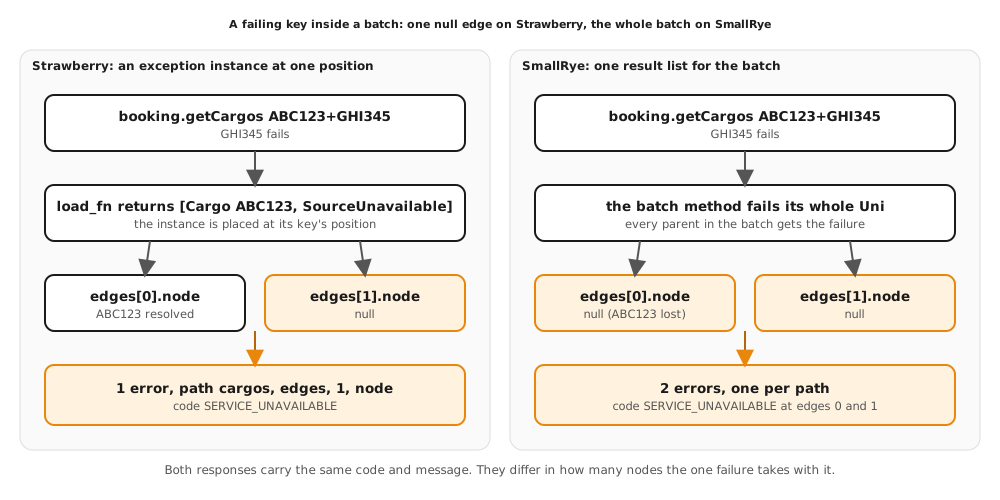
The example keeps the Quarkus behaviour as it is. The two outcomes follow from how each stack resolves a batch, and the choice they imply is where failures should be caught. A source whose keys can fail on their own, and whose clients need the other keys, should handle that inside the batch method or give the field a type that can hold a failure. The error codes themselves are Chapter 9’s, and the null that stops at node is Chapter 12’s. Chapter 6 and Chapter 9 cover the HTTP status that carries either response.
Scope: one request
Everything here lives and dies with a request. The cache inside each loader makes a repeated key within one request free, and it is dropped with the request. That is why the handling write case passes: registerHandlingEvent for an unload of ABC123 at DEHAM returns evt_10, the payload’s delivery.transportStatus is IN_PORT, and a separate query a moment later says the same.
A cache that spans requests is a different tool with different obligations: expiry, invalidation when a write lands, and keys that include who is asking. Chapter 16 builds caching at the request and response levels and deals with those. A DataLoader is not the place to start.
On the wire
Start the stack. Quarkus is on 8230 and Python on 8231, and compose sets TRACKING_SOURCE_LATENCY_MS=250 and TRACKING_DEBUG_ENDPOINTS=true.
docker compose -f examples/13-dataloaders/compose.yaml up -d --build
Q() {
  curl -s localhost:${2:-8230}/graphql -H 'Content-Type: application/json' \
    -d "$(python3 -I -c 'import json,sys; print(json.dumps({"query": sys.argv[1]}))' "$1")"; echo
}
LOG() {
  curl -s localhost:${1:-8230}/debug/source-calls | python3 -I -c 'import json,sys
for c in json.load(sys.stdin)["calls"]: print("%s.%s:%s" % (c["source"], c["op"], c["key"]))'
}
Reset the log, send the four-cargo query to the Python stack and read the log:
curl -s -X DELETE localhost:8231/debug/source-calls
Q '{ cargos(first: 4) { edges { node { trackingId itinerary { legs { voyage { number } loadLocation { unLocode } unloadLocation { unLocode } } } delivery { transportStatus } } } } }' 8231 >/dev/null
LOG 8231
booking.listCargos:*
booking.getCargos:DEF456+STU678+VWX901+XYZ789
routing.getItineraries:DEF456+STU678+VWX901+XYZ789
handling.listEventsFor:DEF456+STU678+VWX901+XYZ789
voyage.getVoyages:V100S+V200E+V300A
location.getLocations:CNSHA+DEHAM+NLRTM+SGSIN+USNYC
Quarkus logs eight calls for the same request, with the itinerary key and the two location keys twice:
booking.listCargos:*
booking.getCargos:DEF456+STU678+VWX901+XYZ789
routing.getItineraries:DEF456+STU678+VWX901+XYZ789
handling.listEventsFor:DEF456+STU678+VWX901+XYZ789
routing.getItineraries:DEF456+STU678+VWX901+XYZ789
location.getLocations:DEHAM+SGSIN+USNYC
voyage.getVoyages:V100S+V200E+V300A
location.getLocations:CNSHA+DEHAM+NLRTM
The nodes fan-out, five ids and three calls:
curl -s -X DELETE localhost:8231/debug/source-calls
Q '{ nodes(ids: ["cargo_ABC123", "cargo_XYZ789", "loc_DEHAM", "loc_NLRTM", "voy_V100S"]) { __typename id } }' 8231
LOG 8231
{"data":{"nodes":[{"__typename":"Cargo","id":"cargo_ABC123"},{"__typename":"Cargo","id":"cargo_XYZ789"},{"__typename":"Location","id":"loc_DEHAM"},{"__typename":"Location","id":"loc_NLRTM"},{"__typename":"Voyage","id":"voy_V100S"}]}}
booking.getCargos:ABC123+XYZ789
location.getLocations:DEHAM+NLRTM
voyage.getVoyages:V100S
The failing key, as each stack answers it. Quarkus:
Q '{ cargos(last: 2) { edges { node { trackingId } } } }' 8230
{"errors":[{"message":"booking service unavailable","locations":[{"line":1,"column":29}],"path":["cargos","edges",0,"node"],"extensions":{"code":"SERVICE_UNAVAILABLE"}},{"message":"booking service unavailable","locations":[{"line":1,"column":29}],"path":["cargos","edges",1,"node"],"extensions":{"code":"SERVICE_UNAVAILABLE"}}],"data":{"cargos":{"edges":[{"node":null},{"node":null}]}}}
Python:
Q '{ cargos(last: 2) { edges { node { trackingId } } } }' 8231
{"data":{"cargos":{"edges":[{"node":{"trackingId":"ABC123"}},{"node":null}]}},"errors":[{"message":"booking service unavailable","locations":[{"line":1,"column":29}],"path":["cargos","edges",1,"node"],"extensions":{"code":"SERVICE_UNAVAILABLE"}}]}
Stop the stack and remove its state when done:
docker compose -f examples/13-dataloaders/compose.yaml down -v
Timestamps and column numbers can differ by stack. The keys, counts, paths and codes do not, except where the table says so.
| Check | Quarkus | Python |
|---|---|---|
first cursor of cargos(first: 2) |
base64url of cargo\|v1\|2026-09-29T09:00:00Z\|VWX901 |
the same |
| four-cargo query | VWX901, XYZ789, STU678, DEF456; 8 calls |
the same data; 6 calls |
| bulk keys | getCargos and listEventsFor DEF456+STU678+VWX901+XYZ789; getVoyages V100S+V200E+V300A; getItineraries that key twice; getLocations DEHAM+SGSIN+USNYC and CNSHA+DEHAM+NLRTM |
the same four keys; getItineraries once; getLocations CNSHA+DEHAM+NLRTM+SGSIN+USNYC once |
| single-key fan-out | 0 getCargo, getItinerary, listEvents, getVoyage, getLocation |
the same |
| page size | two and five cargos make the same total as four | the same |
| order | listCargos before getCargos before listEventsFor before getVoyages; voyage and both location calls overlap; one request id |
listCargos before getCargos before listEventsFor; getItineraries before getVoyages; getItineraries overlaps listEventsFor; getVoyages overlaps the location call |
| alias pair | one getVoyages call, V100S+V200E; all four aliases carry their voyage |
the same |
| itinerary and delivery | 2 getItineraries calls, ABC123 each |
1 |
DEF456 history, first: 7 |
one getLocations DEHAM+NLRTM+USNYC, one getVoyages V100S+V200E, plus pageEvents and the root getCargo; voyages null,null,V200E,V200E,V100S,V100S,null |
the same |
nodes, five ids |
types and ids in the order asked; three calls | the same |
nodes with cargo_ABC123 twice and nope |
[Cargo, Location, null, Voyage, Cargo] by position; three calls: getCargos ABC123, getLocations NLRTM, getVoyages V200E (Chapter 10: four) |
the same |
history, each event’s cargo |
getCargo DEF456, pageEvents DEF456, one getCargos DEF456 |
the same |
DEF456 legs’ locations and history locations |
three getLocations calls, one per location field |
one getLocations call |
| two requests | two request ids; 16 calls, 8 each | 12 calls, 6 each |
voyage(voyageNumber: "V999X") |
null, no error, one getVoyage V999X |
the same |
nodes(ids: ["voy_V999X", "voy_V100S"]) |
[null, {Voyage V100S}]; one getVoyages V100S+V999X |
the same |
cargos(last: 2) |
listCargos, one getCargos ABC123+GHI345; 2 errors at edges.0.node and edges.1.node, both SERVICE_UNAVAILABLE; both nodes null |
the same two calls; 1 error at edges.1.node, SERVICE_UNAVAILABLE, booking service unavailable; node 0 is ABC123 |
unload of ABC123 at DEHAM on V100S, 2026-10-09T15:00:00Z |
evt_10; payload and fresh query say IN_PORT |
the same |
| deprecation and schema | finalArrivalDate deprecated with Use `finalArrivalTime`.; conforms to contracts/schema/; only Subscription is unserved |
the same |
bash examples/13-dataloaders/verify.sh runs the whole sequence on both stacks and prints PASS only when both hold.
Decision
Batching is where the aggregation across sources axis of Chapter 2 pays its bill: a graph that joins many owners must fetch from each in bulk, or every list multiplies every owner's load. The operational and security cost axis decides the scope and the limits: a loader belongs to one request, a bulk operation takes a bounded list of keys, and a batch that mixes keys from different clients must not leak between them, which is why nothing here outlives a request. The contract and evolution style axis is untouched, because batching changed no field, argument or nullability. The tracking view therefore batches every source-backed field under a list, with @Source List resolvers on SmallRye and per-request DataLoaders on Strawberry, accepts the two extra calls that per-field loaders cost on Quarkus, and leaves caching across requests to Chapter 16.
Where this goes next
This chapter counted 29 source calls for a four-cargo page and brought them to 8 on Quarkus and 6 on Python: bulk source operations, one loader per field on SmallRye and one per kind of key on Strawberry, a tick that collects a level’s keys, a missing key as a null, per-request scope, and a failing key that costs one node on one stack and the whole batch on the other.
Chapter 14 treats the page size and the selection depth as inputs to query cost. Batching bounds the number of calls a selection makes, and cost analysis bounds the selection itself.
For the batching rules, read the graphql-java documentation on batching and the java-dataloader project it builds on, and the Strawberry guide to DataLoaders. The SmallRye side is in the Quarkus SmallRye GraphQL guide and the SmallRye GraphQL documentation. Samer Buna’s GraphQL in Action covers caching and batching with DataLoader in “Optimizing data fetching”. Martin Kleppmann and Chris Riccomini’s Designing Data-Intensive Applications, 2nd edition, covers the cost of fanning one request out to many backend calls. Both books are on the Bibliography page.