Evolution and versioning
How a GraphQL schema changes while clients depend on it: one schema without version numbers, safe, dangerous and breaking changes, nullability in both directions, the deprecation lifecycle on both stacks, and the breaking-change gate run on fixtures.
Ten chapters built a schema and served it. Every client that selects a field from it makes the same bet, that the field will still be there next year. The tracking view has clients nobody on the team has met: a dashboard, a mobile app, a partner’s integration. This chapter is about keeping that bet safe while the schema keeps changing.
The code is in examples/11-evolution/. It starts from the Chapter 10 example and applies the one change the earlier chapters kept promising. Itinerary.finalArrivalTime joins the schema, and Itinerary.finalArrivalDate is deprecated in favour of it. Both stacks serve both fields, and verify.sh checks the deprecation through introspection. It then runs the breaking-change gate from Chapter 5, contracts/scripts/breaking.sh, against fixture copies of the contract, one edit per case, to show what each kind of change costs.
One schema, many clients, no version numbers
A REST API that must change in a way old clients cannot survive usually grows a second door, /v2, and keeps the first one open until the last client leaves. GraphQL has no equivalent need for most changes, because a client states exactly which fields it reads. A field the client never selected can appear, change or vanish without touching it. The server evolves one schema, continuously, and the contract is whatever the clients actually select.
That turns the question around. The server does not ask “which version is this client on?” It asks “does any client still select this?” Three habits follow:
- Add, do not change. A new field, a new optional argument or a new type costs existing clients nothing.
- Deprecate before removing. A field marked deprecated keeps working and tells every tool that reads the schema to stop using it.
- Remove only with evidence. A field leaves when nobody selects it, and the gate makes sure it is a recorded decision.
Martin Kleppmann and Chris Riccomini’s Designing Data-Intensive Applications, 2nd edition, names the compatibility directions in its treatment of how formats change over time. Backward compatibility means newer code can read data written by older code. Forward compatibility means older code can read data written by newer code. An API contract has both. A new server must keep answering the queries old clients send, which is backward compatibility, and a client built against a newer schema may reach a server that has not been upgraded yet during a rollout, which is the forward direction. Additive evolution with deprecation keeps both true without a version number.
The slowest client sets the pace. A web client redeploys with the server, but a mobile app on a phone, or a partner’s integration, may run a query written a year ago. Deprecation gives those clients a window, and the schema gives their authors a machine-readable reason to move: the generated types flag the field, and an editor strikes it through. The server keeps its side of the bargain by not deleting the field until the usage says the window can close.
A new endpoint is still justified in a few cases. The whole aggregation root changes, so that no old query can be answered by the new model. The authentication scheme changes for everyone. The transport changes. These are rewrites of the contract and not edits to it, and they should be rare enough to plan. Everything else in this chapter assumes one endpoint, one schema and a stream of small changes.
Safe, dangerous, breaking
GraphQL Inspector sorts every change into one of three classes, from the point of view of a client of the old schema. Figure 11.1 lists one change in each class, with the line the tool prints for it and the result the gate gives.
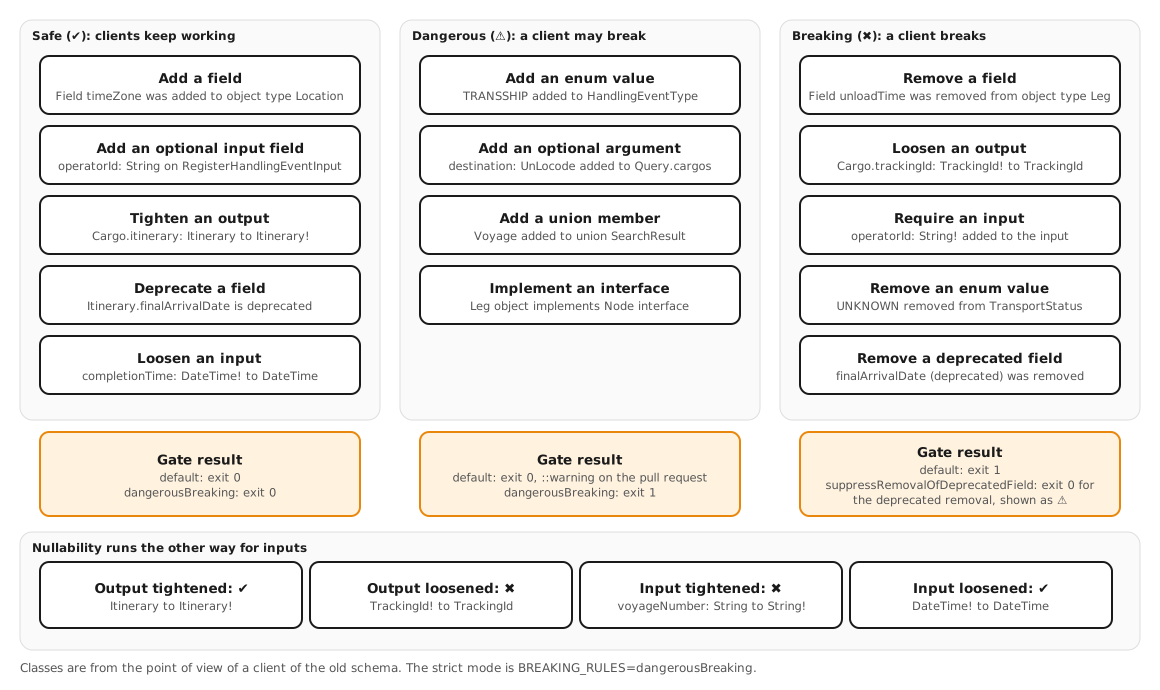
Safe changes cannot break any query that was valid before. A new field on Location, a new optional field on RegisterHandlingEventInput, and a newly deprecated field all print a check mark. Chapter 8 made voyageNumber and idempotencyKey optional from the start so that the input could grow this way.
Dangerous changes keep every old query valid and can still break a client at run time. A new value in HandlingEventType is the case Chapter 3 warned about: a client with an exhaustive switch meets a value it has never seen. A new optional argument on Query.cargos is flagged for a different reason: old queries stay valid, but the resolver behind them has changed, and the tool cannot tell whether a query that omits the argument still gets the same result. Chapter 9 expected the same risk in a new union member, and the tool agrees: adding Voyage to a union prints ⚠ Member Voyage was added to Union type SearchResult. For interfaces the tool classifies by the type that changed. An existing type that starts to implement Node prints ⚠ Leg object implements Node interface. A brand-new type that implements Node prints ✔ Type Vessel was added; Query.node can return a Vessel from then on, and a client with no default branch meets it as it would a new union member, so reviewers treat a new implementer as a dangerous change.
Breaking changes make some valid old query invalid or change its result type. Removing Leg.unloadTime, removing the enum value UNKNOWN, adding a required input field and loosening Cargo.trackingId from TrackingId! to TrackingId all print a cross and fail the gate.
The classes describe risk, not correctness. A dangerous change is often the right one: a handling event type for transshipment is a real requirement. The class tells reviewers where to look, and the next sections show how this chapter’s gate treats each class.
Nullability cuts both ways
Chapter 4 made nullability a promise, and promises change in two directions. For an output field, the server promises a value, so tightening is safe and loosening is not. For an input field, the client promises a value, so the rule flips. The fixtures cover all four moves, each with the line the tool printed:
| Move | Fixture edit | Class | Printed |
|---|---|---|---|
| Output tightened | itinerary: Itinerary to Itinerary! on Cargo |
safe | ✔ Field Cargo.itinerary changed type from Itinerary to Itinerary! |
| Output loosened | trackingId: TrackingId! to TrackingId on Cargo |
breaking | ✖ Field Cargo.trackingId changed type from TrackingId! to TrackingId |
| Input tightened | voyageNumber: String to String! |
breaking | ✖ Input field RegisterHandlingEventInput.voyageNumber changed type from String to String! |
| Input loosened | completionTime: DateTime! to DateTime |
safe | ✔ Input field RegisterHandlingEventInput.completionTime changed type from DateTime! to DateTime |
A client written for a nullable output already handles a value, so a non-null promise costs it nothing. A client written for a non-null output has no code for null, so loosening it breaks the client. A new required input field breaks every caller that does not send it, and the same holds for tightening an optional one.
The first row has a catch, and Chapter 5 set it up. The gate says a tightened output is safe, and for clients it is, but for the server it removes the fuse. With itinerary: Itinerary! a routing outage on one cargo no longer costs one field. The null travels up to Query.cargo, and the client loses the whole cargo. That is the failure Chapter 4 designed Cargo.itinerary to avoid, and the breaking gate cannot see it, because the tool classifies the change by what clients can write and not by what the server can survive. The conformance check from Chapter 5 does see it, because it diffs each stack against the contract in both directions. The two checks answer different questions, and the contract needs both.
The deprecation path, live
The correction that Chapter 10 left open is now in the contract:
"""When the final leg arrives."""
finalArrivalTime: DateTime!
"""When the final leg arrives."""
finalArrivalDate: DateTime! @deprecated(reason: "Use `finalArrivalTime`.")
The change takes three steps in the order the lifecycle demands. First, the replacement is added, so that clients can move before anything is taken away. Second, the old field is marked @deprecated with a reason that names the replacement. Third, the old field stays fully functional. Both stacks answer one query with the same instant in both fields, and the response carries no warning about the deprecated one:
{ cargo(trackingId: "ABC123") { itinerary { finalArrivalTime finalArrivalDate } } }
verify.sh asserts both values are 2026-10-11T18:00:00Z, that the response has no errors and no mention of deprecation, and that a query selecting only finalArrivalDate is served as before. A deprecated field is a signal to tools and humans, and not a behaviour change. Cargo.delivery now reads the arrival from finalArrivalTime, and estimatedTimeOfArrival still returns the same value.
The signal travels through introspection. The September 2025 edition of the GraphQL specification defines the @deprecated directive, with a reason that defaults to “No longer supported”, and describes in “Schema Introspection” how __Field reports isDeprecated and deprecationReason. It also defines a hiding rule: the fields selection on __Type takes includeDeprecated, which is false unless a client asks for it. So a code generator or an editor that lists fields shows only the supported ones, and a client that wants the whole history can ask:
{ __type(name: "Itinerary") { fields(includeDeprecated: true) { name isDeprecated deprecationReason } } }
verify.sh asserts, on both stacks, that fields returns finalArrivalTime and legs and no finalArrivalDate, that fields(includeDeprecated: false) returns the same, and that fields(includeDeprecated: true) adds it. assert_deprecated checks that isDeprecated is true and that the reason equals Use `finalArrivalTime`. exactly. assert_not_deprecated checks the replacement. A third assertion walks every type and counts the deprecated elements across fields, arguments, input fields and enum values: the only one in the schema is Itinerary.finalArrivalDate.
The reason string is the part a client author reads, so it should name the replacement and nothing else. A reason like “legacy” gives no direction.
Removing a field with a sign-off
Deprecation without removal is a note nobody acts on, and removal without evidence is an outage. Figure 11.2 shows the whole lifecycle with the gate’s output at each step.
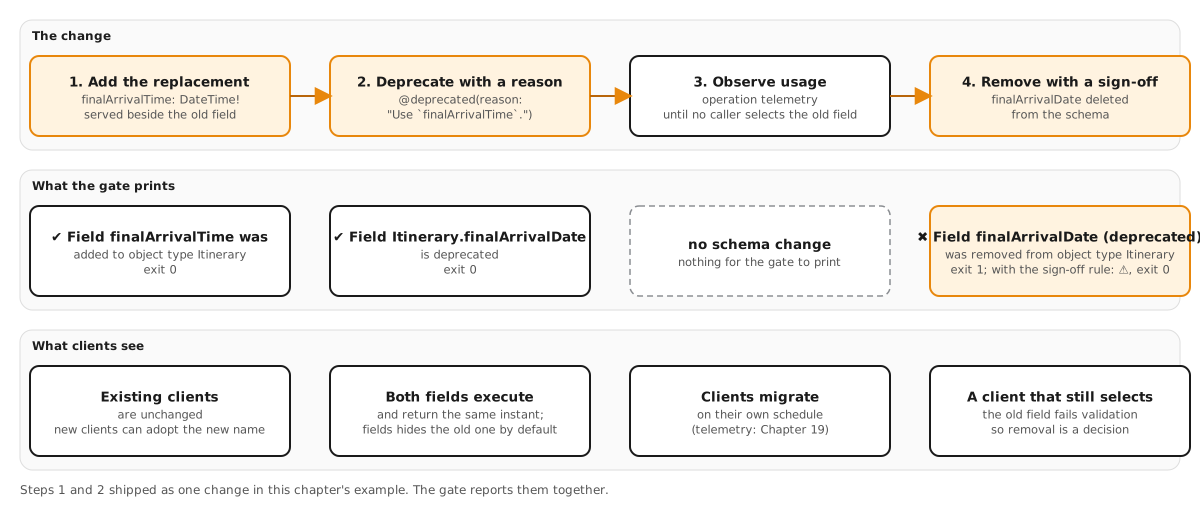
The first two steps ship together in this chapter, and the gate reports them as one change: ✔ Field Itinerary.finalArrivalDate is deprecated and ✔ Field finalArrivalTime was added to object type Itinerary. Then comes the waiting. Operation-level telemetry, which Chapter 19 builds, shows which clients still select finalArrivalDate. Until that count is zero, the field stays.
Removal fails by default, with a message that says what was deleted: ✖ Field finalArrivalDate (deprecated) was removed from object type Itinerary. That failure is intended. Deleting a deprecated field is still a breaking change for any client that never moved, so the gate does not relax because the field was marked. A pull request that removes it after the usage evidence is in can say so by setting the suppressRemovalOfDeprecatedField rule. The same line then prints with a warning sign, ⚠ Field finalArrivalDate (deprecated) was removed from object type Itinerary, and the gate exits 0. The rule is a sign-off recorded in the pull request, not a default.
A client that selects the removed field after the removal fails validation, and the request returns no data. verify.sh checks that failure shape with a field the schema does not have, finalArrivalDay: an error naming it, and no data.
Running the gate
contracts/scripts/breaking.sh, available as npm --prefix contracts run breaking, compares the working tree’s contracts/schema/**/*.graphql with the same files on a base ref, origin/main by default. It extracts the base with git archive, runs graphql-inspector diff between the two and exits with the tool’s code, 0 for a pass and 1 for a breaking change, or with 2 when the base ref does not resolve.
When the base ref holds no .graphql files under contracts/schema, as on the pull request that first adds the contract, the script prints no baseline schema on origin/main yet - skipping breaking check (first introduction) and exits 0. A base ref that does not resolve exits 2 instead, so a missing fetch cannot pass by accident. To show each kind of change without a commit per case, this chapter runs the gate on fixture directories. Three environment variables make that possible:
| Variable | Effect |
|---|---|
BASE_DIR=<dir> |
Compare against a directory of .graphql files instead of a git ref |
NEW_DIR=<dir> |
Use a directory as the new side instead of the working tree |
BREAKING_RULES=<list> |
Pass each comma-separated name to the tool as a --rule |
Once a baseline exists on main, every later change to the contract is diffed against it with no fixtures involved, and these variables remain the way to test the gate itself.
verify.sh builds each fixture the same way. It copies contracts/schema into a base directory and a new directory, applies one textual edit to the new side and runs assert_gate, which passes only when the exit code and a needle from the tool’s output both match. The edit is a replacement that must match exactly once:
edit() {
  python3 -I -c '
import sys

path, old, new = sys.argv[1:4]
text = open(path, encoding="utf-8").read()
if text.count(old) != 1:
    sys.exit("fixture did not apply: %d occurrences in %s of %r" % (text.count(old), path, old))
open(path, "w", encoding="utf-8").write(text.replace(old, new))
' "$@" || { echo "lib.sh: FAIL — fixture did not apply: $1" >&2; return 1; }
}
The guard matters. A fixture whose edit silently did nothing would report “no changes” and pass a case that expected a failure. The needles are full change lines, including the check, warning or cross mark, so the test pins the classification as well as the exit code. The cases run once, after both stack checks, and not per stack, because the contract is the same for both.
Should dangerous changes fail?
The default gate fails only on breaking changes. A dangerous change exits 0, and the result is a decision for the reviewer, not a red build. An added enum value or an added optional argument is routine evolution. A gate that blocks it teaches teams to avoid the evolution that GraphQL makes cheap, or to switch the gate off.
The warning still has to be seen. When the script runs with GITHUB_ACTIONS=true, it echoes each warning-marked line as ::warning title=Dangerous schema change::<line>, which GitHub shows as an annotation on the pull request without failing the job. verify.sh runs the enum-value fixture with that variable set and asserts three facts: exit 0, the annotation prefix, and the change line inside the annotation.
Teams that cannot tolerate that risk, such as a public API with generated clients, can run the strict mode, BREAKING_RULES=dangerousBreaking. The same enum-value fixture then prints ✖ Enum value TRANSSHIP was added to enum HandlingEventType and exits 1. Strict mode changes the verdict and the marker, and it leaves the schema alone.
What the gate cannot see
A diff of two schemas sees structure. Several things that matter during evolution sit outside it.
Behaviour. A field that keeps its name and type and starts returning a different value, such as an arrival time that moves from local time to UTC, is invisible. No schema diff catches it. Behavioural changes need a new field, which the lifecycle above already provides, and tests in the example that assert values.
Default values. The gate sees a default only as text: adding one is dangerous and passes, as Chapter 5 showed. What an omitted argument means to the resolver is invisible, so a server that starts treating a missing first differently changes every caller with no line in the diff. Conformance does not catch a stray default either, because assert_sdl_conforms looks only at breaking lines and descriptions.
Error codes. The extensions.code values from Chapter 9 live in the response, not in the SDL, so no schema diff sees a new code. They follow the enum rules anyway: a client with a default branch survives a new code, and one without it does not. The contract for codes has to be kept in the documentation and in tests.
Deprecation state in conformance. assert_sdl_conforms fails on breaking changes and on description changes. Removing @deprecated is a safe change, so a stack that forgot the deprecation would still conform. verify.sh proves that with a fixture: a copy of the contract without the directive prints ✔ Field Itinerary.finalArrivalDate is no longer deprecated, and assert_sdl_conforms passes against it. That is why Chapters 9 and 10 can serve finalArrivalDate without the directive and still conform, and why this chapter’s example calls assert_deprecated and assert_not_deprecated for each stack. Where a state matters and the structural check ignores it, an explicit assertion covers it.
Evolving the two stacks
Both stacks are code-first, so the deprecation is a line of code in each, and the contract is the yardstick that checks it.
@Type("Itinerary")
@Description("The planned sequence of legs moving a cargo from origin to destination.")
public record Itinerary(
        @NonNull @Description("Ordered legs of the route; never empty for an assigned itinerary.")
                List<@NonNull Leg> legs,
        @NonNull @Description("When the final leg arrives.") Instant finalArrivalTime,
        @NonNull
                @Description("When the final leg arrives.")
                @Deprecated(reason = "Use `finalArrivalTime`.")
                Instant finalArrivalDate) {}
class Itinerary:
    legs: list[Leg] = strawberry.field(
        description="Ordered legs of the route; never empty for an assigned itinerary."
    )
    final_arrival_time: datetime = strawberry.field(description="When the final leg arrives.")
    final_arrival_date: datetime = strawberry.field(
        description="When the final leg arrives.",
        deprecation_reason="Use `finalArrivalTime`.",
    )
Strawberry takes the reason as a keyword argument, deprecation_reason, and introspection reports it with no further work. SmallRye GraphQL offers its own annotation, io.smallrye.graphql.api.Deprecated with a reason. The reason is written once, on the record component, and ContractSchemaDetails, the schema observer the examples already use, applies it to the schema with graphql-java’s deprecate(reason). java.lang.Deprecated carries no reason, so the example uses the SmallRye annotation:
String reason = annotatedDeprecationReason(node);
if (!stripSuffix && reason == null) {
    return TraversalControl.CONTINUE;
}
return changeNode(context, node.transform(field -> {
    if (stripSuffix) {
        field.description(description.substring(0, description.length() - ISO_SUFFIX.length()));
    }
    if (reason != null) {
        field.deprecate(reason);
    }
}));
The annotation stays the one place a developer writes the reason, and the observer reads it from there. The same observer trims the generated ` (ISO-8601) suffix from date descriptions, which keeps the description of the new finalArrivalTime equal to the contract's. The two stacks return fields in different orders, so verify.sh` sorts the names before comparing.
Nothing else in the stacks changed from Chapter 10. verify.sh still runs the scalar checks and the conformance diff on both stacks.
On the wire
Start the stack and ask Quarkus, on port 8210, for both fields. Use 8211 for Python.
docker compose -f examples/11-evolution/compose.yaml up -d --build
gql() { curl -s localhost:8210/graphql -H 'Content-Type: application/json' -d "$1"; echo; }
gql '{"query":"{ cargo(trackingId: \"ABC123\") { itinerary { finalArrivalTime finalArrivalDate } } }"}'
gql '{"query":"{ __type(name: \"Itinerary\") { fields { name } } }"}'
gql '{"query":"{ __type(name: \"Itinerary\") { fields(includeDeprecated: true) { name isDeprecated deprecationReason } } }"}'
{"data":{"cargo":{"itinerary":{"finalArrivalTime":"2026-10-11T18:00:00Z","finalArrivalDate":"2026-10-11T18:00:00Z"}}}}
{"data":{"__type":{"fields":[{"name":"legs"},{"name":"finalArrivalTime"}]}}}
{"data":{"__type":{"fields":[{"name":"finalArrivalDate","isDeprecated":true,"deprecationReason":"Use `finalArrivalTime`."},{"name":"legs","isDeprecated":false,"deprecationReason":null},{"name":"finalArrivalTime","isDeprecated":false,"deprecationReason":null}]}}}
Then run the gate on two copies of the contract, the second without the deprecated field, and again with the sign-off rule:
mkdir -p /tmp/old /tmp/new && cp -r contracts/schema /tmp/old/ && cp -r contracts/schema /tmp/new/
sed -i '/When the final leg arrives/{N;/finalArrivalDate/d}' /tmp/new/schema/shipping/cargo.graphql
BASE_DIR=/tmp/old/schema NEW_DIR=/tmp/new/schema bash contracts/scripts/breaking.sh | tail -2
BASE_DIR=/tmp/old/schema NEW_DIR=/tmp/new/schema BREAKING_RULES=suppressRemovalOfDeprecatedField bash contracts/scripts/breaking.sh | tail -2
[log] ✖  Field finalArrivalDate (deprecated) was removed from object type Itinerary
[error] Detected 1 breaking change
[log] ⚠  Field finalArrivalDate (deprecated) was removed from object type Itinerary
[success] No breaking changes detected
The first command exits 1 and the second exits 0. bash examples/11-evolution/verify.sh runs the checks below on both stacks and then the gate cases:
| Check | Expected |
|---|---|
itinerary { finalArrivalTime finalArrivalDate } for ABC123 |
both 2026-10-11T18:00:00Z; no errors; no mention of deprecation in the response |
itinerary { finalArrivalDate } alone; delivery { estimatedTimeOfArrival } |
2026-10-11T18:00:00Z for both |
Itinerary.finalArrivalDate in introspection |
isDeprecated true, reason Use `finalArrivalTime`. |
Itinerary.finalArrivalTime |
isDeprecated false |
| every deprecated element in the schema | exactly Itinerary.finalArrivalDate |
fields, fields(includeDeprecated: false) |
finalArrivalTime, legs |
fields(includeDeprecated: true) |
finalArrivalDate, finalArrivalTime, legs |
a selection the schema lacks, finalArrivalDay |
an error naming the field; no data |
scalars TrackingId, UnLocode, DateTime |
SCALAR; specifiedByURL null, the UNECE page, RFC 3339 |
live schema vs contracts/schema/ |
conforms (slice) |
npm --prefix contracts run lint |
exit 0 |
| no change | exit 0, No changes detected |
the real change: base without finalArrivalTime and @deprecated |
exit 0, ✔ Field Itinerary.finalArrivalDate is deprecated and ✔ Field finalArrivalTime was added to object type Itinerary |
safe: timeZone: String added to Location |
exit 0, ✔ Field timeZone was added to object type Location |
the same edit with dangerousBreaking |
exit 0, ✔ Field timeZone was added to object type Location |
safe: optional operatorId: String on the input |
exit 0, ✔ Input field operatorId of type String was added to input object type RegisterHandlingEventInput |
safe: itinerary: Itinerary! |
exit 0, ✔ Field Cargo.itinerary changed type from Itinerary to Itinerary! |
safe: completionTime: DateTime on the input |
exit 0, ✔ Input field RegisterHandlingEventInput.completionTime changed type from DateTime! to DateTime |
dangerous: TRANSSHIP added to HandlingEventType |
exit 0, ⚠ Enum value TRANSSHIP was added to enum HandlingEventType; with GITHUB_ACTIONS=true also a ::warning annotation |
the same edit with dangerousBreaking |
exit 1, ✖ Enum value TRANSSHIP was added to enum HandlingEventType |
dangerous: optional destination: UnLocode on Query.cargos |
exit 0, ⚠ Argument destination: UnLocode added to field Query.cargos |
dangerous: Voyage added to a union |
exit 0, ⚠ Member Voyage was added to Union type SearchResult |
dangerous: Leg implements Node |
exit 0, ⚠ Leg object implements Node interface |
safe: a new type Vessel implements Node |
exit 0, ✔ Type Vessel was added |
breaking: Leg.unloadTime removed |
exit 1, ✖ Field unloadTime was removed from object type Leg |
breaking: trackingId: TrackingId on Cargo |
exit 1, ✖ Field Cargo.trackingId changed type from TrackingId! to TrackingId |
breaking: voyageNumber: String! on the input |
exit 1, ✖ Input field RegisterHandlingEventInput.voyageNumber changed type from String to String! |
breaking: required operatorId: String! |
exit 1, ✖ Input field operatorId of type String! was added to input object type RegisterHandlingEventInput |
breaking: UNKNOWN removed from TransportStatus |
exit 1, ✖ Enum value UNKNOWN was removed from enum TransportStatus |
lifecycle: finalArrivalDate removed |
exit 1, ✖ Field finalArrivalDate (deprecated) was removed from object type Itinerary |
the same with suppressRemovalOfDeprecatedField |
exit 0, ⚠ Field finalArrivalDate (deprecated) was removed from object type Itinerary |
a copy of the contract without @deprecated |
gate exit 0, ✔ Field Itinerary.finalArrivalDate is no longer deprecated; assert_sdl_conforms passes |
Decision
Evolution is where the contract and evolution style axis of Chapter 2 is paid for or collected. One schema with additive changes, deprecation with a reason and a gate on removals replaces version numbers, and the cost moves from clients, who never need to upgrade, to the team, which has to watch usage before it deletes anything. The client diversity and shape variance axis is why: with clients nobody on the team has met, a field cannot be removed on a guess. The team ownership and federation axis shows in who signs off: the gate is a file in the repository that every owning team can read and every pull request runs through. The operational and security cost axis registers a small recurring charge, a pinned diff tool and a policy for dangerous changes. The tracking view uses one endpoint, deprecates finalArrivalDate in favour of finalArrivalTime on both stacks, fails the default gate on breaking changes only, annotates dangerous ones on the pull request and keeps dangerousBreaking for teams that want it.
Where this goes next
This chapter classified changes as safe, dangerous or breaking, followed nullability in both directions, deprecated a field live on both stacks and ran the breaking gate on fixtures, from no change to a deliberate removal. The usage evidence that step three of the lifecycle depends on comes from operation telemetry in Chapter 19.
Chapter 12 starts from the Chapter 9 example and carries nodes from Chapter 10 and this chapter’s deprecation with it, then builds the connection that handlingHistory has been waiting for. Chapter 13 batches the source calls that Chapters 7 and 10 counted.
For the formal definitions, read “Field Deprecation”, “@deprecated” and “Schema Introspection” in the GraphQL specification. The diff rules and their names are in the GraphQL Inspector documentation. Martin Kleppmann and Chris Riccomini’s Designing Data-Intensive Applications, 2nd edition, covers backward and forward compatibility, and it is listed on the Bibliography page together with Artur Czemiel’s GraphQL Best Practices, which covers schema design more broadly.