Schema design patterns
How the tracking view's schema is designed from the screens that read it: naming conventions, Node and global ids with Query.nodes, objects instead of foreign keys, interfaces and unions, one input and one payload per mutation, and conventions checked mechanically on the canonical SDL and on both live schemas.
Nine chapters used the schema. This one asks why it looks the way it does. Every type, name and nullability marker the examples served so far came from the canonical SDL in contracts/schema/, and each of them is a decision a client will depend on for years. A field name cannot be changed quietly once a dashboard selects it, and an identity rule cannot be added after caches have been keyed on something else. The patterns here are the ones that keep those decisions cheap to live with.
The code is in examples/10-schema-design/. It starts from the Chapter 8 example and adds one root field, Query.nodes(ids: [ID!]!): [Node]!, which fetches several objects by global id in one request. Its verify.sh also reads each live schema once and checks the naming, input, payload and description conventions mechanically, and it runs the GraphQL ESLint rules on the canonical SDL. The slice predates the deprecation that Chapter 11 introduces: it serves finalArrivalDate without a deprecation and without finalArrivalTime.
Design from demand
A schema that mirrors the tables behind it describes the producers. A schema designed from demand describes what the clients ask. The tracking view has one primary client, a screen with three panels, and the schema exists to answer it in one request.
| Panel | Selects | Owned by |
|---|---|---|
| Status header | cargo(trackingId) and cargo.delivery: transportStatus, estimatedTimeOfArrival, nextExpectedActivity |
booking, routing and handling |
| Route | cargo.itinerary.legs: loadLocation, voyage, unloadLocation |
routing, voyage, location |
| Timeline | cargo.handlingHistory: type, location, completionTime |
handling, location |
The panels name the fields, and the fields name their owners. Cargo.delivery does not exist in any service: it is derived from the itinerary and the handling events, which is the read-oriented aggregation Chapter 2 gave this layer. The client asks for delivery { transportStatus } and never learns that two services answered.
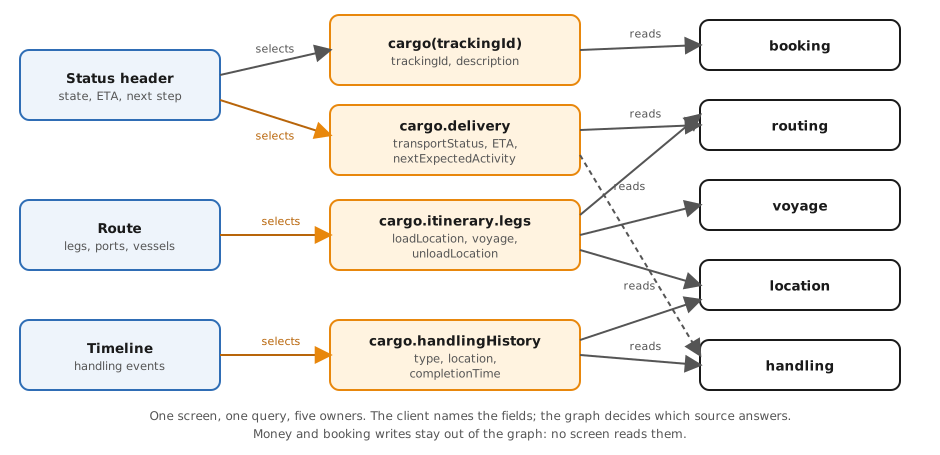
Demand also decides what stays out. Nothing on the screen reads a price, so the graph has no Money type, and no panel creates a booking, so booking writes stay a REST call, as Chapter 8 argued. A field earns a place when a client reads it. Adding one later is a safe change, and removing one is not, so the cheap mistake is the field that was left out.
The reverse also holds. A list that a screen shows in full today and a client shows in part tomorrow is a connection from the start, because turning a list into a connection later changes the field’s type. Chapter 12 builds that for handlingHistory.
Names are the interface
A name is the first thing a client reads and the last thing the server can change. The canonical SDL follows one set of conventions, and the checks described later enforce them.
| Element | Convention | Examples |
|---|---|---|
| Types, interfaces, unions, enums | PascalCase nouns | Cargo, HandlingEvent, RoutingStatus |
| Fields and arguments | camelCase | trackingId, unLocode, completionTime |
| Enum values | SCREAMING_SNAKE_CASE | IN_PORT, NOT_ROUTED |
| Input types | the operation or noun, then Input |
RegisterHandlingEventInput |
| Mutation results | the mutation name, then Payload |
RegisterHandlingEventPayload |
| Pagination types | the element, then Connection or Edge |
HandlingEventConnection |
| Time-valued fields | end in Time or Deadline |
completionTime, arrivalDeadline |
Two of these carry more weight than they appear to. The suffixes make a type’s role readable from its name, so a client author who sees ...Payload knows it is a mutation result, and a linter can enforce the shape. The time suffix is a promise about the type: a field ending in Time holds a DateTime, an instant in UTC, and nothing else. A field named date that holds an instant makes a client wonder whether it is a calendar day.
The canonical SDL departs from that last rule in one place. Itinerary.finalArrivalDate is a DateTime, so by the table it should be finalArrivalTime. It was named before the convention was written down, and it shows what an inconsistency costs: it cannot be corrected by renaming, because every client that selects it would break. The correction is an addition followed by a deprecation, and Chapter 11 does it in that order. Until then the chapter’s checks leave this name alone, because they test the shape of names, not their meaning.
A name that reads well in the schema can still be wrong for the field. Prefer the domain’s word to the implementation’s: Leg, Voyage and HandlingEvent come from the shipping domain, not from the table or the service that holds them.
Identity: Node and global ids
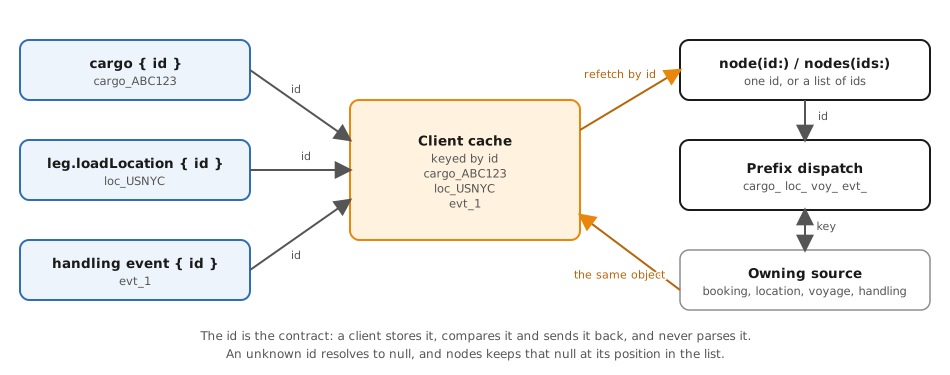
A client that caches objects needs a key that identifies an object across the whole graph, not only within a type. The Relay Global Object Identification specification gives the pattern: an interface Node { id: ID! }, a root field that fetches any Node by id, and the rule that the id is unique across every type.
interface Node {
  id: ID!
}

type Query {
  node(id: ID!): Node
  nodes(ids: [ID!]!): [Node]!
}
In the tracking view four types implement Node: Cargo, Location, Voyage and HandlingEvent. Their ids carry a type prefix, cargo_ABC123, loc_USNYC, voy_V200E and evt_1, and the resolver dispatches on it. The prefix is how two types with overlapping keys, a cargo and a location, stay distinct.
The ids are readable, and the contract says to treat them as opaque. A client stores an id, compares it, sends it back and never takes it apart. That rule matters more than the encoding. If clients parse cargo_ABC123, the server can no longer change how a cargo is keyed. Many APIs enforce opacity by encoding the id, commonly as base64 of Type:key, so that nobody is tempted to read it. That works, but the encoding is not what protects the contract. Clients that are told the id is opaque and never see a reason to doubt it are protected. Readable ids are easier to debug, and the example keeps them for that reason.
The pattern gives one testable rule, the refetch rule: for any object x returned by the graph, node(id: x.id) returns an object with the same id and the same type. verify.sh applies it to each implementer. It obtains an id the way a client would, through a field, and sends it back:
| Implementer | Obtained through | Id | Fragment field after refetch |
|---|---|---|---|
Cargo |
cargo(trackingId: "ABC123") { id } |
cargo_ABC123 |
trackingId is ABC123 |
Location |
the first leg’s loadLocation { id } |
loc_USNYC |
unLocode is USNYC |
Voyage |
the second leg’s voyage { id } |
voy_V200E |
number is V200E |
HandlingEvent |
node(id: "evt_1") { id } |
evt_1 |
type is RECEIVE |
Checking __typename alone would pass for an object with the right type and the wrong contents, so each refetch also selects a field through an inline fragment and compares it with the seed.
nodes(ids:)
A client that has a list of ids, from a cache or from a push message, can fetch them one node call at a time or in one request. nodes takes a list and returns a list of the same length in the same order. An id that resolves to nothing yields null at its position, so the response lines up with the request and the client does not match results back to ids. An empty list returns an empty list.
The return type is [Node]!: the list is never null, and each element may be, which is how an unknown id is represented. The argument is [ID!]!, so a null id is a request error.
@Query
@NonNull
@Description(
        "Fetch several objects by their global ids, in the order given. An unknown id yields null at its position.")
public Uni<List<Node>> nodes(
        @Name("ids") @NonNull @Description("The global ids of the objects to fetch.") List<@NonNull String> ids,
        Context context) {
    if (ids.isEmpty()) {
        return Uni.createFrom().item(List.of());
    }
    String request = context.getExecutionId();
    List<Uni<Node>> fetches = ids.stream().map(id -> resolveNode(request, id)).toList();
    // join().all() keeps the order of the list it is given; each id is its own source call.
    return Uni.join().all(fetches).andFailFast();
}
@strawberry.field(
    description=(
        "Fetch several objects by their global ids, in the order given. "
        "An unknown id yields null at its position."
    )
)
async def nodes(
    self,
    info: Info[TrackingContext],
    ids: Annotated[
        list[strawberry.ID],
        strawberry.argument(description="The global ids of the objects to fetch."),
    ],
) -> list[Node | None]:
    # gather keeps the order of its arguments; each id is its own source call.
    return list(await asyncio.gather(*(resolve_node(info.context, id_) for id_ in ids)))
Both stacks route every id through the helper that node already used, resolveNode on Quarkus and resolve_node on Python, so there is one dispatch and node and nodes cannot disagree about what an id means. Uni.join().all(...) and asyncio.gather both preserve the order of their inputs while running the lookups concurrently.
One detail on Quarkus. The ids argument is declared List<@NonNull String>, and ContractSchemaDetails, the schema observer the examples already use, gives it the contract’s type [ID!]!. The live schema reports [ID!]!, and verify.sh asserts the full signature of the field.
Each id is one source call, and nothing deduplicates them. nodes(ids: ["cargo_ABC123", "loc_NLRTM", "nope", "voy_V200E", "cargo_ABC123"]) makes four calls: booking.getCargo for ABC123 twice, location.getLocation for NLRTM and voyage.getVoyage for V200E. The unknown nope has no recognised prefix and makes none, and neither do a bare prefix such as cargo or an empty key such as cargo_. This is the N+1 shape that Chapter 7 measured, and Chapter 13 batches it, so the four calls become three.
Objects, not foreign keys
A relational schema points from one row to another with a key. A graph points with the object. Leg.voyage returns a Voyage, not a voyageNumber, and Leg.loadLocation returns a Location, not a code. A client that wants the vessel’s name selects it in the same query, and the schema never needs a second field for the key of every relation.
The cost moves to the resolvers. Each of those fields is a source call, and a list of legs makes a call per leg. That cost is measured in Chapters 6 and 7, and it is the reason Chapter 13 exists. The design choice is to keep the schema in terms of the domain and fix the cost behind it, because the reverse, a schema full of keys that clients join by hand, cannot be fixed without a breaking change.
The exception is documented. HandlingEvent has both trackingId and cargo. The tracking id is a scalar copy of the key, kept so that a client can still say which cargo an event belongs to when the booking service is down. In that case cargo is null and trackingId survives, which is why the canonical description of cargo says “Null when the cargo service is unavailable”. It is a denormalization chosen for resilience, and it is the only one in the schema.
Interfaces versus unions
An interface says that several types share fields and a client can select those fields without knowing the concrete type. Node is the example: all a caching client needs from an object is its id, and it selects the rest through inline fragments. The test for an interface is that a client would write a query against the shared fields alone.
A union says that a result is exactly one of several types that share nothing a client would select in common. A search result that is a cargo or a location, or a mutation result that is a success or a failure, fits a union. The client branches on __typename.
Introspection shows the difference. __type(name: "Node") { possibleTypes { name } } lists the implementers, and verify.sh asserts it is Cargo, HandlingEvent, Location and Voyage on both stacks. HandlingEvent joined that list in Chapter 8, when it gained an id. Chapter 9 sketches a union for mutation results and explains why this schema keeps payload fields instead.
Adding a member to a union or a new implementer to an interface is a change clients can break on: a client that switches on __typename and has no default branch fails on the new type. It is not breaking in the schema’s own sense. The gate files a new union member, and an existing type that starts to implement the interface, under dangerous changes; Chapter 11 shows that it passes a brand-new implementing type as safe, and why a reviewer should still treat that one as dangerous.
Inputs and payloads
Chapter 8 built the pattern, and its shape is a rule. Every mutation takes exactly one argument, named input, whose type is a non-null input object, and returns a non-null payload object. The payload holds what changed and a list of userErrors.
type Mutation {
  registerHandlingEvent(input: RegisterHandlingEventInput!): RegisterHandlingEventPayload!
}
One input object means the mutation can gain fields without changing its signature, which is the evolution Chapter 11 relies on: a new optional field on the input, or a new field on the payload, is a safe addition. One payload per mutation means the result is not shared with another mutation that needs to differ. The non-null payload means a client never has to ask whether the mutation ran. It always gets an object, and a refusal is data inside it. verify.sh sends a failing mutation, RECEIVE with a voyage, and asserts that registerHandlingEvent is not null, that userErrors has exactly one entry, VOYAGE_NOT_ALLOWED at ["input","voyageNumber"], and that errors is absent.
Optional fields on an input stay optional. A new required field is a breaking change for every existing client, while a new optional one is not, which is why voyageNumber and idempotencyKey were optional from the start.
The September 2025 edition of the GraphQL specification adds another tool, “OneOf Input Objects”, an input type annotated @oneOf in which exactly one field must be set. It models a choice, such as finding a cargo by tracking id or by id. This schema does not use it, so the chapter does not serve it. The README records what was checked: Strawberry 0.335.0 accepts strawberry.input(one_of=True), prints @oneOf in the SDL and rejects a request that sets two fields with “OneOf Input Object … must specify exactly one key”. SmallRye GraphQL 2.18.5 ships io.smallrye.graphql.api.OneOf, which this example does not exercise. Both are tools to consider when a mutation or a lookup takes alternative keys.
Enums, scalars and nullability as design
Three smaller choices carry most of a schema’s day-to-day behaviour.
Enums for closed sets. HandlingEventType, TransportStatus and RoutingStatus are enums because the set is closed and the domain logic switches on it. A client can render each value and the server can reject anything else during coercion. The cost is that adding a value is a dangerous change, because a client with an exhaustive switch meets a value it has never seen. An open set, such as a list of carriers, should be a type with a field, not an enum.
Custom scalars for values with rules. TrackingId, UnLocode and DateTime are string-backed scalars. Each one validates on the way in and out, and UnLocode and DateTime point at their definitions with @specifiedBy. verify.sh checks that each is a real SCALAR and that the two URLs are exact; the SDL diff covers types, fields and arguments, and this check covers the URLs.
Nullability as a statement about failure. Chapter 4 gave the rule: non-null is a promise the server must keep, and a broken promise propagates upward. Design applies it field by field. Leg.loadLocation is non-null because a leg without a location is not a leg. Cargo.itinerary is nullable because routing may not have assigned one. Leg.voyage is nullable because the voyage service is a separate service that can fail, and a failed field should not erase the leg. A field fed by a service that can fail on its own is nullable, and a field that is part of what the type means is not.
Lists that grow are connections
A list field that can grow without bound should be a connection from the first release. Cargo.handlingHistory returns a HandlingEventConnection with edges, a cursor on each edge and a pageInfo. Chapter 12 builds it, with opaque cursors that stay stable when events are added.
nodes is the bounded exception. Its list is as long as the client made it: the caller chose the ids and the answer has the same length. A list the caller sizes is not unbounded in the sense that matters. A server can still cap the length of ids, and Chapter 14 covers depth and cost limits.
Checking design mechanically
Conventions that rely on review decay. The example checks them in two places.
The first is the canonical SDL. npm --prefix contracts run lint runs GraphQL ESLint with the recommended schema rules, and the project adds two. Every type, field, argument and enum value needs a description. Every entity, meaning a type that implements Node, needs an id, while value objects, payloads and connections are exempt. verify.sh runs the linter first, so a convention break in the contract fails before any stack starts.
The second is each live schema. The SDL could be perfect and a stack could still serve something else: a name derived from a Java class, a description generated in place of the contract’s. verify.sh sends one __schema request per stack and pipes the response to a small checker, written with the Python standard library, that asserts:
- type names are PascalCase, and field, argument and input field names are camelCase;
- enum values match
^[A-Z][A-Z0-9_]*$; - every input object’s name ends in
Input; - every
Mutationfield takes exactly one argument,input, of a non-null input object type, and returns a non-null object whose name ends inPayload; - every type, field, argument, input field and enum value has a non-empty description;
- every implementer of
Nodehasid: ID!.
The checker skips introspection types, the built-in scalars and the framework types that LGTM_SDL_FRAMEWORK_TYPES names, and on a failure it prints each offender, one per line. Chapter 5’s conformance check compares the live schema to the contract; this one asks whether the schema, whatever it is, follows the rules.
On the wire
The commands below run against the Quarkus stack on port 8200. Use 8201 for Python. verify.sh runs the same checks against both.
gql() { curl -s localhost:8200/graphql -H 'Content-Type: application/json' -d "$1"; echo; }
gql '{"query":"{ nodes(ids: [\"cargo_ABC123\", \"loc_NLRTM\", \"nope\", \"voy_V200E\", \"cargo_ABC123\"]) { __typename } }"}'
gql '{"query":"{ nodes(ids: []) { id } }"}'
gql '{"query":"{ __type(name: \"Node\") { possibleTypes { name } } }"}'
{"data":{"nodes":[{"__typename":"Cargo"},{"__typename":"Location"},null,{"__typename":"Voyage"},{"__typename":"Cargo"}]}}
{"data":{"nodes":[]}}
The third response lists the four implementers; verify.sh sorts them before comparing. Port 8200 is also HashiCorp Vault’s default; if it is taken on your machine, change the published port in compose.yaml.
| Check | Expected |
|---|---|
refetch of cargo_ABC123, loc_USNYC, voy_V200E, evt_1 |
the same id back; __typename Cargo, Location, Voyage, HandlingEvent; fragment fields ABC123, USNYC, V200E, RECEIVE |
nodes(ids: ["cargo_ABC123", "loc_NLRTM", "nope", "voy_V200E", "cargo_ABC123"]) |
__typename Cargo, Location, null, Voyage, Cargo; no errors |
| source calls for that request | exactly booking.getCargo:ABC123, location.getLocation:NLRTM, voyage.getVoyage:V200E, booking.getCargo:ABC123 |
nodes with fragments, ids voy_V200E, evt_1, loc_NLRTM, cargo_ABC123 |
number V200E, type RECEIVE, unLocode NLRTM, trackingId ABC123, in that order |
nodes(ids: []) |
[], no source call |
nodes(ids: ["cargo", "evt", "cargo_"]) |
null, null, null; no source call |
__type(name: "Node") { possibleTypes { name } }, sorted |
Cargo, HandlingEvent, Location, Voyage |
Query.nodes in introspection |
type [Node]!, argument ids of type [ID!]!, the canonical description |
one __schema request per stack, checked for names, input and payload shapes, descriptions and Node ids |
no offenders |
npm --prefix contracts run lint |
exit 0 |
registerHandlingEvent with RECEIVE at USNYC on V100S |
no errors; handlingEvent null; one userErrors entry, VOYAGE_NOT_ALLOWED at ["input","voyageNumber"] |
TrackingId, UnLocode, DateTime scalars |
SCALAR; specifiedByURL null, UNECE UN/LOCODE page, RFC 3339 |
live schema vs contracts/schema/ |
no breaking change either way and no description change on what the stack serves (slice) |
bash examples/10-schema-design/verify.sh runs the whole sequence on both stacks and prints PASS only when both hold.
Decision
Schema design is where the contract and evolution style axis of Chapter 2 is decided field by field. Names, suffixes, one input and one payload per mutation, and nullable fields across service boundaries are all choices that keep later changes additive. The read and write balance axis shows in design from demand: the graph holds what the screen reads, and writes stay small and with their owners. The team ownership axis shows in objects over foreign keys and in Node identity: each type points to its owner's data by object and by opaque id, so an owning team can change a key without a client change. The operational and security cost axis shows in what the design defers: every node and nodes id and every object field is a source call until Chapter 13, and lists that grow become connections in Chapter 12. The tracking view uses global ids with an opaque contract, nodes for client caches, objects instead of keys with one documented denormalization, and conventions that a linter and a live-schema check enforce on every run.
Where this goes next
This chapter named the conventions behind the schema and added Query.nodes, the one new field of the example. It also left two things open. finalArrivalDate is the one field outside the time-suffix rule, and Chapter 11 corrects it the only safe way, by adding finalArrivalTime, deprecating the old name and letting the breaking-change gate show what each kind of change costs. The cost of resolving one id at a time is the other: the source-call row in “On the wire” shows booking.getCargo for ABC123 twice, and Chapter 13 removes the duplicate by batching.
Chapter 11 starts from this example. Chapter 12 builds the connection that handlingHistory has been waiting for and carries nodes forward.
For the formal definitions, read “Interfaces”, “Unions”, “Input Objects” and “OneOf Input Objects” in the GraphQL specification, and the Global Object Identification specification from Relay. The GraphQL ESLint documentation lists the rules the contract uses. Samer Buna’s GraphQL in Action covers schema design in “Designing a GraphQL schema”, and Artur Czemiel’s GraphQL Best Practices covers naming, enums, interfaces and pagination in its guidance on schema design; both are listed on the Bibliography page.