Evolution and versioning
Field numbers as the contract, reserved, backward/forward compatibility, package versioning from shipping.routing.v1 to v2, the buf breaking gate with a deliberate-drift test, and the Buf Schema Registry.
shipping.routing.v1.GetQuoteRequest has shipped. Chapter 5 built it, Chapter 10 put a deadline on calling it, Chapter 11 taught it to fail with a code a client can act on. None of that matters if the next change to routing.proto quietly changes what field 3 means to a client compiled against last week’s version of the file. gRPC’s wire format doesn’t carry field names — it carries field numbers, and a message that’s valid Protobuf only means one thing if every reader and every writer agrees on what those numbers stand for. This chapter is about keeping that agreement intact as the schema moves: what changes a field number tolerates, what reserved actually buys you, when a package needs a new major version instead of a new field, and the buf breaking gate that turns all of this from a code-review discipline into a command that exits non-zero when someone gets it wrong.
Field numbers are the contract
A Protobuf message on the wire is a sequence of (field number, wire type, value) tuples — nothing else. shipping.type.v1.Money { currency = "USD"; amount = "1250.00" } serializes to bytes that encode “field 1, length-delimited, these 3 bytes” followed by “field 2, length-delimited, these 7 bytes.” The field names currency and amount exist only in the .proto source and the generated code; they never touch the wire. A reader with a different generated class, built from a different .proto revision, decodes those same bytes by field number alone — which is what makes GetQuote’s identical behavior on Quarkus and Python possible in the first place, and exactly what a careless schema edit can break.
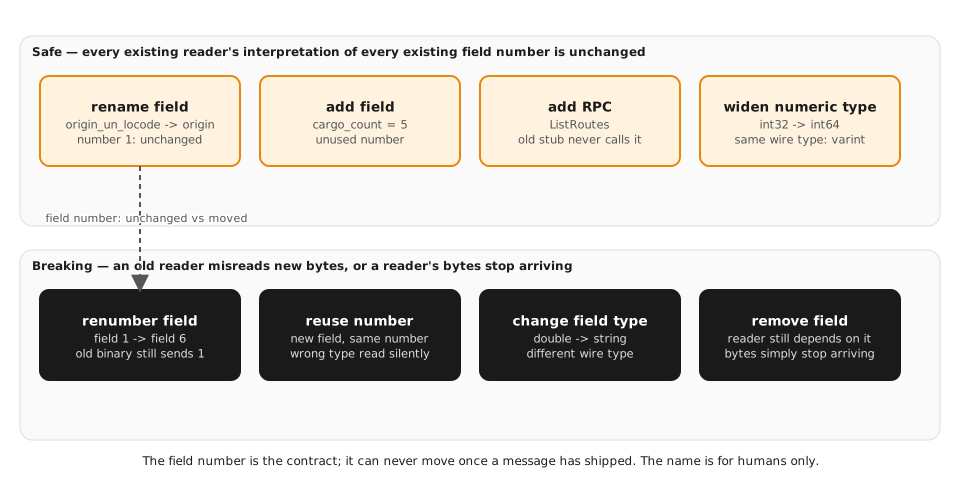
This is why renaming a field is always safe and changing its number almost never is. string origin_un_locode = 1; renamed to string origin = 1; changes nothing on the wire: byte 0 is still “field 1, LEN,” and every existing client’s generated code already binds field 1 to whatever local name it compiled with. Renumbering the same field from 1 to 6 is different: an old binary still emits field 1, a new binary now expects field 6, and the two stop understanding each other the moment both run in production at once — which, during any rolling deploy, they do. The field number is the part of the contract that can never move once a message has shipped; the name is a detail for the humans reading the source.
Three changes are safe by construction, because none of them alter what an existing reader already does with an existing number:
- Adding a new field at an unused number. An old reader built before the field existed never looks for it and drops the bytes on the floor — proto3 skips unknown fields instead of rejecting the message, which is the property every safe change below leans on.
- Adding a new RPC to a service. A client generated from the old
.protohas no stub method for it and never calls it; a server that hasn’t implemented it yet returnsUNIMPLEMENTED, which Chapter 5 already relies on forRoutingService’s four not-yet-built methods. - Widening certain numeric types proto3 treats as wire-compatible —
int32toint64, for instance, both encode as thevarintwire type, so an old reader decoding a value a new writer sent as the wider type still gets the right number back, as long as it fits.
Three changes are breaking, because each one makes an old reader misinterpret bytes a new writer sends, or a new reader misinterpret bytes an old writer already sent:
- Reusing a field number for a different field. The new field’s bytes land exactly where the old field’s reader expects the old field’s type, and nothing in the wire format tells it otherwise — it just produces a wrong answer, silently.
- Changing a field’s type to something with a different wire type, such as
doubletostring, or even to a same-wire-type value whose meaning differs, such asdouble weight_kgbecomingdouble weight_lbat the same number. - Removing a field a reader still depends on. The bytes simply stop arriving; a reader that doesn’t handle absence as a real case — treating a missing optional as “zero” rather than “unset,” for example — draws a wrong conclusion from silence.
The two lists line up column for column: renaming a field is safe because the number never moves, renumbering it is breaking for the same reason in reverse.
reserved: what it actually buys you
Protobuf’s reserved keyword blocks the compiler from accepting a field declaration that reuses a given number or name:
message GetQuoteRequest {
  reserved 4;
  reserved "legacy_notes";

  string origin_un_locode = 1;
  string destination_un_locode = 2;
  double weight_kg = 3;
}
This is easy to overstate. reserved does not make deleting a field safe — a field that mattered to any reader still goes missing the moment it’s removed, reserved or not. What it prevents is a second, unrelated mistake: a future engineer, with no memory of what field 4 used to mean, adds a new field and lets the compiler hand them the first free number, which happens to be 4. Without the reservation that compiles cleanly, and any service still running the pre-removal binary — plausible for a rolling deploy, or an old client nobody’s redeployed in a year — decodes the new field’s bytes as the old field’s type. reserved turns that into a compile error instead of a production incident, a real and durable benefit; it just isn’t the benefit of “now this deletion is safe,” because the deletion itself already broke anyone who still read it.
examples/14-evolution/candidate-breaking/ proves the distinction directly: it deletes legacy_notes (field 4), and buf breaking rejects the deletion whether or not the field is marked reserved on the way out. “The buf breaking gate” below walks through why, and what the real escape hatch looks like.
Backward and forward compatibility, named precisely
Backward compatibility is the property a new reader needs: it correctly interprets a message a client built against the old schema sends. Forward compatibility is the opposite direction: an old reader correctly interprets a message built against the new schema, typically by ignoring fields it doesn’t recognize rather than rejecting the message outright. A rolling deploy of RoutingServiceImpl needs both at once, since old and new binaries serve traffic side by side for the length of the rollout: an old server must tolerate a new client’s extra field (forward compatibility), and a new server must keep making sense of an old client’s message missing a field the new schema added (backward compatibility). Proto3’s “unknown fields are skipped, absent fields read as the zero value” design is what makes both directions hold simultaneously for every safe change above — and why the three breaking changes collapse one direction or the other.
Package versioning: shipping.routing.v1 to v2
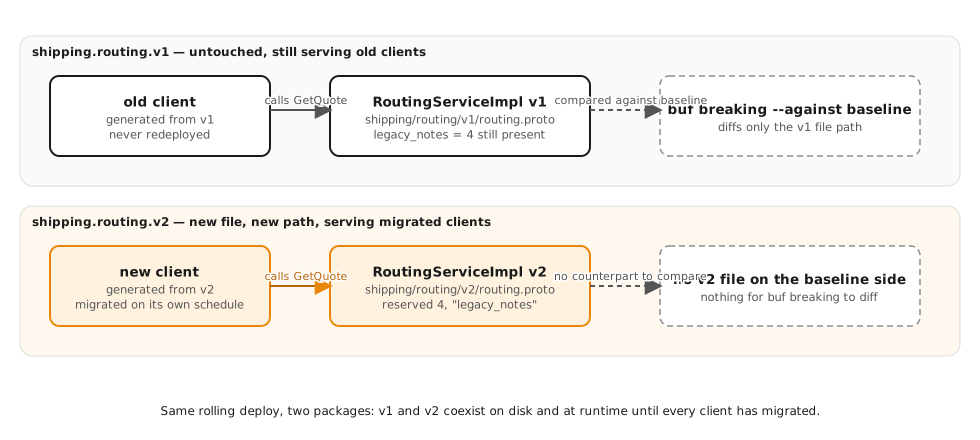
Every safe change named so far is additive: new field, new RPC, wider type. Eventually a schema needs a change that isn’t additive at all — weight_kg really should have been weight_grams, or GetQuoteRequest needs a shape no amount of careful addition can produce. That’s what a new package version is for. shipping.routing.v1 becomes shipping.routing.v2 as a new package statement in a new file at a new path — shipping/routing/v2/routing.proto beside the untouched v1/routing.proto — not an edit to the v1 file in place. The two packages coexist on disk and at runtime: RoutingServiceImpl for v1 keeps serving shipping.routing.v1.RoutingService exactly as before, while a second implementation serves shipping.routing.v2.RoutingService, and existing v1 clients never notice v2 exists until someone migrates them, on their own schedule.
This is the second, more durable use for reserved: when v2 drops a field v1 carried — legacy_notes, say — carrying reserved 4; reserved "legacy_notes"; forward into the v2 message costs nothing and buys the same protection v1 would have wanted. No tool requires it; it’s the same discipline applied one version later, so a v3 can’t reuse the number for something a long-lived v1-era payload might still carry through code that doesn’t distinguish the packages carefully.
The buf breaking gate
Chapter 5 introduced contracts/buf.yaml’s three gates without spelling out what buf breaking actually enforces:
version: v2
modules:
  - path: proto
lint:
  use:
    - STANDARD
breaking:
  use:
    - FILE
breaking: use: [FILE] picks one of several rule categories Buf ships, and the choice matters more than it looks. FILE means no field, message, enum, or RPC may ever be deleted from a file, full stop — reserving the field first changes nothing, because FILE’s FIELD_NO_DELETE rule doesn’t check for a reservation before firing. Buf does ship a more permissive rule, FIELD_NO_DELETE_UNLESS_NUMBER_RESERVED, granting exactly the exception a reader might expect reserved to earn — but it lives in the WIRE_JSON category, not FILE. This book’s contract chooses FILE, the stricter of the two: this gate never lets a field quietly disappear from an existing package. The only way to retire a field here is a new package, a new file, a new path buf breaking has nothing on the old side to compare against.
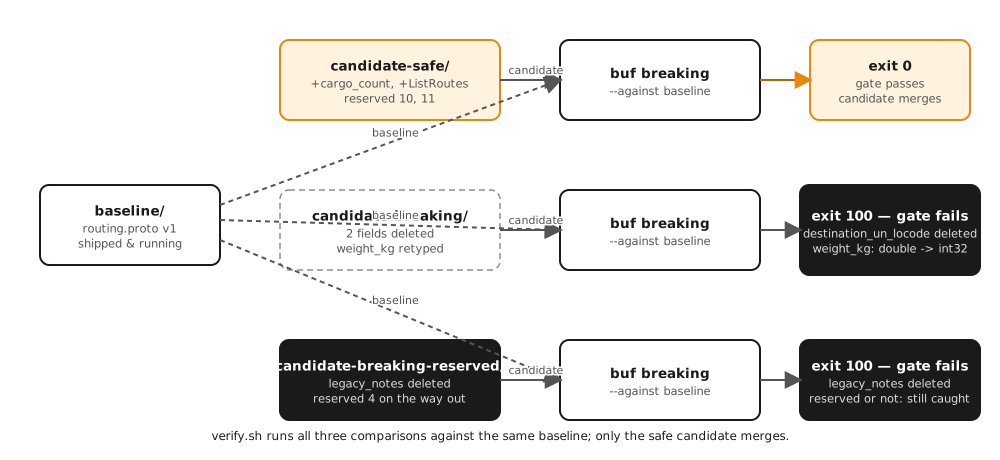
examples/14-evolution/ proves all three outcomes with real buf output, against a standalone schema that never touches contracts/:
// candidate-safe/shipping/routing/v1/routing.proto
message GetQuoteRequest {
  reserved 10, 11;
  reserved "internal_only";

  string origin_un_locode = 1;
  string destination_un_locode = 2;
  double weight_kg = 3;
  string legacy_notes = 4;
  int32 cargo_count = 5;       // new field, unused number
}
// candidate-breaking/shipping/routing/v1/routing.proto
message GetQuoteRequest {
  string origin_un_locode = 1;
  int32 weight_kg = 3;         // destination_un_locode (2) and
}                               // legacy_notes (4) are simply gone;
                                // weight_kg changed double -> int32
verify.sh runs buf breaking <candidate> --against baseline against each, plus a fourth, candidate-breaking-reserved/, that reserves the same field it deletes, and a fifth, v2-migration/, that drops the same field inside a new shipping.routing.v2 package:
=== Step 2: SAFE candidate (add field, add RPC, defensive reserved) ===
ok — buf breaking candidate-safe --against baseline: exit 0 (no breaking changes)

=== Step 3: BREAKING candidate (delete fields, change a field's type) ===
ok — buf breaking candidate-breaking --against baseline: exit 100 (breaking changes found)
candidate-breaking/shipping/routing/v1/routing.proto:13:1:Previously present field "2" with name "destination_un_locode" on message "GetQuoteRequest" was deleted.
candidate-breaking/shipping/routing/v1/routing.proto:13:1:Previously present field "4" with name "legacy_notes" on message "GetQuoteRequest" was deleted.
candidate-breaking/shipping/routing/v1/routing.proto:15:3:Field "3" with name "weight_kg" on message "GetQuoteRequest" changed type from "double" to "int32".

=== Step 4: BREAKING-AND-RESERVED candidate (delete a field, reserve its number anyway) ===
ok — buf breaking candidate-breaking-reserved --against baseline: exit 100 (reserved field 4 still can't be deleted)
candidate-breaking-reserved/shipping/routing/v1/routing.proto:14:1:Previously present field "4" with name "legacy_notes" on message "GetQuoteRequest" was deleted.

=== Step 5: v2-migration (new package carries the retired field as reserved) ===
ok — buf breaking v2-migration --against baseline: exit 0 (shipping.routing.v2 is a new file; v1 is untouched)
Each line names the field, the message, and the exact violation, which is what turns a CI failure into something a reviewer can act on without re-deriving the diff by hand. The safe candidate’s reserved 10, 11 block passes because nothing on the baseline side ever used those numbers; the breaking candidate’s deletions fail regardless of whether they’d been reserved first — and candidate-breaking-reserved/ makes that claim self-demonstrating rather than asserted: it deletes legacy_notes and marks field 4 and its name reserved on the way out, and buf breaking reports the identical FIELD_NO_DELETE-style violation anyway, for the reason the reserved section above already gave. The v2 package’s drop of field 4 passes for a different reason: buf breaking only ever diffs a file against the file at the same path on the other side, and shipping/routing/v2/routing.proto has no counterpart in baseline/. See examples/14-evolution/README.md for the full walkthrough.
This example lives entirely outside contracts/: a proto built to fail buf breaking has no business near the module every stack in this book compiles against. To see the real consequence — the real contracts.yml CI job turning red against the real shipping.routing.v1.routing.proto — run the on-demand script scripts/ch14-demo-breaking.sh. It forks a throwaway branch off the current main, renumbers a real field in routing.proto, pushes the branch, and lets the reader watch the real buf breaking --against main job fail in GitHub Actions, on a contract that was never actually merged. The branch is intentionally red: it exists to be watched failing, not to be fixed or merged, and --cleanup deletes both the local and the remote copy once the point has been made:
scripts/ch14-demo-breaking.sh              # fork, seed the break, push
scripts/ch14-demo-breaking.sh --cleanup    # delete the local and remote demo branch
The script refuses to run against a dirty working tree, re-derives the branch from main on every run so it can never go stale, and never checks out or merges anything into main itself — it only ever pushes a disposable sibling branch for CI to evaluate.
The Buf Schema Registry: remote packages and generated SDKs
Every stack in this book so far generates its stubs from a local copy of contracts/proto/, fetched at build time by each Containerfile’s own COPY. That works well inside one repository with a handful of consuming services, because every consumer already has filesystem access to the same contracts/ checkout. It stops working as cleanly once a schema has consumers outside that repository — a partner team, a different organization, a client SDK shipped to external developers — none of whom should clone this repository just to get shipping.routing.v1’s generated types.
The Buf Schema Registry (BSR) is Buf’s hosted answer to that gap: buf push publishes a module to a registry, versioned and content-addressed, and consumers either buf generate against the published module directly or pull a BSR-hosted generated SDK — a package built from that module in a target language, versioned the same way, published to that language’s normal package manager or to BSR’s own plugin-generated artifacts. A Java consumer adds a BSR-backed Maven dependency; a Python consumer adds a BSR-backed PyPI dependency; neither touches protoc or clones contracts/ to get there. contracts/buf.gen.yaml already uses BSR’s remote plugins for local inspection — buf.build/protocolbuffers/python and buf.build/grpc/python — the same mechanism a hosted SDK pipeline runs on a schedule instead of on demand.
This book does not stand up a live BSR module for shipping.routing.v1: a real module needs a Buf account and a registry to push to, which a runnable, self-contained example in this repository cannot set up for a reader with nothing but a clone and a terminal. The mechanism above is accurate to how BSR works; it’s described, not demonstrated live, the same boundary Chapter 20 draws around any managed service this book can name but can’t run without an account somewhere.
Decision
A monorepo with every consumer inside it — this book's own shape, one contracts/ directory, a handful of services in the same checkout — gets nothing from the BSR that a COPY at build time doesn't already provide, and it avoids a dependency on an external registry's uptime for every build. The BSR earns its cost the moment a schema has a consumer outside that boundary: a partner integration, a public client SDK, a second repository that shouldn't need to clone this one to generate stubs. At that point, the registry's versioning and its hosted SDK generation replace what would otherwise be a brittle, manually-copied .proto file passed around over chat or committed into someone else's repository by hand — the exact failure mode contract-first was adopted in Chapter 5 to eliminate inside this repository, recurring one organizational boundary further out. Choose a local, filesystem-based contract for an internal multi-service repository; reach for the BSR the moment a consumer sits outside it.
Where this goes next
The gate this chapter wires stays in force for every later change to routing.proto, types.proto, quote.proto, and tracking.proto: any field Part 6’s async methods add, any message Part 8’s streaming chapters extend, passes through the same buf breaking --against main check before it reaches a stack that generates code from it. Chapter 5 already depended on this gate existing without spelling out its rules; this chapter is the one that makes the dependency precise. A reader who wants to watch the gate fail against the actual contract this book ships runs scripts/ch14-demo-breaking.sh and sees the CI run turn red — then deletes the branch it made and moves on, since that branch was never meant to merge.
On the wire
A field renumber is the mistake buf breaking exists to catch before it ever reaches a generated stub. Here it is against the real contract, the same seeded edit scripts/ch14-demo-breaking.sh applies on its disposable branch:
cd contracts
# routing.proto, before:  repeated shipping.type.v1.Cargo cargo = 3;
# routing.proto, after:   repeated shipping.type.v1.Cargo cargo = 7;
buf breaking --against '.git#branch=main,subdir=contracts'
proto/shipping/routing/v1/routing.proto:14:1:Previously present field "3" with name "cargo" on message "GetQuoteRequest" was deleted.
Field 3 didn’t get a new type or a new name here — the same cargo field moved to a new number, which buf breaking reports identically to a deletion, because from an old reader’s point of view that’s exactly what happened: whatever a new writer now sends at number 7, nothing at number 3 arrives anymore, and number 7 means nothing to code still compiled against the old file. The fix in a real schema is never “renumber it back” under time pressure — it’s deciding, with the two compatibility directions from this chapter in mind, whether the change belongs in a new field at a new number or in a new package altogether.