Schema design over gRPC
Message granularity, request and response envelopes, pagination with page tokens, and FieldMask projection.
RoutingService.ListRoutes has sat in routing.proto since Chapter 5, returning UNIMPLEMENTED through every chapter that followed — the one RPC in the service whose job was never about a single call’s correctness but about a whole catalog’s shape. This chapter is where it finally gets a body. Pagination and field-mask projection aren’t RPC-shape questions the way a deadline or a status code is; they’re schema-design questions, about how a message is built before the first line of handler code runs. Part 5 opens here: after four chapters on keeping a single call reliable, this one steps back to the messages themselves — how big to make one, how to wrap a response so it can grow, and how a client gets exactly the fields it asked for out of a catalog neither side wants to ship in full on every call.
The code is in examples/13-schema-design/. The run script there (verify.sh) builds and starts both stacks and asserts the pagination and field-mask claims this chapter makes; its README.md covers what it does and how to drive it by hand.
Message granularity: how big should one message be?
shipping.type.v1.types.proto already answers this question by example, and it’s worth naming the rule it follows: a message should be exactly as big as one reusable concept, no bigger. Money, Location, Leg, and Route are each small enough to mean one thing — a currency amount, a port, one hop, a planned path — and that smallness is what let Chapter 2 share all four across RoutingService, and later BookingService and TrackingService, without any of them importing a type built for a different service’s convenience. The opposite failure is a message sized around one call site instead of one concept: a hypothetical GetQuoteRouteInfo that bundled Route fields with quote-specific pricing fields in one flat message would work fine for GetQuote, then immediately be wrong for ListRoutes, which needs a Route with no quote attached at all. Splitting Route and Money into their own messages, rather than inlining price fields everywhere, is what lets ListRoutes return a bare Route and GetQuote return a Route paired with a Money from the same shared type.
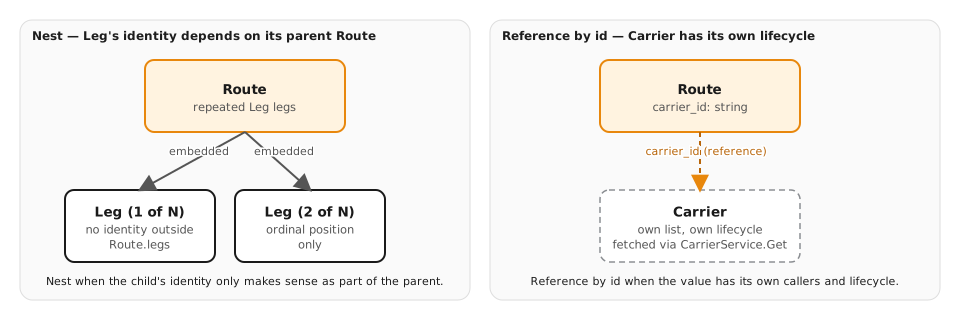
The granularity question has a second axis beyond reuse: how much nesting is too much. A Route with repeated Leg legs is one level of nesting a client reasonably wants in full — a route without its legs isn’t a route, it’s an id. Had the schema instead embedded full Booking objects inside Route, or full Route objects inside every Leg, a client asking for one small thing would receive a message tree several services deep, most of which it throws away. The rule this chapter leans on: nest a message when the nested value’s identity depends on its parent (a Leg only means something as part of a specific Route’s sequence), and reference by id — a plain string field, resolved with a separate call — when the referenced value has its own independent lifecycle and its own reasonable list of callers who want it without the parent attached. Route nests Leg because legs are never useful detached from the route that orders them, but a hypothetical Route.carrier_id would reference a Carrier by id rather than embed one, because a carrier is looked up and listed independently of any route.
Request/response envelopes
Every RPC on RoutingService takes a dedicated FooRequest message and returns a dedicated FooResponse message, never a bare domain type and never two RPCs sharing one request shape. ListRoutesRequest could, in principle, have been a bare int32 for page size plus a string for page token, passed as two scalar RPC arguments — gRPC’s single-request-message rule makes that illegal outright, but even in a protocol that allowed it, wrapping them in a named message is the right call for a reason that outlives this chapter: a message can grow a field; a bare scalar parameter list cannot, without changing the method’s signature and breaking every existing caller’s generated code. ListRoutesRequest already carries three fields — page_size, page_token, field_mask — and when a future chapter wants to add a filter (routes only from a given carrier, say), that’s one new optional field on an existing message, source- and wire-compatible with every client compiled against today’s version. ListRoutesResponse gets the same treatment: repeated Route routes sits next to next_page_token, and a bare repeated Route return value would have had nowhere to put that token at all.
The response envelope earns a second justification once you look at what it doesn’t carry: no total count, no “has more pages” boolean, no page number. next_page_token alone is the entire continuation protocol, because a boolean or a count would need to stay consistent with a catalog that might be changing between page 1 and page 2 — counting is a second query a server has to run and keep consistent with every page it has already returned, while an opaque token only has to describe “where this specific sequence of calls left off,” which a server can compute from the page it just built without any extra work. An envelope that resists the temptation to add fields a client doesn’t strictly need to continue is doing its job; one padded with every value a UI might someday want to display is quietly becoming the kind of god-message granularity warns against.
Pagination with page tokens
A ListRoutes call that returned the entire catalog in one ListRoutesResponse would work today, with five routes, and stop working the day the catalog holds five million — a service with no pagination doesn’t fail gracefully at scale, it fails by making every caller pay for the worst-case catalog size on every call, including the caller who only wanted the first three. page_size and page_token exist to make “give me a slice” a first-class request instead of “give me everything and let the client slice it client-side,” which is both slower over the wire and impossible to bound in advance.
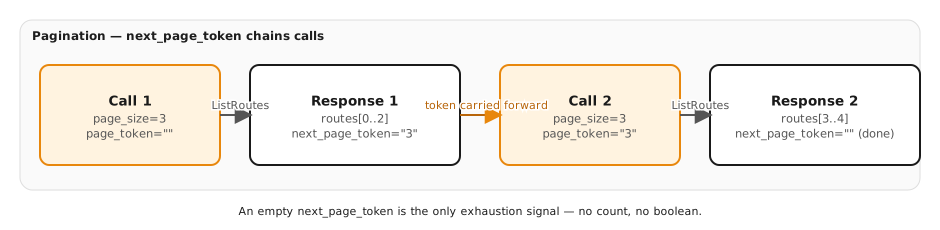
The convention this chapter follows — page_size as a request hint rather than a guarantee, page_token as an opaque string rather than a raw offset — matches Google’s AIP-158 pagination standard, the same family of API-design guidelines that AIP-161 (field masks) and AIP-131 (standard methods) belong to. None of those AIPs are gRPC-specific; they’re conventions for consistent API shape that this book’s .proto files happen to express in Protobuf, and the same rules apply nearly verbatim to a paginated REST collection endpoint. A server is free to return fewer items than page_size asked for — a full page is a courtesy, not a contract — and a client is required to treat page_token as opaque: never parse it or construct one by hand. This chapter’s example tokens are stringified offsets ("3", "6") because that’s the simplest thing a 5-route in-memory list can produce deterministically; a catalog over a real datastore should encode a stable cursor instead — a last-seen sort key, possibly with a filter fingerprint — so a row inserted or deleted between two calls doesn’t shift every subsequent offset out from under a token issued before the change. The client-visible contract is identical either way: call once with page_token="", keep calling with whatever next_page_token the previous response carried, and stop when that field comes back empty. Nothing about that loop changes if the token’s internal encoding changes tomorrow, which is exactly the point of keeping it opaque.
FieldMask projection
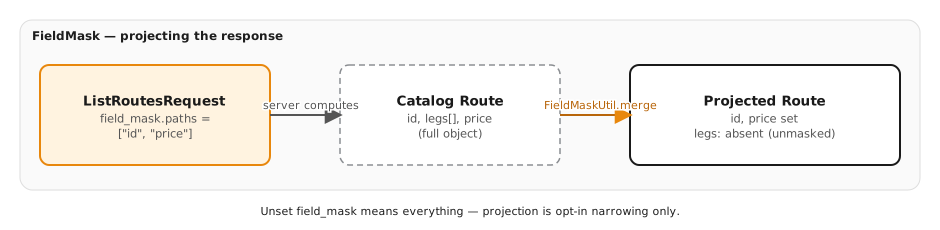
google.protobuf.FieldMask solves a different problem than pagination: not “how much of the catalog,” but “how much of each returned message.” A Route with legs and carriers and timestamps is the right shape for a client rendering a detailed itinerary and a wasteful one for a client that only wants a price list — fetching all of it every time makes every caller pay the bandwidth and serialization cost of the richest consumer’s needs. field_mask.paths lets a request say exactly which top-level fields it wants populated; everything else comes back at its protobuf zero value, which proto3’s wire format and JSON mapping both omit outright, so “didn’t ask for it” and “absent from the response” are the same observable fact, not two different things a client has to reconcile.
Projection is an opt-in narrowing, never an expansion: an unset or empty FieldMask means “give me everything,” not “give me nothing,” which is the only reading that keeps ListRoutes compatible with a client built before field_mask existed on the request at all — that client never sets the field, gets the full Route it always got, and never notices the schema grew a new capability underneath it. This is the same backward-compatibility discipline Chapter 14 names for field numbers in general, applied here to one specific field: adding field_mask to ListRoutesRequest was itself a safe, additive schema change, and the default behavior when it’s absent had to be chosen to preserve what every existing caller already relied on.
private static Types.Route applyFieldMask(Types.Route route, FieldMask mask) {
    if (mask.getPathsCount() == 0) {
        return route; // unset mask -> full object, the backward-compatible default
    }
    if (!FieldMaskUtil.isValid(Types.Route.getDescriptor(), mask)) {
        throw new IllegalArgumentException("field_mask names a path Route does not have: "
                + mask.getPathsList());
    }
    FieldMask normalized = FieldMaskUtil.normalize(mask);
    Types.Route.Builder projected = Types.Route.newBuilder();
    FieldMaskUtil.merge(normalized, route, projected);
    return projected.build();
}
def _apply_field_mask(route: types_pb2.Route, mask: field_mask_pb2.FieldMask) -> types_pb2.Route:
    if not mask.paths:
        return route  # unset mask -> full object, the backward-compatible default
    if not mask.IsValidForDescriptor(types_pb2.Route.DESCRIPTOR):
        raise ValueError(f"field_mask names a path Route does not have: {list(mask.paths)}")
    projected = types_pb2.Route()
    mask.MergeMessage(route, projected)
    return projected
Both sides do the identical three things in the identical order, using a well-known-type library each stack already ships rather than hand-rolled field clearing: reject a path the target message doesn’t have, start from a fresh, empty builder rather than mutating a copy of the source, and merge only the named paths into it. Starting from empty is what turns “merge” into “project” — FieldMaskUtil.merge and FieldMask.MergeMessage both copy named fields from a source into a destination, and clear nothing. The library also buys correctness a hand-rolled version would have to re-derive: a mask path can name a nested field (price.currency) as cleanly as a top-level one, and isValid/IsValidForDescriptor check every path exists on the target descriptor before merging, rejecting a typo’d path as INVALID_ARGUMENT instead of silently returning an empty projection.
How the code works
ListRoutes runs the same four steps on both stacks, over the identical fixed, in-memory catalog of five routes (RouteCatalog.java / app/catalog.py) — a real routing engine would page over a database query ordered by a stable key, but the catalog’s only job here is to give pagination and projection deterministic data to walk.
Clamp page_size, resolve page_token to a start index. page_size <= 0 falls back to a default of 3; a page_size above a maximum of 5 is clamped down to it rather than honored or rejected — a server protecting itself from an unreasonable request without forcing the client to guess the right value in advance. An empty page_token starts at index 0. A non-empty one is parsed as the offset it encodes in this demo; a token that doesn’t parse, or parses to an out-of-range index, returns INVALID_ARGUMENT with a BadRequest naming page_token — the same rich-error shape Chapter 11 built, reused here because an invalid continuation token is exactly the kind of malformed-request failure that detail type exists for.
Slice the catalog, compute next_page_token. end = min(start + page_size, catalog.size()) bounds the slice at the catalog’s actual length regardless of what page_size asked for — asking for 3 more routes than exist returns however many are left, never an error. next_page_token is end restringified when end is still short of the catalog’s length, and the empty string the moment it isn’t; that empty string is the entire “you’ve reached the last page” signal a client checks for, with no separate boolean to keep in sync.
Project each route in the slice through the request’s field_mask, using the applyFieldMask/_apply_field_mask helper shown above — called once per route in the page, never once for the whole response, because the mask describes the shape of one Route, not the shape of the ListRoutesResponse envelope around it (next_page_token is never subject to projection).
Build the response envelope from the projected list plus the computed token: Routing.ListRoutesResponse.newBuilder().addAllRoutes(projected).setNextPageToken(nextPageToken).build() on Quarkus, routing_pb2.ListRoutesResponse(routes=projected, next_page_token=next_page_token) on Python. Both other RPCs this module declares — GetQuote, FindOptimalRoute, RecomputeRoutes, NegotiateRoute — return UNIMPLEMENTED, the same discipline every prior chapter’s example has followed: one RPC gets a real body per chapter, and the rest report that status rather than a stub value that would look like success.
This demo’s page token is a raw offset into a List/list that never changes between calls — the simplification a real service over a changing datastore cannot make, for the reasons “Pagination with page tokens” above lays out.
Decision
Reach for an opaque, server-defined page token over a client-supplied offset or page number whenever the underlying collection can change between calls — which is any collection backed by a live datastore rather than a fixed, in-process list. An offset is cheap to implement and reads naturally, but it silently breaks the moment a row is inserted or removed ahead of the caller's current position, shifting every subsequent "page 3" to skip or repeat rows with no error raised anywhere; a token derived from a stable cursor doesn't have that failure mode, because it names a position in the data rather than a position in an index. Reach for FieldMask projection whenever a message serves callers with meaningfully different needs — a summary list view and a detail view of the same Route — rather than defining two separate RPCs or two separate response messages for the same underlying data; the mask keeps one schema serving both, at the cost of a client having to know which paths exist, which isValid/IsValidForDescriptor makes a loud, immediate rejection rather than a silent gap. Skip both for a collection that's small, fixed, and cheap to return in full on every call — the RoutingService methods this book never bothers to paginate, like a lookup table of supported currencies, aren't wrong for omitting page_size; they're correctly sized for data that will never need it.
Build, run, observe
cd examples/13-schema-design && ./verify.sh
verify.sh brings both services up with docker compose, waits for each to answer reflection’s list, pages the identical 5-route catalog through both stacks, and asserts the field-mask projection on both. Expect PASS once every assertion holds for both stacks; the full input/output tables are in examples/13-schema-design/README.md.
What you learned
- A message is sized around one reusable concept, not one call site; an envelope (
FooRequest/FooResponse) wraps even a single scalar so the schema can grow a field without breaking an existing caller’s generated code. page_size/page_tokenpage a collection with an opaque, server-defined continuation token rather than a client-supplied offset, so the server is free to change how it computes “where we left off” without any client-visible contract change.google.protobuf.FieldMaskprojects a response down to exactly the fields a client named, using each stack’s well-known-type library (FieldMaskUtil/FieldMask.MergeMessage) rather than hand-rolled field clearing — an unset mask means “everything,” which is what keeps the field backward compatible with every caller that predates it.
Chapter 14 turns from designing a message well today to keeping it compatible as it changes tomorrow — field numbers, reserved, and the buf breaking gate that catches a schema edit before it ships a version two independently-deployed stacks no longer agree on.
On the wire
grpcurl -plaintext -d '{"pageSize":3}' \
  localhost:9130 shipping.routing.v1.RoutingService/ListRoutes
{
  "routes": [
    { "id": "rte_001", "legs": [...], "price": { "currency": "USD", "amount": "1200.00" } },
    { "id": "rte_002", "legs": [...], "price": { "currency": "USD", "amount": "2400.00" } },
    { "id": "rte_003", "legs": [...], "price": { "currency": "USD", "amount": "1800.50" } }
  ],
  "next_page_token": "3"
}
grpcurl -plaintext -d '{"pageSize":3,"pageToken":"3"}' \
  localhost:9130 shipping.routing.v1.RoutingService/ListRoutes
{
  "routes": [
    { "id": "rte_004", "legs": [...], "price": { "currency": "USD", "amount": "1150.75" } },
    { "id": "rte_005", "legs": [...], "price": { "currency": "USD", "amount": "2600.25" } }
  ]
}
Note next_page_token is entirely absent from the second response, not present-and-empty — proto3 omits a string field at its zero value from JSON the same way it omits any other default, so “the field doesn’t appear” is “there is no next page,” with no separate boolean to check. One more call, with field_mask spelled out as the message it actually is rather than the comma-string shorthand a statically-compiled client could use:
grpcurl -plaintext -d '{"pageSize":1,"fieldMask":{"paths":["id","price"]}}' \
  localhost:9130 shipping.routing.v1.RoutingService/ListRoutes
{
  "routes": [
    { "id": "rte_001", "price": { "currency": "USD", "amount": "1200.00" } }
  ]
}
legs is gone — not empty, not null, simply never written. Swap 9130 for 9131 and every one of these three calls returns byte-identical JSON from the Python stack; examples/13-schema-design/verify.sh asserts exactly that, plus the no-overlap claim between the two pages, for both stacks on every run.