Well-known types and JSON mapping
Timestamp, Duration, FieldMask, Any, Struct, and the wrapper types, plus the canonical proto3-to-JSON mapping that renders them at the REST and grpcurl edges.
Chapter 3 decoded Money{currency: "USD", amount: "1250.00"} down to fourteen wire bytes and explained why no field name ever appears in them. That’s the right way to think about a message between two generated stubs that both read the same .proto. It’s the wrong way to think about a message read by a human running grpcurl, a browser calling through a REST gateway, or a log line a developer has to eyeball at 2 a.m. — none of those readers has the .proto file loaded, and none of them wants to hand-decode a VARINT. proto3 solves that with a second, officially specified representation of every message: JSON. The mapping between the two isn’t a convention this site invented; it’s part of the Protocol Buffers specification itself, implemented identically by every generator, which is exactly why shipping.routing.v1.RoutingService.FindOptimalRoute’s response looks the same whether protoc’s Java backend or its Python backend produced the code that serialized it.
That mapping only covers scalars, messages, and enums outright. A handful of concepts — a point in time, a span of time, a sparse list of field paths, a value whose schema isn’t known until runtime — don’t have a native proto3 type, so Google ships them as ordinary .proto files, compiled into every language’s standard library alongside the compiler itself: the well-known types. shipping/type/v1/types.proto already imports one of them without comment; this chapter makes that import, and the five or six types like it, the main subject.
The well-known types: a catalog grounded in this contract
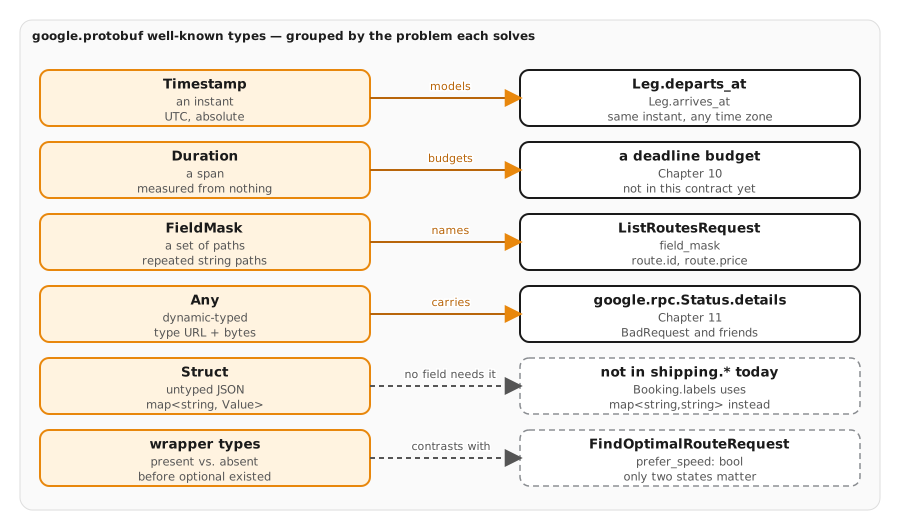
google.protobuf.Timestamp represents an instant — a point in civil time, not a duration and not a local wall-clock reading. It’s two fields, int64 seconds (since the Unix epoch) and int32 nanos (the fractional remainder), always UTC, always absolute. Leg.departs_at and Leg.arrives_at are Timestamps because a shipment’s departure is a fact about the world everyone needs to agree on in the same instant, regardless of which time zone origin, destination, or a caller’s own server happens to sit in. Booking.created_at and TrackingEvent.at use it for the same reason: these are facts stamped once, compared across services, and never meant to be read as “3pm local.”
google.protobuf.Duration represents an elapsed span instead of a point — also seconds and nanos, but measured from nothing rather than from the epoch. Nothing in this contract declares one yet, but the shape recurs the moment a method needs to say “this long,” not “at this time”: a deadline budget handed to a downstream call (Chapter 10), a retry backoff interval, a staleness bound on a cached route. The distinction from Timestamp is the one a raw int64 erases entirely — a Duration can’t be mistaken for an instant, because its wire shape and its JSON rendering both say “elapsed,” never “when.”
google.protobuf.FieldMask represents a set of field paths — ListRoutesRequest.field_mask lets a caller ask for only route.id and route.price out of a full Route, skipping the cost of serializing and transmitting legs it doesn’t need. It’s a repeated string paths under the hood, each entry a dotted path into the response message’s own field names. Chapter 13 covers what a server does with one in depth; this chapter only needs that it exists as a reusable, generator-supported way to say “a subset of these fields,” rather than a bespoke repeated string included_fields every service reinvents slightly differently.
google.protobuf.Any solves a narrower problem: embedding a message whose concrete type the embedding message’s schema doesn’t name. It stores a type URL alongside the serialized bytes, so a generic container — most visibly google.rpc.Status.details, which Chapter 11’s rich error model wraps around google.rpc.BadRequest and friends — can carry one of several message types without a oneof enumerating them all up front, at the cost of the receiver needing to know how to unpack whatever type URL shows up. Nothing in shipping.* uses one today; it’s the right tool for an extension point a service’s own schema can’t close off in advance, which is rarer than it looks and shouldn’t be reached for as a substitute for a field the schema could just name.
Unpacking an Any is a second, independent step from parsing it, and that’s where the cost above lands. A receiver resolves the type URL against whatever message types it has on hand — a compiled-in descriptor, or a type registry for a receiver that can’t know in advance what will show up — and only then deserializes the bytes into that concrete type. A type URL the receiver never linked in resolves to nothing: the outer Any parsed cleanly, but no code on hand knows how to turn its bytes into a typed message, so the failure is a runtime unpack error at the call site, not a decode failure on the wire. That’s the mechanism Chapter 11’s google.rpc.Status.details rides on — a client that never linked in google.rpc.BadRequest can still receive the Status, just not unpack what’s inside details.
google.protobuf.Struct goes further still: an arbitrary, untyped JSON-like object — a map of string keys to values that are themselves strings, numbers, bools, nested structs, or lists. It’s the direct way to accept “whatever JSON shape the caller sends,” the opposite of everything Chapter 3 recommended. Booking.labels is a map<string, string> rather than a Struct for exactly this reason: labels are a known shape (flat key-to-string pairs) that proto3’s type system can describe and validate directly, and reaching for Struct there would throw away the one advantage a typed schema has over a REST site’s free-form JSON body — a compiler that catches the field that doesn’t exist. Struct is worth using only when the shape isn’t known at compile time, such as a webhook payload defined by a third party this contract doesn’t control.
The wrapper types — google.protobuf.BoolValue, Int32Value, StringValue, DoubleValue, and five more scalar siblings — exist to answer a question Chapter 3 raised and left open: how does a proto3 scalar distinguish “never set” from “set to the zero value,” before the optional keyword existed to do it directly? A wrapper boxes a scalar inside a one-field message, and an unset message field is absent rather than zero, so BoolValue’s absence and its presence-set-to-false are distinguishable where a bare bool’s aren’t. FindOptimalRouteRequest.prefer_speed is a plain bool, not a BoolValue, because this contract never needs to ask “did the caller express a preference at all” — a caller who cares about speed sets it true, one who doesn’t leaves it false, and those are the only two states FindOptimalRoute ever has to act on. A wrapper buys real information at a real cost — an extra allocation and a Has*()-style check at every read site — and optional scalar fields now cover most of the same ground more cheaply for a single proto3 file; wrappers still matter for interop with JSON tooling and older proto2-era APIs that expect them by name, which is why they’re worth recognizing on sight even where this contract doesn’t reach for one.
Money as a decimal string: the REST↔gRPC seam, in one message
shipping.type.v1.Money isn’t a well-known type — it’s two plain string fields, currency and amount — and that’s deliberate rather than an oversight. A double amount would serialize compactly and look natural, until two services summed enough weight_kg * rate calculations to drift by a cent through ordinary binary floating-point rounding, the same failure IEEE 754 guarantees for any base-10 fraction it can’t represent exactly. An int64 amount_cents avoids the rounding problem but creates a silent-units problem instead: every caller has to know, out of band, that the integer means cents and not the currency’s major unit or micros, and a client built against the wrong assumption is off by two orders of magnitude with no error from the parser. A decimal string sidesteps both: "1250.00" round-trips through JSON, logs, and a database column exactly as written, with no base-2 approximation and no unit ambiguity to document separately.
This is the one point where this site and its REST sibling make the identical call for the identical reason: the REST contract’s Money JSON Schema component is { currency: string, amount: string }, the same two fields, the same decimal-string rule, because the domain fact — money shouldn’t be a binary float — doesn’t change when the transport does. A Booking crossing the REST↔gRPC seam at the booking service carries one Money value through both notations without either side reinterpreting what amount means.
The canonical proto3 ↔ JSON mapping
Every well-known type above, and every ordinary field, resolves to JSON through one fixed set of rules, and this is the chapter’s spine: learn this table once and every grpcurl response, every REST-gateway payload, and every log line this site produces becomes legible without a lookup.
| Proto construct | JSON representation | Example |
|---|---|---|
| field name | lowerCamelCase | un_locode → unLocode |
google.protobuf.Timestamp |
RFC 3339 string | "2026-02-01T10:00:00Z" |
google.protobuf.Duration |
decimal seconds + s suffix |
"3.5s" |
google.protobuf.FieldMask |
comma-joined path string | "route.id,route.price" |
enum |
the value’s name, as a string | "BOOKING_STATE_CONFIRMED" |
int64, uint64, sint64, fixed64, sfixed64 |
string | "9223372036854775807" |
bytes |
base64-encoded string | "SGVsbG8=" |
wrapper types (Int32Value, etc.) |
the bare scalar, or null if unset |
0 vs. null |
google.protobuf.Struct |
the arbitrary JSON object it holds | {"any": "shape"} |
google.protobuf.Any |
{"@type": "...", ...fields} |
— |
The first row is the one that trips people up fastest, because it looks cosmetic and isn’t: Location.un_locode, a snake_case field exactly as declared in types.proto, becomes the JSON key unLocode on the wire and in every library’s generated accessor, by specification, not by this project’s house style. 64-bit integer types render as JSON strings rather than numbers because JavaScript’s Number only represents integers exactly up to 2^53, and a Money-adjacent int64 id or a large counter silently loses precision the moment a browser’s JSON.parse touches it as a number — proto3 JSON sidesteps that entire class of bug by never emitting a 64-bit integer as a JSON number in the first place.
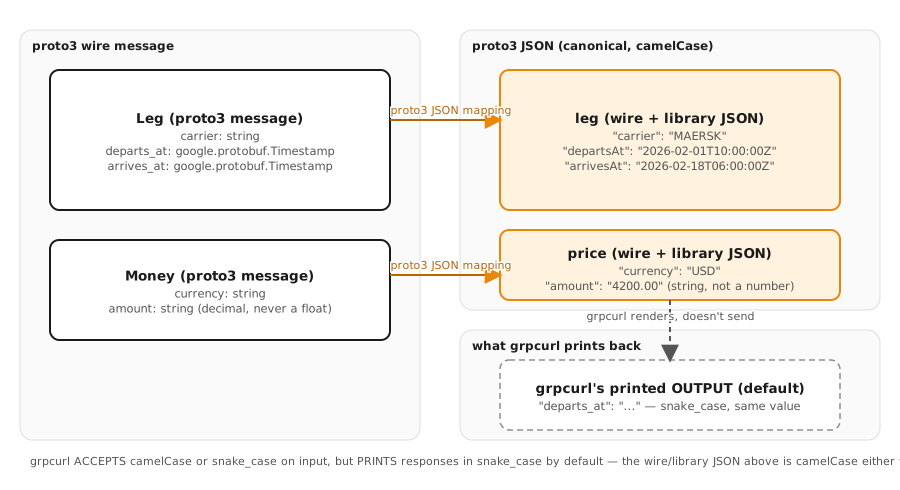
One tool-specific wrinkle is worth knowing before it looks like a contradiction: grpcurl accepts a request body in either lowerCamelCase or the original snake_case field names, but prints a response back using each message’s original, declared field names — snake_case, not camelCase — regardless of which casing the request used. Both directions are still proto3 JSON; grpcurl just chooses to render output in the proto source’s own spelling rather than the canonical wire casing, which means the camelCase rule above is what every library-level JSON encoder emits, and what every REST gateway sees, even on the one call path — grpcurl on your own terminal — where the printed text looks like it disagrees. A request of {"unLocode": "USNYC"} and a printed response field "un_locode": "USNYC" describe the identical mapping read forwards and backwards; neither is wrong, and conflating them is the single easiest proto3-JSON mistake to make the first time a grpcurl session doesn’t match what the generated Java or Python code just handed you.
One more consequence of this table is easy to miss until it causes a real bug: a scalar field left at its default — 0, "", false — is omitted from proto3 JSON entirely, never emitted as a literal zero. That’s not an encoder shortcut; proto3’s wire format already treats a default-valued scalar as absent, so JSON doesn’t invent a distinction the binary encoding never drew. “Never set” and “set to zero” look identical on the wire and in every log line — both render as a key that simply isn’t there. optional scalars and the wrapper types restore the distinction this chapter already introduced: a wrapper set to zero is still a present one-field message and gets emitted, where an absent wrapper serializes as null. Every JSON encoder ships an opt-in to print default-valued scalars anyway, for a caller that needs the full field set. Chapter 13’s FieldMask inherits this same ambiguity: a path resolving to a never-set scalar and one resolving to an explicitly-zeroed scalar merge identically, because the mask can’t tell which one happened.
Setting a Timestamp: the well-known type in generated code
Neither stack’s generator makes you build Timestamp’s two raw integer fields by hand. Both ship a conversion between the well-known type and the host language’s native date-time type, because every language already has one and reinventing a seconds/nanos pair at every call site would be the thing well-known types exist to prevent:
// com.google.protobuf.Timestamp ships inside protobuf-java itself — no
// extra dependency beyond quarkus-grpc, which already pulls it in.
private static final Instant DEPARTS_AT = Instant.parse("2026-02-01T10:00:00Z");

private static Timestamp toTimestamp(Instant instant) {
    return Timestamp.newBuilder()
            .setSeconds(instant.getEpochSecond())
            .setNanos(instant.getNano())
            .build();
}
# google.protobuf.timestamp_pb2 ships inside the `protobuf` package itself —
# already a runtime dependency, not something grpcio-tools adds.
_DEPARTS_AT = datetime(2026, 2, 1, 10, 0, 0, tzinfo=timezone.utc)

def _to_timestamp(when: datetime) -> timestamp_pb2.Timestamp:
    ts = timestamp_pb2.Timestamp()
    ts.FromDatetime(when)
    return ts
Instant.getEpochSecond()/getNano() and Timestamp.FromDatetime() are each stack’s native bridge between the well-known type’s wire shape and a type the rest of the language’s standard library already understands — java.time.Instant and Python’s timezone-aware datetime, both of which refuse to let you forget a time zone the way a bare long millis never stops you from forgetting. Get the input instant right — UTC, explicit, never “now” read off a wall clock mid-test — and both stacks produce the identical seconds/nanos pair, which is what turns into the identical RFC 3339 string on the way out.
On the wire
examples/04-well-known-types/verify.sh makes this exact call against both stacks — Quarkus on 9007, Python on 9008 — and both return byte-identical Timestamp and Money renderings, because both were generated from the same .proto through the same specification:
grpcurl -plaintext -d '{
  "origin": {"unLocode": "USNYC"},
  "destination": {"unLocode": "NLRTM"}
}' localhost:9007 shipping.routing.v1.RoutingService/FindOptimalRoute
Expect this back — note the request’s unLocode versus the response’s printed un_locode, the same grpcurl quirk this chapter called out above, and departs_at/arrives_at rendered as RFC 3339 strings exactly as the mapping table predicts:
{
  "route": {
    "id": "rte_USNYC-NLRTM",
    "legs": [
      {
        "carrier": "MAERSK",
        "origin": {"un_locode": "USNYC"},
        "destination": {"un_locode": "NLRTM"},
        "departs_at": "2026-02-01T10:00:00Z",
        "arrives_at": "2026-02-18T06:00:00Z"
      }
    ],
    "price": {"currency": "USD", "amount": "4200.00"}
  }
}
Swap port 9007 for 9008 and run the identical command against the Python stack for the identical answer — route.price.amount comes back "4200.00", a decimal string, never a JSON number, on both.
Where this goes next
This chapter’s mapping table is the thing every later chapter assumes without re-deriving: Chapter 10 sends a Duration-shaped deadline budget down the same call chain Chapter 2 named; Chapter 11 wraps google.rpc.Status.details around an Any holding a typed error payload; Chapter 13 builds ListRoutes’s pagination and projection logic directly on the FieldMask introduced here; and the REST site’s own OpenAPI contract keeps rendering Money, Location, and every Timestamp-backed field through this exact JSON shape at the one seam both sites share. Chapter 5 is where all of this stops being a table to read and starts being a response you call for yourself: RoutingService.GetQuote, generated on both stacks from the same .proto, gated by buf, and checked by a verify.sh that asserts response fields the way this chapter’s own example already does.
Decision
Choosing Timestamp over a raw int64 epoch, and FieldMask over a bespoke repeated string of field names, both come down to the same two axes from Chapter 2's framework, even though neither is strictly about RPC shape. Failure class is the sharper one: a raw epoch integer's failure mode is a silent misread — seconds decoded as milliseconds lands a date fifty-some years in the wrong direction with no parse error, no non-OK status, nothing a caller's retry logic or buf breaking would ever catch, because the field still type-checks as an integer either way. Timestamp and FieldMask convert that into a loud failure instead: a value that doesn't parse as RFC 3339 is a JSON decode error, not a plausible-looking wrong answer, and a field mask path that doesn't exist on the target message is a validation error a server can reject before it ever computes a response. The other axis is evolution, which Chapter 14 covers in full: a FieldMask-driven ListRoutes keeps working unmodified the day a new field is added to Route, because the mask names paths the caller already knows about and the server doesn't have to special-case; a bespoke "which fields do you want" enum would need a new value, a new server branch, and a new release on both sides for the same change. Reach for the well-known type whenever the alternative is a convention two independently-deployed services have to agree on silently; write the scalar by hand only when there's no well-known type that already names the exact shape you need, the way Money's decimal-string case has none.