Protocol Buffers in depth
The proto3 language in full: scalars, messages, enums, oneof, map, packages, options, field presence, and the tag-number math that turns a message into bytes.
Chapter 2 gave you a lens for classifying a call. This chapter gives you the language for describing the data that call carries. Every type this book’s shipping domain uses — Booking, Cargo, Money, Route — is a .proto message, and every one lives in one place: contracts/proto/, read once by buf and generated into both the Quarkus and the Python stack. That arrangement is the gRPC analog of something the sibling REST site already leans on hard: the same Booking and Money shapes that site models as JSON Schema components, this site models as proto messages — two contract languages describing the same domain nouns, because the nouns don’t change when the transport does. A JSON Schema can describe a number’s range; it cannot tell a parser which bits on the wire belong to that number. Protobuf’s type system and its wire format are the same document, and understanding both is what this chapter is for.
Scalars, messages, and the wire types underneath them
A message in proto3 is a named, ordered set of fields, each with a type and a field number:
message Money {
  string currency = 1;  // ISO 4217, e.g. "USD"
  string amount = 2;    // decimal string, e.g. "1250.00"
}
That field number — the = 1, the = 2 — is not a default value and not an array index. It is the field’s permanent identifier on the wire, and this chapter keeps returning to why that matters. Every scalar type proto3 offers maps to one of four wire types, fixed by the language: int32, int64, uint32, uint64, sint32, sint64, bool, and enum encode as VARINT (wire type 0) — a variable-length integer where small values take one byte, growing a byte at a time as the value does. fixed64, sfixed64, and double encode as I64 (wire type 1) — always eight bytes, cheaper than VARINT for values that are usually large. fixed32, sfixed32, and float encode as I32 (wire type 5) — always four bytes. string, bytes, embedded messages, and packed repeated fields encode as LEN (wire type 2) — a length prefix followed by exactly that many bytes, so a parser knows where a variable-length value ends without scanning for a delimiter.
sint32/sint64 look redundant with int32/int64 and aren’t. Plain int32 VARINT-encodes a negative number as the equivalent unsigned 64-bit two’s-complement value — always ten bytes, regardless of magnitude. sint32/sint64 apply ZigZag encoding first, mapping small-magnitude negatives to small-magnitude unsigned values before VARINT-encoding, so -1 costs one byte instead of ten — a deliberate trade for a specific access pattern, not a safer general-purpose default than int32.
Nested messages and the enum zero-value rule
A message field’s type can be another message, nested as deeply as needed. Booking embeds Location twice, a repeated Cargo, and a Money — each independently defined, reused instead of inlined:
message Booking {
  string id = 1;
  Location origin = 2;
  Location destination = 3;
  repeated Cargo cargo = 4;
  BookingState state = 5;
  Money quote = 6;
  google.protobuf.Timestamp created_at = 7;
  map<string, string> labels = 8;
}
enum is a closed, named set of integer constants, and proto3 enforces one rule with no proto2 equivalent: the value mapped to 0 must exist, and by strong convention is named <ENUM_NAME>_UNSPECIFIED. BookingState’s zero value is BOOKING_STATE_UNSPECIFIED, not BOOKING_STATE_PENDING, even though PENDING is the state every real booking starts in. The reason: proto3 doesn’t distinguish “never assigned” from “explicitly assigned its zero value,” so whatever sits at 0 is what every unset BookingState field reads back as, forever, including in messages built before that field existed. Naming that default UNSPECIFIED keeps a missing value from being silently misread as meaningful. Enum constants are conventionally prefixed with the enum’s name (BOOKING_STATE_CONFIRMED, not bare CONFIRMED) because they share a single namespace with their enclosing scope — two enums in the same file can’t both declare a bare CONFIRMED without colliding.
oneof, map, and repeated: three field shapes with different contracts
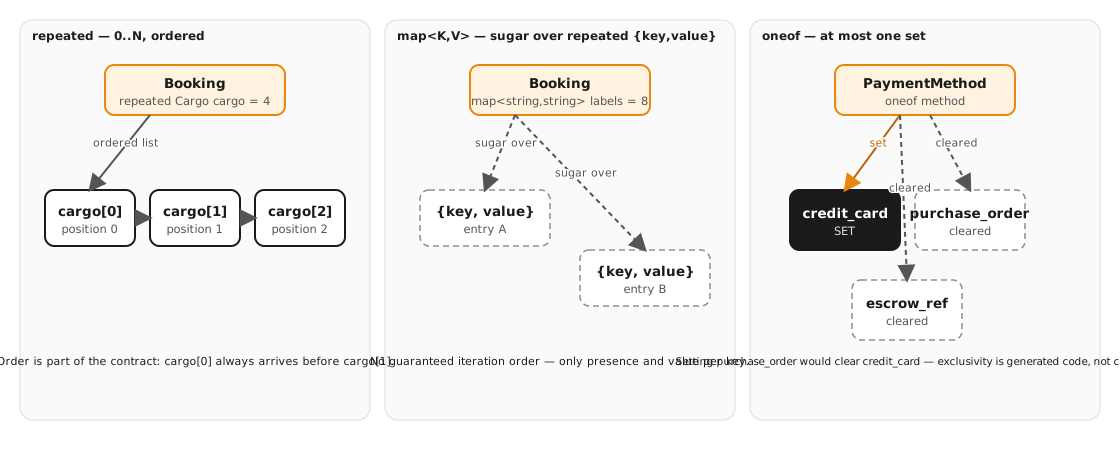
repeated says “zero or more of this type, in order” — Booking.cargo and Route.legs are ordinary repeated fields, one LEN-prefixed entry per element, or a single packed run for repeated scalars. map<K, V> is sugar over a repeated message of implicit {key, value} entries; Booking.labels behaves like a dictionary in every generated language, but what’s on the wire is a sequence of two-field submessages — worth knowing the day you need map ordering (there isn’t any) or wonder why a map field can’t itself be repeated (it already is, underneath).
oneof says something repeated and plain fields can’t: of this named group, at most one is ever set, and setting a second clears whichever was set first. None of the shipping types need one, but the shape recurs — a PaymentMethod that’s a credit card or a purchase order or an escrow reference, never two at once. A oneof enforces that exclusivity at the type level, in every generated language, instead of leaving it an unenforced comment a caller will eventually violate. On the wire, an unset branch contributes nothing — the same LEN/VARINT/I64/I32 encoding every other field uses; the exclusivity is a generated-code guarantee (WhichOneof() in Python, a case enum in Java) layered over fields sharing one storage slot.
Packages, imports, and options
package shipping.type.v1; does two jobs. It namespaces every message and enum in the file, so shipping.type.v1.Location and some unrelated service’s Location never collide, and the trailing v1 is a versioning convention — protobuf has no built-in concept of a package version. An incompatible Location shape gets a new package, shipping.type.v2, beside the old one rather than replacing it (the convention buf breaking enforces, Chapter 14), so callers compiled against v1 keep working untouched.
import "shipping/type/v1/types.proto"; pulls another file’s declarations into scope, resolved against an include path the compiler is given — buf.yaml’s modules: - path: proto lets types.proto and routing.proto resolve against each other without either knowing the other’s filesystem location. routing.proto imports types.proto to reuse Location, Cargo, Money, and Route, and separately imports google/protobuf/field_mask.proto — a well-known type shipped with every protobuf compiler, covered in Chapter 4.
option statements configure code generation without changing the wire format — a file-level option java_package or option go_package tells each language’s generator which package to emit into. None of shipping.type.v1’s files set one, since this book’s generators derive a sensible default from the proto package name; a contract shared across teams with stricter layouts would typically pin them explicitly instead.
proto3 semantics: defaults, presence, and no required
Every scalar field in proto3 has a type-defined zero value — 0 for numeric types, "" for string, false for bool — and an unset field reads back as that zero value, never as null or an error. This is the biggest semantic difference from a typical JSON Schema or ORM model, where “absent” and “present but zero” are usually distinguishable; in bare proto3 they are not: a Cargo.weight_kg of 0.0 is indistinguishable from one nobody ever set. Message-typed fields don’t have this problem — Booking.quote can be present or absent, because an unset message field is a null pointer, not an empty Money{} — but for singular scalars the ambiguity is real and by design.
The optional keyword, added in the 3.15 compiler release, closes that gap: optional int32 progress_pct = 4; generates a HasProgressPct() accessor that tells “explicitly set to 0” apart from “never touched,” implemented as a synthetic single-field oneof — why optional and manually-declared oneof fields share the same explicit-presence behavior on the wire. It isn’t free: it costs a Has*() check at every call site, and most fields don’t need the distinction — Cargo.hazardous false because nobody set it, and explicitly declared non-hazardous, are the same fact to every consumer. Reach for optional when “was this ever set” is information the caller must act on, not as a blanket default.
proto3 has no required keyword — proto2 had one, and proto3 removed it permanently. A required field made an entire message fail to parse if that field was missing, so a server could never safely stop sending it, and an older client could never safely add one, without risking a parse failure in a fleet that hadn’t upgraded. Chapter 14 covers evolution in depth; the short version is that proto3’s answer to “make sure this field is populated” is validation in your own code, not a parser constraint that can never relax without breaking the systems it protects.
Tag numbers: the real contract
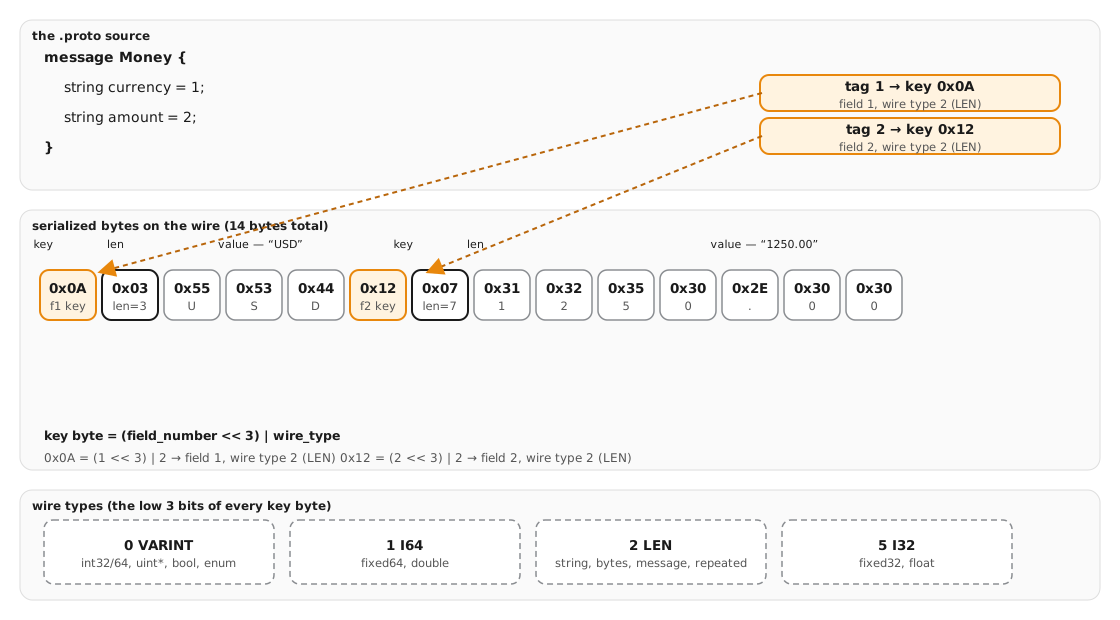
Field numbers are typed as int32, but the usable range is far narrower, for wire efficiency. A key byte is computed as (field_number << 3) | wire_type. Numbers 1 through 15 fit that into a single VARINT byte; 16 needs a second byte, because 16 << 3 | wire_type exceeds one byte’s 7 usable bits. Fields reached for first in Booking or Cargo — serialized every call — should get tag numbers 1 through 15: a one-byte tax instead of a two-byte one, a real cost at RoutingService’s volume.
This is also why a field number, once shipped, is permanent in a way a field name never has to be. Renaming Booking.id to Booking.bookingId changes nothing over the wire — the generated accessor name changes, the bytes do not, since the wire format never encodes the string "id" anywhere. Reusing tag 1 for a different field after Booking.id has shipped is a different story: every message serialized under the old definition still has a 1-tagged LEN value in its bytes, and a parser built against the new definition decodes those old bytes as whatever 1 means now, silently, with no error. The field number is the contract; the field name is documentation for humans. Chapter 14 builds an evolution discipline on exactly this distinction.
Hand-decoding a message’s bytes
The clearest way to see tag-number math stop being abstract is to decode a real message by hand. Serializing Money{currency: "USD", amount: "1250.00"} produces this exact 14-byte sequence:
0A 03 55 53 44 12 07 31 32 35 30 2E 30 30
Reading it left to right: 0x0A is the first key byte. Split it with the inverse of the formula above — binary 0000 1010; the low three bits, 010, are wire type 2 (LEN); the remaining bits are 1 — field number 1, currency, wire type LEN. The next byte, 0x03, is a VARINT length: three bytes follow, 55 53 44, the UTF-8 encoding of "USD". That’s the whole first field: key, length, value. 0x12 is binary 0001 0010 — wire type LEN again, field number 2, amount; 0x07 says seven bytes follow, decoding to "1250.00". Two fields, two key-length-value runs, zero bytes spent on field names — only field numbers, wire types, and values.
Notice what’s absent: no {, no }, no "currency":, no ,. A JSON encoding of the same value — {"currency":"USD","amount":"1250.00"} — runs 38 bytes, nearly three times as many, and every extra byte is syntax and field-name text both ends already agree on. roundtrip.py in this chapter’s example performs exactly this decode in code — a 20-line VARINT reader that walks these same bytes and asserts the values it finds match what went in — so this paragraph’s arithmetic and the generated Python stub agree on the same fourteen bytes.
Why binary beats JSON on the wire
The size difference in the Money example generalizes, and compounds in three ways JSON-over-HTTP can’t close by minifying whitespace. Field identity is a 1-to-2-byte integer tag instead of a quoted string key, so a field’s name costs nothing proportional to how descriptive it is — weight_kg and w would serialize identically, since the name never appears in the bytes. Numeric values use VARINT and fixed-width binary encodings instead of decimal ASCII text, so small integers and booleans cost one byte instead of several characters of digits and separators. And a protobuf parser never tokenizes: no scanning for the next ", :, ,, or }, no escape handling, no distinguishing a number from a string by inspecting characters. A LEN-prefixed field tells the parser exactly how many bytes to consume, and a VARINT’s continuation bit tells it exactly when the integer ends — decoding is fixed-size reads driven by lengths the format carries, not a text scan.
None of this is specific to gRPC — plain HTTP/1.1 keeps every advantage above. Chapter 6 adds what happens when this already-compact format rides HTTP/2’s multiplexed, HPACK-compressed framing instead of a verbose text header block per call: the per-message win here and the per-connection win there stack, and measuring that total is where “gRPC is fast” stops being a slogan and becomes a number you can reproduce.
Choosing oneof over separate fields
Run this question through the five-axis decision framework from Chapter 2. RPC shape and the sync-call-vs-stream axis are usually neutral — a oneof serializes the same way on a unary or streamed call — but the other three aren’t. Failure class and retryability matter when the alternatives represent different outcomes a caller must branch on: a RouteConstraint that’s a max-transit-time or a max-cost isn’t two knobs a caller might forget to check both of, it’s one choice with two shapes, and a oneof makes a missed case a compile-time gap in a generated switch instead of a runtime bug found when both fields are set and the service has to guess which wins. Concurrency model matters when independent writers might otherwise race to populate what should be mutually exclusive state — a oneof makes “exactly one of these” a property of the data, not a convention two services must remember. Evolution pressure, the axis Chapter 14 returns to, cuts the other way: adding a branch to an existing oneof is safe and additive like adding any new field, but converting an existing plain field into a oneof member after it’s shipped is not, because an already-serialized message with that field set still parses as “field N present,” and older code needs to agree on what that now means.
Decision
Reach for a `oneof` when a message's fields represent alternative shapes of the same conceptual value — a payment method that's a card, a purchase order, or an escrow reference, never more than one at a time for a given booking — and the exclusivity is a fact about the domain, not a convention you're hoping callers remember. Keep separate plain fields when values are independent and can coexist freely, even if several of them are usually absent at once: `Booking.labels` holds an open-ended, co-occurring set of key/value pairs, which is exactly what a `map` is for and exactly what a `oneof` is not. Default to plain fields when you're unsure; converting independent fields into a `oneof` later is the safe direction, while converting a `oneof` back out to independent fields after callers depend on its exclusivity is not.
Running the example
cd examples/03-protobuf
./verify.sh
verify.sh runs buf build against contracts/, generates Python stubs for shipping.type.v1 plus a tiny standalone oneof demo proto, then round-trips a Money, a Booking, and the demo — asserting the hand-decoded Money bytes match the tag-number math above. No server, no port, no container; see the example’s README.md for the full walkthrough.
Where this goes next
Chapter 4 picks up the well-known types named only in passing here — Timestamp, Duration, FieldMask, Struct, the wrapper types — and the proto3-to-JSON mapping that lets Booking.created_at render as an RFC 3339 string at the REST↔gRPC seam without either side hand-rolling a converter. Chapter 14 returns to tag numbers as an evolution problem: which changes buf breaking passes, which silently corrupt old data, and why the field-number contract introduced here is what that gate enforces.
On the wire
Run examples/03-protobuf/verify.sh yourself before moving on. It does three things worth watching: buf build compiles the real contracts/ module from scratch, proving the proto you just read about actually parses as one coherent Buf module; python -m grpc_tools.protoc generates fresh Python stubs for shipping.type.v1 into a throwaway virtualenv, proving the generated code and the hand-written proto agree; and roundtrip.py hand-decodes a serialized Money's 14 bytes field-by-field with a 20-line VARINT reader, checking byte 0 == 0x0A and byte 5 == 0x12 against the exact tag-number arithmetic worked through above, before parsing the bytes back with the generated stub and asserting every field — including a nested message, an enum, a map, a repeated field, and a well-known Timestamp — survived the trip.