Federation & schema composition
One graph owned by several teams: the tracking view split into a cargo subgraph and a handling subgraph on both stacks, entities and references, batched entity resolution, composition as a failing build step, a query plan counted from the subgraphs' logs, and two cross-wired Hive gateways that serve the canonical contract.
Chapter 2 named an axis that has stayed quiet since: who owns the schema, and who owns the services behind each field. Every chapter so far gave both answers to one team. This chapter gives them to two. The booking and routing team owns cargo, locations and voyages. The handling team owns handling events and the delivery state derived from them. Each team ships its own service and its own part of the graph, and clients still see one schema.
The code is in examples/20-federation/. It starts from the Chapter 13 example, cut into four services: a cargo subgraph and a handling subgraph on each stack. A composer turns a pair of subgraphs into a supergraph file, and two gateways serve the two pairs. The schema a client sees is the canonical one, minus Query.node, Query.nodes and Subscription, and verify.sh diffs both gateways against contracts/schema/.
When one schema owner becomes the queue
Federation solves a coordination problem, not a technical one. With one schema owner, every new field is a pull request to one repository, reviewed by one team that understands the whole graph. That works while the graph is small and the team is one team. It stops working when the cargo team waits on the handling team to approve a Cargo field, or when the schema owner is the only person who knows which service backs which field. Chapter 2’s seventh axis put the threshold in terms of people: several teams each want to contribute types, and a single owner becomes the queue.
Federation moves the queue. Each team owns a subgraph, a GraphQL service with its own schema, and a gateway composes the subgraphs into one supergraph that clients query. Chapter 1 described a resolver as an aggregation point: one field backed by a REST call, another by a database read, one graph on top. A gateway is the same idea one level up, where a field is backed by another team’s GraphQL service.
It costs something. Every query that crosses a team boundary becomes several requests between services, a composition step has to pass before anything deploys, and a failure in one team’s service reaches fields that look like another team’s. If one team owns the tracking view, as in every earlier chapter, one schema is cheaper and simpler. Federation pays when the ownership is real.
Subgraphs by ownership
The split follows who owns the data, not how the types are shaped (Figure 20.1). The cargo subgraph holds Cargo, Location and Voyage with their itineraries, legs and route specifications, and it serves the root fields cargo, cargos, location and voyage. The handling subgraph holds HandlingEvent, Delivery, HandlingActivity, Mutation.registerHandlingEvent and its input and payload types. Both read the booking and routing sources from Chapter 13, because the delivery state compares a cargo’s itinerary with its handling history. Only the cargo subgraph exposes them as types.
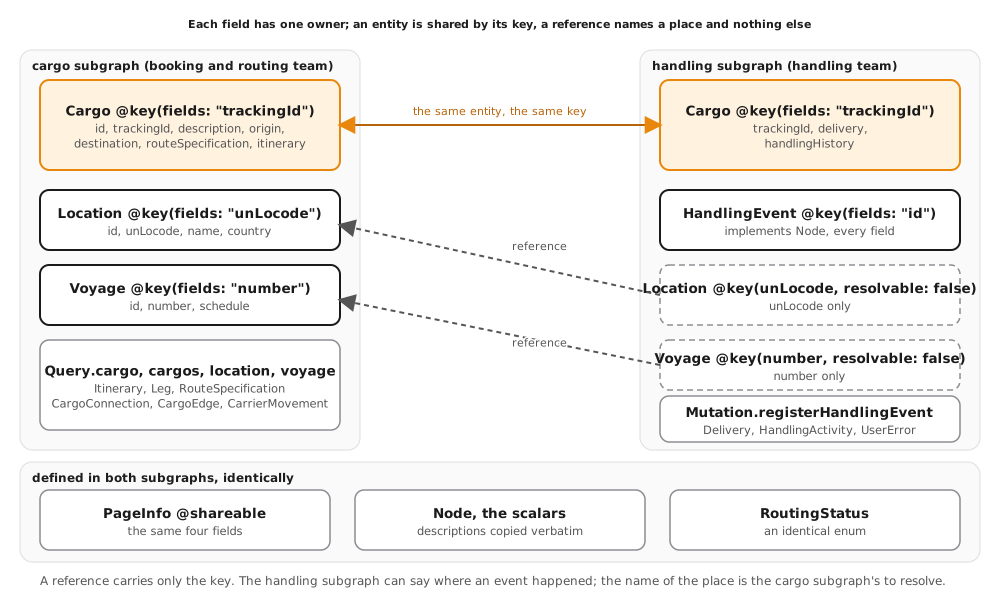
Two things stay out of this example. Query.node and Query.nodes would need the Node lookup to dispatch across subgraphs, which takes entity interfaces and @interfaceObject. Subscription is Chapter 21. Everything else in the canonical SDL has exactly one owning subgraph, apart from the few types both subgraphs must define.
Entities, keys and references
An entity is an object type that more than one subgraph contributes fields to. The @key directive names the fields that identify it, and those fields are the contract between subgraphs. Cargo is an entity with the key trackingId: the cargo subgraph defines its description, route and itinerary, and the handling subgraph defines delivery and handlingHistory. Neither subgraph defines the whole type, and the supergraph merges the two definitions.
The handling subgraph also needs to say where an event happened. It does not own locations. It declares Location with the key unLocode and resolvable: false, which means “this subgraph can name a location by its key but has no entity resolver for it”. The type carries one field, unLocode. Voyage is declared the same way. These are references. A reference keeps the handling team from copying the cargo team’s data, and it tells the gateway that a location’s name has to come from the cargo subgraph.
Value types that both subgraphs return, such as PageInfo, are marked @shareable. Without the directive, composition treats a field that two subgraphs resolve as an accident and refuses it, which is the second failure the composition section shows. Enums and the Node interface are defined identically in both, with every description copied from the canonical SDL, so the composed schema carries the contract’s own text.
Declaring an entity on each stack
A federated subgraph adds two root fields to its own schema. Query._service returns the subgraph’s SDL, including the federation directives, and Query._entities takes a list of representations and returns the matching objects. A representation is a __typename and the key fields, such as {__typename: "Cargo", trackingId: "ABC123"}. Both are defined by the Apollo Federation subgraph specification, which is why a subgraph from any stack composes with any other.
On Quarkus, SmallRye GraphQL has federation annotations. @Key makes a record an entity, @Shareable marks a shared type, and @Link on the API class declares the federation version the subgraph speaks. Two settings in application.properties turn it on and make entity resolution batch:
quarkus.smallrye-graphql.federation.enabled=true
quarkus.smallrye-graphql.federation.batch-resolving-enabled=true
On Python, Strawberry has a federation module. strawberry.federation.type(keys=[...]) declares an entity, and strawberry.federation.Schema adds _service and _entities and the @link for the version.
@Type("Cargo")
@Key(fields = @FieldSet("trackingId"))
@Description("A consignment of goods being shipped, tracked end to end by its tracking id.")
public record Cargo(
        String id,
        @NonNull @Description("The public tracking identifier.") TrackingId trackingId,
        @NonNull @Description("Free-text description of the goods.") String description,
        ...
@strawberry.federation.type(
    keys=["trackingId"],
    description="A consignment of goods being shipped, tracked end to end by its tracking id.",
)
class Cargo(Node):
    id: strawberry.ID = strawberry.field(
        description="The globally unique identifier of this cargo."
    )
    tracking_id: TrackingId = strawberry.field(description="The public tracking identifier.")
    ...
The handling subgraph’s reference is a record with one component. The key is the whole type:
@Type("Location")
@Key(fields = @FieldSet("unLocode"), resolvable = false)
@Description("A port or terminal, identified by its UN/LOCODE.")
public record Location(@NonNull @Description("The UN/LOCODE, for example `NLRTM`.") UnLocode unLocode) {}
Both stacks print the same directive on Location, @key(fields: "unLocode", resolvable: false), and both declare Federation 2.7 with a schema-level @link that imports @key and @shareable. SmallRye’s printer writes a space before each colon, so verify.sh matches these lines with a pattern that allows either.
Resolving entities in a batch
The gateway sends _entities a list of representations, and each one has to become an object. Answering them one at a time is the N+1 problem from Chapter 13 across a network, so the entity resolver is a batch resolver.
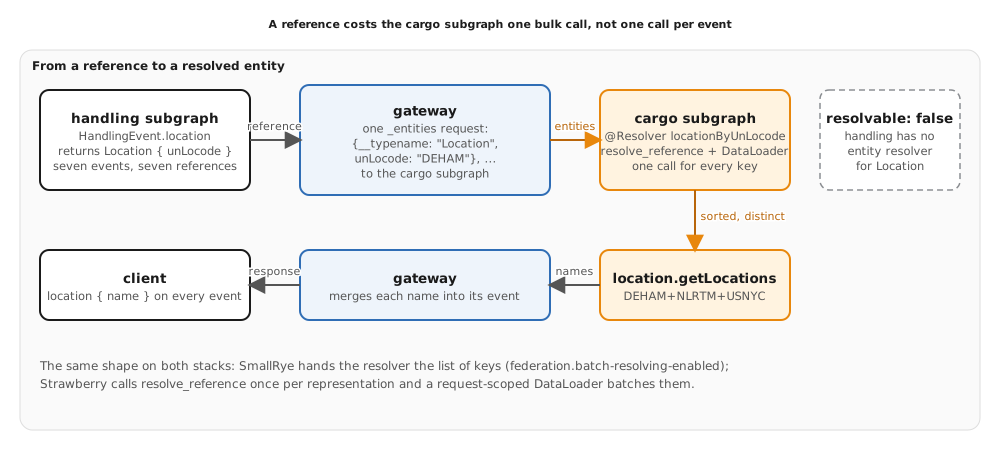
SmallRye’s @Resolver marks an entity resolver without creating a query field. With federation.batch-resolving-enabled, the method takes the list of keys of every representation of its type in the request, and returns one entity per key in the same order. It calls the same bulk source Chapter 13 introduced:
@Resolver
@Description("Entity resolver: the cargo for each tracking id, in order.")
public Uni<List<Cargo>> cargoByTrackingId(@Name("trackingId") List<String> trackingIds, Context context) {
    return booking.getCargos(context.getExecutionId(), trackingIds).map(Outcome::values);
}
Strawberry calls resolve_reference once per representation, so the batching is a request-scoped DataLoader, the same one the other cargo fields use. The keys arrive as keyword arguments named as they are on the wire, so the parameter is trackingId:
@classmethod
async def resolve_reference(
    cls, info: Info[TrackingContext], trackingId: TrackingId
) -> Cargo | None:
    return await info.context.loaders.cargo.load(trackingId)
The results are the same on both stacks. Five Location representations, with DEHAM twice, make one location.getLocations call keyed DEHAM+NLRTM+SGSIN+USNYC. An unknown key is null at its position, which is how a gateway learns that an entity does not exist.
Composition as a gate
Composition is where subgraphs become a supergraph, and it can fail. The composer reads each subgraph’s SDL, checks that the subgraphs agree about every shared type and key, and writes the supergraph. If they disagree, there is no supergraph, and that is the point: the error appears at build time, in a pipeline, before any client sees a broken graph. Chapter 11’s breaking-change gate stops a pull request that would break clients, and composition is the same kind of gate for the seams between teams.
The example makes composition an explicit step (Figure 20.2). @theguild/federation-composition 0.27.0, an MIT-licensed library from The Guild, exposes a composeServices function. gateway/compose-supergraph.mjs is a short script around it. It fetches { _service { sdl } } from each subgraph URL, or reads an SDL file with --file, composes, and writes one file. On an error it prints one line per error, <code>: <message>, and exits 1:
const result = composeServices(services);
if (result.errors?.length) {
  for (const error of result.errors) {
    console.log(`${error.extensions?.code ?? 'COMPOSITION_ERROR'}: ${error.message}`);
  }
  process.exit(1);
}
writeFileSync(values.out, result.supergraphSdl);
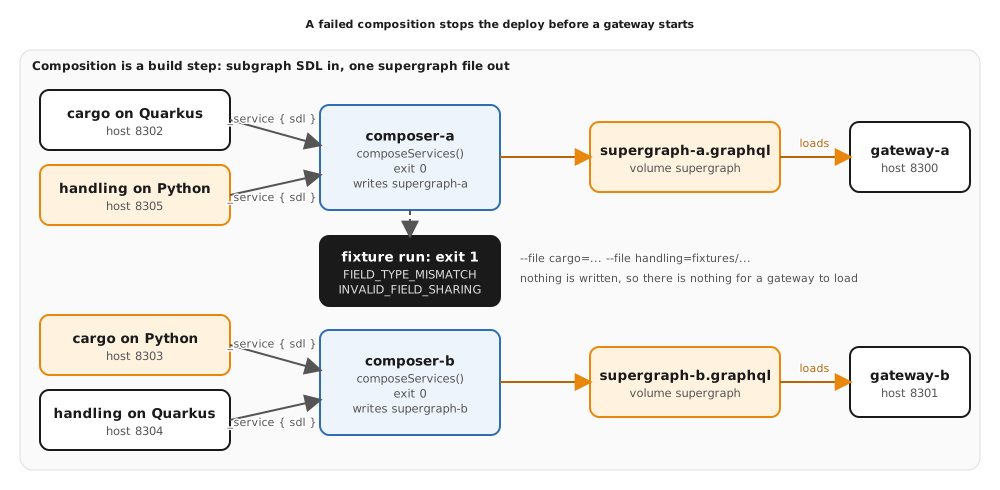
In compose, the composer is a one-shot service that waits for its two subgraphs to be healthy, and each gateway waits for its composer to complete successfully. The gateways load the file and compose nothing. Hive Gateway also has a development mode that composes at startup; the example does not use it, because a gate that runs inside the service it protects is not a gate.
Two committed fixtures show what a failure reads like. Each is the handling subgraph’s SDL with one mistake, composed against fixtures/cargo.graphql, a copy of the cargo subgraph’s SDL. In the first, Location.unLocode is String! instead of UnLocode!. The two subgraphs now disagree about the type of a key field:
FIELD_TYPE_MISMATCH: Type of field "Location.unLocode" is incompatible across subgraphs: it has type "UnLocode!" in subgraph "cargo" but type "String!" in subgraph "handling"
In the second, PageInfo lacks @shareable in the handling subgraph, so both subgraphs resolve PageInfo.hasNextPage, and composition reports INVALID_FIELD_SHARING once for each of the four fields. The codes are stable names. A pipeline can match on them, and a team can look them up in the composition rules.
A query plan
The gateway turns one client query into requests to subgraphs, called a query plan. TrackCargo asks for fields from both teams:
query TrackCargo($id: TrackingId!) {
  cargo(trackingId: $id) {
    trackingId description
    itinerary { legs { loadLocation { name } } }
    delivery { transportStatus lastKnownLocation { name } }
    handlingHistory(first: 2) { edges { node { type location { name } } } }
  }
}
The plan has three fetches (Figure 20.3). The root field and everything the cargo subgraph owns come from one request to it. The gateway then sends the cargo’s key to the handling subgraph as an _entities request for delivery and handlingHistory. Those fields name locations, and only the cargo subgraph knows a location’s name, so a third fetch goes back to the cargo subgraph with the locations handling named.
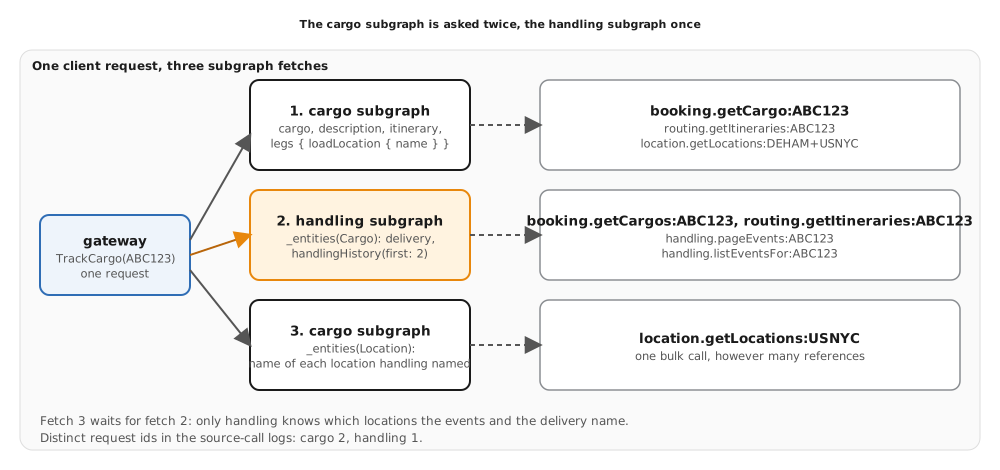
The plan is not asserted from the gateway’s internals. verify.sh reads the plan’s footprint from the subgraphs’ source-call logs, which carry a request id for each HTTP request that reached them. After one TrackCargo, the cargo subgraph’s log holds two distinct request ids and the handling subgraph’s holds one, and the calls under them are the ones in the figure. The numbers are properties of the run, not of the gateway’s documentation: a different planner, or a different selection, would give different counts, and the log would show it.
References and one bulk call
Fetch 3 is the reference mechanism at work (Figure 20.4). The handling subgraph returns Location { unLocode } for every event it names. The gateway collects them into one _entities request to the cargo subgraph, with one representation per distinct location, and the cargo subgraph’s entity resolver turns the list of keys into one bulk call. DEF456’s history has seven events at three places, and the log shows one call:
2 ['booking.getCargo:DEF456', 'location.getLocations:DEHAM+NLRTM+USNYC']
1 ['booking.getCargos:DEF456', 'handling.pageEvents:DEF456']
The first line is the cargo subgraph, with its two requests and the one location call. The second is the handling subgraph, with its one request. The number of events does not change the number of calls; it changes the size of one list. This is Chapter 13’s batching applied across a network boundary, and it only works because the entity resolver is a batch resolver. The gateway sends each distinct location once, so the request carries three representations, and a resolver that looked up one location per representation would make three calls instead of one.
Mutations across subgraphs
registerHandlingEvent is a field of the handling subgraph, so the gateway sends the whole mutation there. The payload is where the graph crosses a boundary. payload.cargo is a Cargo, and its description belongs to the cargo subgraph, so the gateway makes an entity fetch to it after the write:
mutation($i: RegisterHandlingEventInput!) {
  registerHandlingEvent(input: $i) {
    handlingEvent { id }
    cargo { trackingId description delivery { transportStatus } }
    userErrors { code }
  }
}
The unload registers as evt_10, the description is Palletized electronics from the cargo subgraph, and delivery.transportStatus is IN_PORT. The delivery is fresh because the team that wrote the event also computes the delivery. The handling subgraph’s log shows one handling.appendEvent:evt_10, and the cargo subgraph’s shows one booking.getCargos:ABC123. Repeating the request with the same idempotency key returns evt_10 and writes nothing, so Chapter 8’s idempotency still holds across the gateway.
The contract still holds
Composition adds federation directives and fields to the subgraph schemas, and none of it should reach a client. The gateway publishes an API schema with the directives and the _service and _entities fields removed. verify.sh checks the gateway as it checks every other example: assert_sdl_conforms diffs the introspected schema against contracts/schema/, and the only differences are the three unserved pieces, Query.node, Query.nodes and Subscription. The deprecation of Itinerary.finalArrivalDate, the specifiedByURL of UnLocode and DateTime, and every description survive composition. The directives a client can see are the five built-in ones, and the fields of Query are cargo, cargos, location and voyage.
Node is defined in both subgraphs, with its implementers split between them: Cargo, Location and Voyage in one, HandlingEvent in the other. The gateway’s schema lists all four as possible types. That is why Chapter 3’s interface can survive a split without a change to the contract, and why the descriptions are copied verbatim into both subgraphs: composition merges the text, and any drift would show in the diff.
Two stacks, one supergraph
The example runs two supergraphs over the same four subgraph contracts (Figure 20.5). Gateway A, on 8300, composes the cargo subgraph on Quarkus with the handling subgraph on Python. Gateway B, on 8301, composes the cargo subgraph on Python with the handling subgraph on Quarkus. Every assertion that reads a gateway runs against both.
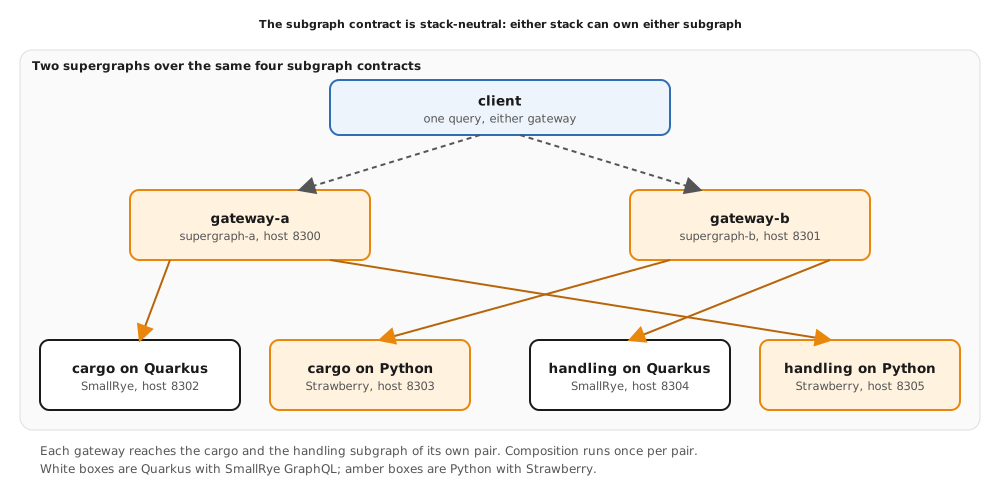
The stacks differ only where their frameworks do, and the differences are the ones earlier chapters recorded. A failed key in a batch fails one edge on Strawberry and every edge of the batch on SmallRye, so the cargos(first: 10) page through gateway B carries one SERVICE_UNAVAILABLE error at the GHI345 edge and five cargos, while the page through gateway A carries six errors and six null nodes. The code survives the gateway in both cases. The gateway adds extensions.serviceName, which names the subgraph that reported the error and is useful when a team has to find an owner. Everything else is the same: both pairs compose, and both answer TrackCargo with the same values in the same three fetches.
When a subgraph is down
A supergraph is one graph with several failure domains. Cargo.delivery is Delivery! and handlingHistory is HandlingEventConnection!, both owned by the handling subgraph. With that subgraph stopped, TrackCargo fails the _entities fetch, the error lands at ["cargo", "delivery"], and Chapter 4’s rule applies at the seam: a null cannot sit in a non-null field, so it climbs to the nearest nullable parent, which is cargo. data.cargo is null. The gateway reports the failed fetch with its own error, Unexpected error. with code INTERNAL_SERVER_ERROR, and its log names the subgraph, handling.
Everything the cargo subgraph owns still answers. The same cargo asked for description, an itinerary or a location returns data. The choice of nullability at a seam is a decision about the team boundary. A non-null delivery tells clients that a cargo always has a delivery state, and it makes the cargo depend on the handling team’s availability. A nullable delivery would let the cargo survive and push the null check to every client. Chapter 4 gave the trade-off for one service, and federation turns it into a question for two teams.
Operating a supergraph
A few practices turn the example into an operating model, and the example demonstrates only the first.
Composition in CI. Each team’s pipeline composes its subgraph with the others’ published schemas before it deploys, and fails on any code. Composition against the other teams’ current schemas catches the change that is valid alone and invalid together. Teams also run the canonical-contract diff on the composed result, so a subgraph change that alters the API schema is a visible, reviewable change.
Trace propagation. A request that crosses a gateway crosses services, and Chapter 19’s trace id has to follow it. Hive Gateway ships an OpenTelemetry integration that creates a span for the gateway’s plan and propagates the W3C traceparent header to each subgraph request, so one trace holds the gateway’s work and each subgraph’s operation span. This example does not run the integration; it keeps the compose stack to the services the chapter needs. The “Monitoring and Tracing” page of the Hive Gateway documentation covers the configuration.
@requires and @provides. An entity field sometimes needs data that only another subgraph has. @requires declares the fields the gateway must fetch and pass in the representation before it calls the resolver, and @provides lets a subgraph resolve fields of a type it normally only references. Both add coupling between teams, so they are for the cases where the alternative is a copy of the data. The example does not use them.
On the wire
Start the stack. The gateways are on 8300 and 8301, and the subgraphs publish 8302 to 8305 for the source-call logs. The composers ran before the gateways started.
docker compose -f examples/20-federation/compose.yaml up -d --build
G() {  # G <port> <query> [variables-json]
  curl -s localhost:$1/graphql -H 'Content-Type: application/json' \
    -d "$(python3 -I -c 'import json,sys; print(json.dumps({"query": sys.argv[1], "variables": json.loads(sys.argv[2]) if len(sys.argv) > 2 else {}}))' "$2" "${3:-{\}}")"; echo
}
SC() {  # SC <port>: the distinct request ids and the calls in a subgraph's log
  curl -s localhost:$1/debug/source-calls | python3 -I -c 'import json,sys; c=json.load(sys.stdin)["calls"]; print(len({x["request"] for x in c}), [x["source"]+"."+x["op"]+":"+x["key"] for x in c])'
}
A subgraph publishes its schema and answers entity requests directly. The cargo subgraph on Quarkus resolves one known and one unknown cargo:
G 8302 '{ _entities(representations: [{__typename: "Cargo", trackingId: "ABC123"}, {__typename: "Cargo", trackingId: "ZZZ999"}]) { ... on Cargo { description } } }'
{"data":{"_entities":[{"description":"Palletized electronics"},null]}}
Composition rejects a broken subgraph and names the rule. The run exits 1 and writes nothing:
docker compose -f examples/20-federation/compose.yaml run --rm -T composer-a --out /tmp/rejected.graphql \
  --file cargo=/fixtures/cargo.graphql --file handling=/fixtures/handling-key-type-conflict.graphql
FIELD_TYPE_MISMATCH: Type of field "Location.unLocode" is incompatible across subgraphs: it has type "UnLocode!" in subgraph "cargo" but type "String!" in subgraph "handling"
TrackCargo through gateway A, with the cargo subgraph on 8302 and the handling subgraph on 8305. Clear the logs first:
for p in 8302 8305; do curl -s -X DELETE localhost:$p/debug/source-calls; done
G 8300 'query TrackCargo($id: TrackingId!) { cargo(trackingId: $id) { trackingId description itinerary { legs { loadLocation { name } } } delivery { transportStatus lastKnownLocation { name } } handlingHistory(first: 2) { edges { node { type location { name } } } } } }' '{"id":"ABC123"}'
SC 8302; SC 8305
{"data":{"cargo":{"trackingId":"ABC123","description":"Palletized electronics","itinerary":{"legs":[{"loadLocation":{"name":"New York"}},{"loadLocation":{"name":"Hamburg"}}]},"delivery":{"transportStatus":"ONBOARD_CARRIER","lastKnownLocation":{"name":"New York"}},"handlingHistory":{"edges":[{"node":{"type":"LOAD","location":{"name":"New York"}}},{"node":{"type":"RECEIVE","location":{"name":"New York"}}}]}}}}
2 ['booking.getCargo:ABC123', 'routing.getItineraries:ABC123', 'location.getLocations:DEHAM+USNYC', 'location.getLocations:USNYC']
1 ['booking.getCargos:ABC123', 'handling.pageEvents:ABC123', 'routing.getItineraries:ABC123', 'handling.listEventsFor:ABC123']
The page of cargos through gateway B, whose cargo subgraph is Python, carries one error at the GHI345 edge:
G 8301 '{ cargos(first: 10) { edges { node { trackingId } } } }'
{"errors":[{"message":"booking service unavailable","path":["cargos","edges",5,"node"],"extensions":{"code":"SERVICE_UNAVAILABLE","serviceName":"cargo"}}],"data":{"cargos":{"edges":[{"node":{"trackingId":"VWX901"}},{"node":{"trackingId":"XYZ789"}},{"node":{"trackingId":"STU678"}},{"node":{"trackingId":"DEF456"}},{"node":{"trackingId":"ABC123"}},{"node":null}]}}}
Stop the handling subgraph behind gateway A and ask again. The cargo is null, and the cargo subgraph’s own fields still answer:
docker compose -f examples/20-federation/compose.yaml stop handling-python
G 8300 'query($id: TrackingId!) { cargo(trackingId: $id) { trackingId description delivery { transportStatus } } }' '{"id":"ABC123"}'
G 8300 '{ cargo(trackingId: "ABC123") { description } location(unLocode: "NLRTM") { name } }'
docker compose -f examples/20-federation/compose.yaml down -v
{"errors":[{"message":"Unexpected error.","path":["cargo","delivery"],"extensions":{"code":"INTERNAL_SERVER_ERROR"}}],"data":{"cargo":null}}
{"data":{"cargo":{"description":"Palletized electronics"},"location":{"name":"Rotterdam"}}}
| Check | Gateway A (cargo Quarkus, handling Python) | Gateway B (cargo Python, handling Quarkus) |
|---|---|---|
| subgraph SDL | Cargo keyed by trackingId; Location and Voyage references (resolvable: false) in handling; Federation 2.7 |
the same |
_entities, Cargo |
[{description}, null] on cargo; ONBOARD_CARRIER on handling |
the same |
_entities, five Locations |
one location.getLocations:DEHAM+NLRTM+SGSIN+USNYC |
the same |
| composition fixtures | FIELD_TYPE_MISMATCH, INVALID_FIELD_SHARING, exit 1 |
the same |
TrackCargo(ABC123) |
values as above; cargo subgraph 2 request ids, handling 1 | the same |
| DEF456 history, seven locations | one location.getLocations:DEHAM+NLRTM+USNYC |
the same |
cargos(first: 10) |
6 errors at the six edges, all nodes null | 1 error at edge 5, five nodes resolved |
registerHandlingEvent |
evt_10, IN_PORT, one appendEvent; a repeat writes nothing |
the same |
| schema | conforms; only node, nodes and Subscription unserved; finalArrivalDate deprecated |
the same |
Node possible types |
Cargo, HandlingEvent, Location, Voyage |
the same |
| handling subgraph stopped | data.cargo null, error at ["cargo","delivery"]; location(NLRTM) is Rotterdam |
the same |
bash examples/20-federation/verify.sh runs the whole sequence and prints PASS only when every check holds on both gateways.
Decision
Federation is the team ownership and federation axis of Chapter 2 made concrete, and it brings the aggregation across sources axis up a level: a field is now backed by another team's graph. The contract and evolution style axis is where it pays off, because the canonical schema is the contract and composition is the gate that keeps every subgraph inside it. The operational and security cost axis is what it spends: a build step to run, a gateway to operate, and a request that crosses a boundary for every field a team does not own. The client diversity and shape variance axis is untouched, since clients see one schema. The tracking view therefore stays one schema while one team owns it, and splits into a cargo subgraph and a handling subgraph, composed by an explicit step that fails the deploy, when two teams each own their part. Each subgraph shares an entity by its key, names the other team's types as references, and batches entity resolution into one bulk call.
Where this goes next
This chapter split the tracking view by ownership: two subgraphs on each stack, entities shared by key, references that name another team’s types, batched entity resolvers, composition as a failing step with two fixtures that show its errors, a query plan counted from the subgraphs’ logs, and two cross-wired gateways that serve the canonical contract and null a cargo when the handling team’s service is down.
Chapter 21 returns to the one operation that cannot cross a gateway as a plain request and response. Subscription.cargoHandled pushes each new event to a client as it is registered, and the chapter compares GraphQL over WebSocket and server-sent events. For the specifications, read the Apollo Federation subgraph specification, in particular the sections on Query._service, Query._entities, @key, @shareable, @external, @requires and @provides, and the Hive documentation for the composition library and for Hive Gateway’s “Gateway: Supergraph schema” and “Monitoring and Tracing” pages. The Quarkus SmallRye GraphQL guide has a section on federation, and Strawberry’s federation guide covers strawberry.federation and resolve_reference.