Mutations and input types
How registerHandlingEvent takes a typed input object, rejects malformed input as a request error and broken domain rules as userErrors data, returns the event with a recomputed delivery, runs aliased mutation fields in order, and stays safe to retry with an idempotency key.
Seven chapters read data. This one writes it. The tracking view has exactly one mutation, registerHandlingEvent, and it carries most of what a write in GraphQL needs: a typed input object, two different ways to say no, a payload that hands the changed cargo back, the engine’s rule that mutation fields run in order, and a key that makes a retry safe. You will meet each on the running stacks, and each claim is something verify.sh asserts.
The code is in examples/08-mutations/. It starts from the Chapter 7 example and keeps its asynchronous sources, the source-call log and the derived Delivery. The handling data changes from a fixed list into a store that requests write to, HandlingEvent and the mutation types join the schema, and Query.node resolves evt_* ids. The store is in memory, so every run of verify.sh starts from a fresh stack, and README.md covers how to drive it.
Why the write surface is one field
Chapter 2 put writes with their owners: the service that holds the data enforces its validation, idempotency and transactional rules, and a second implementation in an aggregation layer is a second place to get them wrong. The canonical schema says as much in its description of Mutation: the write surface is small because writes belong to the owning services. Booking a cargo stays a REST call.
registerHandlingEvent is the exception because of what the caller wants back. A terminal app that reports “unloaded at Hamburg” also wants the cargo’s new state, and a mutation can return it in the same round trip, shaped by the caller’s selection. In the example the handling store stands in for the owning service. The mutation validates, hands the event to the store through handling.appendEvent, and reads the result back through the same sources the queries use. It does not become a second system of record.
Input types
An input type is an object type for arguments. It uses the keyword input, and its fields are data, not resolvers. That is why an input field can hold only a scalar, an enum or another input type: an object type’s fields can take arguments and run resolvers, an interface or a union needs a runtime type to pick a branch, and none of that has a meaning for a value that arrives as JSON. Chapter 3 showed the canonical definition. Here it is again with each field’s job:
input RegisterHandlingEventInput {
  trackingId: TrackingId!
  type: HandlingEventType!
  location: UnLocode!
  voyageNumber: String
  completionTime: DateTime!
  idempotencyKey: String
}
Four fields are required: which cargo, what kind of handling, where, and when it happened. voyageNumber is optional because a RECEIVE has no voyage, and idempotencyKey is optional because a client that never retries does not need one. The location field is a UnLocode and not a Location because an input names a place, and the server resolves the name.
Chapter 4 raised the third state that inputs have: an absent field and an explicit null are different inputs. For these two fields the mutation treats them alike, and verify.sh does not depend on the difference. A client that sends "voyageNumber": null on a LOAD gets VOYAGE_REQUIRED, exactly as when it omits the field. The stacks still differ in how they let you tell the two apart, which shows in the declaration.
@Input("RegisterHandlingEventInput")
@Description("Input for `Mutation.registerHandlingEvent`.")
public record RegisterHandlingEventInput(
        @NonNull @Description("The cargo that was handled.") TrackingId trackingId,
        @NonNull @Description("What kind of handling occurred.") HandlingEventType type,
        @NonNull @Description("Where it occurred.") UnLocode location,
        @Description("The voyage number; required for LOAD and UNLOAD, forbidden otherwise.") String voyageNumber,
        @NonNull @Description("When the handling actually happened.") Instant completionTime,
        @Description("Client-supplied key making retries safe: ...") String idempotencyKey) {}
@strawberry.input(description="Input for `Mutation.registerHandlingEvent`.")
class RegisterHandlingEventInput:
    tracking_id: TrackingId = strawberry.field(description="The cargo that was handled.")
    type: HandlingEventType = strawberry.field(description="What kind of handling occurred.")
    location: UnLocode = strawberry.field(description="Where it occurred.")
    voyage_number: strawberry.Maybe[str | None] = strawberry.field(
        description="The voyage number; required for LOAD and UNLOAD, forbidden otherwise."
    )
    completion_time: datetime = strawberry.field(description="When the handling actually happened.")
    idempotency_key: strawberry.Maybe[str | None] = strawberry.field(description="Client-supplied key ...")
SmallRye binds a Java record directly. The name takes one explicit setting. SmallRye derives an input type’s name from the class and appends Input, and this record’s name already ends in Input, so the derived name would be RegisterHandlingEventInputInput. The explicit @Input("RegisterHandlingEventInput") pins the contract’s name, and the conformance check would flag any other. A field is required when it is @NonNull and nullable otherwise.
Strawberry takes the opposite default: a field is required unless the annotation says | None. The canonical schema gives the optional fields no default, so the example declares them as strawberry.Maybe[str | None] with no default, which prints a plain String. Spelling the field voyage_number: str | None = None would print voyageNumber: String = null in the SDL, and the conformance diff classifies an added default as a dangerous change, not a breaking one, as Chapter 5 warned. It is the type the Strawberry documentation recommends for optional input fields, because an absent field arrives as None and a sent value as Some(value), so a resolver that needs the difference between “not sent” and “sent null” can see it. This mutation does not need that difference, so it unwraps both to None. A plain str | None with no default also prints no default; Maybe is the choice that keeps the distinction available. Since the conformance check cannot see the difference, step 11 of verify.sh asserts that every defaultValue of the input type is JSON null.
Coercion: the first line of defence
Before any resolver runs, the engine checks the input against its type. This is the coercion that Chapter 6 placed ahead of execution, and the specification describes it under “Coercing Variable Values” for variables and “Input Coercion” for values written in the document. It rejects what the type system can express: a value of the wrong kind, an enum value that does not exist, a required field that is missing, a field the input type does not have.
verify.sh sends five such requests, each as a variable so the input travels as JSON:
| Input | What is wrong |
|---|---|
no type |
a required field is missing |
"type": "TELEPORT" |
not a value of HandlingEventType |
"location": 123 |
UnLocode accepts only a string |
"completionTime": "yesterday" |
not an RFC 3339 date-time |
an extra field "weightKg": 1 |
RegisterHandlingEventInput has no such field |
All five come back with errors and no data, and the source-call log is empty: no resolver ran, so nothing was looked up, validated or written. Because the engine, not the code, makes this check, it is the same on any mutation the schema adds later, and the only thing a resolver author owes it is the type declaration. The shape of the failure differs by stack. Quarkus omits the data key, as the specification says a request error should. Strawberry sends "data": null, which assert_no_data treats as the same thing. Both answer HTTP 200. To the Accept: application/json that verify.sh sends, both label the body application/json; to a client that accepts any type, such as the plain curl under “On the wire”, Quarkus answers application/graphql-response+json.
The date-time case is where the stacks differ most. Strawberry rejects yesterday during coercion with a single error that names the scalar, and does so whether it is a variable or a literal in the document. SmallRye converts the DateTime inside an input object later, when it binds the argument to the record, which is after validation and inside execution. The response carries two errors, one that quotes the input object and one reporting that registerHandlingEvent, a non-null field, produced null, and data is null. The older editions of the specification call this kind of failure a “field error”; the current term is an “execution error”, and it is what bubbles up here, through the non-null payload type of Chapter 4. The outcome is the same as for the other four cases: errors, no data, no resolver body, no write. A client should not depend on the difference in shape, and a design that needs a clean message for a bad date-time would validate the string in the resolver and return a userError, at the price of declaring the field as String.
Domain validation as data
Coercion knows types. It does not know that NOPE99 is not a cargo, or that a LOAD needs a voyage. Those are domain rules, and they fail differently: the response is a normal result in which userErrors is not empty.
type UserError {
  code: UserErrorCode!
  message: String!
  field: [String!]
}
Each failure has a stable code a program can switch on, a message a person can read, and a field path that names the input field. The path starts at input because that is the argument’s name, and it is null when a failure concerns the input as a whole. The resolver collects every applicable failure in a fixed order, so a client fixes a form in one round trip and not one field at a time.
| Order | Code | Rule |
|---|---|---|
| 1 | UNKNOWN_CARGO |
no cargo has that tracking id |
| 2 | UNKNOWN_LOCATION |
no location has that UN/LOCODE |
| 3 | VOYAGE_REQUIRED, VOYAGE_NOT_ALLOWED, UNKNOWN_VOYAGE |
a LOAD or UNLOAD needs a voyage that exists; the other types must not name one |
| 4 | INVALID_COMPLETION_TIME |
after the server clock |
NOPE99 at ZZZZZ returns UNKNOWN_CARGO with ["input","trackingId"] and then UNKNOWN_LOCATION with ["input","location"], in that order, on both stacks. A failure leaves handlingEvent and cargo null and writes nothing, which the log confirms: no appendEvent call. The three lookups run together, so a rejected request costs one source window, not three.
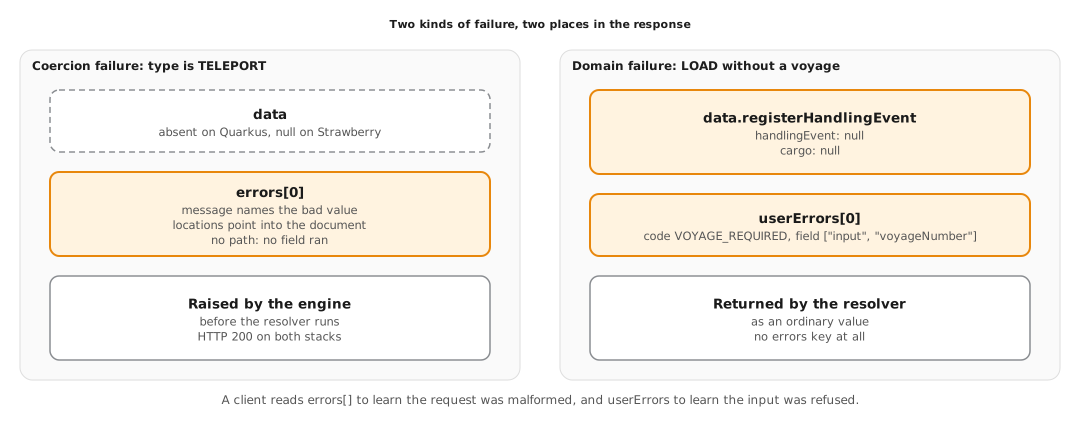
Why not throw, and let the failure appear in the top-level errors? Because the two arrays mean different things to a client. errors says the request could not be run as written or the server failed: a developer’s problem, usually the same for every user, and a monitor counts it. userErrors says the server understood the request and refused this input: a user’s problem, expected, and part of the contract. A typed list lets a client render VOYAGE_REQUIRED next to the voyage field, where an exception message would be text to display or parse. Chapter 9 sets out the conventions for both, including the alternative of modelling the result as a union of success and error types, and why this book does not.
The payload and the re-read
A mutation field returns a payload type, not the bare event. RegisterHandlingEventPayload has three fields: handlingEvent, cargo and userErrors. On success the first two are set and userErrors is []. On a refusal it is the other way around.
The cargo field is the reason the mutation is in the graph. Cargo.delivery is a resolver that derives the delivery state from handling.listEvents and the itinerary, as Chapter 7 built it, and the payload’s cargo is an ordinary Cargo. The write happens first, then the engine resolves the payload’s fields, so delivery reads the store after the new event is in it. The client gets the new state without a second request and without computing it. An UNLOAD at Hamburg on V100S moves ABC123 from ONBOARD_CARRIER to IN_PORT, and the next expected activity from UNLOAD at DEHAM to LOAD at DEHAM on V200E, which is the UNLOAD row of the derivation table in the example’s README.
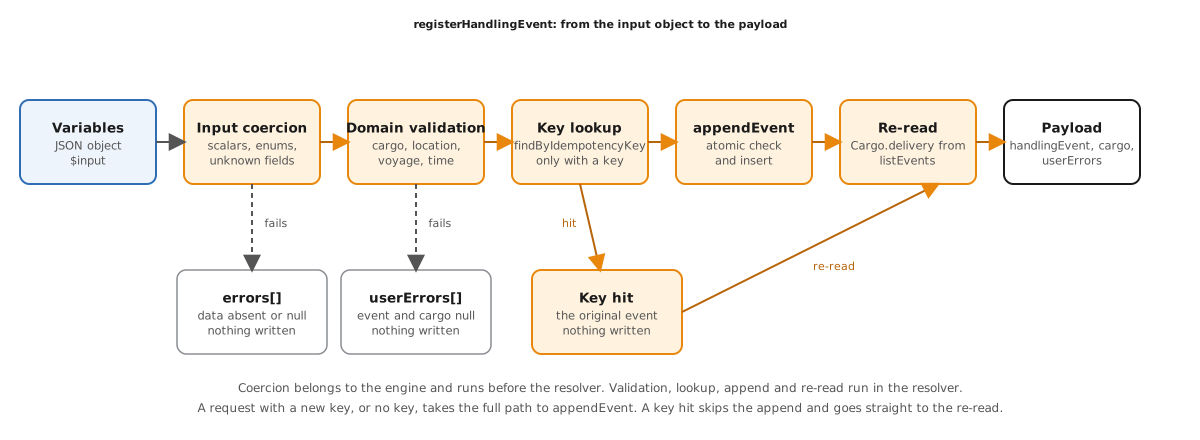
The re-read has a cost, and the log shows it. A successful registration makes a lookup window for the cargo, the location and the voyage together, a window for the key, a window for the append, and then the payload’s own reads: listEvents and getItinerary for the delivery, and the location and voyage of the event. Each is 250 ms in the example. A client that needs only an acknowledgment can select only handlingEvent { id }, and the delivery is never derived, because an unselected field costs nothing. That is the same selection-driven saving Chapter 6 measured.
The event itself is a Node, so node(id: "evt_3") refetches it. HandlingEvent.cargo is nullable: the contract says it is null when the cargo service is unavailable, which makes the event usable when its cargo is not.
Mutation fields run in order
Chapter 6 stated the rule from the specification’s “Normal and Serial Execution”: the top-level fields of a mutation run one at a time, in the order written, each completely before the next. Figure 6.4 drew it and promised a measurement. This is the measurement, with two aliased fields in one document.
mutation($a: RegisterHandlingEventInput!, $b: RegisterHandlingEventInput!) {
  a: registerHandlingEvent(input: $a) { handlingEvent { id } cargo { delivery { transportStatus ... } } }
  b: registerHandlingEvent(input: $b) { handlingEvent { id } cargo { delivery { transportStatus ... } } }
}
Field a loads ABC123 onto V200E at Hamburg and b unloads it at Rotterdam. b is only meaningful once a has landed. Two independent observations show the order, and either would fail on an engine that ran them together:
- The log.
appendEvent:evt_4ends beforeappendEvent:evt_5starts, and so doesfindByIdempotencyKey:k-003, the first thingbdoes. A parallel engine would have startedb’s lookup at the same time asa’s. - The payload of
a. Itscargo.deliveryisONBOARD_CARRIERonV200E, nextUNLOADatNLRTM. Ifbhad run first or alongside,awould showIN_PORTand the next activityCLAIM.b’s payload shows exactly that.
findByIdempotencyKey   k-002  +   0 to + 251
appendEvent            evt_4  + 251 to + 502
listEvents             ABC123 + 506 to + 757
findByIdempotencyKey   k-003  +1015 to +1265
appendEvent            evt_5  +1265 to +1516
listEvents             ABC123 +1520 to +1771
The gap between a’s last call and b’s first is the rest of a’s payload, the location and voyage reads. graphql-java, under SmallRye, runs the mutation root with a serial strategy, and graphql-core runs it through execute_fields_serially; the log shows both do. Below the root nothing is serial: the fields inside a’s payload are siblings again and may overlap, which they do. Query fields have no such guarantee, so a client that needs ordered writes must send them in one mutation, and a client that sends two mutations in two requests has no ordering at all.
Retries and idempotencyKey
A mutation changes state, so a retry is dangerous. A client sends a request, the server records the event, the response is lost, and the client, seeing a timeout, sends it again. Without help the store now holds two events for one handling, and the second is wrong. The cargo’s derived state may even change, because the duplicate is the new last event.
The canonical input has the answer: idempotencyKey, a string the client chooses and repeats on every retry of the same intent. The rule is that a repeated request with the same key returns the originally recorded event instead of recording a second one. The implementation has two steps, and the second is the one that matters.
- Look the key up.
handling.findByIdempotencyKeyreturns the event the key already produced, if any. A hit skips the write. - Insert only if absent, atomically.
handling.appendEventchecks the key and inserts the event in one indivisible step. It is the only step that can be trusted, because the lookup and the insert are separate calls, and two requests that arrive together can both miss the lookup.
public Appended append(NewHandling handling, String idempotencyKey) {
    if (idempotencyKey == null) {
        return new Appended(insert(handling, now()), true);
    }
    AtomicBoolean created = new AtomicBoolean();
    HandlingRecord event = byIdempotencyKey.computeIfAbsent(idempotencyKey, key -> {
        created.set(true);
        return insert(handling, now());
    });
    return new Appended(event, created.get());
}
async def append(self, handling: NewHandling, idempotency_key: str | None) -> Appended:
    async with self._lock:
        if idempotency_key is not None and (
            existing := self._by_idempotency_key.get(idempotency_key)
        ):
            return Appended(existing, created=False)
        event = self._insert(handling, _now())
        if idempotency_key is not None:
            self._by_idempotency_key[idempotency_key] = event
        return Appended(event, created=True)
ConcurrentHashMap.computeIfAbsent runs its function at most once per key, atomically, so exactly one caller creates the event and the others receive it. The created flag tells the source whether this call wrote. On Python the asyncio.Lock serializes the section. Nothing awaits between the check and the insert, so the single-threaded event loop would already make it indivisible; the lock states the invariant and keeps it true the day someone adds an await there, such as a database call.
The proof is a race. verify.sh fires eight identical requests at once with the key k-par. All eight return the same id, evt_8. The log holds eight findByIdempotencyKey calls and exactly one appendEvent. The requests arrive inside one source window, so their lookups run before the write lands and miss, and verify.sh checks that at least two did, which proves the race took place. node(id: "evt_9") is null. The lookup alone would have written eight events; the atomic step is what makes the guarantee. A call that loses the race writes nothing and logs nothing, so every appendEvent entry in the log means one new event.
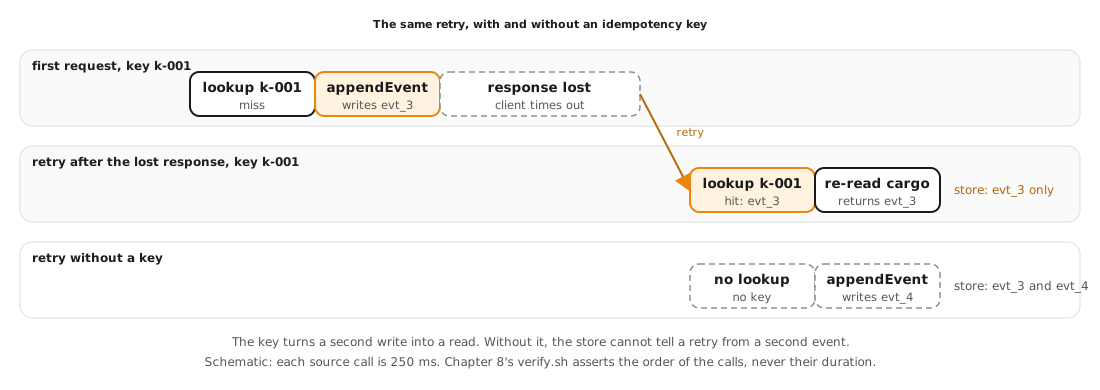
Replay returns the original even when the retry differs. A request with k-001 and a completionTime of 16:00 returns evt_3 with its original 15:00. That is a design choice, and its price is that a client reusing a key for a different intent is answered with the old event and no signal that the input differed. A stricter server compares the stored input and rejects a mismatch; the example does not. A request with no key gets a new event each time: two identical CUSTOMS registrations are evt_6 and evt_7. The example’s key space is also one global map that never expires. A production store would scope a key to the caller, expire it after a window, and keep the key and the event in the same transaction.
Mutations and HTTP
A GraphQL operation travels over HTTP, and GraphQL over HTTP allows a query on GET, with the query and variables in the URL. It does not allow a mutation there. The “GET” section of the specification says a server must refuse a mutation received that way with a 4xx status and halt execution, and recommends 405 (Method Not Allowed). A note adds that a 405 must carry an Allow header, which RFC 9110 requires of every 405 response. The reason is the web’s own contract: GET is safe, so proxies, prefetchers and caches may repeat it or answer it from memory, and a state change must never hide behind it.
verify.sh sends the step 7 mutation by GET and observes the following, and the example asserts what each stack does:
| Status | Body | Executed | |
|---|---|---|---|
| Quarkus | 405 | empty, no Allow header |
no |
| Python | 400 | text, mutations are not allowed when using GET |
no |
Both refuse, and the log shows no source call. Both meet the mandatory part: a 4xx, and no execution. Quarkus answers the recommended 405 without an Allow header. Strawberry answers 400, a 4xx other than the recommended one, with a plain-text body. Neither matters to a client that sends mutations by POST, which is what every GraphQL client library does. It matters to a gateway or a cache in front of the service, which is why Chapters 15 and 16 return to GET.
Naming and shape conventions
Four habits keep a mutation easy to evolve.
- Verb then noun.
registerHandlingEventnames the action, and the type names follow:RegisterHandlingEventInput,RegisterHandlingEventPayload. A reader finds the input and the payload from the field name. - One
inputargument. A single input object means a new optional field is an additive change. A new argument on a field is also additive, but a long argument list is awkward to pass and to validate, and thefieldpath in aUserErrorreadsinputand then the field name. - A payload per mutation. Returning
Booleanor the bare event leaves no room foruserErrorsor for the cargo, and adding them later changes the return type, which breaks clients. A payload that starts as a wrapper can grow. - A key you control for retries. The Relay mutation convention has a
clientMutationIdthat the server echoes back. It correlates a response with a request but does not make a retry safe.idempotencyKeydoes the work that matters here, so the tracking view uses it and leavesclientMutationIdout.
On the wire
Start the stack. Quarkus is on 8180 and Python on 8181, and the store starts with evt_1 and evt_2 on ABC123.
docker compose -f examples/08-mutations/compose.yaml up -d --build
Q='mutation($i: RegisterHandlingEventInput!) { registerHandlingEvent(input: $i) { handlingEvent { id type completionTime } cargo { delivery { transportStatus lastKnownLocation { unLocode } currentVoyage { number } nextExpectedActivity { type location { unLocode } voyage { number } } } } userErrors { code field message } } }'
reg() { curl -s localhost:8180/graphql -H 'Content-Type: application/json' -d "$(python3 -I -c 'import json,sys; print(json.dumps({"query": sys.argv[1], "variables": {"i": json.loads(sys.argv[2])}}))' "$Q" "$1")"; echo; }
A coercion failure first. The input is well formed JSON with a value the enum does not have:
reg '{"trackingId":"ABC123","type":"TELEPORT","location":"DEHAM","completionTime":"2026-10-09T15:00:00Z"}'
{"errors":[{"message":"Variable 'i' has an invalid value: Invalid input for enum 'HandlingEventType'. No value found for name 'TELEPORT'","locations":[{"line":1,"column":10}],"extensions":{"classification":"ValidationError"}}]}
Python answers {"data":null,"errors":[{"message":"Variable '$i' has invalid value at .type: Value 'TELEPORT' does not exist in 'HandlingEventType' enum.","locations":[{"line":1,"column":10}]}]}: the same failure, a different message, and a data that is null. Then two domain failures:
reg '{"trackingId":"ABC123","type":"LOAD","location":"DEHAM","completionTime":"2026-10-09T15:00:00Z"}'
reg '{"trackingId":"NOPE99","type":"CUSTOMS","location":"ZZZZZ","completionTime":"2026-10-09T15:00:00Z"}'
{"data":{"registerHandlingEvent":{"handlingEvent":null,"cargo":null,"userErrors":[{"code":"VOYAGE_REQUIRED","field":["input","voyageNumber"],"message":"LOAD events must name a voyage."}]}}}
{"data":{"registerHandlingEvent":{"handlingEvent":null,"cargo":null,"userErrors":[{"code":"UNKNOWN_CARGO","field":["input","trackingId"],"message":"No cargo has tracking id NOPE99."},{"code":"UNKNOWN_LOCATION","field":["input","location"],"message":"No location has UN/LOCODE ZZZZZ."}]}}}
Both stacks answer these byte for byte. Now a success with a key, and the same request sent again with a different completionTime:
reg '{"trackingId":"ABC123","type":"UNLOAD","location":"DEHAM","voyageNumber":"V100S","completionTime":"2026-10-09T15:00:00Z","idempotencyKey":"k-001"}'
reg '{"trackingId":"ABC123","type":"UNLOAD","location":"DEHAM","voyageNumber":"V100S","completionTime":"2026-10-09T16:00:00Z","idempotencyKey":"k-001"}'
{"data":{"registerHandlingEvent":{"handlingEvent":{"id":"evt_3","type":"UNLOAD","completionTime":"2026-10-09T15:00:00Z"},"cargo":{"delivery":{"transportStatus":"IN_PORT","lastKnownLocation":{"unLocode":"DEHAM"},"currentVoyage":null,"nextExpectedActivity":{"type":"LOAD","location":{"unLocode":"DEHAM"},"voyage":{"number":"V200E"}}}},"userErrors":[]}}}
{"data":{"registerHandlingEvent":{"handlingEvent":{"id":"evt_3","type":"UNLOAD","completionTime":"2026-10-09T15:00:00Z"},"cargo":{"delivery":{"transportStatus":"IN_PORT","lastKnownLocation":{"unLocode":"DEHAM"},"currentVoyage":null,"nextExpectedActivity":{"type":"LOAD","location":{"unLocode":"DEHAM"},"voyage":{"number":"V200E"}}}},"userErrors":[]}}}
The two responses are identical. The second is the replay: evt_3, the original time, and no appendEvent call in the log. The serial pair is one document with the aliases a and b, each with its own input variable:
PAIR='mutation($a: RegisterHandlingEventInput!, $b: RegisterHandlingEventInput!) { a: registerHandlingEvent(input: $a) { handlingEvent { id } cargo { delivery { transportStatus currentVoyage { number } nextExpectedActivity { type location { unLocode } } } } } b: registerHandlingEvent(input: $b) { handlingEvent { id } cargo { delivery { transportStatus lastKnownLocation { unLocode } nextExpectedActivity { type location { unLocode } } } } } }'
curl -s localhost:8180/graphql -H 'Content-Type: application/json' -d "$(python3 -I -c 'import json,sys; print(json.dumps({"query": sys.argv[1], "variables": {"a": json.loads(sys.argv[2]), "b": json.loads(sys.argv[3])}}))' "$PAIR" '{"trackingId":"ABC123","type":"LOAD","location":"DEHAM","voyageNumber":"V200E","completionTime":"2026-10-10T06:30:00Z","idempotencyKey":"k-002"}' '{"trackingId":"ABC123","type":"UNLOAD","location":"NLRTM","voyageNumber":"V200E","completionTime":"2026-10-11T18:30:00Z","idempotencyKey":"k-003"}')"; echo
{"data":{"a":{"handlingEvent":{"id":"evt_4"},"cargo":{"delivery":{"transportStatus":"ONBOARD_CARRIER","currentVoyage":{"number":"V200E"},"nextExpectedActivity":{"type":"UNLOAD","location":{"unLocode":"NLRTM"}}}}},"b":{"handlingEvent":{"id":"evt_5"},"cargo":{"delivery":{"transportStatus":"IN_PORT","lastKnownLocation":{"unLocode":"NLRTM"},"nextExpectedActivity":{"type":"CLAIM","location":{"unLocode":"NLRTM"}}}}}}}
Its handling log is the six-line listing in the serial section. Then the GET refusal and the race:
curl -s -o /dev/null -w '%{http_code}\n' -G localhost:8180/graphql --data-urlencode 'query=mutation { registerHandlingEvent(input: {trackingId: "ABC123", type: CUSTOMS, location: "NLRTM", completionTime: "2026-10-12T09:00:00Z"}) { handlingEvent { id } } }'
curl -s localhost:8180/graphql -H 'Content-Type: application/json' -d '{"query":"{ node(id: \"evt_6\") { __typename } }"}'; echo
for i in 1 2 3 4 5 6 7 8; do reg '{"trackingId":"ABC123","type":"CLAIM","location":"NLRTM","completionTime":"2026-10-13T09:00:00Z","idempotencyKey":"k-par"}' & done; wait
405
{"data":{"node":null}}
The status is 400 on port 8181. The eight parallel responses all carry "id":"evt_6", and the handling counts verify.sh prints from the log are {'findByIdempotencyKey': 8, 'appendEvent': 1, 'listEvents': 8}. Request ids and timestamps differ on every run. The ids, codes, paths, order and counts do not.
| Check | Expected |
|---|---|
five coercion failures: no type, "TELEPORT", "location": 123, "yesterday", an extra weightKg |
errors, no data, no source call |
| five domain failures | no errors; handlingEvent and cargo null; the codes and paths above; non-empty message; no appendEvent; node(id: "evt_3") still null |
UNLOAD at DEHAM on V100S, key k-001 |
evt_3; delivery IN_PORT, last location DEHAM, no current voyage, next LOAD at DEHAM on V200E; userErrors []; one append after the key lookup |
the same key again, then with 16:00 |
evt_3, completion 2026-10-09T15:00:00Z; no append |
serial pair k-002, k-003 |
evt_4 then evt_5; a ONBOARD_CARRIER on V200E with next UNLOAD at NLRTM; b IN_PORT at NLRTM, next CLAIM, ETA 2026-10-11T18:00:00Z; data keys a,b; evt_4 appended before evt_5, and before k-003 was looked up |
CUSTOMS at NLRTM, no key, twice |
evt_6, then evt_7, one append each |
the same mutation by GET |
405 on Quarkus, 400 on Python; no source call; node(id: "evt_8") null |
node(id: "evt_3") { __typename ... on HandlingEvent { type cargo { trackingId } } } |
HandlingEvent, UNLOAD, ABC123 |
eight parallel requests, key k-par |
all evt_8; eight key lookups, at least two before the write, one append; node(id: "evt_9") null |
inputFields { name defaultValue } of RegisterHandlingEventInput |
six fields, every defaultValue null |
TrackingId, UnLocode, DateTime scalars |
SCALAR; specifiedByURL null, UNECE UN/LOCODE page, RFC 3339 |
live schema vs contracts/schema/ |
no breaking change either way and no description change on what the stack serves (slice) |
bash examples/08-mutations/verify.sh runs the whole sequence on both stacks, starts each from a fresh store, and prints PASS only when both hold.
Decision
The mutation is where the read and write balance axis of Chapter 2 becomes code: one write, in the schema because the caller wants the recomputed Cargo back in the same round trip, and a payload that returns it. The contract and evolution style axis shows in the input and the payload: one input argument, a payload type that can grow, and UserErrorCode values that clients switch on, all additive to extend. The operational and security cost axis shows in retries and HTTP: an idempotencyKey made atomic in the store, a mutation refused over GET, and a per-call cost that the log makes visible. The team ownership axis shows in where the write goes: the tracking view validates and delegates to the handling store, which stands for the owner, and does not become a second system of record. The tracking view rejects malformed input as a request error and a refused input as userErrors data, runs ordered writes in one mutation, requires a key from any client that retries, and leaves bulk and booking writes with their owners.
Where this goes next
This chapter added the write path: an input type with its coercion, domain failures as data, a payload that re-reads the cargo, the serial rule observed on both stacks, and an idempotency key that holds under a race. Two things it leaves open. The two kinds of failure get a full contract in Chapter 9, which covers errors and extensions, the union-of-results alternative, and what a message should say. The new HandlingEvent type is the node of the connection that Chapter 12 builds for Cargo.handlingHistory.
Chapter 9 starts from this example and gives execution errors the same attention that userErrors received here. Chapter 11 treats adding a required field to an input as a breaking change and adding an optional one as safe, which is why voyageNumber and idempotencyKey are optional from the start.
For the formal definitions, read “Input Objects”, “Input Coercion”, “Coercing Variable Values” and “Normal and Serial Execution” in the GraphQL specification, and “GET” in GraphQL over HTTP. Samer Buna’s GraphQL in Action covers the same ground in “Implementing mutations”; the book is listed on the Bibliography page.