Queries and resolvers
What a resolver receives and returns, how a parent value becomes a child's arguments and then a source key, how Delivery is derived from handling events instead of stored, and how variables, aliases, fragments and the @include and @skip directives change which sources a query calls.
Chapter 6 followed a request through the engine and stopped at the point where the engine calls a resolver. A resolver is an ordinary function with four inputs and one output, and the whole shape of a GraphQL server’s cost comes from how those functions pass values to each other: the parent’s data becomes the child’s argument, and the argument becomes a key into a source. You will see that chain on the running stacks, replace the stored Delivery of earlier chapters with one derived from handling events, and then use variables, aliases, fragments and directives to see which of them change the calls a query makes.
The code is in examples/07-queries-resolvers/. It starts from the Chapter 6 example and keeps its asynchronous sources, the source-call log and the per-request id. Two things change. A new handling source returns the events recorded for a cargo, and Cargo.delivery is computed from those events and the itinerary instead of read from a delivery source, which is removed. verify.sh asserts every value in the “On the wire” section on both stacks, and README.md covers how to drive it.
Anatomy of a resolver
Every resolver receives the same four inputs, spelled differently by each stack.
- The parent is the object the field is selected on. For a root field it is the root value and is usually ignored. For
Cargo.itineraryit is theCargothatQuery.cargoreturned. - The arguments are the values written in the document for that field, after coercion.
Query.cargotakestrackingId;Cargo.itinerarytakes none. - The context is state that belongs to the request, not to a field: here the request id and the five sources.
- The info describes the field being resolved: its name, its path in the response, the fields selected beneath it and the schema.
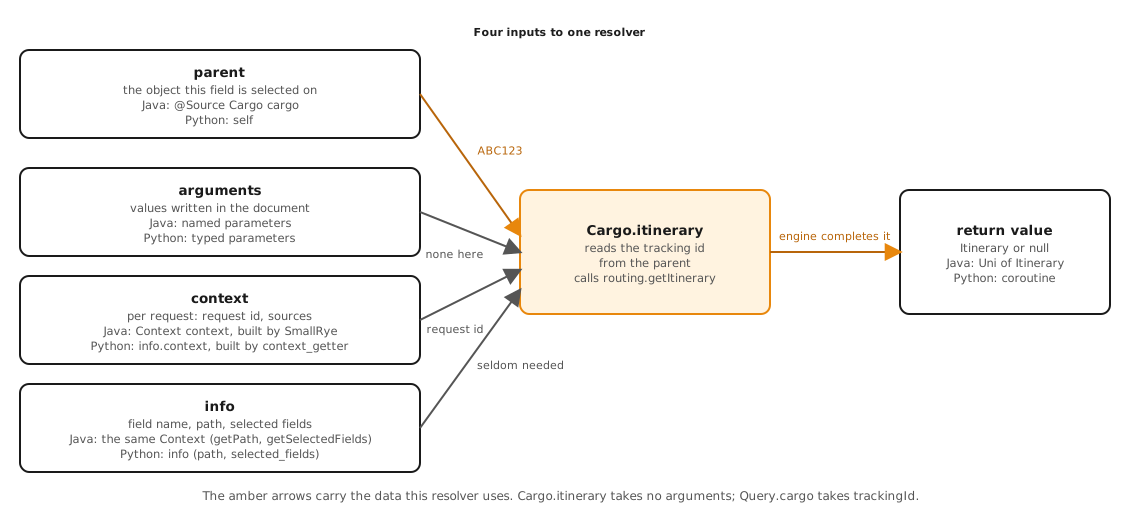
On Quarkus the resolver is a method in the @GraphQLApi class. A method whose first parameter is annotated @Source is a field of that parent type; a method annotated @Query is a root field. Plain parameters are arguments, named with @Name. The SmallRye Context is a parameter the engine fills in, and it carries both the request-level and the field-level information: getExecutionId(), getFieldName(), getPath() and getSelectedFields() are all on it. On Python a resolver is a method on the type, self is the parent, typed parameters are the arguments, and info carries the field details and the context that the router’s context_getter built.
@Description("The planned route. Null until the routing service has assigned one.")
public Uni<Itinerary> itinerary(@Source Cargo cargo, Context context) {
    return routing.getItinerary(context.getExecutionId(), cargo.trackingId().value());
}
@strawberry.field(description="The planned route. Null until the routing service has assigned one.")
async def itinerary(self, info: Info[TrackingContext]) -> Itinerary | None:
    return await info.context.routing.get_itinerary(self.tracking_id)
Both resolvers do the same three things: read the key from the parent, call the source, and give the result back to the engine. Neither touches the response. A resolver returns a value, or something that becomes one (Uni, a coroutine), and the engine completes it against the declared type as Chapter 6 described under “Value Completion”. The spec’s “Value Resolution” step describes the same contract as ResolveFieldValue(objectType, objectValue, fieldName, argumentValues); the context and the info are what each engine adds to that signature.
Default resolvers
Most fields have no resolver of their own. Cargo.description, Cargo.origin and Cargo.routeSpecification come from the booking record that Query.cargo returned, and the engine reads them as properties of the parent: a record accessor on Quarkus, an attribute on Python. That default resolver is the reason the first check of Chapter 6 costs one call. It is also the line between fields that cost something and fields that do not.
{ cargo(trackingId: "ABC123") { description } }
The log for this query is exactly booking.getCargo:ABC123 on both stacks. The rule for placing a field is therefore a question about who owns the data. If the booking record already carries it, leave it a property. If another service owns it, make it a resolver, as Cargo.itinerary is, and the cost becomes visible in the log and, later, in the chapters on batching and cost limits.
Root resolvers and arguments
The four root fields are cargo, location, voyage and node. Each takes one argument, hands it to a source as the key, and returns null when the source has nothing, because the contract makes each result nullable: “Null when no such cargo exists.” A lookup that finds nothing is an answer, not a failure.
{ voyage(voyageNumber: "V999X") { number } }
Both stacks answer {"data":{"voyage":null}} with no errors. The same holds for cargo(trackingId: "NOPE99"). Chapter 4 explained why the nullable root is the first fuse in the tracking schema; here it is the reason a client can distinguish “no such voyage” from “the voyage service failed”, which would arrive as an entry in errors.
Query.node dispatches on the prefix of the id, cargo_, loc_ or voy_, and calls the matching source. Chapter 3 introduced it as the Relay refetch field. In this chapter it shows that a root resolver can choose among sources, but still maps one argument to one key.
The resolver chain
A query is a chain of such calls. Take the selection cargo { itinerary { legs { voyage { number } } } } and follow the values.
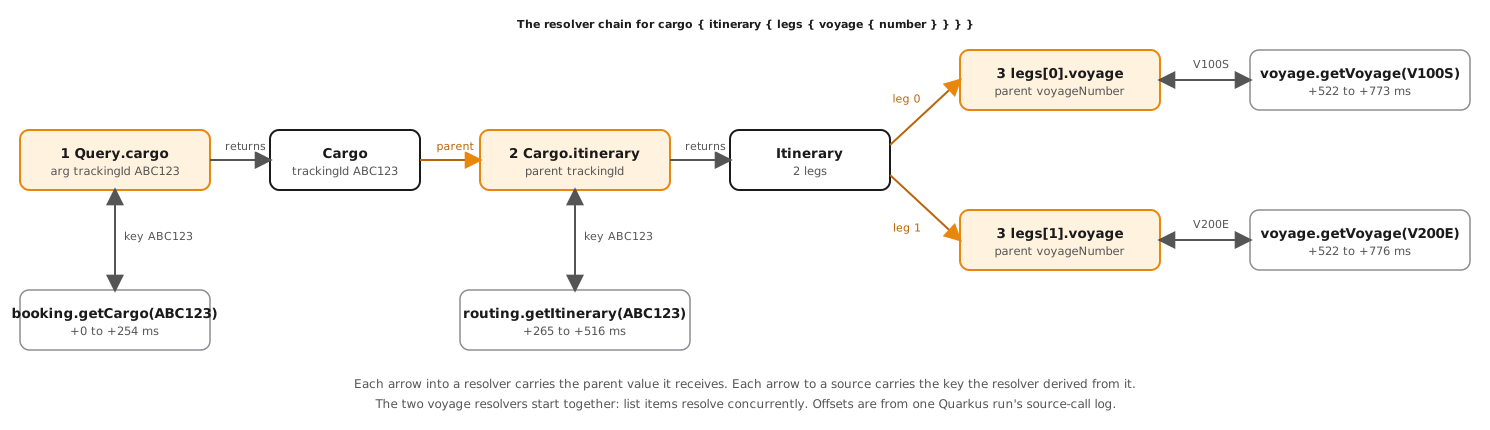
Query.cargo receives the argument ABC123 from the document and passes it to booking.getCargo. The Cargo that comes back is the parent of itinerary, and the resolver reads trackingId from it and calls routing.getItinerary. The Itinerary holds two Leg values, each with a voyage number, and the engine runs Leg.voyage once per list item with that leg as the parent. Each resolver gets its input from the one above it, and no resolver knows about the one below.
On Quarkus, a run with 250 ms sources produced this log, with the request id shortened to its position:
booking   getCargo      ABC123  start +   0  end + 254
routing   getItinerary  ABC123  start + 265  end + 516
voyage    getVoyage     V100S   start + 522  end + 773
voyage    getVoyage     V200E   start + 522  end + 776
verify.sh asserts the four calls as a set, then that getItinerary ends before either voyage call starts, and that the two voyage calls overlap. The order is the dependency: the itinerary is the only place the voyage numbers exist, so no voyage call can start before it ends. The overlap is the list: items of one list are siblings, and Chapter 6’s rule for siblings applies to them. The query’s latency is three levels of 250 ms, whatever the number of legs.
Computed fields
Delivery is not a record any service stores. It is a view of three facts: what the customer asked for (the route specification), what routing planned (the itinerary) and what has happened (the handling events). Chapters 3 to 6 served it as constants so that the type system and the engine could be taught first. Here it is derived, and the values must not change: verify.sh asserts that the derived Delivery for ABC123 and XYZ789 equals exactly what Chapter 3 returned.
The derivation takes the last handling event, the one with the greatest completion time, and reads the state off it.
| Last event | transportStatus |
currentVoyage |
nextExpectedActivity |
|---|---|---|---|
| none | NOT_RECEIVED |
none | RECEIVE at the route’s origin |
RECEIVE |
IN_PORT |
none | LOAD on the first leg |
LOAD at L on V |
ONBOARD_CARRIER |
V | UNLOAD at the matching leg’s end |
UNLOAD at L on V |
IN_PORT |
none | CLAIM at L if L is the destination, else LOAD on the next leg |
CUSTOMS |
IN_PORT |
none | none |
CLAIM |
CLAIMED |
none | none |
lastKnownLocation is that event’s location. routingStatus is NOT_ROUTED without an itinerary, MISROUTED when the first leg does not load at the origin or the last leg does not unload at the destination, and ROUTED otherwise. misdirected is true when the last load or unload does not match a leg by location and voyage. The estimate, estimatedTimeOfArrival, is the itinerary’s final arrival date only when the cargo is ROUTED and not misdirected. ABC123 has two events, a RECEIVE in New York and a LOAD on V100S, so it is ONBOARD_CARRIER on V100S, and the leg that matches the load ends with an UNLOAD in Hamburg. XYZ789 has none, so it is NOT_RECEIVED with a RECEIVE expected in Singapore.
Where the derivation lives is a design decision with two parts. The rules live in one class that takes plain values and calls no source: DeliveryDerivation on both stacks (app/derivation.py on Python). It can be tested without a request, and the table above is its documentation. The resolver is only the glue that fetches the inputs.
@NonNull
@Description("Delivery status derived from handling history.")
public Uni<Delivery> delivery(@Source Cargo cargo, Context context) {
    String request = context.getExecutionId();
    String trackingId = cargo.trackingId().value();
    return Uni.combine()
            .all()
            .unis(routing.getItinerary(request, trackingId), handling.listEvents(request, trackingId))
            .with((itinerary, events) -> derivation.derive(cargo, itinerary, events));
}
@strawberry.field(description="Delivery status derived from handling history.")
async def delivery(self, info: Info[TrackingContext]) -> Delivery:
    itinerary, events = await asyncio.gather(
        info.context.routing.get_itinerary(self.tracking_id),
        info.context.handling.list_events(self.tracking_id),
    )
    return info.context.derivation.derive(self, itinerary, events)
The two fetches do not depend on each other, so the resolver starts both: Uni.combine().all() on Quarkus, asyncio.gather on Python. The log confirms it, with getItinerary and listEvents overlapping after getCargo ends. This is Chapter 6’s sibling rule applied inside one resolver, and a resolver that awaited them one after the other would add 250 ms to every query that selects delivery. The resolver gets the itinerary from the routing source, not from the parent: a parent Cargo carries no itinerary, and reaching for a value some other field fetched would couple two resolvers through hidden state.
The alternative is a derived field in the source, a delivery service that does this work and returns the result. That is the right answer when the derivation is shared by several clients of the service, and the earlier chapters’ DeliverySource modeled it. Here the tracking view owns the rule because it combines facts from routing and handling that no single service holds. The cost is visible: the tracking view now depends on two sources for one field, and a slow handling service slows every query that selects delivery.
Variables and defaults
A variable lets a document stay fixed while its inputs change. It is declared with a type after the operation name, used with $, and may carry a default.
query($t: TrackingId! = "ABC123") { cargo(trackingId: $t) { trackingId } }
With no variables in the request, both stacks answer ABC123. With {"t":"XYZ789"} they answer XYZ789, since a supplied value wins over the default. The default belongs to the operation, not to the schema: the schema’s argument is TrackingId! and has no default, which is what the canonical SDL says. Both stacks can give an argument a schema-level default, @DefaultValue("V100S") on the SmallRye parameter and = "V100S" after the Annotated[...] parameter in Strawberry, and nothing in this slice needs one. They differ in what they print. Strawberry keeps the wrapper, voyageNumber: String! = "V100S", and the diff reports the added default only as a dangerous change, which the conformance check does not fail. SmallRye prints voyageNumber: String = "V100S", a nullable argument with a default, and the check reports that as breaking. Chapter 6 covered where coercion happens. The point here is that a document with variables is the form a client should send, because the server can parse and validate it once and a persisted query can later refer to it by hash.
Aliases
Each field in a response sits under a key, and two fields with the same name and different arguments would want the same key. An alias gives a field another response key, so one document can ask for the same field twice with different arguments.
{ ny: location(unLocode: "USNYC") { name } rtm: location(unLocode: "NLRTM") { name } }
Both stacks answer {"data":{"ny":{"name":"New York"},"rtm":{"name":"Rotterdam"}}}. The spec’s “Field Alias” section defines the rule, and the “Field Collection” step of execution is what merges fields that share a response key. Two aliased root fields are siblings, so the log shows two location.getLocation calls that overlap: one round trip for the client, two lookups for the server, running together. An alias also appears in an error’s path, where Chapter 4 showed it names the aliased key.
Fragments
A fragment names a selection set so that several places can reuse it. A named fragment has a type condition, and a spread applies it.
{ cargo(trackingId: "ABC123") { origin { ...Place } destination { ...Place } } }
fragment Place on Location { unLocode name country }
Both stacks answer with origin as {"unLocode":"USNYC","name":"New York","country":"US"} and destination as {"unLocode":"NLRTM","name":"Rotterdam","country":"NL"}, the same values Chapter 0 returned for the two locations. A fragment is a unit of reuse for the client, not for the server: after “Field Collection” the spread is expanded in place, so the engine sees the same fields as if they were written twice. An inline fragment, ... on Location { name }, applies a type condition without naming the selection, and it is how a client selects fields of one implementer under an interface:
{ node(id: "loc_NLRTM") { __typename ... on Location { name } } }
returns {"__typename":"Location","name":"Rotterdam"}, and a ... on Cargo fragment in the same selection would contribute nothing, as Chapter 3 showed. The spec covers both in “Fragments” and “Inline Fragments”.
@include and @skip
Two built-in directives take a boolean and decide whether a field takes part in the query at all. @include(if: true) keeps a field and @skip(if: true) drops it. Because the boolean can be a variable, one document serves two views.
query($full: Boolean!) {
  cargo(trackingId: "ABC123") {
    trackingId
    itinerary @include(if: $full) { legs { loadTime } }
    delivery @skip(if: $full) { transportStatus }
  }
}
The spec places this in “Field Collection”: a field excluded by either directive is dropped before execution reaches it, so its resolver never runs and its sources are never called. Figure 7.3 shows the two runs.
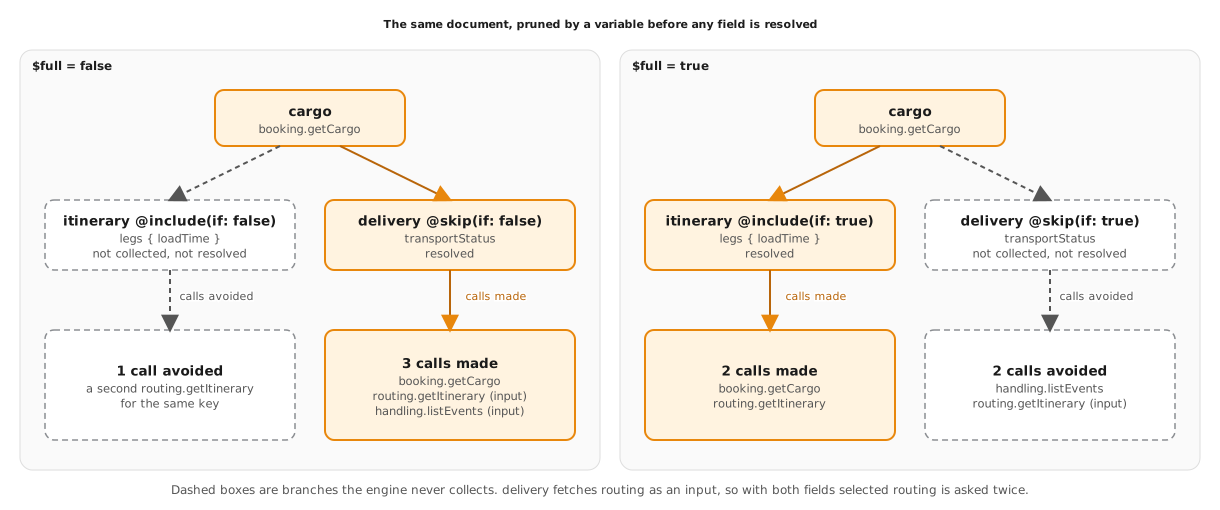
verify.sh asserts both runs from the log. With full false the response has no itinerary key, delivery.transportStatus is ONBOARD_CARRIER, and the log is booking.getCargo, routing.getItinerary and handling.listEvents. With full true the response has itinerary with loadTime 2026-10-01T08:00:00Z for the first leg and no delivery key, and the log is booking.getCargo and routing.getItinerary, with no handling call at all.
The routing.getItinerary call appears in both runs, but for different reasons: in the first it is an input of the derivation, in the second it is the itinerary field itself. The saving is what a query with both fields would have paid. Selecting itinerary and delivery together makes two routing.getItinerary:ABC123 calls, one from each field, and the check asserts that count. Pruning does not make a resolver cheaper. It decides which resolvers run, and the client, not the server, makes that decision, which is why a variable-driven document is the practical way to give a mobile screen a lighter view than a desktop one.
Request context
The context is the one object every resolver of a request shares. Chapter 6 introduced it for one purpose, the request id that tags every source call, and this chapter’s example uses it that way throughout: on Quarkus each resolver reads Context#getExecutionId() at entry and passes the id to the source, and on Python the router’s context_getter builds a TrackingContext per request.
@Query
public Uni<Cargo> cargo(@Name("trackingId") @NonNull TrackingId trackingId, Context context) {
    return booking.getCargo(context.getExecutionId(), trackingId.value());
}
class TrackingContext(BaseContext):
    def __init__(self, request_id, booking, routing, voyage, location, handling, derivation) -> None:
        super().__init__()
        self.request_id = request_id
        self.handling = handling
        ...
The context is the right place for anything scoped to a request and shared across fields: the caller’s identity once authentication exists (Chapter 18), a per-request cache or a loader (Chapter 13), and the request id for tracing. It is the wrong place for something shared across requests, which belongs in an application-scoped bean or a module-level object. The derivation object is an example: it holds reference data and no request state, so Python builds it once and the context only points at it. verify.sh asserts assert_single_request on the chain’s calls, which proves every resolver of one request saw one context, and assert_distinct_requests on a second request, which proves contexts do not leak between requests.
The repeated-fetch smell
The resolver design so far has a cost the log makes visible. Nothing caches within a request, and a resolver is called once per field occurrence, so two selections of the same field fetch the same data twice.
{ cargo(trackingId: "ABC123") { itinerary { legs { a: voyage { number } b: voyage { number } } } } }
Two legs and two aliases make four voyage.getVoyage calls, two of them for V100S and two for V200E. Both stacks do this, and verify.sh asserts the count of four. The aliases are artificial, but the same shape arises without them. A page that shows a leg’s voyage in a header and again in a detail card, or a list of cargos that share a voyage, does the same work for each place the voyage appears.
This chapter leaves the smell in place. The fix has several parts: a loader that batches the keys a level asks for into one call, a cache scoped to the request context so repeated keys cost nothing, and a decision about where the batching sits relative to the sources. Chapter 13 builds them, and the four-call count here is the number that chapter reduces. Fixing it early would hide the cost the next chapters need to measure.
On the wire
Start the stack. Quarkus is on 8170 and Python on 8171, and compose sets TRACKING_SOURCE_LATENCY_MS=250 and TRACKING_DEBUG_ENDPOINTS=true. Reset the log, send the chain query and read the log:
docker compose -f examples/07-queries-resolvers/compose.yaml up -d --build
curl -s -X DELETE -w '%{http_code}\n' localhost:8170/debug/source-calls
curl -s localhost:8170/graphql -H 'Content-Type: application/json' -d '{"query":"{ cargo(trackingId: \"ABC123\") { itinerary { legs { voyage { number } } } } }"}'
curl -s localhost:8170/debug/source-calls
204
{"data":{"cargo":{"itinerary":{"legs":[{"voyage":{"number":"V100S"}},{"voyage":{"number":"V200E"}}]}}}}
{"calls":[{"request":"21107852851","source":"booking","op":"getCargo","key":"ABC123","startMs":34,"endMs":288},{"request":"21107852851","source":"routing","op":"getItinerary","key":"ABC123","startMs":301,"endMs":552},{"request":"21107852851","source":"voyage","op":"getVoyage","key":"V100S","startMs":559,"endMs":811},{"request":"21107852851","source":"voyage","op":"getVoyage","key":"V200E","startMs":560,"endMs":814}]}
Four calls, one request id, and the two voyage calls start one millisecond apart. Python answers the same body, with a uuid4 as the request id and the two voyage calls starting together. Now the derived delivery, after a reset:
curl -s localhost:8170/graphql -H 'Content-Type: application/json' -d '{"query":"{ cargo(trackingId: \"ABC123\") { delivery { transportStatus routingStatus misdirected lastKnownLocation { unLocode } currentVoyage { number } estimatedTimeOfArrival nextExpectedActivity { type location { unLocode } voyage { number } } } } }"}'
curl -s localhost:8170/debug/source-calls
{"data":{"cargo":{"delivery":{"transportStatus":"ONBOARD_CARRIER","routingStatus":"ROUTED","misdirected":false,"lastKnownLocation":{"unLocode":"USNYC"},"currentVoyage":{"number":"V100S"},"estimatedTimeOfArrival":"2026-10-11T18:00:00Z","nextExpectedActivity":{"type":"UNLOAD","location":{"unLocode":"DEHAM"},"voyage":{"number":"V100S"}}}}}}
{"calls":[{"request":"21107852852","source":"booking","op":"getCargo","key":"ABC123","startMs":969,"endMs":1220},{"request":"21107852852","source":"routing","op":"getItinerary","key":"ABC123","startMs":1234,"endMs":1486},{"request":"21107852852","source":"handling","op":"listEvents","key":"ABC123","startMs":1234,"endMs":1486}]}
The delivery is the Chapter 3 constant, computed, and getItinerary and listEvents start together. The same query for XYZ789 on both stacks answers:
{"data":{"cargo":{"delivery":{"transportStatus":"NOT_RECEIVED","routingStatus":"NOT_ROUTED","misdirected":false,"lastKnownLocation":null,"currentVoyage":null,"estimatedTimeOfArrival":null,"nextExpectedActivity":{"type":"RECEIVE","location":{"unLocode":"SGSIN"},"voyage":null}}}}}
Pruning, with the document from the previous section and {"full":false} and then {"full":true}:
{"data":{"cargo":{"trackingId":"ABC123","delivery":{"transportStatus":"ONBOARD_CARRIER"}}}}
{"data":{"cargo":{"trackingId":"ABC123","itinerary":{"legs":[{"loadTime":"2026-10-01T08:00:00Z"},{"loadTime":"2026-10-10T06:00:00Z"}]}}}}
The log for the first is booking.getCargo:ABC123, routing.getItinerary:ABC123, handling.listEvents:ABC123, and for the second only the first two. The request ids, startMs and endMs differ on every run. What stays the same is the keys, the order and the overlap.
| Check | Expected |
|---|---|
cargo { itinerary { legs { voyage { number } } } } |
V100S, V200E; exactly booking.getCargo:ABC123, routing.getItinerary:ABC123, voyage.getVoyage:V100S, voyage.getVoyage:V200E; getCargo before getItinerary, getItinerary before each voyage call; the two voyage calls overlap; one request id |
cargo { delivery { ... } } for ABC123 |
the whole object above; exactly booking.getCargo:ABC123, routing.getItinerary:ABC123, handling.listEvents:ABC123; getCargo before listEvents; getItinerary overlaps listEvents |
the same for XYZ789 |
the NOT_RECEIVED object above; the same three calls with key XYZ789 |
cargo { description } |
Palletized electronics; the log is exactly booking.getCargo:ABC123 |
cargo(trackingId: "NOPE99"), voyage(voyageNumber: "V999X") |
data.cargo and data.voyage are null, no errors |
query($t: TrackingId! = "ABC123") with no variables, then {"t":"XYZ789"} |
ABC123, then XYZ789 |
ny: location(USNYC), rtm: location(NLRTM) |
New York, Rotterdam; the two getLocation calls overlap |
...Place on origin and destination |
USNYC / New York / US and NLRTM / Rotterdam / NL |
node(id: "loc_NLRTM") { __typename ... on Location { name } } |
Location, Rotterdam |
@include / @skip with full false |
no itinerary key; delivery.transportStatus is ONBOARD_CARRIER; calls: booking, routing, handling |
the same with full true |
itinerary.legs.0.loadTime is 2026-10-01T08:00:00Z; no delivery key; calls: booking, routing; no handling.* call |
| a second request without a reset | the log holds at least two distinct request ids |
two aliases of Leg.voyage over two legs |
four voyage.getVoyage calls; itinerary and delivery together make two routing.getItinerary calls |
voyage(V100S) { schedule { departureLocation { unLocode } arrivalTime } } |
USNYC, 2026-10-09T14:00:00Z |
__type of TrackingId, UnLocode, DateTime |
SCALAR; specifiedByURL null, https://unece.org/trade/uncefact/unlocode, https://www.rfc-editor.org/rfc/rfc3339 |
live schema vs contracts/schema/ |
no breaking change either way and no description change on what the stack serves (slice) |
bash examples/07-queries-resolvers/verify.sh runs all of it on both stacks and prints PASS only when both hold. As in Chapter 6 it asserts keys, order and overlap, never a duration.
Decision
Resolvers are where the aggregation across sources axis of Chapter 2 turns into code. Each field that crosses a service boundary is a resolver, the derived Delivery combines facts from two of them, and the log shows the price: one query is several calls whose depth sets its latency. The client diversity and shape variance axis shows in variables, aliases, fragments and directives, which let one schema serve many views and let the client, not the server, decide what runs. The operational and security cost axis shows in the repeated fetch: nothing here limits or batches what a document can ask for, so four calls for two legs is the cost of an open selection, and Chapters 13 and 14 bring the controls. The team ownership and federation axis shows in where Delivery is derived: the tracking view owns the rule because no single service holds all three inputs, and it takes on the dependency. The tracking view derives in a plain class, fetches independent inputs together, keeps request state in the context, and leaves the repeated fetch visible until it can be measured.
Where this goes next
This chapter looked inside the resolver: its four inputs, the chain that turns a parent value into a source key, the derived Delivery that replaced a stored one, and the effect of variables, aliases, fragments and directives on the calls a query makes. The repeated fetch is still in the example, and the source-call log is how a later chapter will prove it gone.
Chapter 8 copies this example and adds the first mutation, registerHandlingEvent. Its payload re-reads the cargo and its delivery, so a new handling event changes the derived Delivery that this chapter computes: an UNLOAD in Hamburg moves ABC123 from ONBOARD_CARRIER to IN_PORT with a LOAD on V200E expected next, and an UNLOAD in Rotterdam, the destination, makes the next expected activity CLAIM. Chapter 9 gives execution errors a contract, and Chapter 13 batches the voyage lookups.
For the formal definitions, read “Executing Fields”, “Field Collection”, “Field Alias”, “Fragments”, “Inline Fragments”, “Variables” and the built-in @skip and @include directives in the GraphQL specification. Samer Buna’s GraphQL in Action covers resolvers and operations in “Customizing and organizing GraphQL operations”, “Implementing schema resolvers” and “Working with database models and relations”; the book is listed on the Bibliography page.