Progressive delivery & mTLS
Evolving a contract in the open with an Istio v1→v2 canary, and the decision to mesh selectively rather than enabling injection namespace-wide.
Part of the capstone.
Data products evolve. A product that can never change its contract is a product nobody will build on for long — but a product that changes its contract carelessly breaks every consumer downstream. This page is about evolving safely: shifting traffic gradually between an old and a new version of a product’s contract, with the service mesh both routing the split and securing the traffic. It’s also where the capstone makes a genuine architectural decision that the rest of the set has been alluding to — to mesh selectively rather than meshing everything — and explains why, from experience.
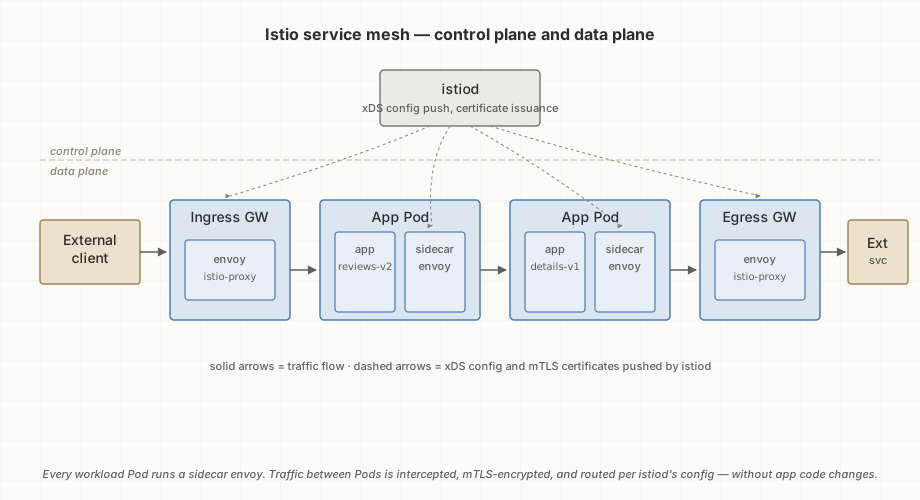
Canarying a contract, not just a binary
The interesting thing to canary in a data mesh isn’t a new build of the same service —
it’s a new version of the contract. This capstone takes order-service through a
v1→v2 change: v2 adds a currency field to the order response, the canonical
“evolve the contract without breaking clients” move. v1 keeps serving the old shape; v2
serves the new one; and Istio splits live traffic between them by weight, so you can
move from all-v1 to all-v2 gradually, watching for trouble at each step rather than
flipping a switch.
The mechanism is the standard Istio trio: a DestinationRule defines the v1 and v2
subsets (by a version pod label), a VirtualService routes a weighted split across
them, and a Gateway admits the traffic. Shifting the canary is just re-applying the
VirtualService with new weights — 90/10, then 50/50, then 0/100 — so the
progressive rollout is a sequence of one-line weight changes, and rolling back is the
same operation in reverse.
A couple of honest simplifications worth naming. v1 and v2 here run the same image
with an environment toggle and a different version label, rather than two images from
two commits — that keeps the demo focused on the traffic-management mechanism rather
than an image pipeline, and the Istio mechanics are identical either way. And traffic
enters through the ingress gateway (published to the host at 127.0.0.1:8080 through
a NodePort, as in §11) rather than from a meshed client, so no client needs to join the mesh for the
canary to work.
This was verified end to end: with the split set to 90/10, a run of 100 requests landed 95 on v1 and 5 on v2; shifted to 50/50, it landed 46 on v1 and 54 on v2 — both within the expected band, both subsets healthy in the mesh. The contract evolved in the open, under controlled traffic, exactly as the pattern intends.
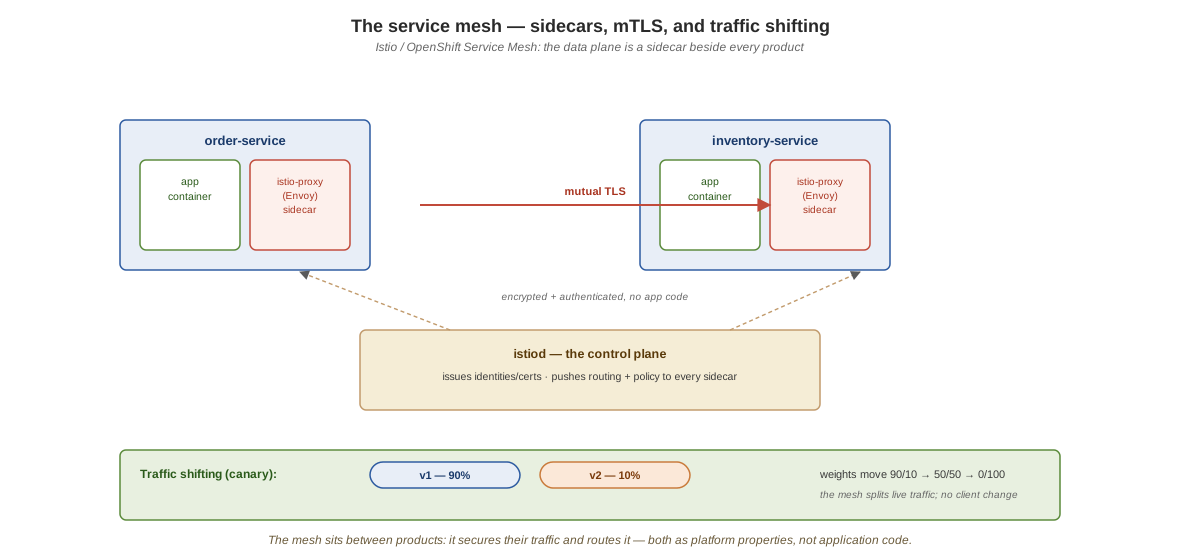
mTLS for free
The same mesh that routes the canary also secures it. When two services are in the mesh, Istio establishes mutual TLS between their sidecars automatically — each service proves its identity to the other and the traffic between them is encrypted, with no change to the application code. That’s the federated computational governance principle in action: “traffic between products is authenticated and encrypted” becomes a property the platform enforces, not a checklist item each team implements. The service author writes no TLS code; the mesh provides it at the boundary.
The decision: mesh selectively, not namespace-wide
Here’s the architectural choice this page exists to make, and it runs against the
convenient default. Istio offers a one-label switch — mark a namespace
istio-injection=enabled and every pod created in it gets a sidecar automatically.
It’s tempting: one label, whole-namespace mTLS, nothing to think about per workload.
The capstone’s position, learned the hard way, is that namespace-wide injection is the
wrong default for a mesh that contains more than just mesh-appropriate services — and
that you should instead opt specific workloads into the mesh.
The reasoning is that a sidecar is not free, and it’s not appropriate for every kind of workload. Three categories in particular do not belong in the mesh, and meshing them ranges from wasteful to actively broken:
- Batch jobs that are supposed to finish. A meshed Job gets a sidecar that never exits — the proxy keeps running after the job’s work is done, so the pod never reaches a completed state and the Job hangs forever. The catalog’s ingestion jobs hit exactly this. A workload that’s meant to run-and-terminate cannot carry a sidecar designed to run-and-stay.
- Operator-managed infrastructure with its own TLS. A managed database that runs its own TLS on its internal ports collides with an injected sidecar that re-wraps those connections — the database’s own encrypted channels break, and it crash-loops. Stateful infrastructure that already secures itself doesn’t want a second TLS layer wrapped around it.
- Anything where the sidecar’s overhead or coupling buys nothing. Each sidecar consumes resources and couples the workload’s startup to the mesh control plane being reachable. For a workload that isn’t doing mesh-managed service-to-service traffic, that’s cost with no benefit.
Beyond those specific breakages, there’s a systemic reason: with namespace-wide injection, every pod creation in the namespace depends on the injection webhook being reachable. If the mesh control plane has a bad moment, you can’t create a database pod, a job, or anything else — workloads that have nothing to do with the mesh are now coupled to its health. Selective injection contains that blast radius: only the workloads that actually need the mesh depend on it.
So the capstone meshes the services that participate in mesh-managed traffic — the ones doing the canary, the ones that benefit from mTLS and traffic management — and keeps the database, the batch jobs, and other operator-managed infrastructure out of the mesh by opting them out explicitly. The trade-off is real and worth stating plainly: namespace-wide injection is genuinely simpler to reason about and gives blanket mTLS with one label, while selective injection is more work to configure and means you have to decide, per workload, whether it belongs in the mesh. The capstone takes that configuration cost in exchange for resilience and correctness — because the failures above aren’t hypothetical, they’re what happens otherwise.
The specific incidents behind this decision — the hung ingestion job, the crash-looping database, the control-plane dependency that bit during a node recovery — are documented as operational gotchas rather than retold here. This page is the decision; the gotchas are the evidence, in detail.
Why this belongs to the mesh chapter
Progressive delivery and mTLS are two sides of one capability: a service mesh that sits between products, routing their traffic and securing it. The canary shows the routing side — moving consumers from one contract version to the next without a flag day. The mTLS shows the security side — authenticated, encrypted traffic as a platform property. And the selective-injection decision is what keeps the mesh an asset rather than a liability: applied where it helps, kept away from where it hurts.
Next, the other half of operating a mesh under real conditions: scaling products to match demand — including down to zero — and recovering when things fail.