Debugging gRPC
Reflection and channelz, common failure modes, decoding frames, and GRPC_TRACE and GRPC_VERBOSITY.
Chapter 25 proved a service behaves correctly. This chapter is about the moment it doesn’t — a call comes back wrong, or not at all, and the question is no longer “does it work” but “where, exactly, did this fail.” RoutingService.GetQuote is the RPC under test again, the same formula every unary chapter has shipped, but this chapter is not really about GetQuote. It is about four shapes a gRPC failure takes, how to tell them apart from the client side without adding a debugger to the server, and the three tools — reflection, channelz, and the GRPC_TRACE/GRPC_VERBOSITY environment variables — that answer “why” once a failure has a name.
The code is in examples/26-debugging/. The run script there (verify.sh) builds and starts both stacks, reproduces all four failure modes against each one, then runs the diagnosis pass; its README.md covers what it does and how to drive it by hand.
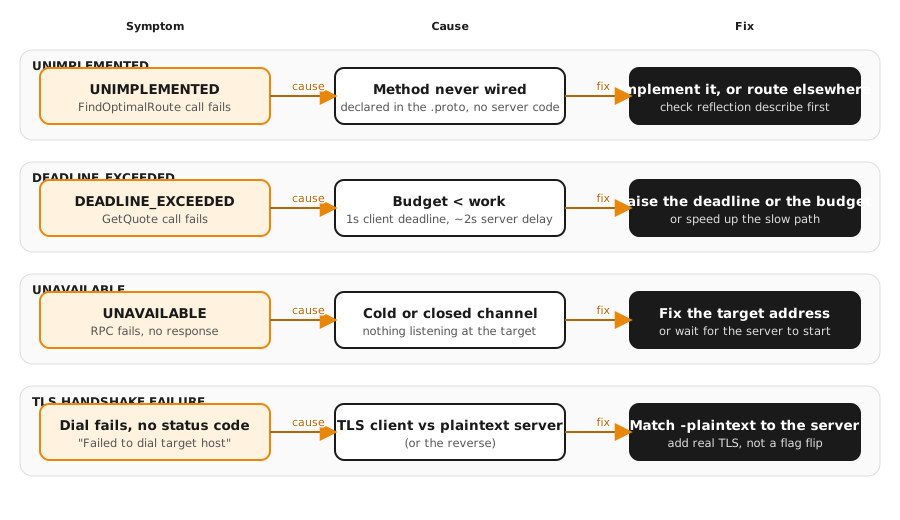
Not every failure is a status code
Every error chapter before this one — Chapter 11’s rich errors, Chapter 19’s TLS rejections, Chapter 20’s UNAUTHENTICATED/PERMISSION_DENIED — assumed a call reached gRPC’s own status machinery: a server received a request, decided it could not satisfy it, and returned a Status with a canonical code. That assumption holds for exactly one of this chapter’s four failure modes. UNIMPLEMENTED and DEADLINE_EXCEEDED are real statuses, returned by a server (or, for the deadline, by the runtime on the caller’s behalf) that successfully exchanged HTTP/2 frames with a client. UNAVAILABLE on a cold channel and a TLS/plaintext mismatch are not — they happen before a connection exists at all, which is exactly why grpcurl reports them with no Code: line, the same “Failed to dial target host” prefix Chapter 19 first described for a TLS rejection. Telling these two families apart is the first and most useful diagnostic skill this chapter teaches: if the error text names a code, the server ran and decided something; if it doesn’t, the bytes never arrived as a gRPC call at all.
UNIMPLEMENTED: a method that exists in the contract but not in the code
contracts/proto/shipping/routing/v1/routing.proto declares five RPCs on RoutingService; this chapter’s servers, like every one before it, implement only GetQuote. Calling FindOptimalRoute fails on both stacks with the same code and two different messages, because the two stacks reach UNIMPLEMENTED by different paths. Quarkus’s RoutingServiceImpl throws it explicitly:
@Override
public Uni<Routing.FindOptimalRouteResponse> findOptimalRoute(Routing.FindOptimalRouteRequest request) {
    return Uni.createFrom().failure(unimplemented("FindOptimalRoute"));
}

private static StatusRuntimeException unimplemented(String method) {
    return Status.UNIMPLEMENTED
            .withDescription(method + " lands in a later chapter")
            .asRuntimeException();
}
Python’s RoutingServiceServicer never overrides FindOptimalRoute at all — the generated routing_pb2_grpc.RoutingServiceServicer base class already implements every method with a default that sets UNIMPLEMENTED and a stock message, so a subclass that overrides nothing still returns that status. Both are equally correct; the difference is purely cosmetic, and it is a useful one to notice in a traceback, because a custom message like "FindOptimalRoute lands in a later chapter" tells a caller this was a deliberate, documented gap, while "Method not implemented!" tells them only that nobody wrote the code — worth knowing which one you’re looking at before filing a bug against someone else’s service.
DEADLINE_EXCEEDED: a budget that can’t cover the work
Chapter 10 taught deadline propagation with a real downstream hop; this chapter needs only a deadline to have something to lose against, so GetQuote here carries a configurable artificial delay instead — QUOTE_DELAY_MS, 2000ms by default, read on both stacks and applied right before the response is built. On Quarkus, the delay is a Mutiny operator, not a blocking sleep:
@ConfigProperty(name = "ch26.quote-delay-ms", defaultValue = "2000")
long quoteDelayMs;
// ...
return Uni.createFrom().item(response)
        .onItem().delayIt().by(Duration.ofMillis(quoteDelayMs));
.delayIt() schedules the emission on Mutiny’s worker pool rather than parking the event-loop thread the way a Thread.sleep() call in this method would — the request waits, but the server keeps serving everything else while it does. Python reaches the same effect with a plain coroutine sleep, which is non-blocking by construction on an asyncio event loop:
_QUOTE_DELAY_MS = int(os.environ.get("QUOTE_DELAY_MS", "2000"))
# ...
if _QUOTE_DELAY_MS > 0:
    await asyncio.sleep(_QUOTE_DELAY_MS / 1000)
return routing_pb2.GetQuoteResponse(quote=quote, route=route)
With the delay fixed at 2000ms, a 1-second client deadline (grpcurl -max-time 1) cannot possibly be satisfied — the call fails DEADLINE_EXCEEDED on both stacks every time, not occasionally, because the race is 1000ms of budget against 2000ms of unavoidable work. A 5-second deadline clears it with room to spare. Nothing about the server’s correctness changed between those two calls; only how much time the caller was willing to wait did. That is the entire diagnostic value of this failure mode: DEADLINE_EXCEEDED almost never means “the server is broken” — it means “the budget and the work disagree,” and the fix is to change one of those two numbers, not to go looking for a bug in QuoteCalculator.
UNAVAILABLE on a cold channel — and why grpcurl can’t show it
UNAVAILABLE is gRPC’s catch-all for “no usable connection to the target,” and this chapter reproduces the simplest version of it: a channel aimed at a port nothing is listening on. compose.yaml never publishes anything on port 9999 on either container, so a call against quarkus:9999 or python:9999 is refused by the operating system every single run — deterministic, not a race against a server that hasn’t finished starting yet.
Reproducing this with grpcurl demonstrates the same gap Chapter 19 already found for a TLS mismatch: grpcurl dials blocking, before it ever attempts an RPC, so against a closed port it reports a raw dial failure — Failed to dial target host "...": connection refused — with no Code: line, because the call never reached gRPC’s status machinery at all. A real application client built the way every unary chapter in this book has built one behaves differently. grpc.aio.insecure_channel(target) returns immediately without dialing anything; the channel only attempts to connect the first time a call is actually made on it. That first call against a dead target therefore surfaces the condition as a status — grpc.StatusCode.UNAVAILABLE — because the attempt and the failure both happen inside the RPC itself, not before it.
examples/26-debugging/python/app/unavailable_probe.py makes exactly that call:
async def run(target: str) -> int:
    channel = grpc.aio.insecure_channel(target)
    try:
        stub = routing_pb2_grpc.RoutingServiceStub(channel)
        try:
            await stub.GetQuote(_REQUEST, timeout=5)
        except grpc.aio.AioRpcError as exc:
            if exc.code() == grpc.StatusCode.UNAVAILABLE:
                return 0
            return 1
    finally:
        await channel.close()
verify.sh runs this script from the already-built Python image — docker compose run --rm --entrypoint python python -m app.unavailable_probe quarkus:9999 — against each stack’s own dead port in turn, so the assertion is a real grpc.StatusCode.UNAVAILABLE, not a text match on a CLI tool’s dial-failure wording. The lesson generalizes past this one script: whatever client library is making the call, if it builds a channel lazily (and most do), a cold or closed channel shows up as an application-visible status the caller’s own error-handling code already knows how to catch — it is grpcurl’s particular dialing strategy that makes this one failure mode look, on the command line, indistinguishable from a TLS mismatch.
TLS handshake failure: the wrong assumption about plaintext
This chapter’s servers are plaintext, exactly like every chapter before Chapter 19. grpcurl defaults to TLS unless told otherwise with -plaintext, so a call that omits that flag against either server fails before a single byte of GetQuoteRequest is deserialized:
Failed to dial target host "localhost:9260": tls: first record does not look like a TLS handshake
This is the single most common real confusion in gRPC tooling, and the fix is almost never TLS configuration — it’s checking that the -plaintext flag (or your client library’s equivalent, grpc.insecure_channel versus grpc.secure_channel) actually matches what the server speaks. The same mismatch in the other direction — a plaintext client against a TLS-only server — produces the same family of error, as Chapter 19 showed with three different exact wordings depending on where the handshake dies. All three wordings, and this chapter’s, share the one property that actually matters: no Code: line, because TLS negotiation happens below gRPC’s own framing, and a failure there never reaches it.
Watch out
Reflection's two implementations disagree about what they can resolve. grpc-java's reflection service (Quarkus) answers grpcurl describe shipping.routing.v1.RoutingService.GetQuote — a full method name — directly. grpcio-reflection (Python) only resolves service and message symbols; the identical method-level describe call against the Python stack fails with Symbol not found: shipping.routing.v1.RoutingService.GetQuote, confirmed while writing this chapter. Neither behavior is a bug — the v1alpha reflection protocol never mandated method-level symbol resolution — but it means a describe script written and tested against one stack can silently stop working against the other. describe shipping.routing.v1.RoutingService (the service, not the method) resolves identically on both, which is why verify.sh asserts that form.
How the code works: channelz, and the two probe scripts
This chapter’s Python server adds one registration to the same grpc.aio.server() every prior chapter built, right alongside RoutingServiceServicer:
from grpc_channelz.v1 import channelz, channelz_pb2, channelz_pb2_grpc

server = grpc.aio.server()
routing_pb2_grpc.add_RoutingServiceServicer_to_server(RoutingServiceServicer(), server)
channelz_pb2_grpc.add_ChannelzServicer_to_server(channelz.aio.ChannelzServicer(), server)

service_names = (
    routing_pb2.DESCRIPTOR.services_by_name["RoutingService"].full_name,
    channelz_pb2.DESCRIPTOR.services_by_name["Channelz"].full_name,
    reflection.SERVICE_NAME,
)
reflection.enable_server_reflection(service_names, server)
channelz.aio.ChannelzServicer() is the asyncio-server variant of the servicer the grpcio-channelz package ships (a synchronous grpc.server() would instead call the module-level channelz.add_channelz_servicer(server)); either way, it is a gRPC service like any other, added to the same server, answering on the same port — there is no separate admin listener to stand up or firewall. The one mistake worth watching for is forgetting the second line in service_names: channelz’s servicer is registered and will answer a call that names it exactly, but without its full name in the reflection set, grpcurl cannot discover or resolve it by name at all, and a describe grpc.channelz.v1.Channelz would fail exactly the way an unregistered symbol always does.
unavailable_probe.py and trace_probe.py (both under examples/26-debugging/python/app/) are one-shot clients, not servers — the same shape as Chapter 7’s reuse_client.py, run from the already-built Python image via docker compose run --entrypoint python, never shipped as a second image. unavailable_probe.py’s full logic is above; trace_probe.py is simpler still — it builds a channel, makes exactly one GetQuote call, and exits, because its entire job is to exist as something GRPC_TRACE/GRPC_VERBOSITY can act on when verify.sh sets them in the container environment it runs in. Both scripts import the generated routing_pb2/routing_pb2_grpc the same way the production server does, from PYTHONPATH=/app/generated:/app — nothing about them requires a special build step beyond the one the server already needs.
Build, run, observe
cd examples/26-debugging && ./verify.sh
Expect PASS after roughly two minutes of build time (first run) or a few seconds (cached): both stacks come up, the baseline GetQuote correctness check passes on each, all four failure modes above reproduce and assert on each, and the diagnosis pass (reflection on both, channelz on Python, GRPC_TRACE/GRPC_VERBOSITY on both) completes last. Real output from each step is in examples/26-debugging/README.md and in the “On the wire” section below.
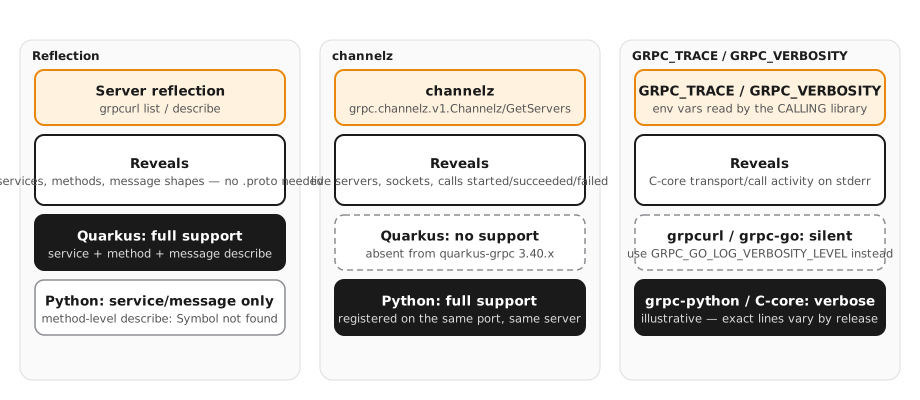
Diagnosis: reflection, channelz, and GRPC_TRACE
Reflection is unchanged from every prior chapter — both stacks answer grpcurl list and grpcurl describe shipping.routing.v1.RoutingService without a local copy of the .proto file, which is the whole reason a tool like grpcurl is useful against a service you didn’t build. Channelz goes one layer deeper than reflection: instead of describing the shape of a service, grpc.channelz.v1.Channelz/GetServers reports what the running server actually did — how many calls started, succeeded, and failed, what socket it’s listening on — all without touching RoutingServiceImpl or RoutingServiceServicer at all. This chapter’s Python server exposes it; its Quarkus server does not, because quarkus-grpc 3.40.x has no channelz support at all — it appears nowhere in either the gRPC reference guide or the service-implementation guide, confirmed by searching both before writing this chapter. That gap is a property of the extension, not a configuration this book skipped: a Quarkus deployment’s equivalent diagnostic surface is the combination this chapter already covers for it — reflection to confirm shape, and structured logs (LOG.infof in RoutingServiceImpl) to confirm behavior — plus the Micrometer-based gRPC metrics Chapter 21 covered, which report aggregate call counts and latencies without channelz’s live per-connection detail.
GRPC_TRACE and GRPC_VERBOSITY sit outside both of those: they are environment variables the calling library reads, not a service the target server exposes, so they work identically against either stack’s GetQuote — what varies is which client library is doing the calling. grpc-python, like grpc-java and the C++ core, wraps the same underlying C-core gRPC implementation, and GRPC_VERBOSITY=DEBUG with GRPC_TRACE=api,call_error,connectivity_state makes that core log every call, every connectivity-state transition, on stderr. grpcurl cannot demonstrate this at all, for the same reason it dials differently than grpc.aio does: it’s built on grpc-go, a from-scratch Go implementation with its own logging surface (GRPC_GO_LOG_VERBOSITY_LEVEL, GRPC_GO_LOG_SEVERITY_LEVEL) that ignores GRPC_TRACE entirely. trace_probe.py exists specifically to have a C-core-backed caller available for this demonstration.
Cross-check
Independent of the Python probe’s own assertion, a connection attempt at the TCP level — no gRPC involved at all — confirms the same fact the UNAVAILABLE repro depends on:
docker compose -p ch26-debugging exec quarkus sh -c "echo > /dev/tcp/quarkus/9999"
# sh: connect: Connection refused
# sh: line 1: /dev/tcp/quarkus/9999: Connection refused
A shell built-in that knows nothing about gRPC, protobuf, or status codes gets refused at exactly the same TCP layer unavailable_probe.py does — confirming the failure is what this chapter claims it is (nothing listening on that port) rather than some gRPC-specific misbehavior that only looks like a connection problem.
Decision
Start every unexplained gRPC failure with reflection — grpcurl describe <service> against the target costs one command and tells you whether the method you're calling exists at all, which rules out UNIMPLEMENTED in one step. If the error text contains a Code: line, the server ran: treat DEADLINE_EXCEEDED as a budget-versus-work problem first (what did the deadline say, how long did the call actually take) before suspecting application logic. If it doesn't contain a Code: line, nothing reached the server: check the obvious transport mismatch first — plaintext versus TLS, wrong port, wrong network — before reaching for certificates or firewalls. Reach for channelz when you need live connection and call-count data from a running Python service without redeploying it with new logging; reach for GRPC_TRACE/GRPC_VERBOSITY only as a last resort on a C-core-backed caller (grpc-python, grpc-java, grpc-c++), since the volume of output is real and the exact lines are not a stable contract across releases.
What you learned
- Only two of this chapter’s four failure modes are real gRPC statuses (
UNIMPLEMENTED,DEADLINE_EXCEEDED); the other two (a cold channel, a TLS/plaintext mismatch) fail before a connection exists, which is why their error text never contains aCode:line — that absence is itself the diagnostic signal. grpcurl’s blocking dial andgrpc.aio’s lazy channel disagree about how a dead target shows up: a CLI dial failure with no status code, versus an application-visiblegrpc.StatusCode.UNAVAILABLEon the first real RPC — the same underlying condition, reported two different ways by two different client designs.- channelz and
GRPC_TRACE/GRPC_VERBOSITYanswer different questions at different layers: channelz asks the server what it’s doing right now; the trace variables ask the calling library’s C-core what it’s doing on the wire — and both have real gaps (no channelz inquarkus-grpc3.40.x; noGRPC_TRACEsupport ingrpcurl’s Go-based client) worth knowing before you go looking for output that was never going to appear. - Reflection’s own symbol resolution isn’t identical across implementations — service- and message-level
describeare portable acrossgrpc-javaandgrpcio-reflection; method-leveldescribeis not.
Chapter 27 puts every piece this book has built — contracts, both language stacks, TLS, auth, observability, and now debugging — into one running system end to end.
On the wire
The four failure modes, real output from an authoring-machine run:
grpcurl -plaintext -d '{"origin":{"unLocode":"USNYC"},"destination":{"unLocode":"NLRTM"},"preferSpeed":false}' \
  localhost:9260 shipping.routing.v1.RoutingService/FindOptimalRoute
# ERROR:
#   Code: Unimplemented
#   Message: FindOptimalRoute lands in a later chapter
grpcurl -plaintext -max-time 1 -d '{"origin":{"unLocode":"USNYC"},"destination":{"unLocode":"NLRTM"},"cargo":[{"weightKg":1200.5}]}' \
  localhost:9260 shipping.routing.v1.RoutingService/GetQuote
# ERROR:
#   Code: DeadlineExceeded
#   Message: context deadline exceeded
docker compose run --rm --entrypoint python python -m app.unavailable_probe quarkus:9999
# unavailable_probe: target=quarkus:9999 code=StatusCode.UNAVAILABLE
#   details='failed to connect to all addresses; last error: UNKNOWN:
#   ipv4:172.19.0.3:9999: Failed to connect to remote host: Connection refused'
# unavailable_probe: ok — UNAVAILABLE on a cold/closed channel
grpcurl -d '{}' localhost:9260 shipping.routing.v1.RoutingService/GetQuote
# Failed to dial target host "localhost:9260": tls: first record does not look like a TLS handshake
The diagnosis pass, in order: reflection, channelz, trace.
grpcurl -plaintext localhost:9260 describe shipping.routing.v1.RoutingService
# service RoutingService {
#   rpc FindOptimalRoute ( .shipping.routing.v1.FindOptimalRouteRequest ) returns ( .shipping.routing.v1.FindOptimalRouteResponse );
#   rpc GetQuote ( .shipping.routing.v1.GetQuoteRequest ) returns ( .shipping.routing.v1.GetQuoteResponse );
#   ...
# }

grpcurl -plaintext -d '{}' localhost:9261 grpc.channelz.v1.Channelz/GetServers
# {
#   "server": [
#     {
#       "ref": { "server_id": "2" },
#       "data": {
#         "trace": { "creation_timestamp": "2026-10-14T11:47:17.543483636Z", "events": [...] },
#         "calls_started": "3",
#         "calls_failed": "1",
#         "last_call_started_timestamp": "2026-10-14T11:47:20.335483678Z"
#       },
#       "listen_socket": [{ "socket_id": "3", "name": "chttp2 listener ipv4:0.0.0.0:9000" }]
#     }
#   ],
#   "end": true
# }

docker compose run --rm -e GRPC_TRACE=api,call_error,connectivity_state -e GRPC_VERBOSITY=DEBUG \
  --entrypoint python python -m app.trace_probe quarkus:9000
# I1014 11:46:31.754228       1 channel_create.cc:249] grpc_channel_create(target=quarkus:9000, creds=0x55bd30d982f0, args=0x7f2b0c5676d0)
# I1014 11:46:31.755093      13 connectivity_state.cc:150] ConnectivityStateTracker client_channel[0x55bd30f81888]: IDLE -> CONNECTING (started resolving, OK)
# I1014 11:46:31.795887      17 connectivity_state.cc:150] ConnectivityStateTracker client_channel[0x55bd30f81888]: CONNECTING -> READY (helper, OK)
# trace_probe: GetQuote ok, quote.amount=3001.25
Verification status: verified.
examples/26-debugging/verify.sh was run end to end against both stacks: the
baseline GetQuote correctness check passed on both; FindOptimalRoute
failed UNIMPLEMENTED on both; a 1-second deadline against the
artificially-delayed GetQuote failed DEADLINE_EXCEEDED on both (a 5-second
deadline succeeded on both); a call against each stack’s own closed port
9999 failed with grpc.StatusCode.UNAVAILABLE; a TLS-defaulting grpcurl
call against each plaintext server failed at the handshake
(tls: first record does not look like a TLS handshake); reflection’s
service-level list/describe succeeded on both, and the method-level
describe asymmetry between grpc-java and grpcio-reflection documented
above was reproduced directly, not inferred; channelz’s GetServers
returned live server data on the Python stack; and GRPC_TRACE/
GRPC_VERBOSITY produced non-empty C-core trace output from a grpc-python
caller against both stacks. The GRPC_TRACE/GRPC_VERBOSITY log lines
quoted above are copied verbatim (four lines selected out of 60+ total) from
one real captured run — a reader’s own run will show the same four kinds of
line with different timestamps, thread IDs, and object addresses, since
those vary every run by construction, and verify.sh asserts only that
output appeared at all, not these exact bytes.