Client-streaming and bidirectional
TrackingService.ReportPositions and .Sync — folding a stream of requests into one answer, and running two independent directions on one connection.
Chapter 8 pointed TrackingService.WatchShipment at the shape where the server has more to say than the client does: one request, a sequence of responses, streamed as events happen. The shipping contract names two more shapes on the same service, and both invert that relationship instead of repeating it. ReportPositions is the opposite of WatchShipment — many requests from the client, one response from the server. Sync refuses to pick a direction at all — both sides send whenever they have something to say, on the same connection, independently. Four RPC shapes exist because four distinct relationships between request count and response count exist, and this chapter closes out the set TrackingService was built to demonstrate: client-streaming and bidirectional.
Client-streaming: folding a sequence into one answer
ReportPositions exists because a telemetry agent tracking a shipment’s container doesn’t have one position report to send — it has a batch, accumulated since the last upload, and it wants one acknowledgment for the whole batch rather than a round trip per report. The proto names the shape directly:
rpc ReportPositions(stream ReportPositionsRequest) returns (ReportPositionsResponse);
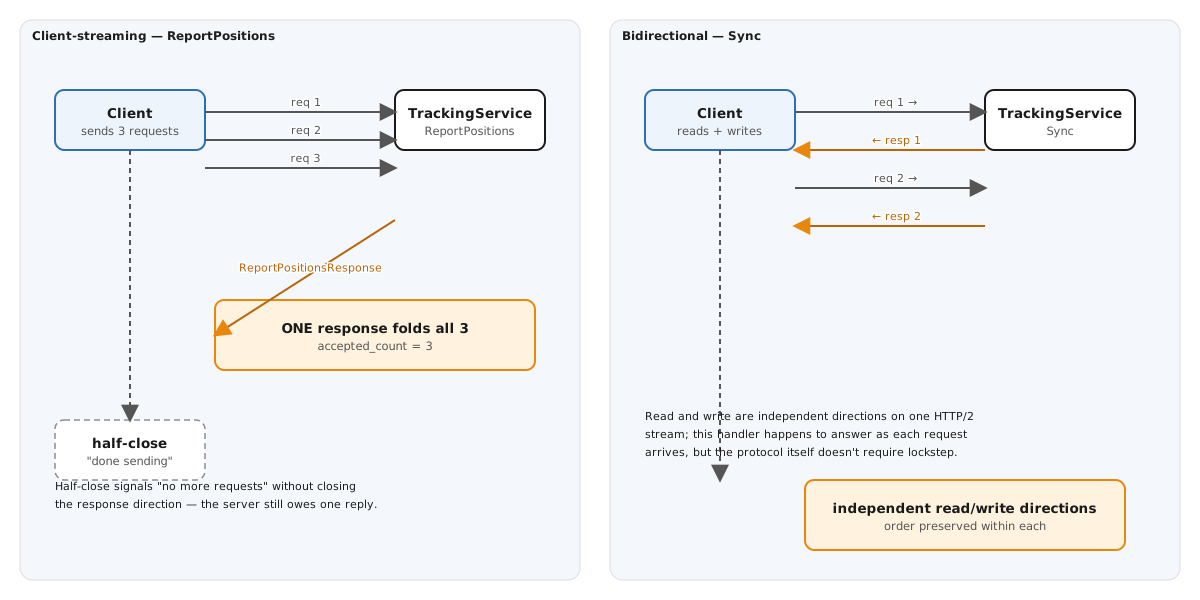
stream appears once, on the request side only. The client opens the call and sends as many ReportPositionsRequest messages as it has — each one wrapping a TrackingEvent — for as long as it has more to send. The server reads every one of them off that single stream, and only when the client signals there’s nothing left to read does the server send back its one ReportPositionsResponse, carrying accepted_count: how many reports it saw. Three requests in, one response out, and the response describes the whole batch rather than any single item in it.
The shape fits whenever many small units of work share one acknowledgment and the caller has no use for a per-item reply. Bulk ingest is the clearest case — a batch of records committed together, answered with one summary rather than one status per record. Telemetry upload is ReportPositions’s own case: sensor readings, position reports, or log lines accumulated client-side and flushed as a stream, where the server’s only obligation is to say how many it got (or, with a richer response message, which ones it rejected). A chunked file upload fits the same shape — a stream of DATA-carrying messages followed by one response once the last chunk arrives — though this chapter’s own example stays with position reports because that’s what the contract already names. What unifies all three: the client knows up front it has a sequence to send, the server has nothing useful to say until that sequence ends, and paying for N round trips to acknowledge N items would be pure overhead with no payoff, since nothing about item 2 depends on a reply to item 1.
Half-close: how “done sending” gets signaled
A client-streaming call needs a way for the client to say “that’s everything” without closing the whole RPC, because the server still owes a response after the last request arrives. HTTP/2 already has the mechanism: each endpoint’s half of a stream can close independently. The client sends its DATA frames carrying each ReportPositionsRequest, and when it has no more to send, it sets the END_STREAM flag on its final frame instead of sending an explicit “done” message of any kind — there’s no sentinel value in the protobuf schema, no empty terminator message to send and recognize. That flag is the client’s half of the stream closing, commonly called a half-close: the client’s write side is done, but the stream itself stays open because the server’s write side hasn’t closed yet. The server keeps that stream’s resources — buffers, read state — alive, finishes reading whatever frames already arrived, and only then is free to write its own HEADERS and DATA frames carrying the response, followed by its own END_STREAM on the frame that closes the RPC from both directions at once.
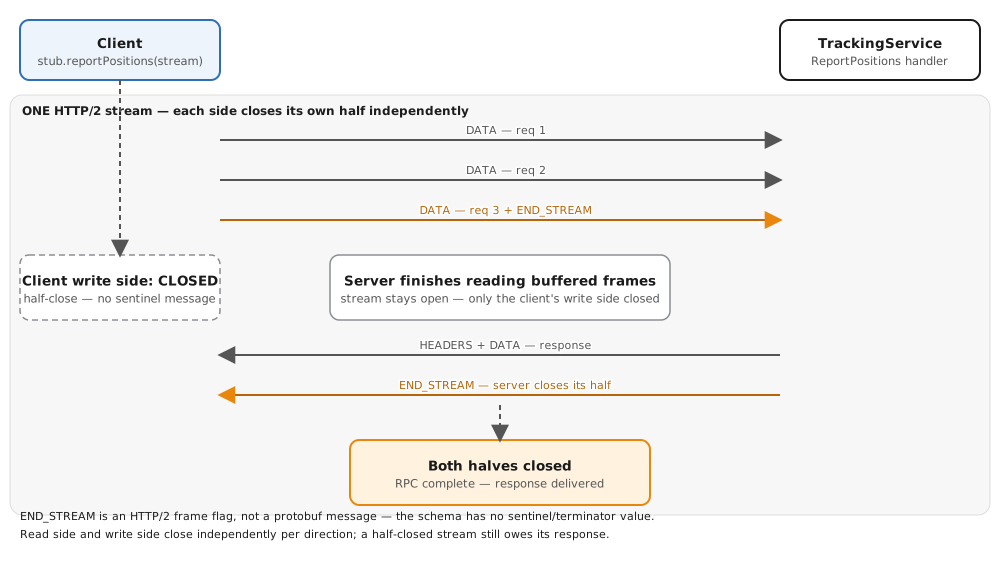
This is why a client-streaming handler on either stack reads as “consume everything, then produce one value,” never as “produce a value per request.” The Quarkus implementation in this chapter’s example makes the half-close concrete: request.collect().asList() subscribes to the inbound Multi<ReportPositionsRequest> and buffers every item it emits — which, for a Multi backed by this inbound stream, only happens once per request, driven by frames actually arriving — until the stream itself signals completion, which on the wire is exactly the client’s END_STREAM flag. Only then does the Uni returned by collect().asList() resolve with the full list, and only then does .onItem().transform() run to build the one ReportPositionsResponse. Python’s grpc.aio servicer method makes the same mechanics explicit as ordinary control flow: async for _ in request_iterator doesn’t exit the loop early and doesn’t exit it on a timer — it exits precisely when the async iterator is exhausted, which grpc.aio ties to the client’s half-close on the wire. Either way, the count that ends up in accepted_count is a count of frames that actually arrived before the half-close, not an estimate or a fixed batch size — this chapter’s verify.sh sends exactly three requests and asserts exactly accepted_count = 3 for precisely that reason.
Ordering matters here too, even though a client-streaming call’s visible behavior is “many in, one out.” The inbound stream preserves the order the client sent its requests in — HTTP/2 doesn’t reorder frames within one stream, only across different streams — so a handler that cares about sequence (a position report where only the last one matters, say) can rely on request_iterator/Multi delivering items in send order. ReportPositions’s own response collapses that order into a count and throws the sequence away, but the guarantee is there underneath for any client-streaming RPC that needs it.
Bidirectional: two directions, one stream
Sync is the shape that doesn’t pick a direction at all:
rpc Sync(stream SyncRequest) returns (stream SyncResponse);
stream appears on both sides. Once the call opens, the client can send SyncRequest messages and the server can send SyncResponse messages, in whatever order and at whatever pace each side chooses, on the one HTTP/2 stream the call opened. Neither direction waits for the other to finish, because neither direction is “finished” until both sides close their own half — this is the same half-close mechanism ReportPositions used for its one-sided stream, just available independently in each direction instead of only the client’s.
The handler in this chapter’s example answers each SyncRequest with one SyncResponse echoing its event, as soon as that request arrives — a reasonable default, but a choice the handler makes, not something the protocol requires. A bidirectional stream doesn’t enforce any correspondence between requests and responses: a server could send three responses before reading a second request, or read every request to exhaustion before writing anything, or correlate requests and responses by an ID carried in the message rather than by position at all. What the protocol does guarantee is that each direction, read on its own, preserves the order its sender emitted it in — the client’s requests arrive at the server in send order, and the server’s responses arrive at the client in send order — while placing no ordering relationship between the two directions themselves. Sync’s particular choice to answer request-for-request, in order, is a correlation the proto comment and this chapter’s implementation establish by convention, not a guarantee built into stream SyncRequest / stream SyncResponse itself.
Bidirectional is worth its cost — a connection held open for the life of a back-and-forth, state kept on both ends for as long as it runs — when the interaction really is a conversation rather than a transaction with a predictable shape. Event reconciliation is Sync’s own case: two sides comparing state over time, each one capable of surfacing a discrepancy whenever it notices one, not on a schedule either side dictates. A negotiation protocol is the sharper example, and the shipping contract carries one: RoutingService.NegotiateRoute declares the identical stream ... returns (stream ...) shape for a carrier and a shipper proposing and countering route terms back and forth until both sides agree or one gives up — the same two-way, unpredictable-cadence profile Sync has, in a different domain. NegotiateRoute stays UNIMPLEMENTED in this chapter’s example (TrackingService, not RoutingService, is what’s running), but the shape transfers directly: wherever a real-time interactive session, a multi-round negotiation, or a long-lived duplex connection is the actual requirement, bidirectional is the RPC type built for it, and two independent client-streaming/server-streaming calls bolted together is usually a worse fit, not a cheaper one — it costs two connections and discards a correlation a single bidirectional stream could have carried without either side inventing one.
The generated shapes on both stacks
quarkus-grpc’s code generation gives ReportPositions and Sync the Mutiny signatures the proto’s two stream placements predict directly: a stream on the request side alone becomes a Multi parameter feeding a Uni return; stream on both sides becomes a Multi parameter feeding a Multi return. grpc_tools.protoc gives Python’s TrackingServiceServicer base class an async def method for each RPC, but the parameter and the body are what change between the shapes — a client-streaming method’s request_iterator parameter is consumed with async for until exhausted, then the method returns a single message, while a bidirectional method is itself an async generator: its body still iterates request_iterator, but produces output with yield instead of return, so the method keeps running (and keeps reading) after emitting its first response rather than ending there.
// Client-streaming: Multi<Request> in, Uni<Response> out.
@Override
public Uni<Tracking.ReportPositionsResponse> reportPositions(Multi<Tracking.ReportPositionsRequest> request) {
    return request.collect().asList()
            .onItem().transform(reports -> Tracking.ReportPositionsResponse.newBuilder()
                    .setAcceptedCount(reports.size())
                    .build());
}
# Client-streaming: request_iterator in, one return value out.
async def ReportPositions(self, request_iterator, context):
    accepted_count = 0
    async for _ in request_iterator:
        accepted_count += 1
    return tracking_pb2.ReportPositionsResponse(accepted_count=accepted_count)
There’s a cost worth naming in how the two handlers above reach the same accepted_count. request.collect().asList() buffers every ReportPositionsRequest the client sends — all of it, in memory, as one List — before .onItem().transform() ever runs; for this chapter’s three-item batch that’s free, but a client-stream with no size limit — an agent replaying a day’s worth of position reports after a network outage, say — turns that buffer into memory proportional to whatever the client decided to send. The Python handler right above it already avoids this: accepted_count += 1 inside the async for loop folds the stream incrementally, holding one integer regardless of how many requests arrive, never the requests themselves. The fix on the Quarkus side is the same shape, not a rewrite — replace collect().asList() with a fold, such as collect().with(Collectors.counting()) or an explicit .onItem().scan(...) accumulator, so the running result is the only thing held in memory. Chapter 17 covers the fuller backpressure story, including what happens when a handler can’t drain a stream as fast as the client sends; this is the narrower, upstream half of that problem — don’t buffer what you can fold.
// Bidirectional: Multi<Request> in, Multi<Response> out — a 1:1 mapping
// operator, so each response goes out as its matching request arrives.
@Override
public Multi<Tracking.SyncResponse> sync(Multi<Tracking.SyncRequest> request) {
    return request.onItem().transform(req ->
            Tracking.SyncResponse.newBuilder().setEvent(req.getEvent()).build());
}
# Bidirectional: request_iterator in, yield out — an async generator, not a
# single return.
async def Sync(self, request_iterator, context):
    async for request in request_iterator:
        yield tracking_pb2.SyncResponse(event=request.event)
All four handlers above assume the server keeps reading until the client’s stream ends: collect().asList(), the async for count loop, and both Sync bodies never exit the inbound loop early. A real ReportPositions or Sync handler doesn’t always get that luxury. A bulk-ingest handler validating each ReportPositionsRequest as it arrives — rejecting the whole batch the moment one TrackingEvent fails validation, say — may need to stop reading and return an error before the client’s END_STREAM arrives; sends the client issues after that point fail outright rather than queue, because the server’s read side is gone, not merely slow. Sync has the sharper version: either side can abort mid-conversation — the server calling context.abort(...) or completing its Multi early, the client cancelling the call — and the other side’s next send surfaces that abort as a failure on its own stream, not as a value to process. Neither stack’s generated code forces a handler to drain its entire inbound stream before responding; reading to the end is this chapter’s choice, not the protocol’s requirement.
Both pairs run against the same TrackingService registration: one @GrpcService class on Quarkus, one add_TrackingServiceServicer_to_server(...) call on Python, with WatchShipment left to answer UNIMPLEMENTED on both — Quarkus because the generated TrackingService interface requires every method implemented explicitly, Python because the generated servicer base class answers UNIMPLEMENTED for anything a subclass doesn’t override. This chapter’s hands-on example registers only TrackingService, and only these two methods, to keep the both-stack build to one moving part per stack rather than two services’ worth of streaming code landing at once — the REST→gRPC seam Chapter 2 introduced doesn’t change shape here; it’s still the same decision about which calls cross a protocol boundary, just not this chapter’s subject.
Decision
Run both of this chapter's shapes through Chapter 2's five axes. RPC shape is the whole decision for ReportPositions: a telemetry agent has a batch of reports and wants one acknowledgment, which is client-streaming by definition — the alternative, N unary ReportPositions-style calls each carrying one report, pays N round trips and N sets of HTTP/2 header frames for work that has no per-item answer to give back, a straight loss with no corresponding gain. RPC shape decides Sync too, but against a different alternative: two independent half-duplex streams (one client-streaming call for the client's events, one server-streaming call for the server's) would need two connections, two lifecycles to track, and no protocol-level way to correlate a response on one stream with a request on the other, where one bidirectional stream gives both directions, in order, on one connection, with correlation left to the application's own convention rather than invented twice. Sync vs. stream is already answered by RPC shape in both cases — there is nothing to decide once the shape is chosen, since a streaming RPC is inherently consumed as a stream. Deadline and budget diverge sharply between the two: a bounded client-streaming call like ReportPositions can carry a deadline covering the whole batch, since the server knows the call ends when the client's half-close arrives; Sync's bidirectional, open-ended conversation resists a single deadline entirely, and reaches instead for a keepalive or an application-level idle timeout, the two tools this book leaves to Chapter 10's deadline chapter to name properly. Failure class also splits: ReportPositions failing mid-stream (`UNAVAILABLE` before the half-close) is usually safe to retry whole, since nothing committed until the one response arrived; a Sync session interrupted mid-conversation needs the application to decide what state survives a reconnect, because gRPC's retry machinery has no concept of "resume a bidirectional stream from message 40." Concurrency model favors the reactive/async style for both, more than Chapter 7's unary case did: a thread blocked reading a client-stream to exhaustion, or blocked on either direction of a bidirectional one, is a thread pinned for the entire call's lifetime rather than one round trip, which is precisely the cost Mutiny's Multi and grpc.aio's async iterators exist to avoid paying.
Where this goes next
The half-close this chapter named for ReportPositions and the independent-directions model it named for Sync are both HTTP/2 stream behaviors Chapter 6 already built the vocabulary for — nothing here needed a new transport concept, only a new way of using the one Chapter 6 covered. Chapter 10 puts a real deadline on a streaming call for the first time, including the harder question this chapter’s Decision callout flagged: what a deadline even means for a connection with no natural end. Chapter 11 returns to failure mid-stream with the full rich-error-model treatment, past the single retryable/non-retryable split this chapter used. Chapter 17 comes back to both RPCs under load — what backpressure looks like when a client-stream’s buffer fills faster than a handler drains it, and what a slow consumer does to a bidirectional stream’s flow-control window on each side independently. And Chapter 26, the site’s complete-project chapter, is where RoutingService.NegotiateRoute — mentioned here as the same bidirectional shape in a different domain — finally gets implemented instead of returning UNIMPLEMENTED.
On the wire
verify.sh brings both services up, waits for each to answer reflection’s list, then drives both RPCs with grpcurl’s client-stream support: newline-delimited JSON request messages piped to -d @, which sends them in order and half-closes once stdin runs out.
printf '%s\n' \
  '{"event":{"bookingId":"bkg_demo","note":"p1"}}' \
  '{"event":{"bookingId":"bkg_demo","note":"p2"}}' \
  '{"event":{"bookingId":"bkg_demo","note":"p3"}}' \
  | grpcurl -plaintext -d @ localhost:9090 shipping.tracking.v1.TrackingService/ReportPositions
# { "accepted_count": 3 }

printf '%s\n' \
  '{"event":{"bookingId":"bkg_demo","note":"s1"}}' \
  '{"event":{"bookingId":"bkg_demo","note":"s2"}}' \
  | grpcurl -plaintext -d @ localhost:9090 shipping.tracking.v1.TrackingService/Sync
# { "event": { "bookingId": "bkg_demo", "note": "s1" } }
# { "event": { "bookingId": "bkg_demo", "note": "s2" } }
Swap 9090 for 9091 and the Python stack answers identically: accepted_count: 3 for the first call, two SyncResponse messages in the same order for the second. verify.sh asserts both numbers directly against both stacks — accepted_count via a single JSON field read, the Sync response count via the shared harness’s json_stream_count helper, which counts concatenated JSON objects on grpcurl’s stdout rather than assuming a fixed shape — so “folds three into one” and “echoes two into two, in order” are checked claims for every chapter rebuild, not a one-time observation written into this prose.