Client integration
What a GraphQL client adds over curl: a normalized cache that answers a second query with no request and takes a mutation payload into the cached object, types generated from the canonical SDL that stop a build on a stale document, gql with local schema validation, the SmallRye typesafe and dynamic clients, partial results as data a client keeps, and a header that names the client.
Every chapter so far sent documents with curl and read the JSON that came back. That is enough to prove a server right, and it leaves everything a real consumer needs to the reader: writing a document that still matches the schema next month, reading the result as a typed value, keeping what it already knows, deciding what to do when half of an answer failed. A client library takes those jobs on, and the choice of client decides how much of the contract the consumer sees at build time instead of at run time.
The code is in examples/22-client-integration/. It starts from the Chapter 13 example and serves the same schema from both stacks, so there is no new server code. What is new is three clients, one per language, each run as a one-off container against Quarkus and then Python: Apollo Client with GraphQL Code Generator in TypeScript, gql in Python, and the SmallRye GraphQL typesafe and dynamic clients in Java. verify.sh asserts what each prints.
What a client is for
curl gives a transport and nothing else. A client adds five things, and each of the three examples shows a different mix of them.
- Documents. The operation text lives in a file or a type, not in a shell string, and it is checked by something other than the server.
- Typed results. The response is a value with fields the compiler knows, not a JSON blob.
- Errors as data. The
errorsarray of Chapter 9 becomes something a program branches on. - A cache. What the client has already been told is kept and reused.
- A transport. Headers, retries and, for Chapter 21’s subscriptions, a connection that stays open.
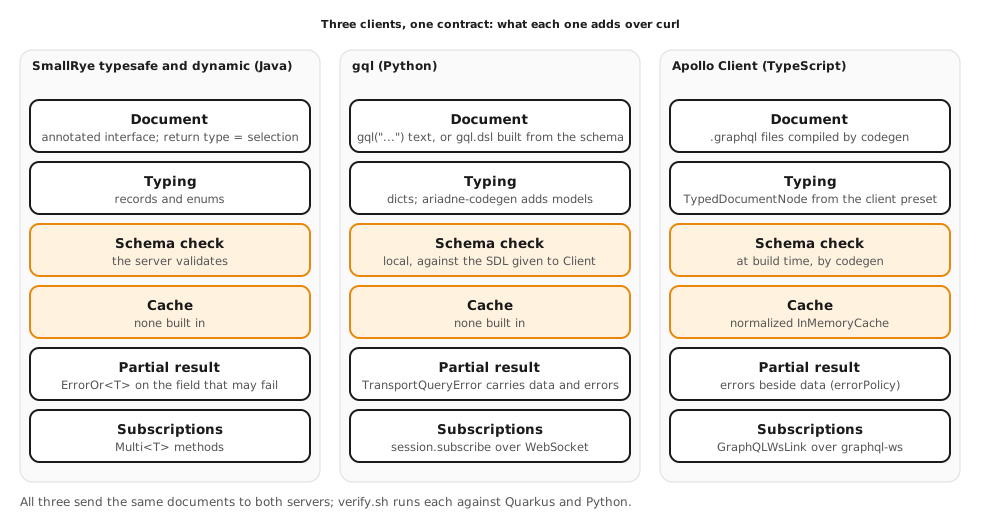
Figure 22.1 puts the three clients side by side. The orange rows are where they differ most: where the schema is checked, and whether anything is cached. Apollo Client checks documents at build time and caches by object identity. gql checks them when a request is made, against the SDL it was given. The SmallRye clients leave both to the server and to Java’s own types.
The same call, TrackCargo for ABC123, reads like this in each:
var cargo = tracking.cargo(new TrackingId("ABC123"));
data = await session.execute(TRACK_CARGO, variable_values={"id": "ABC123"})
const track = await client.query({ query: TrackCargoDocument, variables: { id: "ABC123" } });
All three print IN_PORT for ABC123 after the first client has written to it, ONBOARD_CARRIER before.
The normalized cache
A client that stores each response whole can reuse only a response that repeats the request exactly. Apollo Client’s InMemoryCache stores objects instead. Chapter 10 gave every Node a stable id, and the cache keys any object that has an id and a __typename by the pair: Cargo:cargo_ABC123. A response is flattened into those entries, and a field that holds an object becomes a reference to its entry. Chapter 16 listed this as the first of four places to keep an answer. Here it runs.
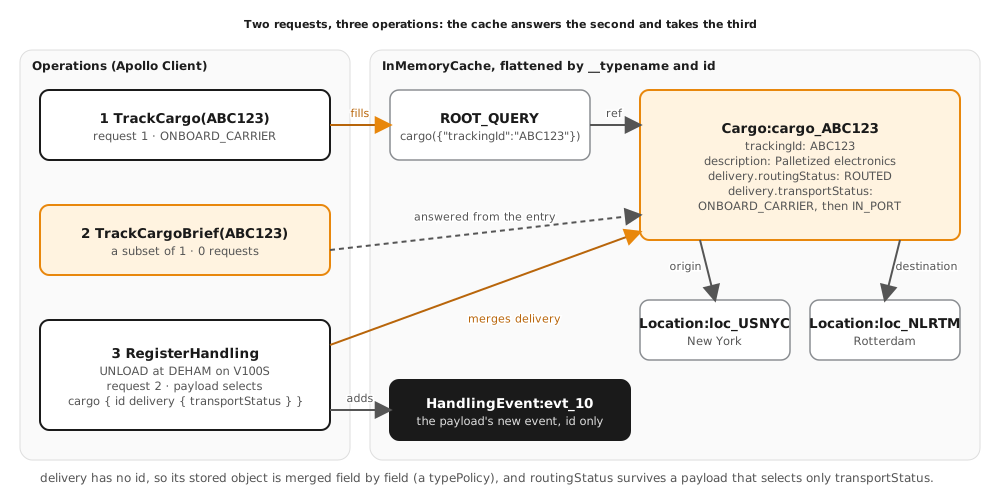
The example’s JS client makes three operations against one server. TrackCargo asks for the cargo’s id, trackingId, description, its origin and destination locations and two delivery fields. TrackCargoBrief asks for a subset of that on the same root field and arguments: id, trackingId and delivery { transportStatus }. RegisterHandling is the mutation of Chapter 8. Figure 22.2 follows the cache through them.
The client is built from three pieces, and the file shows all of them:
let fetches = 0;
const countingFetch: typeof fetch = (input, init) => {
  fetches += 1;
  return fetch(input, init);
};

const cache = new InMemoryCache({
  typePolicies: {
    Delivery: { merge: true },
  },
});

const client = new ApolloClient({
  link: new HttpLink({
    uri: url,
    fetch: countingFetch,
    headers: { "X-Client-Name": "ch22-js", "X-Client-Version": "1.0.0" },
  }),
  cache,
});
HttpLink takes the fetch implementation as an option, which is the documented place to wrap it, so the counter sees every request that leaves the process. The first query prints {"step":"track","status":"ONBOARD_CARRIER","fetches":1}. The second, with the default cache-first policy, finds every field it selects already in Cargo:cargo_ABC123 and prints "fetches":1: no request. verify.sh confirms it from the other side. After the whole run the servers’ source-call log holds exactly three request ids, one each for the first query, the mutation and a page query that comes later, and no call belongs to the subset query.
cache.extract() shows the shape. It holds one Cargo:cargo_ABC123 entry and two Location: entries, loc_USNYC and loc_NLRTM, keyed by id. A second cargo with the same origin would reuse Location:loc_USNYC, and a change to that location would show in both.
The mutation is why the server returns the changed object (Chapters 8 and 16). registerHandlingEvent answers with cargo { id delivery { transportStatus } }. The client reads Cargo and cargo_ABC123 in the payload, finds the entry, and writes IN_PORT into it. A cache-only readQuery of the first document then returns IN_PORT with no request, and the step prints "fetches":2. Nothing in the client says “refetch the cargo”; the identity in the payload did the work. A mutation payload that omits id updates nothing, so the identity rule is a rule for the payload as much as for the queries.
The cache has a policy per request, and the example uses two. cache-first, the default for client.query, answers from the cache when every selected field is present and otherwise asks the server. network-only always asks, and the ListCargos step uses it so that the page is fetched whatever the cache holds. readQuery is the cache alone: it returns what is stored or nothing. Between them they cover the usual cases, a screen that should render at once from what is known and a screen that must be current. A cached answer is only as fresh as the last response that touched its entries, so a client that needs a freshness bound sets one per query. Chapter 16’s TTLs apply to the layers behind the server; the client’s bound is its own.
Variables are part of the cache key as well. The root entry stores cargo({"trackingId":"ABC123"}), so a query for DEF456 is a different field of ROOT_QUERY that points at a different Cargo entry, and two queries for the same cargo with different selections share the entry and add fields to it. That is why the example passes the id as a variable ($id: TrackingId!) and never builds a document by string concatenation: the document stays constant, the cache keys stay predictable, and the server sees the same operation text for every cargo.
Delivery has no id, so the cache stores it inside the cargo entry and, by default, replaces it as a whole whenever a response brings a new one. The payload selects only transportStatus, while the first query also stored routingStatus. The type policy Delivery: { merge: true } merges the fields of the two objects instead, so routingStatus stays ROUTED after the update. Apollo’s documentation on configuring the cache covers typePolicies and merge, and the next time a type without an id appears in a payload, that policy is the place to look.
Types from the contract
A cache saves requests. Types prevent a different failure, the document that was right when it was written. GraphQL Code Generator’s client preset reads two things: the schema and the documents. Its output is one TypedDocumentNode per operation, a document carrying its result and variable types.
The schema is the canonical SDL. The example does not copy contracts/schema/ into the client; the compose file passes it to the image build as a named context, and the Containerfile mounts it at /schema:
js-client:
  profiles: ["client"]
  build:
    context: ./clients/js
    dockerfile: Containerfile
    target: runtime
    additional_contexts:
      schema: ../../contracts/schema
The codegen configuration points at it and at the example’s .graphql files:
const config: CodegenConfig = {
  schema: "/schema/**/*.graphql",
  documents: ["src/**/*.graphql"],
  generates: {
    "src/gql/": {
      preset: "client",
      presetConfig: { fragmentMasking: false },
      config: {
        useTypeImports: true,
        enumsAsTypes: true,
        importExtension: ".ts",
        scalars: { TrackingId: "string", UnLocode: "string", DateTime: "string" },
      },
    },
  },
  // A document that no longer matches the schema stops the run.
  ignoreNoDocuments: false,
};
The three custom scalars map to string, which is what they are on the wire (Chapter 3). Without the mapping the generated type of trackingId is unknown. enumsAsTypes emits TransportStatus as a union of string literals, and importExtension makes the generated files import each other with their extension.
That last setting matters because of how the client runs. Figure 22.3 shows the build. npm ci installs from the committed package-lock.json, codegen writes src/gql/graphql.ts, tsc --noEmit checks main.ts against it, and the runtime image, ubi10/nodejs-24-minimal, runs node src/main.ts. Node 24 strips the type annotations and runs the TypeScript files as they are, so there is no compile step to ship. Imports with extensions are what both Node and tsc accept in that mode.
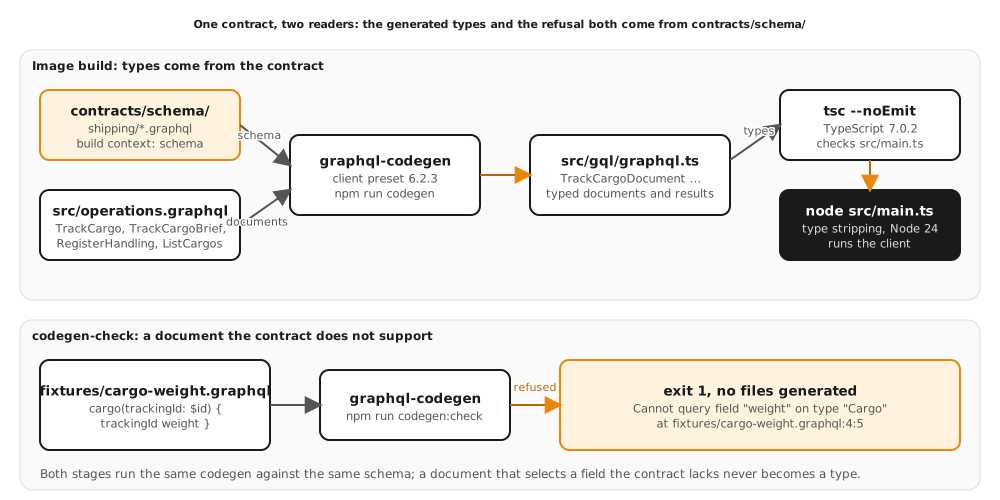
The lower half of the figure is the useful half. A second compose service, codegen-check, runs the build stage of the same image with a different configuration, codegen.fail.ts, whose only document selects Cargo.weight. The contract has no such field, and codegen stops:
✖ Generate [FAILED: GraphQL Document Validation failed with 1 errors;
  Error 0: Cannot query field "weight" on type "Cargo".
    at /opt/app-root/src/fixtures/cargo-weight.graphql:4:5]
✔ Generate outputs
  ✖ One or more errors occurred, no files were generated. To allow output on errors, set config.allowPartialOutputs=true
The exit status is 1, verify.sh asserts the message, and the same would happen to a real document the day the contract dropped a field. This is the client’s half of Chapter 5’s contract loop. The server’s build checks that it still conforms to the SDL, and the client’s build checks that its documents still do. A removal that Chapter 11’s breaking-change gate would flag shows up in the client build as a failed document before any consumer runs it.
The preset can also emit a persisted-document manifest. With persistedDocuments: true it writes persisted-documents.json, a map from sha256: hashes to document text, which is the registration step of Chapter 15 done at build time. Chapter 15’s manifest is an operations list in Apollo’s format, so a server that reads one needs a small conversion to read the other. The example leaves the option off, and the choice between the two formats is the server’s.
Python: gql
gql takes a different position on the same question. It validates at run time, but before anything is sent, and against the contract:
sdl = "\n".join(path.read_text() for path in sorted(SCHEMA_DIR.rglob("*.graphql")))
...
client = Client(transport=transport, schema=sdl)
SCHEMA_DIR is /schema, filled by the same additional_contexts entry. With a schema in hand, session.execute checks each document against it first. The example runs a document that selects weight on Cargo, and the client refuses it with graphql-core’s message: Cannot query field 'weight' on type 'Cargo'. The step prints "sent":0: the transport’s request hook counted no request for it. The run sends three requests in all, the text query, the DSL query and the page query, and the server’s log holds the same three.
The same schema builds documents. gql.dsl is a query builder whose fields come from the schema object, so a misspelled field fails when the document is built:
ds = DSLSchema(client.schema)
query = dsl_gql(DSLQuery(ds.Query.location.args(unLocode="NLRTM").select(ds.Location.name)))
That asks for location(unLocode: "NLRTM") { name } and gets Rotterdam. Text documents and DSL documents go through the same session and the same validation.
The transport is HTTPXAsyncTransport, which hands its options to httpx. The example uses event_hooks to count requests and headers for the client name. Results are plain dicts. A project that wants models for them has the route the Apollo example takes at build time: ariadne-codegen generates a typed client from the same SDL and a set of documents. The example stays with gql, which is also the client Chapter 21 uses for subscriptions.
Java: SmallRye typesafe and dynamic clients
The Java client inverts the Apollo approach. There is no document file. An interface describes the operations, and the return types describe the selection:
@GraphQLClientApi(configKey = "tracking")
public interface TrackingClient {

    @Query("cargo")
    Cargo cargo(@NonNull @Name("trackingId") TrackingId trackingId);

    @Query("cargos")
    CargoPage cargos(@Name("first") int first);

    @Mutation("registerHandlingEvent")
    RegisterPayload registerHandlingEvent(@NonNull @Name("input") RegisterInput input);
}
The Quarkus extension implements the interface and injects it. Cargo is a record of trackingId, description and delivery, so the generated document selects those three fields and nothing else. Adding a field to the record adds it to every request that returns it. The URL and the client-name header come from configuration under the same key:
quarkus.smallrye-graphql-client.tracking.url=${TRACKING_URL}
quarkus.smallrye-graphql-client.tracking.header.X-Client-Name=ch22-java
The custom scalars need one adaptation, which is the client’s version of the mapping in the codegen configuration. A class with a static of(String) factory is treated as a scalar, and @Name gives the variable its declared type:
@Name("TrackingId")
public record TrackingId(String value) {

    public static TrackingId of(String value) {
        return new TrackingId(value);
    }

    @Override
    public String toString() {
        return value;
    }
}
The input object takes @Input("RegisterHandlingEventInput"), which names the variable’s type the way the SDL does. The mutation registers a RECEIVE at SGSIN for VWX901 and gets evt_11 with IN_PORT back, and verify.sh counts one handling.appendEvent.
Where a schema validates at build time for Apollo and at the client for gql, the typesafe client leaves it to the server, which answers a mismatched variable or field with a validation error. What the client gains is Java’s own type system: the record is the selection and the result in one declaration.
The dynamic client is for a shape decided at run time. DynamicGraphQLClient takes a Document built with the Document, Operation and Field helpers:
Document document = document(operation(
        field("location", args(arg("unLocode", "NLRTM")), field("name"))));
Response response = dynamic.executeSync(document);
The response is a jakarta.json object, so getData().getJsonObject("location").getString("name") reads Rotterdam. Both clients read the configuration key tracking, so they call the same server with the same header.
Errors in a client
Chapter 9 gave failures a contract: a response may carry data and errors together, and each error has a path and a code. A client decides what that means for the program. The example runs the same page query, cargos(first: 10), through all three clients, and the seed makes one of the six cargos, GHI345, fail at the booking service with SERVICE_UNAVAILABLE.
Each client keeps the part that arrived:
- Apollo Client resolves the promise with
dataanderrorwhen the document is sent witherrorPolicy: "all".erroris aCombinedGraphQLErrorsobject holding theerrorsarray. With the default policy,none, the promise rejects with the same object, and the partial data is not returned. - gql raises
TransportQueryErrorfor a response with errors, and the exception carriesdataanderrorsas attributes. The example catches it and reads both. - SmallRye declares where a failure may land. The node of each edge is an
ErrorOr<CargoSummary>, which holds either the value or the errors reported at its path:
public record CargoEdge(String cursor, ErrorOr<CargoSummary> node) {
}
The page returns, each edge’s isPresent() says whether its node loaded, and getErrors() lists what went wrong at that path. Without ErrorOr, the typesafe client raises an exception for the whole call.
The numbers are the part to read carefully, because they differ by server and not by client. On Python, GHI345’s loader key fails alone: the page has six edges, one null node and one error at ["cargos","edges",5,"node"]. On Quarkus, SmallRye resolves the cargo loads of the page as one batch (Chapter 13), so the failure is reported at every edge: six null nodes and six errors. All three clients see the same on each server, and verify.sh asserts both outcomes per stack. A client cannot depend on how many nodes arrive. It can depend on the shape: nodes that loaded are in data, every error carries a path, and the code is SERVICE_UNAVAILABLE, which is a value the program can branch on to show a retry or a placeholder.
Identifying the client
All three clients send X-Client-Name and X-Client-Version: ch22-js, ch22-python and ch22-java, each with 1.0.0. The example’s servers do not read them, so nothing asserts them here. Chapter 19 does read the header: a name per client is what turns a trace or a count of deprecated-field usage (Chapter 11) into an answer to which consumer needs to move. The header costs a line in each client’s configuration, and the servers can ask for it later.
The operation name does the same job per document, and the example gives every document one: TrackCargo, TrackCargoBrief, RegisterHandling, ListCargos. An anonymous document shows up in a log or a metric as a hash of nothing. Codegen reinforces the habit: each named operation becomes a generated constant, such as TrackCargoDocument, and an anonymous one has nothing to call it by.
Subscriptions from a client
This chapter’s servers serve no subscription; Subscription.cargoHandled arrives with Chapter 21, which builds the server side and a client that speaks both WebSocket subprotocols. The three client libraries each have a route:
- Apollo Client adds a
GraphQLWsLink, built on thegraphql-wspackage, and routes subscription operations to it withsplit, while queries and mutations stay onHttpLink. - gql has WebSocket transports and
session.subscribe, which is an async iterator of results. - SmallRye returns a
Multi<T>from a typesafe method annotated@Subscription.
The cache above does not change. A subscription event that carries id and __typename is written into the same entries, and a screen showing that object updates, which is the same mechanism the mutation payload used.
On the wire
Start the servers. Quarkus is on 8320 and Python on 8321; the clients run on the compose network and reach the servers by service name.
cd examples/22-client-integration
docker compose up -d --build
docker compose --profile client run --rm --build js-client http://quarkus:8080/graphql
{"step":"track","status":"ONBOARD_CARRIER","fetches":1}
{"step":"brief","status":"ONBOARD_CARRIER","fetches":1}
{"step":"normalized","cargoKeys":["Cargo:cargo_ABC123"],"locationKeys":["Location:loc_NLRTM","Location:loc_USNYC"]}
{"step":"after-mutation","event":"evt_10","userErrors":0,"status":"IN_PORT","fetches":2}
The partial step follows. The Python and Java clients run the same way:
docker compose --profile client run --rm --build python-client http://quarkus:8080/graphql
docker compose --profile client run --rm --build -e TRACKING_URL=http://quarkus:8080/graphql java-client
docker compose --profile client run --rm --build codegen-check
| Check | Quarkus | Python |
|---|---|---|
codegen on the Cargo.weight fixture |
exit 1, Cannot query field "weight" on type "Cargo", no files |
|
JS TrackCargo(ABC123) then TrackCargoBrief |
ONBOARD_CARRIER, fetches 1 and 1 |
the same |
| JS cache | one Cargo:cargo_ABC123; Location:loc_NLRTM, Location:loc_USNYC |
the same |
JS RegisterHandling and cache-only read |
evt_10, IN_PORT, fetches 2 |
the same |
JS ListCargos with errorPolicy: "all" |
6 edges, 6 null nodes, 6 errors, fetches 3 |
6 edges, 1 null node, 1 error |
| server log of the JS run | 3 request ids, 1 handling.appendEvent |
the same |
Python TrackCargo, DSL location |
IN_PORT; Rotterdam |
the same |
Python document selecting weight |
refused locally, 0 sent; 3 requests at the server | the same |
Python cargos(first: 10) |
6 null nodes, 6 errors | 1 null node, 1 error at edge 5 |
Java cargo(ABC123) |
Palletized electronics, IN_PORT |
the same |
Java CargoPage with ErrorOr |
0 present, 6 edges with errors | 5 present, 1 edge with errors |
Java registerHandlingEvent for VWX901 |
evt_11, IN_PORT, 1 appendEvent |
the same |
Java dynamic location(NLRTM) |
Rotterdam |
the same |
| schema | conforms; finalArrivalDate deprecated; only Subscription unserved |
the same |
docker compose down -v
bash examples/22-client-integration/verify.sh runs the whole sequence in a fixed order and prints PASS only when both servers satisfy every row. The order matters: the JS client writes evt_10 first, the Python client then reads the written state, and the Java client writes evt_11.
Decision
The client is where the client diversity and shape variance axis of Chapter 2 stops being an argument and becomes code: three consumers in three languages ask for three shapes of the same data. The contract and evolution style axis decides how much of that is checked before it runs, which is the reason to generate types from the canonical SDL or to validate against it rather than trust a document written once. The aggregation across sources axis is why the normalized cache pays: objects from several sources share an identity, so one payload refreshes every view of them. The operational and security cost axis shows in the details, a client-name header on every request and an operation name on every document. The tracking view therefore ships one client per language with the idiomatic tool for each, builds the TypeScript client's types from contracts/schema/ so a stale document fails the build, keeps partial results and branches on extensions.code, and identifies every client by name.
Where this goes next
This chapter put clients on the contract: a normalized cache that answered one query from another’s response and took a mutation payload into the same entry, generated types that fail the build for a document the schema no longer supports, local validation in gql, the SmallRye typesafe and dynamic clients with ErrorOr for the node that may fail, partial results kept by all three, and a client name on every request.
Chapter 23 tests the whole of it: what a GraphQL API suite asserts at each layer, and the load-testing harness that runs the same documents at volume. For the client side, read the Apollo Client documentation on caching (“Caching in Apollo Client” and “Configuring the cache”) and on HttpLink, the GraphQL Code Generator documentation for the client preset, the gql documentation on schema validation, the DSL module and transports, and the Quarkus guide to the SmallRye GraphQL client for the typesafe and dynamic clients and ErrorOr. The GraphQL-over-HTTP draft describes what a client sends, the media types and the GET and POST forms Chapter 15 used. Full Stack GraphQL Applications by William Lyon builds a React client on Apollo Client, and GraphQL in Action by Samer Buna covers consuming a GraphQL API from a client application.