SDL and the type system in depth
The kinds of type a GraphQL schema is built from (scalars, enums, objects, interfaces, unions, input types and their wrappers), how a selection maps onto them, and how SmallRye and Strawberry express each one code-first.
Chapter 2 gave the tracking view a role and a boundary. This chapter gives it a vocabulary. Every GraphQL service is described by a schema, the schema is made of a small set of type kinds, and nearly every question a client or a reviewer asks about the API reduces to which kind a type is and how it is wrapped. You will read the canonical SDL for the tracking view kind by kind, run the full cargo graph on Quarkus and on Python, and watch the same selection produce the same bytes on both.
The code is in examples/03-sdl-type-system/. It starts from the lab in Chapter 0 and replaces the canned cargo with an in-memory seed of five locations, three voyages and two cargos. Its verify.sh asserts every value in the “On the wire” section.
The schema is a type graph
A schema is a set of named types connected by fields. Schema Definition Language (SDL) is the text form: type Cargo { ... } declares a node, and each field inside it is an edge to another type or to a leaf. A client never asks for a type. It starts at one of the root operation types and walks edges, and the shape of what it wrote is the shape of what comes back.
The root operation types are declared once, in contracts/schema/shipping/schema.graphql:
schema {
  query: Query
  mutation: Mutation
  subscription: Subscription
}
Query holds the read entry points: cargo, cargos, location, voyage and node. Mutation and Subscription are the write and push entry points. Everything else in the schema is reachable only through them. A type that no root can reach is dead weight, and a field that no type exposes cannot be queried.
The canonical schema is split across six files, and the split follows ownership rather than syntax. scalars.graphql holds the three custom scalars, Node and PageInfo. location.graphql and voyage.graphql hold the reference types, cargo.graphql and handling.graphql hold the aggregates, and schema.graphql holds the roots. GraphQL has no notion of a file. The tools load the six files as one document, so a type declared in location.graphql is usable in cargo.graphql without an import, and a duplicate name in two files is an error. That is why the conformance check in lib.sh points at a glob.
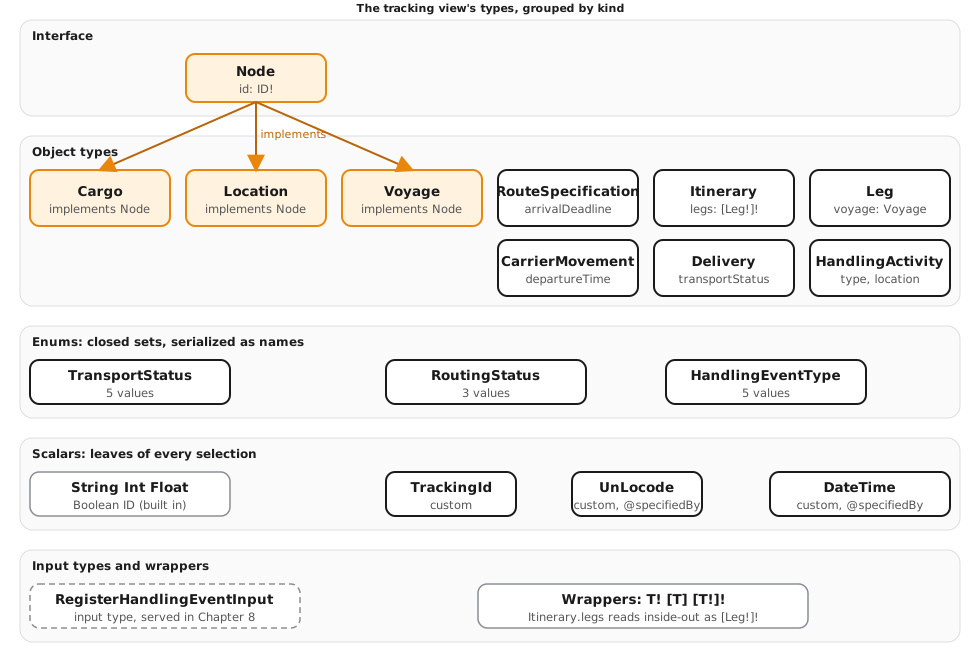
The sections below take the kinds in dependency order: leaves first (scalars and enums), then the object types that hang them together, then the abstract types, and finally the wrappers and the input side.
Scalars: built-in and custom
A scalar is a leaf. A selection can never go below it, which is why trackingId { x } is rejected: TrackingId has no fields to select. GraphQL has five built-in scalars. Int is a signed 32-bit integer, Float is a double-precision float, String is UTF-8 text, Boolean is true or false, and ID is an opaque identifier that is serialized as a string and accepts either a string or an integer on input. The tracking view uses String, Boolean and ID directly and adds three custom scalars.
TrackingId and UnLocode are string-backed. They exist so the schema says what the string is: a client sees location(unLocode: UnLocode!) and not location(code: String!), and a code generator can map each to its own type. DateTime carries an instant in time. The canonical SDL defines it once:
scalar DateTime @specifiedBy(url: "https://www.rfc-editor.org/rfc/rfc3339")
@specifiedBy points a custom scalar at the document that defines its format, so a client author knows what the string means without asking. The Scalars section of the specification describes it; UnLocode points at the UN/LOCODE list and TrackingId has no URL because its value is opaque by design.
A scalar is more than a name. The specification defines two coercions for it: result coercion, from a resolver’s internal value to the response, and input coercion, from an argument or variable to an internal value. Implementations split the input side in two, so each scalar has three functions: serialize for results, parse value for a JSON value from the variables map, and parse literal for a value written inline in the document. The input pair exists because an inline argument is part of the query text, an abstract syntax tree node, while a variable arrives as already-parsed JSON.
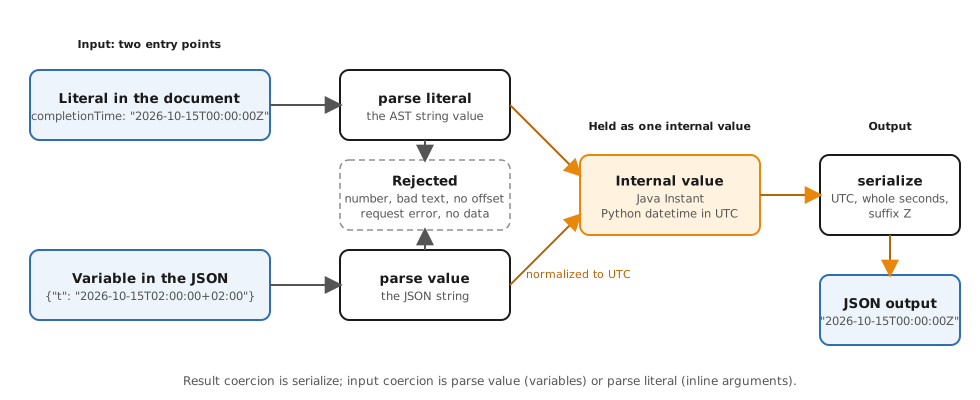
Input is where a loose scalar does damage, because a scalar that accepts too much makes the stacks disagree. Both stacks reject a number for UnLocode, as a literal and as a variable, and return errors with no data. parse_value=str would have turned 123 into "123", so the Python scalar checks the type first, and SmallRye’s CustomStringScalar refuses a non-string literal at validation. verify.sh asserts both rejections.
DateTime is pinned to one output format on both stacks: UTC, whole seconds, a Z suffix, as in 2026-10-15T00:00:00Z. RFC 3339 permits offsets and fractional seconds, so left to defaults two correct serializers print 2026-10-15T00:00:00Z and 2026-10-15T00:00:00+00:00, and every client that compares or caches by string sees two values for one instant. Pinning one form removes the ambiguity. Strawberry needs a custom serializer for it. SmallRye’s built-in mapping for java.time.Instant already prints that form for whole-second values, and the example checks every timestamp as an exact string to prove it.
Object types and fields
An object type is a named set of fields, and each field has a type, optional arguments, and a description. Cargo is the root of the tracking view:
type Cargo implements Node {
  id: ID!
  trackingId: TrackingId!
  description: String!
  origin: Location!
  destination: Location!
  routeSpecification: RouteSpecification!
  delivery: Delivery!
  itinerary: Itinerary
  handlingHistory(first: Int, after: String, last: Int, before: String): HandlingEventConnection!
}
Read it as edges. origin and destination lead to Location. routeSpecification leads to a small object holding the two locations again and arrivalDeadline. itinerary leads to Itinerary, whose legs lead to Leg, whose voyage leads to Voyage, whose schedule leads to CarrierMovement. The type graph also has a cycle, through Cargo.handlingHistory to HandlingEvent and its cargo field back to Cargo. A response is still finite, because a selection is finite text and every branch of it must end in leaves.
Descriptions are part of the contract. Every type, field, argument and enum value in the canonical SDL has one, tools display them in documentation panels and linters require them, and the conformance check in lib.sh fails when a served description differs from the canonical text. This chapter’s check compares the date-field descriptions too (see the last section).
In this chapter the objects are embedded. A Leg holds its Voyage and Location as ordinary properties, and Delivery is a stored constant, so no field below Query has a resolver. The default behavior of both frameworks, reading the property of the parent object, does all the work. Chapters 4, 6 and 7 replace those properties with resolvers over services.
Enums
An enum is a closed set of names. TransportStatus has five: NOT_RECEIVED, IN_PORT, ONBOARD_CARRIER, CLAIMED and UNKNOWN. RoutingStatus has three and HandlingEventType has five. On the wire an enum value is always its name as a JSON string, never a number, so "transportStatus": "ONBOARD_CARRIER" is the whole representation. In a document an enum value is written bare, as in type: LOAD, and a variable carries it as the string "LOAD". A client that sends "TELEPORT" gets a coercion error before any resolver runs, which is the point of closing the set.
Closed sets have a cost for evolution. Adding a value to an output enum is an additive change for the schema and a possible break for a client that switches exhaustively over the known values, which is why the breaking-change gate treats an added value as a risk and a removed value as a failure. Chapter 11 returns to this.
Descriptions work on enum values too, and the example asserts the sets through introspection. The stacks differ in one respect here. Strawberry lists values in declaration order. SmallRye returns them alphabetically (CLAIMED, IN_PORT, NOT_RECEIVED, ONBOARD_CARRIER, UNKNOWN). The order of enum values carries no meaning in GraphQL, so verify.sh compares the sets and the canonical diff ignores order, but a client that renders a dropdown from introspection should sort the values itself rather than rely on either.
Interfaces and Node
An interface is an abstract type: a set of fields that any implementing object type must provide. Node has one field, id: ID!, and three types implement it: Cargo, Location and Voyage. A field whose type is an interface can return any implementer, and the selection can ask for the shared fields directly and for the rest through an inline fragment.
Node exists to support Relay’s Global Object Identification contract. Every object that can be fetched by itself exposes a globally unique, opaque id, and Query.node(id: ID!) takes one and returns whatever it names. In this schema the ids are cargo_ABC123, loc_NLRTM and voy_V200E. The prefix is an implementation detail that clients must not parse. It lets the server find the object, and it is why a single field can serve three types. The contract is described in the Global Object Identification specification.
Take one query with a fragment for each of two types:
{
  node(id: "loc_NLRTM") {
    __typename
    ... on Location { unLocode }
    ... on Cargo { trackingId }
  }
}
The server looks up loc_NLRTM and finds a Location. Node is abstract, so the server must decide the object’s runtime type, and __typename reports it. Each inline fragment applies only if the runtime type matches its condition. ... on Location matches and contributes unLocode. ... on Cargo does not match and contributes nothing: no error and no null. The response is {"node":{"__typename":"Location","unLocode":"NLRTM"}}.
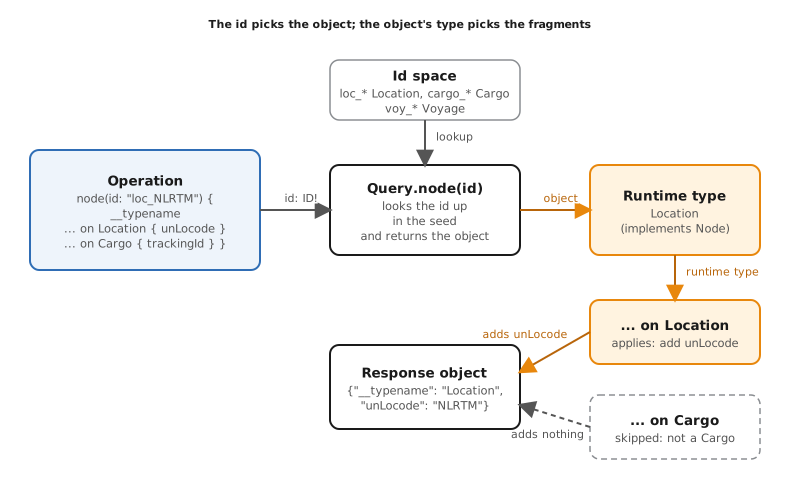
The shared-field rule is what validation enforces. node(id: "loc_NLRTM") { unLocode } is rejected before execution, because Node has no field unLocode. The server cannot know which implementer the id will name, so the document must say what to do for each. Python’s error suggests the fix (“Did you mean to use an inline fragment on ‘Location’?”), while Quarkus reports FieldUndefined. Both return HTTP 200 with errors and no data.
Unions, and why this schema has none
A union is the other abstract type: one of several object types, with no fields of its own. The difference from an interface is the contract. An interface promises fields. A union promises only membership, so every selection on it needs inline fragments, and __typename is the only field available without one. The usual use is a result that may be one of several unrelated shapes:
# Illustration only: not part of the canonical schema.
union SearchResult = Cargo | Location | Voyage

type Query {
  search(text: String!): [SearchResult!]!
}
The tracking view does not need one. Its abstract case has a shared field, the id, so an interface fits better. A union would also hide that the three types share an identity contract, which is exactly what Node expresses. Reach for a union when the members share nothing a client can rely on, and for an interface as soon as they do. Mutation results shaped as unions of success and error types are a common pattern, and Chapter 9 explains why this book models domain failures as userErrors data instead.
Lists and non-null wrappers
Two wrappers modify any type. [T] is a list of T, and T! is non-null. They nest, and a wrapper chain reads inside-out. Itinerary.legs is [Leg!]!: the innermost Leg! says each element is non-null, the brackets make a list, and the final ! says the list itself is non-null. So the field is never null, never contains a null, and may be empty in principle (the description says an assigned itinerary never is). Cargo.itinerary is the contrast: Itinerary without a bang, so it is null until routing has assigned a route.
Nullability is a promise about failure as much as about data, because a null in a non-null position cannot be returned and the null moves up to the nearest nullable parent. That is Chapter 4’s subject. The one fact needed here is the default difference between the stacks. A Java field is nullable unless annotated @NonNull, and a Strawberry field is non-null unless annotated | None. The example spells out every non-null in Java and every nullable in Python, and the conformance check fails if either stack gets one wrong.
Input types
Input types are the mirror of object types for arguments. input RegisterHandlingEventInput { ... } looks like an object type but differs in three ways. Its fields can have default values. It may contain only scalars, enums and other input types, never an object, an interface or a union. And it appears only in input positions: an argument or a variable. A type is one or the other, never both, because an output field can take arguments and return an interface or a union, and neither means anything in a value the client sends.
The canonical schema has one, used by the one mutation:
input RegisterHandlingEventInput {
  trackingId: TrackingId!
  type: HandlingEventType!
  location: UnLocode!
  voyageNumber: String
  completionTime: DateTime!
  idempotencyKey: String
}
It combines everything covered so far: two custom scalars, an enum and DateTime among the required fields, and two optional strings. This chapter does not serve it. Chapter 8 does, and it is where DateTime input coercion meets a served argument. For now it is a map of what the input side can hold.
How a selection maps onto types
A selection is a path through the type graph, and each step has a type. Take the operation a client writes to see a cargo’s legs and voyages:
query {
  cargo(trackingId: "ABC123") {
    itinerary { legs { voyage { number } } }
  }
}
cargo is a field of Query that returns Cargo. On Cargo, itinerary returns Itinerary. On that, legs returns [Leg!]!, and on each Leg, voyage returns Voyage, where number is a String! leaf. Each step is checked against the type the previous step produced. The response then mirrors the selection: an object for each object field, an array for each list, a leaf for each scalar. Figure 3.4 pairs the three side by side.
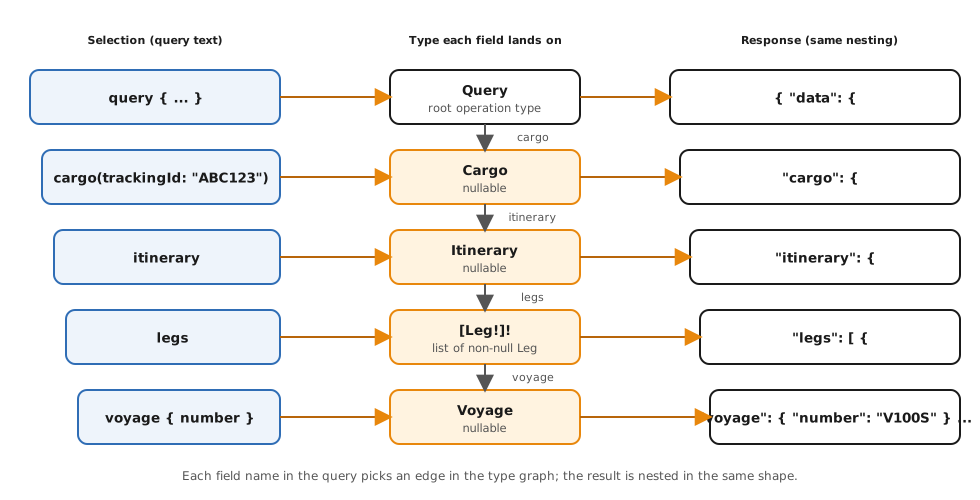
This is also what validation does, and it runs before any data is touched. The server checks each field against the type it hangs from, each argument against its declared type, each fragment condition against the possible types and each selection against the kind of its field. The specification calls these request errors: they are raised before execution begins. They return HTTP 200 with errors and no data over application/json, and the example asserts three: a field not on the interface (node { unLocode }), an object field with no subselection (cargo { origin }, rejected because Location! needs one) and a subselection on a scalar (trackingId { x }). Errors that arise while a resolver runs are execution errors in the current specification, which older editions called field errors. They return partial data beside errors, and they are Chapter 4’s subject.
The three failures share a property that matters for caching and clients: nothing ran. No source was called and no state changed, so a client may fix the document and retry safely.
Code-first on two stacks
Both stacks build their schema from code, and the canonical SDL is the yardstick. The following sections show the same type in each stack: the Node interface with Location, then the DateTime handling.
@Interface
@Description("A global object identifier, unique across the whole graph. ...")
public interface Node {
    @Id @NonNull
    @Description("The globally unique, opaque identifier of this object.")
    String getId();
}

@Type("Location")
public record Location(
        String id,
        @NonNull UnLocode unLocode,
        @NonNull String name,
        @NonNull String country) implements Node {

    @Override @Id @NonNull
    public String getId() { return id; }
}
@strawberry.interface(description="A global object identifier, unique across the whole graph. ...")
class Node:
    id: strawberry.ID = strawberry.field(description="The globally unique, opaque identifier of this object.")


@strawberry.type(description="A port or terminal, identified by its UN/LOCODE.")
class Location(Node):
    id: strawberry.ID = strawberry.field(description="The globally unique identifier of this location.")
    un_locode: UnLocode = strawberry.field(description="The UN/LOCODE, for example `NLRTM`.")
    name: str = strawberry.field(description="The human-readable name, for example `Rotterdam`.")
    country: str = strawberry.field(description="The ISO 3166-1 alpha-2 country code, for example `NL`.")
SmallRye maps an interface’s fields from getter-named methods only, so the implementing records carry an explicit getId(). @Id is what turns a String into ID. Annotations carry everything else: @Type for objects, @NonNull for a bang, List<@NonNull Leg> for [Leg!], a primitive boolean for Boolean! without any annotation, and @Description on types, fields, arguments and enum constants. Strawberry needs no annotation for a bang, because non-null is the default. camelCase is automatic: un_locode becomes unLocode and final_arrival_date becomes finalArrivalDate. An enum is a Python Enum with strawberry.enum_value(..., description=...) per member.
DateTime shows the largest difference between the stacks:
@Type("RouteSpecification")
public record RouteSpecification(
        @NonNull Location origin,
        @NonNull Location destination,
        @NonNull @Description("The date by which the cargo must arrive.") Instant arrivalDeadline) {}
SCALAR_MAP = {
    # ... TrackingId and UnLocode, both NewType strings ...
    datetime: strawberry.scalar(
        name="DateTime",
        description="An RFC 3339 date-time in UTC, for example `2026-10-15T09:30:00Z`.",
        specified_by_url="https://www.rfc-editor.org/rfc/rfc3339",
        serialize=_serialize_datetime,   # UTC, whole seconds, suffix Z
        parse_value=_parse_datetime,     # rejects non-strings and datetimes with no offset
    ),
}

schema = strawberry.Schema(query=Query, config=StrawberryConfig(scalar_map=SCALAR_MAP))
SmallRye maps java.time.Instant, and the other java.time date types, to its built-in DateTime scalar, so the field needs no scalar code at all. Strawberry also has a default for datetime, but its output form differs from the pinned form, so the schema’s scalar_map replaces it with a definition whose serializer writes the pinned form and whose parser refuses a datetime with no UTC offset. Fields stay annotated with the plain datetime. The same map turns the two NewType strings into TrackingId and UnLocode; the map is Strawberry’s current form for custom scalars.
SmallRye’s defaults differ from the contract in three places, and the canonical SDL stays as it is in each. First, SmallRye appends ` (ISO-8601) to the description of every date-typed field, which the description comparison reports. Second, it describes the DateTime scalar as "Scalar for DateTime" and gives it no @specifiedBy URL. Third, ContractSchemaDetails rewrites types with graphql-java's SchemaTransformer, so each interface's type resolver has to return the rebuilt types, and a fragment such as … on Location matches them. ContractSchemaDetails applies all three through the CDI event SmallRye fires before it builds the schema (quarkus.smallrye-graphql.events.enabled=true): it sets the Query description, the two scalars' URLs and the DateTime description, strips the suffix, and re-points each interface's type resolver at the executing schema's own types. The node-dispatch assertion checks the third: a fragment on each implementer of Node` selects its fields.
On the wire
Start the stack and send the cargo query. Quarkus is on 8130 and Python on 8131; both return the same bytes.
docker compose -f examples/03-sdl-type-system/compose.yaml up -d --build
curl -s localhost:8130/graphql -H 'Content-Type: application/json' -d '{"query":"{ cargo(trackingId: \"ABC123\") { trackingId routeSpecification { arrivalDeadline } itinerary { finalArrivalDate legs { voyage { number } loadLocation { unLocode } unloadLocation { unLocode } loadTime unloadTime } } delivery { transportStatus routingStatus misdirected lastKnownLocation { unLocode } currentVoyage { number } estimatedTimeOfArrival nextExpectedActivity { type location { unLocode } voyage { number } } } } }"}'
{"data":{"cargo":{"trackingId":"ABC123","routeSpecification":{"arrivalDeadline":"2026-10-15T00:00:00Z"},"itinerary":{"finalArrivalDate":"2026-10-11T18:00:00Z","legs":[{"voyage":{"number":"V100S"},"loadLocation":{"unLocode":"USNYC"},"unloadLocation":{"unLocode":"DEHAM"},"loadTime":"2026-10-01T08:00:00Z","unloadTime":"2026-10-09T14:00:00Z"},{"voyage":{"number":"V200E"},"loadLocation":{"unLocode":"DEHAM"},"unloadLocation":{"unLocode":"NLRTM"},"loadTime":"2026-10-10T06:00:00Z","unloadTime":"2026-10-11T18:00:00Z"}]},"delivery":{"transportStatus":"ONBOARD_CARRIER","routingStatus":"ROUTED","misdirected":false,"lastKnownLocation":{"unLocode":"USNYC"},"currentVoyage":{"number":"V100S"},"estimatedTimeOfArrival":"2026-10-11T18:00:00Z","nextExpectedActivity":{"type":"UNLOAD","location":{"unLocode":"DEHAM"},"voyage":{"number":"V100S"}}}}}}
The second cargo has no route yet, and absence is data. Replace the argument with XYZ789 and drop routeSpecification, legs and misdirected to keep the line short:
{"data":{"cargo":{"trackingId":"XYZ789","itinerary":null,"delivery":{"transportStatus":"NOT_RECEIVED","routingStatus":"NOT_ROUTED","lastKnownLocation":null,"currentVoyage":null,"estimatedTimeOfArrival":null,"nextExpectedActivity":{"type":"RECEIVE","location":{"unLocode":"SGSIN"},"voyage":null}}}}}
Node dispatch uses the query from earlier, with a fragment for each of two types:
curl -s localhost:8131/graphql -H 'Content-Type: application/json' \
  -d '{"query":"{ node(id: \"loc_NLRTM\") { __typename ... on Location { unLocode } ... on Cargo { trackingId } } }"}'
{"data":{"node":{"__typename":"Location","unLocode":"NLRTM"}}}
An unknown id is {"data":{"node":null}}, and so are location(unLocode: "ZZZZZ") and voyage(voyageNumber: "V999X") under their own names. Selecting a field that is not on the interface is a validation failure, and the two stacks word it differently:
curl -s localhost:8130/graphql -H 'Content-Type: application/json' \
  -d '{"query":"{ node(id: \"loc_NLRTM\") { unLocode } }"}'
{"errors":[{"message":"Validation error (FieldUndefined@[node/unLocode]) : Field 'unLocode' in type 'Node' is undefined","locations":[{"line":1,"column":27}],"extensions":{"classification":"ValidationError"}}]}
The specification says data should be absent when an error is raised before execution begins; Quarkus omits it and Python answers with "data":null and the message Cannot query field 'unLocode' on type 'Node'. Did you mean to use an inline fragment on 'Location'?. verify.sh asserts that the response has errors, that data is absent or null, and that the message names unLocode, and nothing more.
| Check | Expected |
|---|---|
ABC123 |
the values above, DateTime as ...Z, enums as names, misdirected false |
XYZ789 |
itinerary, lastKnownLocation, currentVoyage, estimatedTimeOfArrival and nextExpectedActivity.voyage null, no errors |
location(unLocode: "DEHAM") |
loc_DEHAM, Hamburg, DE |
voyage(voyageNumber: "V100S") |
voy_V100S, USNYC to DEHAM, 2026-10-01T08:00:00Z to 2026-10-09T14:00:00Z |
node on loc_NLRTM, cargo_ABC123, voy_V200E |
Location/NLRTM, Cargo/ABC123, Voyage/V200E |
node on loc_NLRTM with only ... on Cargo selecting |
exactly {"__typename":"Location"} |
node { unLocode }, cargo { origin }, trackingId { x } |
HTTP 200, errors, no data |
location(unLocode: 123) |
errors, no data |
TransportStatus values |
CLAIMED, IN_PORT, NOT_RECEIVED, ONBOARD_CARRIER, UNKNOWN (as a set) |
RoutingStatus, HandlingEventType values |
MISROUTED, NOT_ROUTED, ROUTED and CLAIM, CUSTOMS, LOAD, RECEIVE, UNLOAD (as sets) |
Node |
kind INTERFACE, possible types Cargo, Location, Voyage |
DateTime |
kind SCALAR, specifiedByURL https://www.rfc-editor.org/rfc/rfc3339 |
bash examples/03-sdl-type-system/verify.sh runs all of it on both stacks, ends with the conformance check against contracts/schema/, and prints PASS only when both stacks hold.
Decision
The type system is where the contract and evolution style axis of Chapter 2 becomes concrete. Every type, field and enum value in the canonical SDL is a public promise that many unknown clients read, so naming a scalar UnLocode instead of String, closing a set as an enum and giving every field a description all push the cost of ambiguity to the schema author, which is where it is cheapest to pay. The client diversity and shape variance axis is served by the object graph itself: three clients select three different slices of Cargo with no change to the server. Aggregation across sources shows in the shape of Node, one id space spanning three owners behind one field. The operational and security cost axis registers a small charge here, since an abstract type and a custom scalar mean each stack needs code that the contract does not generate, and a conformance gate to catch drift in it. The tracking view uses interfaces where members share a field, avoids unions until members share nothing, and pins DateTime to one wire format, because one canonical string per instant costs less than every client normalizing two.
Where this goes next
This chapter covered every type kind the tracking view uses, how each is written on both stacks, how a selection maps onto types, and what happens when a document does not. It also introduced the three SmallRye defaults that ContractSchemaDetails aligns with the contract.
Chapter 4 takes the wrappers and follows a null up the tree: how a non-null field that cannot be filled empties its parent, and which fields the schema makes nullable. Chapter 5 builds the export-and-diff loop that keeps both stacks aligned with the canonical SDL. Chapter 8 serves the input type from this chapter and exercises the DateTime input paths, and Chapter 11 returns to enum evolution and the breaking-change gate.
For the formal definitions, read the Type System section of the GraphQL specification, including Scalars and @specifiedBy, and the Relay Global Object Identification specification linked above. Samer Buna’s GraphQL in Action covers the same ground in “Introduction to GraphQL” and “Designing a GraphQL schema”; both are listed on the Bibliography page.